UK GAAP changes 2026: what is new for December 2026 year ends
By Alon Zieve FCA · Last reviewed
The UK GAAP changes for 2026 reach every UK company that prepares its accounts under FRS 102, FRS 105 or FRS 101, and a year ending 31 December 2026 is the first to carry most of them. The largest is the revised FRS 102 (most leases on the balance sheet, a five-step revenue model), for periods beginning on or after 1 January 2026. The same accounts are a calendar-year company's first at the higher company size limits; their directors' report drops several disclosures and, for a large company, gains new ones on paying suppliers. Directors then approve those accounts on a going concern assessment made with numbers that have moved.
Edition: December 2026 year ends. Covers twelve-month periods ending 31 December 2026 to 30 September 2027; earlier 2026 year ends are in the second table. Each item is marked in force, later or not yet law. Last checked: 5 November 2026. Next edition: by early December 2027.
What are the UK GAAP changes for 2026?
One large change and several smaller ones. The large one is the revised FRS 102, the main standard in UK GAAP, with revenue changes to match in FRS 105. FRS 101 has had two annual rounds of smaller amendments. Three changes to company law land in the same accounts: higher size limits, a shorter directors' report and, for large companies, payment practices disclosures. There is no new UK GAAP standard: FRS 100 to FRS 105 remain, amended.
| Change | Who it affects | Status | Applies to periods beginning on or after |
|---|---|---|---|
| Revised FRS 102: leases, revenue, fair value | Every FRS 102 company, small ones included | In force | 1 January 2026 |
| Section 1A: more required notes | Small companies using Section 1A | In force | 1 January 2026 |
| FRS 105: revenue amended, leases not | Micro-entities | In force | 1 January 2026 |
| Supplier finance disclosures (FRS 102) | Users of supplier finance; not required of small companies | In force | 1 January 2025 |
| FRS 101: two amendment cycles | FRS 101 companies | In force; mostly bites with IFRS 18 | See FRS 101 below |
| Three amendments to UK-adopted IFRS | FRS 101 companies | In force | 1 January 2026 |
| FRS 100, FRS 103, FRS 104: Periodic Review 2024 amendments | Users of those standards | In force | See below |
| Higher company size limits | Every company | In force | 6 April 2025 |
| Directors' report: disclosures removed | Companies that prepare one | In force | 6 April 2025 |
| Directors' report: payment practices | Large companies | In force | 1 January 2026 |
| Charities SORP 2026 | Charities preparing accruals accounts | In force | 1 January 2026 |
| Adapted formats amendment (FRS 102) | Companies that adapt the formats | Later | 1 January 2027 |
| IFRS 18 | FRS 101 companies | Later | 1 January 2027 |
| Revised ISAs (UK) 240, 570 and 700 | Audited companies | Later | 15 December 2026 |
| Software-only filing of accounts | Every company | Later (announced by Companies House) | Not by period: accounts filed from 1 April 2028 |
| Audit exemption for medium-sized companies | Medium-sized companies | Proposed, not law | No date; consultation closes 30 November 2026 |
| Removing the directors' report | Companies that prepare one | Announced, not law | No date |
Who is affected turns on the company's framework and size. For most, the UK GAAP accounting changes that matter are the first three rows; the amendments themselves, and how each is first applied, are in FRS 102 changes. This page covers what else reaches the same year end.
Which change applies to which year end
The UK GAAP changes take effect by the day an accounting period begins, not the day it ends, and the start dates differ: 1 January 2025, 6 April 2025, 1 January 2026, 15 December 2026 and 1 January 2027. A twelve-month year to 30 September 2026 is therefore at the higher size limits but on the old FRS 102, unless the company adopted early. Companies House's software-only rule is the exception: it looks at the day the accounts are filed.
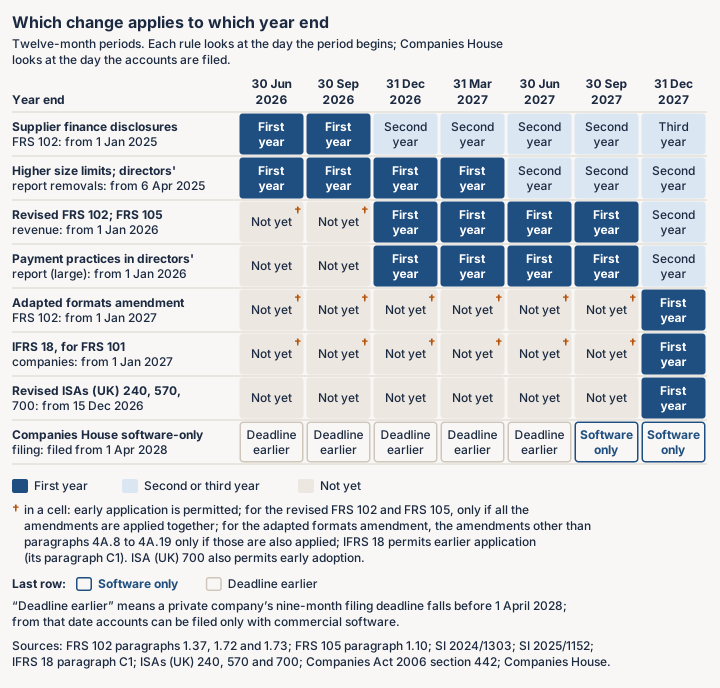
| Change (periods beginning on or after) | 30 Jun 2026 | 30 Sep 2026 | 31 Dec 2026 | 31 Mar 2027 | 30 Jun 2027 | 30 Sep 2027 | 31 Dec 2027 |
|---|---|---|---|---|---|---|---|
| Twelve-month period begins | 1 Jul 2025 | 1 Oct 2025 | 1 Jan 2026 | 1 Apr 2026 | 1 Jul 2026 | 1 Oct 2026 | 1 Jan 2027 |
| Supplier finance disclosures, FRS 102 (1 Jan 2025) | First year | First year | Second year | Second year | Second year | Second year | Third year |
| Higher size limits; directors' report removals (6 Apr 2025) | First year | First year | First year | First year | Second year | Second year | Second year |
| Revised FRS 102; FRS 105 revenue (1 Jan 2026) | Not yet† | Not yet† | First year | First year | First year | First year | Second year |
| Payment practices in the directors' report, large companies (1 Jan 2026) | Not yet | Not yet | First year | First year | First year | First year | Second year |
| Adapted formats amendment, FRS 102 (1 Jan 2027) | Not yet† | Not yet† | Not yet† | Not yet† | Not yet† | Not yet† | First year |
| IFRS 18, for FRS 101 companies (1 Jan 2027) | Not yet† | Not yet† | Not yet† | Not yet† | Not yet† | Not yet† | First year |
| Revised ISAs (UK) 240, 570 and 700 (15 Dec 2026) | Not yet | Not yet | Not yet | Not yet | Not yet | Not yet | First year |
| Companies House software-only filing (accounts filed from 1 Apr 2028) | Deadline earlier | Deadline earlier | Deadline earlier | Deadline earlier | Deadline earlier | Software only | Software only |
† Early application is permitted; for the revised FRS 102 and FRS 105, only if all the amendments are applied together (FRS 102 paragraph 1.37; FRS 105 paragraph 1.10); for the adapted formats amendment, the amendments other than paragraphs 4A.8 to 4A.19 (current or non-current classification) only if those paragraphs are also applied (FRS 102 paragraph 1.73); IFRS 18 permits earlier application (its paragraph C1). ISA (UK) 700 also permits early adoption. "Deadline earlier": a private company's nine-month filing deadline falls before 1 April 2028; "Software only": it falls after that date. For a short or long period, apply each test to the date the period begins.
Two first years at once. For a December, January, February or March year end, the first year under the revised FRS 102 is also the first at the higher size limits. The two interact: the size tests use the balance sheet total, "the aggregate of the amounts shown as assets in the company's balance sheet" (Companies Act 2006 section 382(5)), and right-of-use assets are assets. An invented example: a company with turnover of £14.0m and 58 employees has assets of £7.1m before leases, inside the £7.5m limit for a small company. Right-of-use assets of £0.6m take the total to £7.7m, and with more than 50 employees it then satisfies one of the three requirements, not the two it needs. One such year does not change its category; two consecutive years do (section 382(2)).
UK GAAP 2026, standard by standard
FRS 102 and Section 1A
The revised FRS 102 is the largest of the UK GAAP amendments (see FRS 102 changes). Its transition rules run from the date of initial application, the first day of the first period under it (1 January 2026 for a December year end), and a lessee does not restate comparatives (paragraphs 1.40 and 1.47). Most leases come onto the balance sheet (FRS 102 lease changes) and revenue follows a five-step model (FRS 102 revenue recognition). The FRC's February 2026 clarifications, on the exemptions from consolidated accounts and on inventories (the latter in FRS 105 too), count as Periodic Review 2024 amendments, so they too apply to periods beginning on or after 1 January 2026 (FRS 102 paragraph 1.36 and FRS 105 paragraph 1.10, as amended).
The changes do apply to small companies: one using Section 1A applies every recognition and measurement change and has more required notes, going concern among them (paragraph 1AC.2C; see FRS 102 Section 1A disclosure requirements).
FRS 105
Micro-entities are affected, but less. FRS 105's revenue section is amended from the same date, for contracts that begin after the micro-entity first applies the amendments (paragraph 1.11). Its lease section was not amended. FRS 105 vs FRS 102 compares the two standards.
FRS 101
FRS 101 lets a qualifying entity (a subsidiary or ultimate parent included in published group accounts) apply UK-adopted IFRS in its own accounts with fewer disclosures. Two things move its accounts: the FRC's annual amendments to FRS 101, and changes to IFRS itself.
- The 2024/25 cycle (28 May 2025) prepares FRS 101 for IFRS 18, which replaces IAS 1; those amendments apply only when the company applies IFRS 18 (paragraph 19). Two applied on issue: a company using FRS 101 "shall not apply IFRS 19" (paragraph 5), and need not give prior-period reconciliations of fixed assets (paragraph 8B).
- The 2025/26 cycle (21 May 2026) made drafting improvements only, and sets no effective date of its own.
- IFRS amendments for 2026. Three on the UK Endorsement Board's adoption list take effect from 1 January 2026: classification and measurement of financial instruments (IFRS 9 and IFRS 7), Annual Improvements Volume 11, and contracts referencing nature-dependent electricity. The FRC amended nothing in FRS 101 for them.
- IFRS 18 was adopted for use in the UK on 10 December 2025 and applies, retrospectively, to annual periods beginning on or after 1 January 2027, so for a December year end the 2026 figures become its comparatives. Its reach depends on the formats: under the 2024/25 amendments a company keeping a Companies Act profit and loss format uses it instead of IFRS 18's paragraphs on that statement's layout; one that adapts the formats applies the relevant presentation requirements of IFRS 18.
FRS 100, FRS 103 and FRS 104
FRS 100 (which standard applies to whom) and FRS 103 (insurance contracts) were amended as a result of the Periodic Review 2024, for periods beginning on or after 1 January 2026; one FRS 103 transition rule applied from 1 January 2024. FRS 101 had editorial amendments from the same date (paragraph 18). FRS 104 (interim reports) was amended too: the FRC's FRS 104 page lists those amendments as effective from 1 January 2026 (the standard's paragraph 56D has the detail). As at 5 November 2026 the FRC's pages (FRS 100, FRS 103, FRS 104) show September 2024 editions and no later amendment.
Company law changes that land in the same accounts
The higher size limits
The limits for micro, small and medium-sized companies rose for financial years beginning on or after 6 April 2025 (SI 2024/1303, regulation 2(2)). For such a year, earlier years are judged as if the new limits had already applied (regulation 3), so a company inside the new limits in that year and the one before moves down a category straight away. The category decides which reports are due and whether an audit is required: see company size thresholds.
What left the directors' report
For the same years, SI 2024/1303 removed four things from a large or medium-sized company's directors' report: financial instruments, the miscellaneous disclosures in paragraph 7 of Schedule 7, the employment of disabled persons, and engagement with employees, suppliers, customers and others (regulation 5). A small company's report lost the disabled persons disclosure (regulation 4).
Payment practices: what large companies add
SI 2025/1152 adds a Part 9 to Schedule 7 of the accounts regulations (SI 2008/410), for financial years beginning on or after 1 January 2026. For the company's qualifying contracts with suppliers (defined in paragraph 32), the directors' report must give:
- the payment period in the company's standard payment terms, in days, and any change to those terms in the year, with how suppliers were notified or consulted;
- the average number of days taken to pay;
- the percentage of payments made, and the sum paid, within 30 days, in 31 to 60 days and on day 61 or later;
- the percentage and the sum of payments due in the year that were not paid within the agreed period.
It applies to large companies only: it is not required for a company's first financial year or a year in which it qualifies as medium-sized (paragraph 29), and SI 2008/410 does not apply to a company in the small companies regime (its regulation 2(4)). In a group directors' report the disclosures cover the company and its consolidated subsidiaries (paragraph 30(2)). The government's guidance says it does not apply to LLPs. It is a second duty, not a replacement: a company within SI 2017/395 still publishes its report on the government's web service for each reporting period, and that instrument's size test looks at the last two balance sheet dates, so the two can differ.
UK GAAP updates that are not mandatory yet
These UK GAAP updates are issued or announced, but do not bind a 31 December 2026 year end.
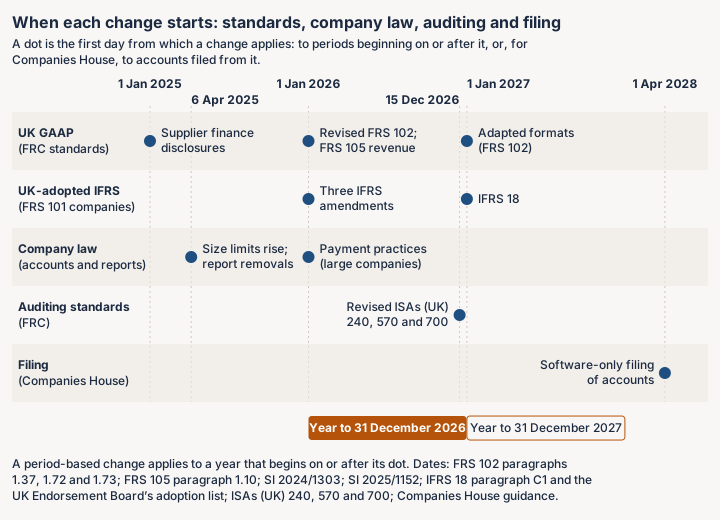
- Adapted formats (FRS 102): later. Periods beginning on or after 1 January 2027. Early application is permitted: paragraphs 4A.8 to 4A.19 (current or non-current classification) on their own, the other amendments "provided that paragraphs 4A.8 to 4A.19 are also applied" (paragraphs 1.72 and 1.73). The format changes affect only companies that adapt the statutory formats (see the FRC's Factsheets 12A and 12B).
- Revised ISAs (UK) 240 (fraud), 570 (going concern) and 700 (the auditor's report): later. Audits of periods beginning on or after 15 December 2026: a 31 December 2027 year end, not this one.
- Software-only filing: later. Companies House says that from 1 April 2028 accounts can be filed only with commercial software; the plan to make small companies and micro-entities file a profit and loss account was paused on 23 October 2026 (Companies House accounts filing changes).
- Audit exemption for medium-sized companies: proposed. The consultation Modernising corporate reporting (7 September 2026) asks whether the audit exemption should be expanded to medium-sized companies. It closes on 30 November 2026 and is not law; for today's limits see audit exemption thresholds.
- Removing the directors' report: announced. The government has said it will legislate to remove the directors' report, with supplier payment reporting "relocated elsewhere in the annual report for the time being" (Annex A to the consultation). That is "subject to the legislative process", not law.
What the board should check before it approves these accounts
Going concern first. Under FRS 102 the directors assess whether the company can continue as a going concern, looking at least 12 months ahead from the date the accounts are authorised for issue (paragraph 3.8). This year the forecasts and covenant tests behind it sit on a new basis: with leases on the balance sheet, the FRC notes, gearing, interest cover, the current ratio and EBITDA may change, and in some cases "entities may want to renegotiate covenants". An auditor tests those forecasts and covenants against evidence; the procedures are set out in the guide to going concern audit procedures. A small company using Section 1A now gives a going concern note, and the FRC's Factsheet 13 is written for small companies and micro-entities.
An auditor tests the directors' assessment under the current ISA (UK) 570; the revised standard (ISA 570 revised) applies from the next year end. If your board is preparing for an audit, Innate offers statutory audits signed by an ICAEW-registered partner firm, which your company appoints as its auditor, with our platform finding the documents and reconciling the numbers: get in touch.
Three shorter checks: the size category, with right-of-use assets in the balance sheet total; the directors' report, without the removed disclosures and, for a large company, with a full year's payment figures; and reserves before a dividend. A lessee's transition adjustment goes through opening retained earnings; whether a profit or loss is realised is a separate question, not answered here: see distributable reserves.
UK subsidiaries of overseas groups: what this year end adds
A UK subsidiary's statutory accounts change this year even where the group's own GAAP did not; what a US parent holds under US GAAP still differs from the revised FRS 102 (US GAAP vs UK GAAP). For a subsidiary using FRS 101, see the FRS 101 section above.
A large subsidiary gives the payment practices disclosures in its own directors' report unless paragraph 30 of the new Part 9 applies. That needs three things: the company is a subsidiary undertaking at the year end; it is included in the group directors' report of a parent undertaking; and that report is for a parent's financial year ending with, or before, the subsidiary's. The Companies Act defines a group directors' report as the consolidated report of a parent company whose directors prepare group accounts (section 415(2)). Neither the regulations nor the guidance says whether an overseas parent's report, prepared under another country's law, counts, so take advice before relying on the exception.
From now to filing: dates for a 31 December 2026 year end
- 1 January 2026, already passed: the date of initial application. A lessee's opening adjustment under the revised FRS 102 is measured at this date.
- Now: finish the lease data, using the lease register template.
- Before the year end: settle the size category for 2026, testing both years at the new limits.
- Before the first covenant test on the new numbers: speak to the lender.
- By 31 December 2026: the directors' report data, with a large company's payment figures.
- Before the board approves the accounts: the going concern paper.
- Before the audit starts: the request list, in the year-end audit checklist.
- 30 September 2027: a private company's filing deadline, nine months after the year end (section 442).
For 31 March, 30 June and 30 September 2027 year ends the order is the same; the deadlines are 31 December 2027, 31 March 2028 and 30 June 2028.
About this edition, and what the next one will cover
This guide stays at one address and is republished each year, so the UK GAAP changes on it are the current ones. The December 2027 edition is expected to cover the second year of the revised FRS 102, the first of the adapted formats amendment and of IFRS 18, the first audits under the revised ISAs (UK), and the consultation's outcome if there is one.
Change log. 5 November 2026: first edition.