FRS 102 lease changes: what moves onto the balance sheet, the exemptions and your covenants
By Alon Zieve FCA · Last reviewed
The FRS 102 lease changes apply to accounting periods beginning on or after 1 January 2026, so a company with a 31 December year end applies them for the first time in its 2026 accounts. A company that leases property, vehicles or equipment now puts most of those leases on the balance sheet, as a right-of-use asset and a lease liability, unless a lease is short-term or of a low-value asset and the company elects to leave it off. Small companies using Section 1A are included. Assets, debt and EBITDA all move, which can affect bank covenants and even the company's size.
What are the FRS 102 lease changes?
The Financial Reporting Council (FRC) replaced Section 20 of FRS 102, the main standard in UK GAAP, with a model based on IFRS 16. A lessee no longer sorts its leases into finance and operating leases. At the start of each lease it recognises a right-of-use asset and a lease liability (FRS 102 paragraph 20.45), depreciates the asset and charges interest on the liability (paragraphs 20.57 and 20.64). The only leases kept off the balance sheet are short-term leases and leases of low-value assets that the company chooses to exempt (paragraphs 20.5 to 20.7).
| Old operating lease | Old finance lease | Revised Section 20 (most leases) | |
|---|---|---|---|
| Balance sheet | Nothing, apart from any accrual or prepayment | Asset and finance lease liability | Right-of-use asset and lease liability |
| Profit and loss | Rent, usually straight-line | Depreciation and interest | Depreciation and interest |
The old columns are the models FRS 105 still uses (FRS 105 paragraphs 15.10 to 15.14).
Lessors still classify leases as operating or finance (paragraph 20.86) and make no transition adjustments, except for some subleases (paragraphs 1.56 and 1.57).
When the lease changes take effect, and which companies they apply to
The amendments apply to accounting periods beginning on or after 1 January 2026; a company may apply them earlier only if it applies all the Periodic Review 2024 amendments at the same time, and it must disclose that it has done so (paragraphs 1.37(b) and 1.38). Leases are the largest of the FRS 102 changes; the other amendments and their effective dates are in one table there.
The first day of the first year under the new rules is the "date of initial application" (paragraph 1.40(a)):
| Year end | First year under revised Section 20 | Date of initial application |
|---|---|---|
| 31 December | Year ending 31 December 2026 | 1 January 2026 |
| 31 March | Year ending 31 March 2027 | 1 April 2026 |
| 30 June | Year ending 30 June 2027 | 1 July 2026 |
| 30 September | Year ending 30 September 2027 | 1 October 2026 |
A year ending 31 March 2026 is not caught, because it began on 1 April 2025.
| Who | Are leases affected? |
|---|---|
| Companies using full FRS 102 | Yes |
| Small companies using Section 1A | Yes: recognition and measurement rules apply in full (paragraph 1A.1) |
| Micro-entities using FRS 105 | No: FRS 105 keeps operating and finance leases (see FRS 105 vs FRS 102) |
| Companies using FRS 101 or UK-adopted IFRS | Not by these amendments: they already apply IFRS 16 |
| Lessors | Still classify leases as operating or finance; no transition adjustments except some subleases (see above) |
| Subsidiaries of IFRS groups | Yes, and may use the group's IFRS 16 balances (paragraph 1.48) |
Small companies are not exempt: a Section 1A company capitalises its leases in the same way, and only the disclosure is reduced (see FRS 102 Section 1A disclosure requirements).
Which leases go on the balance sheet under Section 20
A contract is, or contains, a lease if it "conveys the right to control the use of an identified asset for a period of time in exchange for consideration" (paragraph 20.15). Control means the customer has both the right to direct how the asset is used and the right to obtain substantially all the economic benefits from using it (paragraph 20.16).
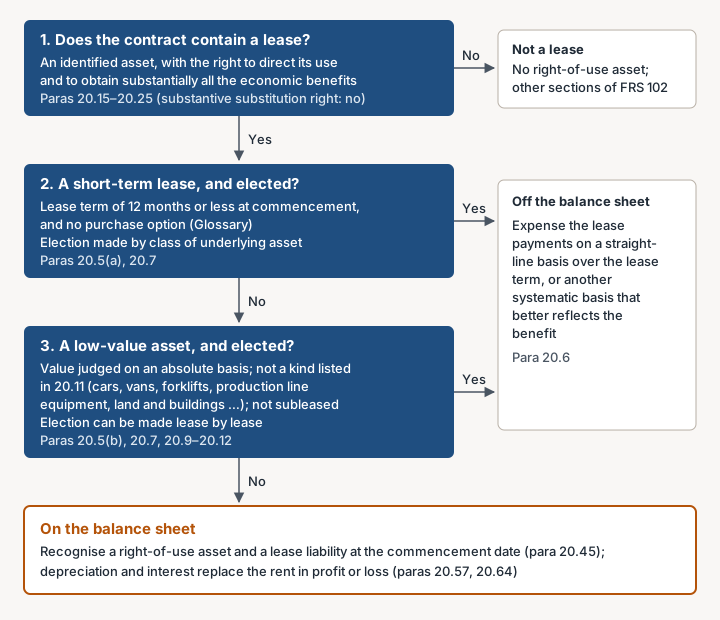
Three points decide most real cases:
- Substitution. There is no identified asset if the supplier has a substantive right to swap it throughout the period of use: it must be practically able to and benefit from doing so (paragraph 20.20). If the customer cannot readily tell, it presumes there is no such right (paragraph 20.21). Serviced offices and hire contracts where the supplier can and does swap the equipment need this test. A floor of a building can be an identified asset (paragraph 20.22).
- Lease and service elements. A contract that bundles a lease with services, such as a vehicle with maintenance, is split between the two, unless the company elects, by class of asset, to treat the whole as a lease (paragraphs 20.28 and 20.33).
- The lease term. It is the non-cancellable period, plus periods under an extension option the company is reasonably certain to exercise, plus periods under a break option it is reasonably certain not to exercise (paragraph 20.38). It drives the liability and the short-term test.
Commonly caught: property, cars and vans on contract hire, forklifts and plant, and leases embedded in outsourcing or supply contracts. A peppercorn arrangement may not be a lease at all (paragraph 20.35).
The short-term and low-value lease exemptions
A company may choose not to put two kinds of lease on the balance sheet, and expenses the payments on a straight-line basis instead, or on another systematic basis that better reflects its benefit (paragraphs 20.5 and 20.6).
Short-term leases: the definition
A short-term lease is "a lease that, at the commencement date, has a lease term of 12 months or less. A lease that contains a purchase option is not a short-term lease" (FRS 102 Glossary). Note "12 months or less", not "less than 12 months": a 12-month lease qualifies. The lease term includes extension options the company is reasonably certain to use, so a 12-month contract that the business always renews may not qualify. The election is made by class of underlying asset (paragraph 20.7), and a short-term lease that is modified, or whose term changes, is treated as a new lease (paragraph 20.8).
Low-value leases: no monetary limit
FRS 102 sets no figure for low value. The value of the underlying asset is judged "on an absolute basis", regardless of whether the leases are material to the company, and "the value of lease payments has no bearing" (paragraph 20.9). The asset must be usable on its own or with readily available resources, and not highly dependent on or interrelated with other assets (paragraph 20.10), and a head lease of an asset the company subleases cannot qualify (paragraph 20.12). Paragraph 20.11 gives examples of assets that would not be of low value: cars, vans, buses, coaches, trams, trucks and lorries; cranes, excavators, loaders and bulldozers; telehandlers and forklifts; tractors, harvesters and related attachments; boats and ships; railway rolling stock; aircraft and aero engines; land and buildings; and production line equipment.
The FRC calls its approach "more permissive" than IFRS 16, and says applying the exemption to "at least" tablets and personal computers, small items of office furniture and telephones would be acceptable (Basis for Conclusions B20.8 and B20.10). This election can be made lease by lease (paragraph 20.7).
| Relief | Test | How elected | Paragraph | Instead |
|---|---|---|---|---|
| Short-term lease | Term 12 months or less at commencement, no purchase option | By class of underlying asset | Glossary; 20.5(a), 20.7 | Expense straight-line |
| Low-value asset | Low value on an absolute basis; not a 20.11 asset; not subleased | Lease by lease | 20.5(b), 20.7, 20.9–20.12 | Expense straight-line |
| Transition only: lease ending soon | Lease term ends within 12 months of the date of initial application | Lease by lease | 1.53(c) | Treat as short-term; include in the short-term lease expense disclosure |
| Transition only: low-value lease | Low-value lease that will be expensed under 20.6 | Follows the 20.7 election | 1.52(a) | No transition adjustment |
What changes in the numbers: balance sheet, profit and cash flow
The lease liability is the present value of the lease payments not yet paid (paragraph 20.49). For a new lease, the right-of-use asset is the liability plus payments made at or before commencement, less incentives received, plus initial direct costs and any restoration provision (paragraph 20.47). The asset is depreciated, usually over the shorter of the lease term and its useful life (paragraphs 20.57 and 20.58), and tested for impairment under Section 27 (paragraph 20.59). Interest is charged at a constant rate on the falling liability (paragraph 20.63).
The discount rate. The company uses the interest rate implicit in the lease if it can be readily determined. If not, it chooses, lease by lease, either its incremental borrowing rate or its obtainable borrowing rate (paragraph 20.49). The obtainable borrowing rate is the rate it "would have to pay to borrow, over a similar term, an amount similar to the total undiscounted value of lease payments"; the incremental borrowing rate also asks for similar security and an asset of similar value (Glossary). On transition, former operating leases use one of those two rates (paragraph 1.51(a)). A subsidiary of an IFRS group can instead take its IFRS 16 balances (paragraph 1.48).
The total charge over a lease does not change, but it is front-loaded, because interest is highest when the liability is largest. In an invented example of one property lease, rent of £400,000 a year paid annually in arrears with eight years left at transition and a 7% rate, the year 1 charge is £465,761 (depreciation £298,565 plus interest £167,196), £65,761 more than the rent; from year 5 the charge is lower than the rent.
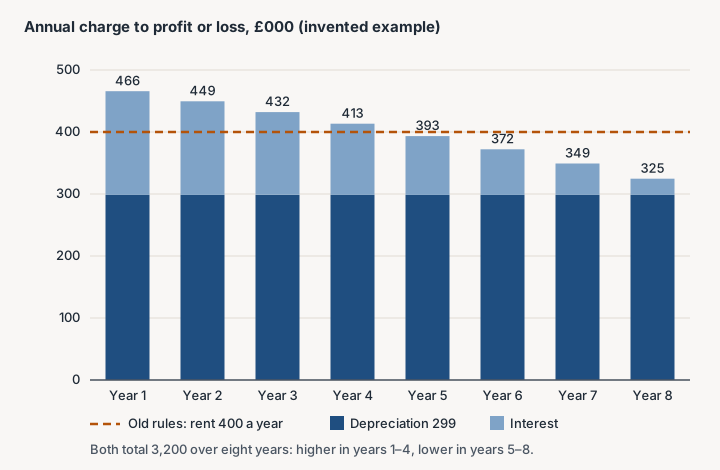
Cash does not change, but the cash flow statement does: the principal portion of lease payments is a financing outflow (paragraph 7.6(e)), and the interest portion is classified as operating or financing by policy, applied consistently (paragraphs 7.14 and 7.15). Section 1A companies are not required to prepare a cash flow statement (paragraph 1A.7A). A worked transition example, five leases from sorting to the first year's accounts, is in our FRS 102 lease accounting example.
FRS 102 and IFRS 16, where they differ (the FRC's description, Basis for Conclusions B20.6 to B20.17):
| Point | FRS 102 revised Section 20 | Compared with IFRS 16 |
|---|---|---|
| Discount rate | Implicit rate, or the incremental or the obtainable borrowing rate | The obtainable borrowing rate is an FRS 102 addition (B20.12(a)) |
| Low-value assets | No figure; 20.11 gives examples of what is not low value | Described by the FRC as "more permissive" (B20.8) |
| Lease modifications | Unchanged rate allowed in three cases (20.72) | Fewer modifications need a revised rate (B20.12(b)) |
| Sale and leaseback | Where the transfer is a sale, a policy choice for the gain or loss (20.123(a)) | A simpler option, close to old FRS 102 (B20.12(c)) |
| Transition | Modified retrospective only, asset equal to liability, or IFRS 16 group balances | IFRS 16 also allowed full retrospective application (B20.17) |
Transition: what the first year's accounts show
Comparatives are not restated. The cumulative effect of the change goes to opening retained earnings, or another component of equity, at the date of initial application (paragraph 1.47), and the company describes the transitional provisions it used (paragraph 1.50).
Why equity usually does not move. For each former operating lease, the liability is the present value of the remaining payments, and the right-of-use asset is set equal to that liability, adjusted for rent already prepaid or accrued (paragraph 1.51(a) and (b)). The two sides match, so the adjustment to equity is usually nil. It can move where the right-of-use asset is impaired at transition (paragraph 1.51(c)), where a below-market lease carried a government grant (paragraph 1.51(b)), where a lease will be investment property at fair value (paragraph 1.52(c)), or where a subsidiary takes its IFRS 16 group balances (paragraph 1.48). Former finance leases carry across at their existing amounts (paragraph 1.55). For transition worked through on figures, see the FRS 102 lease accounting example.
The practical expedients:
- No reassessment of what is a lease (paragraph 1.45), applied to all contracts and disclosed.
- IFRS 16 group balances (paragraph 1.48), for all leases, disclosed.
- One discount rate for a portfolio of similar leases (paragraph 1.53(a)).
- The onerous lease provision instead of an impairment review (paragraph 1.53(b)).
- Leases ending within 12 months of the date of initial application treated as short-term (paragraph 1.53(c)).
- Hindsight, for example on options (paragraph 1.53(d)).
The 1.53 expedients apply to former operating leases and can be used lease by lease. In the first year the company need not give the usual change-in-policy disclosures in paragraph 10.13(b) to (d) for Section 20; instead it discloses, where practicable, the adjustment to profit or loss for the current period, or explains why it cannot (paragraph 1.44).
How the lease changes affect EBITDA, net debt and bank covenants
EBITDA rises, because rent leaves operating costs and returns as depreciation and interest, both below EBITDA. FRS 102's own definition of net debt includes "obligations under leases" (Glossary; the reconciliation in paragraph 7.22 uses it), but EBITDA is not defined in FRS 102, and a covenant uses whatever the facility agreement says: net debt rises if that counts lease liabilities. So leverage usually rises and interest cover falls, with no change in the business. The invented company below has the property lease from the previous example, a £2,000,000 bank loan at 7% and £500,000 of cash. Figures are for its first year under revised Section 20, before tax. Equity is £3,000,000 on the old basis and £2,934,239 on the revised basis, after the lower profit.
| Old Section 20 | Revised Section 20 | Frozen GAAP basis | |
|---|---|---|---|
| Rent in operating costs | £400,000 | £0 | £400,000 |
| EBITDA | £1,500,000 | £1,900,000 | £1,500,000 |
| Depreciation | £300,000 | £598,565 | £300,000 |
| Interest | £140,000 | £307,196 | £140,000 |
| Profit before tax | £1,060,000 | £994,239 | £1,060,000 |
| Net debt (with lease liability) | £1,500,000 | £3,655,716 | £1,500,000 |
| Net debt to EBITDA | 1.00x | 1.92x | 1.00x |
| Interest cover (EBITDA to interest) | 10.7x | 6.2x | 10.7x |
| Gearing (net debt to equity) | 50% | 125% | 50% |
Leverage almost doubles and interest cover falls from 10.7x to 6.2x, on the same trading. Whether that matters depends on the facility agreement.
A breach matters for the balance sheet too. In the statutory balance sheet formats, a creditor is due within one year when, at the year end, the company has no unconditional right to defer payment for at least 12 months, for example because the lender could demand repayment (paragraph 4.7). A breach not remedied by the year end can do that, depending on the facility terms, and must be disclosed (paragraph 11.47); a Section 1A company is not specifically required to, but may need to for a true and fair view (paragraphs 1A.5 and 1A.17).
Frozen GAAP and other ways lenders deal with it
A frozen GAAP clause tests the covenants as if the accounting rules had not changed. It protects the ratios, but the company then keeps a second set of numbers each test date, prepared on the old operating-lease basis. Other routes are to reset the covenant levels, to redefine EBITDA and debt to exclude lease items, or to widen the baskets for permitted finance leases and other debt. Bonus and earn-out definitions based on EBITDA need the same check. The time to raise it with the lender is before the first test date, with the numbers in hand.
Company size and the other tests that use your balance sheet total
Capitalised leases count towards company size. The Companies Act 2006 defines the balance sheet total as "the aggregate of the amounts shown as assets in the company's balance sheet" (s382(5)), and a right-of-use asset is one of them. For financial years beginning on or after 6 April 2025, a company is small if it meets two or more of: turnover not more than £15 million, balance sheet total not more than £7.5 million, and not more than 50 employees (s382(3)).
The invented company has turnover of £12,000,000 and 60 employees. Its balance sheet total was £6,000,000 on the old basis; with the right-of-use asset of £2,089,954 at the first year end it is £8,089,954, so it now meets only one of the three conditions. That does not change its size straight away: a company's status changes only if it meets, or stops meeting, the conditions in two consecutive financial years (s382(2)). If the second year is also over, it stops being small. Size decides whether a company can use the small companies regime, including Section 1A (s381), and the small-company audit exemption (s477). A company near the limit should model its next two year ends now (see audit exemption thresholds). Contracts and other rules that refer to total or gross assets should be checked against the new figures too.
Do the FRS 102 lease changes affect corporation tax?
Yes, mainly in timing. Trading profits are calculated in accordance with generally accepted accounting practice, subject to adjustments required or authorised by law (Corporation Tax Act 2009 s46), so the tax computation starts from the depreciation and interest in the accounts, but no deduction is allowed for items of a capital nature (s53). Costs inside a right-of-use asset need looking at one by one.
A lessee's transitional adjustment, whether income or a deduction, is spread. For leases that would not be finance leases if the company had to decide (paragraph 12(1)(b)), Finance Act 2019, Schedule 14, spreads it over a period built from the remaining term of each lease, weighted by its share of the total adjustment (paragraphs 12 and 13). HMRC's Business Leasing Manual applies this to the FRS 102 (2024 amendments) and notes that, because the right-of-use asset generally equals the liability, there will be "fewer situations where a transitional adjustment is likely to arise" (BLM52005). Spreading matters where a transitional adjustment does arise, for example from an impairment at transition or group IFRS 16 balances, and where it applies, deferred tax on the amounts not yet taxed or relieved needs considering.
For the Corporate Interest Restriction, the definition of "finance lease" includes a right-of-use lease that would be a finance lease if the company had to decide (Taxation (International and Other Provisions) Act 2010 s494), so a company within those rules still needs to know which of its leases would have been finance leases. This section is a summary, not tax advice; the position depends on each lease.
Getting ready, and what the auditor will ask for in the first year
For the finance team, in order:
- Find every contract that might contain a lease, embedded ones included.
- Build a lease register: asset, dates, payments, options, incentives, restoration terms.
- Confirm the date of initial application, the date at which the transition balances and rates are measured (paragraphs 1.40(a) and 1.51).
- Choose a discount rate for each lease and keep the evidence.
- Record the exemption elections, by class or lease.
- Calculate the transition balances.
- Tell the lender what will move, and agree how covenants will be tested.
- Model company size and tax for the next two years.
For an audited company, the first audit under revised Section 20 tests this work. The company's auditor will usually want to see the lease register and how its completeness was checked, often by tracing rent and hire payments in the ledger to it; the contracts; the lease-term judgements; the evidence for each rate, such as lender quotes; the transition calculation; and the exemption elections. Where necessary to understand significant leasing arrangements, the notes also give, when relevant, information about restrictions or covenants imposed by leases and the types of discount rate used, with the proportion of the liability at each (paragraph 20.77). Lenders often test covenants on audited figures, so it pays to have this ready before fieldwork. If your investors have asked for an audit, tell us about your company: Innate offers statutory audits signed by an ICAEW-registered partner firm, which your company appoints as its auditor, with our platform doing the legwork to save you time and money.