UK audit exemption thresholds: the small-company and group tests, and the proposal to exempt medium-sized companies
By Alon Zieve FCA · Last reviewed
The UK audit exemption thresholds, for financial years beginning on or after 6 April 2025, are turnover of not more than £15 million, a balance sheet total of not more than £7.5 million, and no more than 50 employees on average. A private company that meets at least two of the three is small and can be exempt from audit. To use that exemption, a company in a group also needs the whole group, worldwide, to be small (£15 million net or £18 million gross turnover; £7.5 million net or £9 million gross assets; 50 employees) and not ineligible. A change in size counts only once it has happened two years running. Medium-sized companies generally still need an audit; a government consultation that closes on 30 November 2026 asks whether that should change.
For the wider picture, see UK audit requirements.
Status, 26 October 2026. Thresholds in force: financial years beginning on or after 6 April 2025 (SI 2024/1303). Medium-sized audit exemption: under consideration in a government consultation, open from 7 September to 30 November 2026; not law. Last checked: 26 October 2026.
The UK audit exemption thresholds at a glance
| Test | Small company, old | Small company, new | Small group, old | Small group, new |
|---|---|---|---|---|
| Turnover | £10.2m | £15m | £10.2m net or £12.2m gross | £15m net or £18m gross |
| Balance sheet total | £5.1m | £7.5m | £5.1m net or £6.1m gross | £7.5m net or £9m gross |
| Average employees | 50 | 50 | 50 | 50 |
"Old" is for financial years beginning between 1 January 2016 and 5 April 2025; "new" for years beginning on or after 6 April 2025. Each figure is a maximum: the Act says "not more than", so turnover of exactly £15 million meets the test. The company limits are in section 382(3) of the Companies Act 2006 and the group limits in section 383(4), as amended by regulation 9 of SI 2024/1303, which was made on 9 December 2024. Its amendments have effect for "financial years beginning on or after 6th April 2025" (reg 2(2)). It also raised the micro-entity and medium-sized limits.
The new limits follow the date the financial year begins, not the date it ends:
| Year end | First financial year at the new limits |
|---|---|
| 31 December | 1 January 2026 to 31 December 2026 |
| 31 March | 1 April 2026 to 31 March 2027 (the year from 1 April 2025 began before 6 April 2025) |
| 30 April | 1 May 2025 to 30 April 2026 |
| 30 June | 1 July 2025 to 30 June 2026 |
| 30 September | 1 October 2025 to 30 September 2026 |
What counts is the date the financial year actually begins. For a 31 December year end, the 2026 accounts are the first at the new limits. A year that begins on 6 April 2025 or later, such as one ending on 5 April 2026, is already under them.
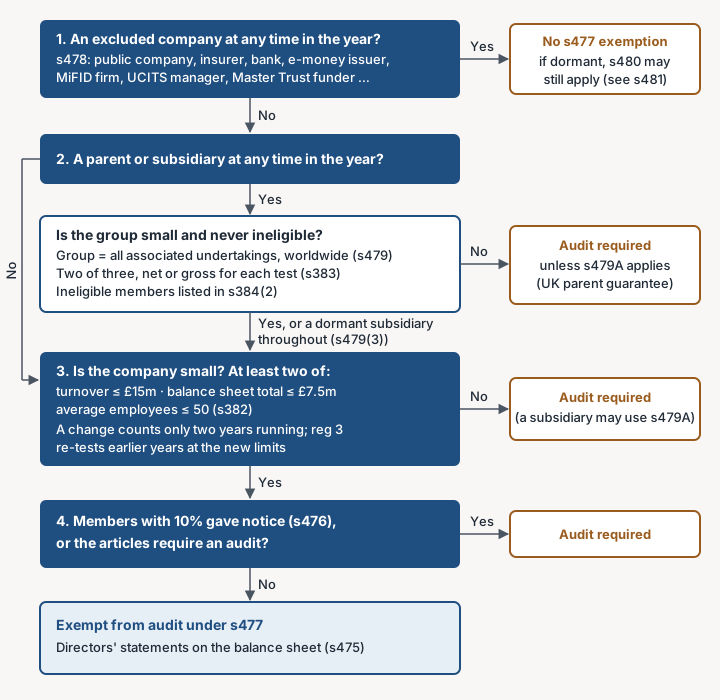
In words: an excluded company cannot use section 477 (a dormant one may still use section 480); a company in a group needs a small, eligible group (or to be a dormant subsidiary), or else section 479A or an audit; the company itself must be small, with the two-year rule; and members holding at least 10% (or the articles) can still require an audit. A company that clears all four is exempt, and says so on its balance sheet.
How to tell whether your company qualifies as small
Do small companies need to be audited? Not usually: a small company is exempt under section 477, unless one of the exceptions below applies. Being small turns on three figures, each defined in the Act.
- Turnover is the amount derived from providing goods and services, after trade discounts, VAT and other taxes based on those amounts (s474(1)). For a financial year longer or shorter than twelve months, only the turnover limit is adjusted in proportion (s382(4)): £11.25 million for nine months, £22.5 million for eighteen.
- Balance sheet total is "the aggregate of the amounts shown as assets in the company's balance sheet" (s382(5)): total assets, before liabilities. A company with large liabilities can have total assets over £7.5 million even if its net assets are small.
- Employees are an average of the people employed under contracts of service: count them for each month (whether employed for the whole month or not), add the monthly totals and divide by the number of months (s382(6)). It is a headcount, so a part-timer counts as one. The government's consultation asks whether full-time equivalents should be allowed instead (paragraph 56 and question 12); for now, the headcount is the law.
In its first financial year, a company is small if it meets the conditions in that year (s382(1)). After that, the two-year rule applies.
The two-year rule, and how the April 2025 increase applies
A change in size counts only when it happens in two consecutive financial years: where a company "meets or ceases to meet the qualifying conditions, that affects its qualification as a small company only if it occurs in two consecutive financial years" (s382(2)). For financial years beginning on or after 6 April 2025, regulation 3 of SI 2024/1303 re-tests the earlier years at the new limits, as though they had always applied.
Growing past the thresholds
A small company that goes over the limits stays small for the first year over, and loses the exemption only if it is over again the next year. An invented company with a 31 December year end:
| Year | Limits | Turnover | Balance sheet total | Employees | Meets new limits? | Small? | Audit? |
|---|---|---|---|---|---|---|---|
| 2024 | Old | £9.5m | £4.9m | 40 | Yes | Yes | No |
| 2025 | Old | £14m | £7m | 45 | Yes | Yes (first year over the old limits) | No |
| 2026 | New | £16m | £8m | 55 | No | Yes (first year over the new limits) | No |
| 2027 | New | £18m | £9m | 60 | No | No (second year over) | Yes |
Its first audit is for 2027, and only if it is over the limits again that year.
Falling below them
The rule works the same way in reverse. A company that is not small and comes within the limits becomes small only once it has met the conditions in two consecutive years. Until then, it still needs an audit.
The first year under the new limits
For a year beginning on or after 6 April 2025, a company "is to be treated as having qualified … in any previous year in which it would have so qualified if amendments to the same effect as the amendments made by regulations 9 and 10 had had effect in relation to that year and preceding financial years" (reg 3(2)); regulation 3(3) does the same for meeting the conditions. Groups are treated the same way. A second invented company, with a 31 December year end and more than 50 employees throughout:
| Year | Limits | Turnover | Balance sheet total | Meets old limits? | Meets new limits? | Small under the rules in force? | Audit? |
|---|---|---|---|---|---|---|---|
| 2022 | Old | £9m | £4.8m | Yes | Yes | Yes | No |
| 2023 | Old | £11m | £5.6m | No | Yes | Yes (first year over) | No |
| 2024 | Old | £12m | £6m | No | Yes | No | Yes |
| 2025 | Old | £13m | £6.4m | No | Yes | No | Yes |
| 2026 | New | £14m | £6.9m | No | Yes | Yes (2023 to 2025 re-tested) | No |
The 2025 accounts still need an audit: that year began on 1 January 2025, before the new limits. For 2026, regulation 3 treats 2023 to 2025 as years in which the company met the conditions and was small, so it is exempt straight away. Some guides say a company must have qualified as small in the previous year under the old thresholds. Regulation 3 says the reverse: earlier years are judged at the new limits. Read the old way, this company would wrongly need an audit for 2026 too.
Audit threshold for UK groups: net and gross, and the ineligible-group trap
What is the audit threshold for group companies? For financial years beginning on or after 6 April 2025, a group is small if it meets at least two of: turnover of not more than £15 million net or £18 million gross, a balance sheet total of not more than £7.5 million net or £9 million gross, and no more than 50 employees (s383(4)). A company that was a parent or a subsidiary at any time in the year can use the small-company exemption only if its group qualifies as small and was never an ineligible group in that year (s479(1)), unless it is a dormant subsidiary (below). It must also be small on its own figures.
"The group" is the company with all its associated undertakings: undertakings are associated if one is a subsidiary undertaking of the other, or both are subsidiary undertakings of a third (s479(4)). The tests apply "as if all the bodies corporate in the group were companies" (s479(6)). There is no line at the UK border: an overseas parent and its other subsidiaries count.
The figures are aggregated for every member (s383(5)), using each subsidiary's individual accounts for the year ending with the parent's, or the last one ending before it (s383(7)). "Net" means after the set-offs and other adjustments that eliminate group transactions; "gross" means without them. Then: "A company may satisfy any relevant requirement on the basis of either the net or the gross figure" (s383(6)). Each requirement can use whichever basis works. An invented UK group:
| Requirement | Net | Gross | Limit | Met? |
|---|---|---|---|---|
| Turnover | £14m | £19m | £15m net or £18m gross | Yes, on net |
| Balance sheet total | £7.8m | £8.8m | £7.5m net or £9m gross | Yes, on gross |
| Employees | 70 | 70 | 50 | No |
Two of three are met, so the group is small; on a single basis throughout it would fail either way. The group also has to satisfy the two-year rule (s383(3)).
A group is ineligible if any member is listed in section 384(2): in short, a company with securities admitted to trading on a UK regulated market (or another body corporate with shares admitted to one); a person (other than a small company) with a Part 4A permission under the Financial Services and Markets Act 2000 to carry on a regulated activity; an e-money issuer; a small company that is an authorised insurer, bank, MiFID investment firm or UCITS management company; a person carrying on insurance market activity; or a Master Trust scheme funder. Both listing tests name a UK regulated market, so a parent listed only overseas does not make the group ineligible on that ground alone. Its other activities, and its size, still count.
When the group is too big: a worked example
An invented UK company has turnover of £3 million, a balance sheet total of £2 million and 12 employees: small on its own. Its worldwide group has turnover of £36 million net (£40 million gross), a balance sheet total of £22 million net (£25 million gross) and 180 employees, so it fails all three group tests. The UK company cannot use section 477.
The routes left are an audit, or the s479A audit exemption, which, among other conditions, needs a parent undertaking established under the law of a part of the UK to give a guarantee under section 479C (s479A(1)(b), (2)), and is not available to a company excluded by section 479B, such as a traded company, bank or insurer. Where the only parent is overseas, section 479A is not available. For the full picture, see does a UK subsidiary need an audit.
Dormant group companies
The group test does not exclude a company that, throughout its time as a group company in the year, was both a subsidiary undertaking and dormant (s479(3)): it had no significant accounting transaction, meaning none that section 386 requires to be entered in its accounting records, apart from a few listed items (s1169). The dormant company exemption in section 480 may also apply.
When a small company still needs an audit
- It is an excluded company. Section 478 removes the exemption from a company that was at any time in the year a public company; an authorised insurance company, banking company, e-money issuer, MiFID investment firm or UCITS management company; a company carrying on insurance market activity; a Master Trust scheme funder; or a special register body or employers' association. A dormant company may still use section 480, unless section 481 excludes it.
- Its members require one. Members holding at least 10% of the nominal value of the issued share capital, or of any class of it (or, with no share capital, 10% of the members), can require an audit by notice (s476(1)–(2)). The notice cannot be given before the financial year starts, and "must be given not later than one month before the end of that year" (s476(3)). GOV.UK says it should be in writing, sent to the registered office.
- Its articles of association require one, as GOV.UK's guidance notes.
- A lender, investor or contract requires audited accounts. That is a commercial requirement rather than a legal one; see voluntary audit.
Charities have their own audit thresholds under charity law. Limited liability partnerships use the same size tests, applied with modifications by SI 2008/1911, with their own version of the April 2025 transition (SI 2024/1303 reg 3(4)–(6)).
Do medium-sized companies need an audit?
Yes. Under the law in force on 26 October 2026, the exemption in section 477 is for small companies only, so a medium-sized company must have its accounts audited unless another exemption applies. A company is medium-sized if it meets two of: turnover not more than £54 million, balance sheet total not more than £27 million, and no more than 250 employees (s465(3)); for a group, £54 million net or £64 million gross turnover and £27 million net or £32 million gross assets (s466(4)).
One route exists now for some medium-sized companies: a subsidiary of any size (as the consultation itself notes, paragraph 90) can use the s479A audit exemption if it has a UK parent undertaking and meets that section's conditions.
Whether that should change is the subject of the government's consultation.
The proposal to exempt medium-sized companies from audit: where it stands
The proposal is in a government consultation, Modernising corporate reporting, published on GOV.UK on 7 September 2026 by the Department for Business, Innovation, Science and Trade. It is a consultation, not law: none of its proposals has been legislated or has a commencement date. Question 10 asks: "Do you agree or disagree that the audit exemption should be expanded to include companies eligible for the medium-sized company regime?"
What the document proposes for audit, in its own terms:
- Extending the exemption to all SMEs. The government "is considering extending the small company audit exemption to all SMEs". It is "not convinced" a statutory audit "is always necessary for medium-sized companies", given that subsidiaries of any size can already claim an exemption, and says the burden of requiring one for all of them "may not be justified" (paragraph 90). It also says audited accounts "can be extremely valuable to companies" and wants to test "whether this value justifies the burden", or whether all SMEs should have a choice (paragraph 45). It asks whether the change would reduce access to lending or raise its cost (paragraph 90).
- A voluntary assurance standard, on which it seeks views, that could give lenders the assurance they need "at a lower cost than that of a full statutory audit" (paragraph 91).
- What an audit would cover. Without a true and fair requirement, an audit "could consider compliance with the accounting standard" (paragraph 92).
- Subsidiaries without a guarantee. The government is considering an audit exemption for wholly-owned (non-PIE) subsidiaries of UK parent companies with no parent guarantee, filing only the group audit report, and whether to extend this to non-wholly-owned subsidiaries if all shareholders agree (paragraph 106).
- What stays. Public interest entities' audit regime is not under review (paragraph 49), and the government proposes that regulated financial services companies stay excluded (paragraph 50).
The document notes that a company may find out it needs audited accounts only when it applies for finance, and says the government is "keen to explore this question thoroughly before making any decision on requirements" (paragraph 46).
The consultation closes at 11:59pm on 30 November 2026. Anyone can respond, by the online survey or by email to mcr.review@businessandtrade.gov.uk. The government will then "summarise all responses and publish this on GOV.UK", and aims "to publish a consultation outcome within six months of the close of the consultation". Any change to the audit requirement would then need legislation. Even the reporting measures announced on 21 October 2025 (no strategic report for most medium-sized private companies; the directors' report removed, with some of its contents moved elsewhere) still await statutory instruments, to be laid "in due course"; we found none on legislation.gov.uk on 26 October 2026.
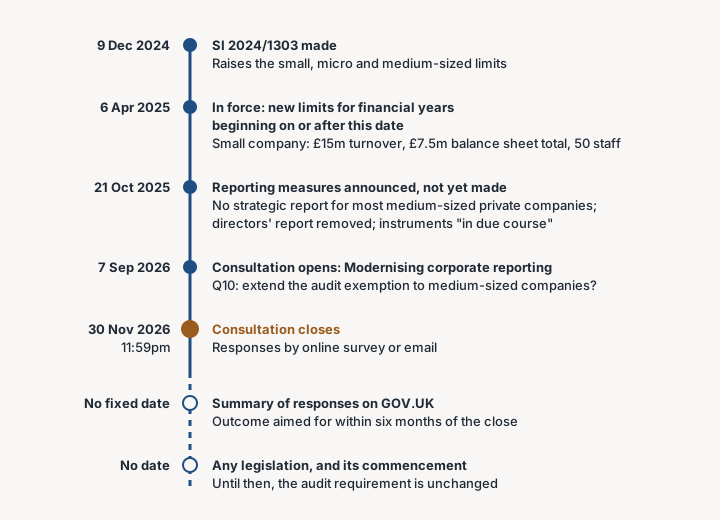
Until the law changes, each year is tested under the law in force, and a medium-sized company plans its audit as before.
If your company has outgrown the exemption
The first audited year is the second consecutive year over the limits, so directors can usually see it coming from the forecast for that year.
An auditor must be appointed for each financial year unless the directors reasonably resolve that audited accounts are unlikely to be required (s485(1)). Where the company had no auditor while it was exempt, the directors may appoint one "at any time before the company's next period for appointing auditors" (s485(3)(b)); the members may appoint by ordinary resolution (s485(4)). That period is the 28 days beginning with the end of the time allowed for sending out the previous year's accounts, or with the day they are sent out if earlier (s485(2)).
A first audit also has to deal with the opening balances carried in from the unaudited year before, under ISA (UK) 510, Initial Audit Engagements—Opening Balances: see first statutory audit. A company that finds it claimed the exemption for a year in which it did not qualify has a different problem, outside the scope of this page.
Once the exemption no longer applies, Innate can arrange a statutory audit signed by an ICAEW-registered partner firm, which your company appoints as its auditor: get a quote. Our platform finds the data and documents and helps the audit team prepare its work, to save you questions, time and money.
Claiming the exemption: the statement on the balance sheet
A company is entitled to the exemption only if its balance sheet carries the directors' statements: that it is exempt, that the members have not required an audit under section 476, and that the directors acknowledge their responsibilities for accounting records and the preparation of accounts (s475(2)–(3)). They go above the directors' signature (s475(4)). GOV.UK gives this wording:
For the year ending [your company's year end date], the company was entitled to exemption from audit under section 477 of the Companies Act 2006 relating to small companies.
The members have not required the company to obtain an audit of its accounts for the year in question in accordance with section 476.
The directors acknowledge their responsibilities for complying with the requirements of the Act with respect to accounting records and the preparation of accounts.
These accounts have been prepared in accordance with the provisions applicable to companies subject to the small companies' regime.
Section 57 of the Economic Crime and Corporate Transparency Act 2023 substitutes a new section 475(2), requiring the statement to identify the exemption and confirm that the company qualifies; Companies House says this applies from 1 April 2028, but on 26 October 2026 the new wording was not yet in force and no commencement regulations had been made. See Companies House accounts filing changes.