Audit exemption for UK subsidiaries: the s479A parent guarantee
By Alon Zieve FCA · Last reviewed
The s479A audit exemption lets a UK subsidiary of any size skip the statutory audit of its own accounts (the independent audit the Companies Act 2006 otherwise requires) if a parent established in the UK includes it in audited consolidated accounts. The price is set by the Act. Every member of the subsidiary agrees, each year. The parent guarantees every liability the subsidiary has at the year end, with no cap and no way to withdraw it. And the subsidiary files form AA06, the members' agreement and the parent's audited group accounts with its own. A subsidiary whose parent is outside the UK cannot use it directly: the third section below explains why, and the one workaround.
This guide is part of the UK audit requirements series.
What is the s479A audit exemption?
The exemption removes one thing: the audit of the subsidiary's individual accounts. The subsidiary still prepares and files accounts, its directors still answer for them, and the parent's consolidated accounts, which include the subsidiary's figures, are still audited.
Section 475 of the Companies Act 2006 requires a company's annual accounts to be audited unless one of three audit exemptions applies: small companies (s477), subsidiary companies (s479A) or dormant companies (s480). (Section 482 separately takes some non-profit companies subject to public sector audit out of the audit rules.) Section 479A was inserted from 1 October 2012, under the heading "Exemption from audit: qualifying subsidiaries", for accounts for financial years ending on or after that date.
Two conditions that are sometimes assumed are not in the section. There is no size test: ICAEW's technical release on the exemption says "There is no limit on the size of a company for the purposes of the exemption." Nor does the section require the subsidiary to be dormant: a trading subsidiary qualifies on the same terms.
Which companies can use section 479A?
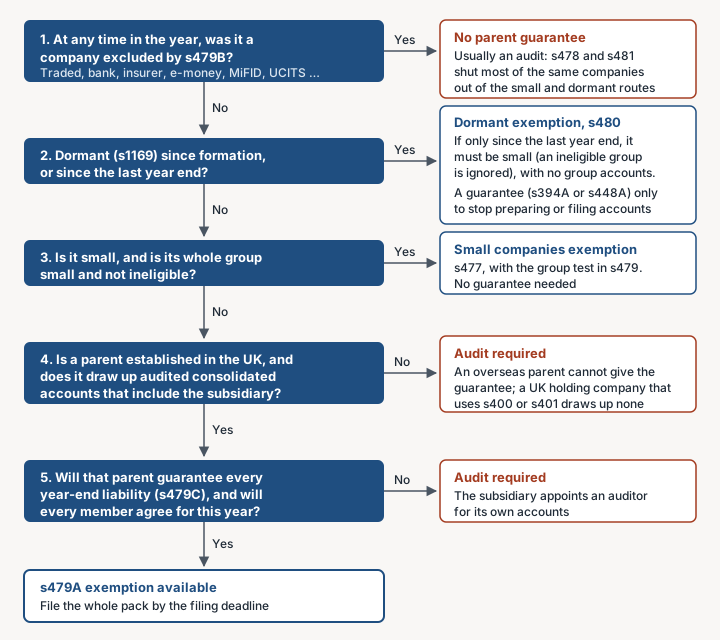
A company can use section 479A of the Companies Act for a financial year if all of these are met:
- It is a subsidiary undertaking.
- Its parent undertaking is established under the law of any part of the UK.
- All members of the subsidiary agree to the exemption for that financial year.
- The parent gives a guarantee under s479C for that year.
- The subsidiary is included in consolidated accounts drawn up by that parent for the same year (or to an earlier date in it), under the Act's Part 15 rules (or, for a parent that is not a company, the rules on consolidated accounts that apply to it) or UK-adopted international accounting standards.
- The parent's consolidated accounts disclose, in the notes, that the subsidiary is exempt from audit by virtue of s479A.
- The subsidiary's directors deliver the filing pack to Companies House on or before the date they file its accounts.
The exemption also depends on the balance-sheet statements in s475(2) and (3) and gives way to s476: members holding at least 10% of the issued share capital, or of any class of shares (or 10% of the members, if the company has no share capital), can still require an audit.
Section 479B shuts a subsidiary out if, at any time in the year, it was a traded company; an authorised insurance company, bank, e-money issuer, MiFID investment firm or UCITS management company; carried on insurance market activity; funded a Master Trust pension scheme; or was a special register body or employers' association. The tests look at the subsidiary alone: "There is no concept of an 'ineligible group'" (ICAEW), so an insurer elsewhere in the group does not matter.
LLPs have the same route, with form LLAA06. A charitable subsidiary still needs any audit the Charities Act requires: the guarantee does not lift it (ICAEW).
Section 479A is one of several ways out of a subsidiary's audit. Only it and the dormant-subsidiary routes need a guarantee:
| Route | Section | The main condition | Guarantee? | What the subsidiary files |
|---|---|---|---|---|
| Small company, not in a group | s477 | Qualifies as small; not excluded by s478 | No | Its accounts, with the statements |
| Small company in a group | s477 with s479 | The whole group is small and was never ineligible in the year | No | Its accounts, with the statements |
| Dormant company | s480 | Dormant since formation; or dormant since the last year end, entitled to the small companies regime (ignoring public or ineligible-group status) and not required to prepare group accounts; not excluded by s481 | No | Its accounts, with the statements |
| Dormant subsidiary that stops preparing or filing accounts | s394A or s448A | Dormant all year; UK parent; members agree; in the consolidated accounts; not excluded by s394B or s448B | Yes (s394C or s448C) | AA06, members' notice and group accounts, instead of its own |
| Subsidiary of a UK parent | s479A | The seven conditions above; not excluded by s479B | Yes (s479C) | Its accounts and statements, plus AA06, members' notice and group accounts |
The small company limits change from time to time; the current figures are in the guide to audit exemption thresholds.
Can a subsidiary of a US or overseas parent use the guarantee?
No, not directly. Section 479A(1)(b) requires the parent to be "established under the law of any part of the United Kingdom". Until the end of the Brexit transition period the words were "an EEA State", and a transitional rule kept an EEA parent eligible only for financial years that began before the end of that period (11pm on 31 December 2020). A US, EU or any other non-UK parent cannot give an s479A guarantee for a later year.
There is one workaround, and it has a catch. The guarantee does not have to come from the ultimate parent: ICAEW confirms an intermediate parent can give it, "although that parent undertaking would have to prepare consolidated accounts". The catch is that a UK holding company owned from overseas is often exempt from preparing group accounts under s401. Broadly, that exemption applies where the overseas parent owns all of the holding company, or 90% or more with the other shareholders' approval, or more than half with no notice from holders of 5% asking for group accounts; the holding company is not a traded company; and it and all its subsidiaries are included in the overseas parent's audited consolidated accounts, drawn up to UK or equivalent standards and filed at Companies House. A holding company relying on that exemption draws up no consolidated accounts of its own, so it cannot meet condition 5. (Section 400 is the matching exemption where the holding company's immediate parent is in the UK; there, a UK parent higher up already draws up audited group accounts and can give the guarantee itself.)
To give the guarantee, the holding company must choose to prepare group accounts, which s399(4) allows. Those group accounts must be audited, because every subsidiary's filing pack has to include the auditor's report on them, and the holding company cannot use s479A for its own accounts, because its parent is overseas. The route moves the audit up a level rather than removing it. It is most likely to pay where several UK subsidiaries sit under one UK holding company, and inserting one has tax and legal effects that need their own advice.
For the wider question of whether a UK subsidiary needs an audit at all, see the separate guide.
What the parent company guarantee covers, and why it cannot be withdrawn
Section 479C(3) sets out the effect in two limbs. The parent "guarantees all outstanding liabilities to which the subsidiary company is subject at the end of the financial year to which the guarantee relates, until they are satisfied in full", and the guarantee "is enforceable against the parent undertaking by any person to whom the subsidiary company is liable in respect of those liabilities".
Four features decide whether the parent company guarantee audit exemption is worth having:
- It is created by statute, not contract. The guarantee is given when the subsidiary's directors deliver the parent's statement (AA06) to Companies House. ICAEW: "No contract is required between the parent giving the guarantee and the parties who benefit from the guarantee."
- It has no cap, and its edges are uncertain. It covers liabilities at the year end, not later ones. ICAEW says scope "is one of law and not accounting" and may reach contingent and prospective liabilities ("a litigation liability and future rentals on a lease"); only the courts can settle how far. On an overdraft, the rule in Clayton's case presumes later repayments clear the earliest debits first, unless there is a contrary intention or the debtor directs how a payment is applied.
- It cannot be withdrawn. Nothing allows it to be revoked or transferred. A parent that sells the subsidiary stays liable to its creditors for the guaranteed debts, even with an indemnity from the buyer. Having the audit after all does not end it either.
- It is public. AA06 tells the filer that "all information on this form will appear on the public record", so lenders and suppliers can see which parent stands behind the subsidiary.
Revised FRS 102 brings most leases onto the lessee's balance sheet (see FRS 102 lease changes), which makes a lease obligation easier to see. It changes how the obligation is presented, not what the guarantee covers: ICAEW already lists future rentals on a lease as a liability that may be in scope.
Parent guarantee or audit: weighing the trade-off
The group gives an unlimited, irrevocable, public guarantee and takes on a yearly paperwork cycle. It saves the subsidiary's separate statutory audit.
That saving is often smaller than it looks. Under ISA (UK) 600 (Revised), the auditing standard for group audits, the group auditor takes responsibility for "determining the components at which to perform further audit procedures and the nature, timing and extent of the work to be performed at those components". A component is a part of the group, such as a subsidiary, that the group auditor treats as a unit for planning the work. A subsidiary that is large or risky for the group may still get substantial audit work. The exemption removes the separate audit and its report, not every hour spent on the subsidiary: in ICAEW's words, the choice is between "a statutory audit or only the work needed to support the audit of the parent's consolidated accounts".
An audit is still required, or the safer choice, where:
- members holding 10% of the shares (or of any class) give notice under s476, not later than one month before the year end;
- a lender, investor or customer contract requires audited accounts, or a regulator does;
- the subsidiary is being sold, or prepared for sale: a buyer may want audited accounts, and the seller's guarantee survives the sale;
- the subsidiary carries large or uncertain liabilities (litigation, warranties, long leases) that the parent would rather not guarantee, or that its board cannot yet list.
A worked example (illustrative figures, computed in code). A UK trading subsidiary has these liabilities at 31 December 2026:
| Year-end liability | £ |
|---|---|
| Trade creditors | 1,450,000 |
| Accruals and deferred income | 420,000 |
| Corporation tax | 160,000 |
| Lease liabilities under revised FRS 102 | 1,180,000 |
| Liabilities to people outside the group | 3,210,000 |
| Amounts owed to fellow group companies | 2,300,000 |
| All liabilities on the balance sheet | 5,510,000 |
| Disputed customer claim (contingent, not recognised) | 250,000 |
| Including the contingent claim | 5,760,000 |
For scale only: the FRC's SME Audit Market Study (final report, March 2026) put the average 2024 audit fee for medium-sized entities at £30,900: a 2% winsorised mean (an average that limits the pull of extreme fees) from the FRC's data on audits of companies that were medium-sized under the Companies Act. On these figures the parent guarantees external liabilities of about 104 times that average fee, and about 186 times it once group balances and the disputed claim are counted. The guarantee is enforceable by "any person" the subsidiary owes, so the group balances are within its words too. The guarantee is not a cost in itself: the parent pays only if the subsidiary does not. A real comparison uses the subsidiary's own figures and a real quote; the guide to how much an audit costs explains what drives the fee. A subsidiary that leaves the exemption without a prior audit faces a first year audit.
If your subsidiary needs its own audit, talk to us: Innate offers statutory audits signed by an ICAEW-registered partner firm, which the subsidiary appoints as its auditor, with our platform taking on the legwork to save you time and money.
Form AA06: how to complete and file it
The AA06 form is the Companies House form for the parent's statement of guarantee. The same form serves all three guarantees: s479C (audit), s394C (not preparing dormant accounts) and s448C (not filing them). The current version is 5.0, dated 03/26. Box by box:
| Box | What goes in it |
|---|---|
| 1. Subsidiary company details | The subsidiary's registered number and name in full, matching the register |
| 2. Relevant financial year | The year end the guarantee relates to (dd/mm/yyyy) |
| 3. Guarantee | The section the guarantee is given under (394C, 448C or 479C), and the UK parent's name and registered number. The EEA option applies only to years that began before the end of the transition period |
| 4. Date | The date the statement was made |
| 5. Signature | Signed on behalf of the parent undertaking |
| 6. Signature | Signed by a director of the subsidiary |
| Presenter information | Optional, and "visible to searchers of the public record" |
File one AA06 per subsidiary per year, since the statement names both (s479C(2)), and check names and numbers against the register: Companies House "may return forms completed incorrectly or with information missing". An LLP uses LLAA06.
Can form AA06 be filed electronically?
Yes, as part of the accounts package. Companies House lists "audit exempt subsidiary accounts" among the package accounts that can be filed online: a ZIP file, iXBRL-tagged using software, which can contain "accounts that include a Companies House form". Not all software can file package accounts, so check with the provider. The Companies House guidance we checked describes no separate online route for AA06 on its own. Paper is still accepted until 1 April 2028; from then, accounts can be filed only through commercial software. The form itself says "You can upload certain forms to Companies House instead of sending them by post"; the blank form is on GOV.UK.
The s479A filing pack and timetable
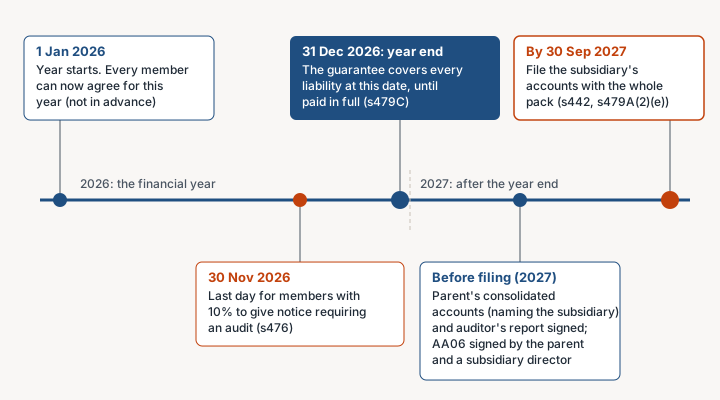
The filing requirements for the s479A audit exemption are in s479A(2)(e). With or before the subsidiary's accounts, its directors deliver:
- a written notice that all members agree to the exemption for the year;
- the parent's statement of guarantee (AA06);
- a copy of the parent's consolidated accounts;
- a copy of the auditor's report on them;
- a copy of the parent's consolidated annual report.
Companies House's guidance counts the pack as three documents (the parent's accounts, annual report and auditor's report being one), wants the members' notice to show the subsidiary's name, number and the section relied on, and wants the parent's accounts to show the subsidiary's name and registered number (the front page will do).
The subsidiary's own balance sheet must carry statements "to the effect" of the Companies House wording:
- "For the year ending (date/month/year) the company was entitled to exemption from audit under section 479A of the Companies Act 2006 relating to subsidiary companies."
- "The members have not required the company to obtain an audit of its accounts for the year in question in accordance with section 476."
- "The directors acknowledge their responsibilities for complying with the requirements of the Act with respect to accounting records and the preparation of accounts."
From 1 April 2028, Companies House says, the statement must also name the exemption and confirm that the company qualifies.
When to file. The Act says "on or before the date that they file the accounts". Form AA06 says "on or before the date on which its accounts are due", and Companies House guidance says "before the subsidiary company's accounts filing deadline". The safe reading of all three: deliver the whole pack with the accounts, and by the filing deadline, which is nine months after the year end for a private company. In practice the parent's audited group accounts, naming the subsidiary, set the pace. The exemption "takes effect when we accept all 3 documents" (Companies House).
Members' agreement, every year. ICAEW advises that consent is given for each financial year and not in advance, because consent given before the year begins "might give rise to a claim of invalidity". One document can record the members' consent for several subsidiaries, but a copy is filed for each.
If a condition is missed, the exemption is not available for that year, s475 requires an audit, and the audit is commissioned late against the same filing deadline.
Dormant subsidiaries: s480 and the dormant subsidiary exemptions
A dormant subsidiary usually needs no guarantee. "Dormant" means it had no significant accounting transaction in the period, ignoring a few items such as certain fees paid to Companies House (s1169). Such a company can use the dormant companies exemption in s480 if it has been dormant since its formation, or if it has been dormant since its last year end, is entitled to the small companies regime and does not have to prepare group accounts. Being in an ineligible group does not stop it, because s480(2)(a)(ii) disregards that. It files dormant accounts with the usual statements. Section 481 excludes traded companies, authorised insurers, banks, e-money issuers, MiFID investment firms, UCITS management companies and companies carrying on insurance market activity.
A guarantee is needed only to go further. A dormant subsidiary of a UK parent can stop preparing accounts altogether (s394A) or prepare them but not file them (s448A). Both require it to be dormant throughout the whole year, and both use the same conditions as s479A: every member agrees, the parent guarantees, and the parent's audited consolidated accounts include it and say so. The parent signs the same AA06, ticking s394C or s448C. The pack is due "within the period for filing", and the guarantee is the same unlimited one. A dormant company can still owe money, often within the group, and the guarantee covers it.
Your s479A checklist for the year
- Confirm the route: the subsidiary is not excluded by s479B, and a UK parent draws up audited consolidated accounts that include it.
- The parent's board decides whether to guarantee this year, knowing the subsidiary's liabilities.
- Obtain every member's agreement for this year, once the year has started.
- Make sure the parent's consolidated accounts name the subsidiary, with its registered number, and state the s479A exemption in the notes.
- Complete AA06 version 5.0, signed on behalf of the parent and by a director of the subsidiary.
- Put the three exemption statements on the subsidiary's balance sheet, above the director's signature.
- File the subsidiary's accounts and the whole pack together, by the filing deadline.
- Diarise next year: the agreement, the guarantee and the pack start again.