AI in auditing and finance: what a UK audit uses it for, and how finance teams use it safely
By Alon Zieve FCA · Last reviewed
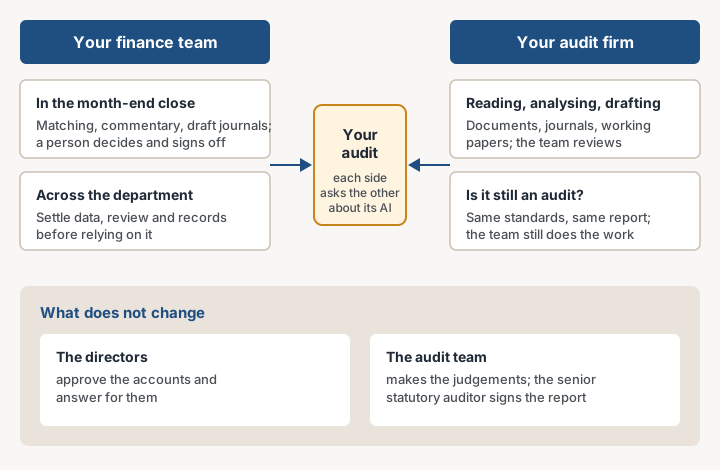
AI in auditing means an audit firm using software, including machine learning and generative AI, to read documents, analyse whole ledgers and prepare parts of the work for the audit team to review. In a finance team, the same kinds of tool turn up in the month-end close and in reporting. On either side, one thing does not change: the directors answer for the accounts, the audit team obtains the evidence and makes the judgements, and the auditor signs the report. This page sets out what that means for a UK company and points to a guide for each question. Practitioners documenting their own tools want FRC AI audit guidance and UK auditing standards.
What does AI in auditing mean?
In a UK statutory audit, it means the audit firm using tools that learn from data or generate text to do parts of the audit work: reading contracts and board minutes, scoring the journals in a ledger for how unusual each looks against the rest, drafting a working paper for someone to review. The team checks what the tools produce and decides what it means. AI in audit work is a set of tools the team uses, not a different kind of audit.
Three things people mean by "AI and audit"
The phrase covers three different activities, and much of what is written about it is about the other two:
- An audit firm using AI on a company's statutory audit. The external audit required by the Companies Act, ending in the auditor's report to the members. This is what this page, and the guides it links to, are about.
- Internal audit using AI. A company's own internal audit function (or an outsourced one) reviewing its controls and risks for management and the board. Advice written for internal auditors does not always carry over to the statutory audit.
- An "AI audit". A review of an AI system itself, its fairness or its safety, which is not covered here.
AI in auditing and accounting are two sides of the same audit: the firm's tools on one side, the company's own tools in its finance team on the other. They meet when the auditor tests figures that the company's tools helped produce.
The kinds of tool the regulator distinguishes
The Financial Reporting Council (FRC), which sets the UK's auditing standards, uses a few terms that are worth having in plain words. Its 2025 guidance on AI in audit says its scope "comprises both traditional machine learning techniques and deep learning models, including generative AI". Its 2026 guidance adds agentic AI. In order of how much the tool does on its own:
- Tools that follow fixed rules. Traditional data analytics routines, such as a routine that lists every journal posted to an account combination the firm treats as unusual. In the FRC's own example these are "binary pass/fail", whereas the AI tool can evaluate items "along a spectrum of how unusual they appear". The FRC's example combines both in one tool.
- Traditional machine learning. Models trained on data. The FRC's 2026 guidance describes predictive machine learning components as applying patterns to "forecast, classify, score or detect": for example, scoring journals for how unusual they are.
- Generative AI. Systems that "can generate content in response to prompts, using learned patterns from large training datasets". Large language models are the form that reads and writes text. The FRC's example is a tool that translates documents "for the auditor to review".
- Agentic AI. Systems that "can orchestrate and execute multiple components and/or tasks toward a goal, with some degree of autonomy": a tool that carries out a sequence of steps rather than answering one prompt.
The more a tool generates or acts on its own, the more it matters who checks it. The FRC's 2026 guidance calls that person the "human in the loop": someone who "directs, authorises or reviews the system's actions or outputs".
Who answers for the work when AI is used
Responsibility does not pass to software. The Companies Act and the auditing standards place it on three parties, and the regulator has said that AI does not move it.
| Who | What they answer for | Source |
|---|---|---|
| The directors | They must not approve the accounts unless satisfied that they give a true and fair view. The board approves the accounts, and a director signs the balance sheet on its behalf. | Companies Act 2006 s393(1), s414(1)–(2) |
| The auditor and its engagement team | The auditor reports to the members and states its opinion on whether the accounts give a true and fair view. Where the auditor is a firm, the senior statutory auditor signs the report in their own name for the firm. The team must obtain sufficient appropriate evidence and apply professional judgement and scepticism, and the engagement partner takes overall responsibility for quality on the audit. | Companies Act 2006 s495(1), (3), s503(3); ISA (UK) 200 paras 15–17; ISA (UK) 500 para 6; ISA (UK) 220 (Revised July 2021) para 13 |
| The audit firm | Its system of quality management must include the objective that appropriate technological resources are obtained or developed, implemented, maintained and used, and the AI tools its teams use are among them. | ISQM (UK) 1 para 32(f) |
The directors. Using AI in the finance team does not move their duty to the software, or to the auditor. The Act says the auditor "must have regard to" the directors' duty to approve only true and fair accounts (s393(2)); it does not take that duty over. If a tool drafted a figure and the board approved it, the board answers for it.
The auditor. The opinion is the auditor's, and the standards require the work behind it to be the team's: designing procedures to obtain "sufficient appropriate audit evidence" (ISA (UK) 500 para 6), planning and performing the audit with professional scepticism (ISA (UK) 200 para 15) and exercising professional judgement (para 16). A tool can prepare work for the team. It cannot hold the responsibility for it.
The firm. Under ISQM (UK) 1, the quality management standard every audit firm applies, the firm answers for the technology it gives its teams, whether it built the tool or bought it.
What the regulator has said. The FRC published its first guidance on AI in audit on 26 June 2025. It says the guidance "is not prescriptive", that it "does not introduce new regulatory requirements", and that "the requirements against which firms will be assessed remain only those in the ISQMs and ISAs (UK)". It followed on 30 March 2026 with guidance on generative and agentic AI, saying that "the human auditor is always accountable - this guidance does not alter that position". Its factsheet adds that the firm and the engagement partner "retain full responsibility for audit quality". What firms document about their tools is set out in FRC AI audit guidance.
AI in auditing: what a UK audit uses it for
AI is already used in UK audits. The FRC wrote in 2025 that "we have begun to see tools that use AI being deployed on live engagements". The uses the FRC describes are mainly reading, analysing and preparing work for the team's review.
Where it is used in the audit
The FRC's documents describe current and potential uses: tools that read documents such as contracts and board minutes, analyse whole populations of transactions such as journals, draft working papers, match supporting documents to samples and check the arithmetic of the financial statements, with the team reviewing each output. Which of these a given firm uses, and at which stage, differs from firm to firm; the guide to how auditors use AI goes through each stage of the audit.
Whether it is still an audit
The question behind "AI and audit quality" is not whether a tool was used but whether the team did the work the ISAs (UK) require and can show it. The standards are the same with or without AI. The FRC says AI "deployed responsibly and appropriately, has the potential to significantly enhance audit quality", and its 2026 guidance sets out three risks to audit quality: a deficient output, an output that is misused, and a methodology that permits approaches that "fail to meet auditing standards". A lender or investor reads the auditor's report, which is the same report under the same section of the Act whatever tools were used. Whether software could do the audit on its own is answered in can AI do an audit.
How finance teams use AI safely
A finance team's use of AI is part of how the company produces its figures, so it sits inside the company's own controls, and the auditor will look at it. The auditor must understand the information system that produces the financial statements, including "the entity's resources, including the IT environment" that it relies on (ISA (UK) 315 (Revised July 2020) para 25(a)(iv)). A tool that drafts journals or reconciles accounts is part of that.
In the month-end close
Finance teams use AI to match transactions, draft variance commentary and prepare journals for someone to approve. Whether a journal is posted stays a person's decision, and so does the review of what the tool matched or explained: the board approves the accounts that those journals feed. The tasks, the controls around them and what the auditor will look for are in AI for the month-end close.
Across the finance department
Before relying on AI anywhere in the team, three things need settling: what data may go into which tool, who reviews the outputs before they are used, and what is kept as a record of what the tool did. A short written answer to each makes the audit easier, because the auditor can see the controls rather than infer them. The detail is in using AI in a finance department.
The wider guides to the close, the year end and getting ready for the audit are in our guides for finance teams.
AI in your company's audit: what each side can ask
The two sides meet in the audit, and each has fair questions for the other.
The auditor will want to know where AI touches figures in the accounts and how its outputs are reviewed, because that is part of understanding how the figures are produced. The questions to expect, and how to answer them, are in what your auditor will ask if you use AI.
You can ask the audit firm about its AI too. Four questions cover most of it:
- What will the tools do on the audit, and at which stages?
- Who on the team reviews their output, and how?
- Where is the company's data processed, and is it used to train models?
- How has the firm satisfied itself that the tools work for this use?
A firm should be able to answer all four plainly. The FRC's 2026 factsheet on its guidance says other risks exist, "such as cybersecurity and data risks", but that the guidance is limited to risks to audit quality, so the third question is yours to ask; the regulator's guidance does not answer it for you. Choosing an auditor more generally is covered in how to choose an auditor. Innate publishes how the Innate platform uses AI.
If you want an audit where software does the legwork and people make the judgements, Innate offers statutory audits signed by an ICAEW-registered partner firm, which your company appoints as its auditor: find out more.
Which guide answers your question
The guides in AI in audit and finance each answer one of the questions below.
| If your question is… | The short answer | Read |
|---|---|---|
| Is an audit that uses AI still a proper audit, and will our bank accept it? | Yes, if a registered firm does it under the ISAs (UK); same report | Can AI do an audit |
| What does the auditor's AI actually do, stage by stage? | Reads, matches, flags and drafts; the team reviews and decides | How auditors use AI |
| Can the finance team use AI in the month-end close? | Yes: AI drafts, matches and flags; a person decides and signs off | AI for the month-end close |
| How can the finance team use AI safely, and what will the auditor ask? | Settle data, review and records first | Using AI in a finance department |
| How do auditors document the AI tools they use? (practitioners) | Centrally and on the file; more on file the more bespoke the tool | FRC AI audit guidance |
| Does the company need an audit at all? | Most small private companies can claim an exemption; the tests decide | UK audit requirements |
Whether your company needs an audit in the first place is answered in UK audit requirements.
Guides
- Can AI do an audit? What an AI-assisted audit is, and whether your bank will accept itCan AI do an audit? Not on its own: the law says who can be appointed auditor, and a named person signs. What AI does, who is responsible, what banks see.Last reviewed
- How do auditors use AI? Each stage of a UK audit, and what stays with peopleHow do auditors use AI in a UK statutory audit? What it does at each stage, what the audit team decides, and what your company is asked for.Last reviewed
- How to use AI in a finance department safely: uses, data rules and controlsHow to use AI in a finance department safely: the uses that work, the UK data and confidentiality rules, the controls, and what your auditor will ask.Last reviewed
- Using AI for the month-end close: what works, what to control, and what your auditor will askHow UK companies can use AI for month-end close: which steps it can draft, what a person must own, who may post journals, and what your auditor will ask.Last reviewed