Company directors' responsibilities in the UK: accounts, audit, dividends and Companies House
By Alon Zieve FCA · Last reviewed
Company director responsibilities in the UK come in two kinds. Every director owes the company the seven general duties in the Companies Act 2006, and the board carries specific obligations around the money: keep accounting records, approve accounts only if they give a true and fair view, have them audited unless the company is exempt, file them at Companies House on time, pay dividends only out of profits available for the purpose, and get loans to directors approved and disclosed. The duties apply to every director, executive or not. This page takes them in the order a director meets them, with a guide for each.
What are a company director's responsibilities in the UK?
The legal responsibilities of a company director are owed to the company: to run it within the general duties, to meet the Act's specific obligations on records, accounts, filing, dividends and loans, and to answer personally when those obligations are broken. In a UK limited company, director responsibilities sit on each person, not only on the board as a body. The general duties are owed by each director (s170(1)), and several offences are committed by "every officer of the company who is in default" (s387(1)) or by every person who was a director when the filing deadline passed (s451(1)).
Who counts as a director is wider than the names on the register. The Act's word "director" includes "any person occupying the position of director, by whatever name called" (s250), so someone who acts as a director without being appointed can be one. A shadow director, a person "in accordance with whose directions or instructions the directors of the company are accustomed to act" (s251(1)), owes the general duties "where and to the extent that they are capable of so applying" (s170(5)). Advice given in a professional capacity does not make the adviser a shadow director (s251(2)). Nor is a parent company treated as a shadow director of its subsidiary for the general duties merely because the subsidiary's directors follow its instructions (s251(3)): for a UK subsidiary of an overseas group, following the parent's instructions does not by itself move the duties away from the subsidiary's own directors.
The Act draws no line between executive and non-executive directors: the duties are owed by "a director", and only the standard of care moves with the functions the director carries out (s174(2)). Hiring an accountant does not move the responsibility either. Companies House's guidance says a director who hires a professional is "still legally responsible for your company's records, accounts and performance".
| Obligation | The law (Companies Act 2006) | What the board does | Read |
|---|---|---|---|
| Keep accounting records | ss386–388 | Makes sure adequate records are kept and preserved | Guides for finance teams |
| Prepare and approve the accounts | ss393, 394, 414 | Approves only true and fair accounts; a director signs | Approving the accounts, below |
| Have the accounts audited, unless exempt | ss475–480, 485 | Checks the exemption; appoints an auditor if one is needed | Does your company need an audit |
| File at Companies House | ss441–442, 853A | Files the accounts and confirmation statement on time | Companies House accounts filing changes |
| Pay dividends lawfully | ss830, 836–838, 847 | Checks profits available on the relevant accounts | Distributable reserves |
| Approve and disclose loans to directors | ss197, 413 | Gets members' approval; discloses the loans in the accounts | Directors' loan account disclosure |
| Act within the general duties | ss171–177 | Applies them to every decision above | The duties, below |
Directors' duties under the Companies Act 2006
Directors' duties in the UK are set out as seven general duties in sections 171 to 177 of the Companies Act 2006, owed by each director to the company (s170(1)). They take the place of the common law and equitable rules they were based on, and are interpreted in the same way (s170(3)–(4)). In brief, a director must:
- act within powers: follow the company's constitution and use powers only for the purposes for which they are conferred (s171);
- promote the success of the company for the benefit of its members as a whole, having regard, among other things, to the long term, employees, business relationships and the community (s172);
- exercise independent judgment (s173);
- exercise reasonable care, skill and diligence (s174);
- avoid conflicts of interest (s175);
- not accept benefits from third parties given because of being a director (s176);
- declare an interest in a proposed transaction or arrangement with the company (s177).
Most of the duties meet the accounts somewhere. A director who approves a dividend or a loan without following the procedure in the articles is not acting "in accordance with the company's constitution" (s171(a)). The duty of care has two limbs: a director is judged against what a reasonably diligent person in that role would know and do, and against the director's own knowledge, skill and experience (s174(2)). So a director who is an accountant is held to more when approving accounts, and a non-executive cannot drop below the standard of the role by not reading them. A loan to a director, or a contract with a business a director owns, is a transaction in which that director is interested, and the interest must be declared to the other directors before the company enters into it (s177(1), (4)).
Section 172 changes when the company is in financial difficulty. It has effect "subject to any enactment or rule of law requiring directors, in certain circumstances, to consider or act in the interests of creditors of the company" (s172(3)), and in BTI 2014 LLC v Sequana SA [2022] UKSC 25 the Supreme Court confirmed that such a rule exists. In Lord Reed's words it applies "when the company is insolvent or bordering on insolvency, or where an insolvent liquidation or administration is probable, or where the transaction in question would place the company in one of those situations" (para 12), and not "merely because the company is at a real and not remote risk of insolvency at some point in the future" (para 14). It is not a separate duty owed to creditors. The directors must consider creditors' interests along with the members', giving them more weight as the difficulties deepen, and once insolvent liquidation or administration is inevitable the members' interests "cease to bear any weight" (para 11).
A breach of the general duties carries the same consequences as a breach of the common law or equitable rule it replaced (s178); personal liability is covered below.
The director's year: records, accounts, audit and filing
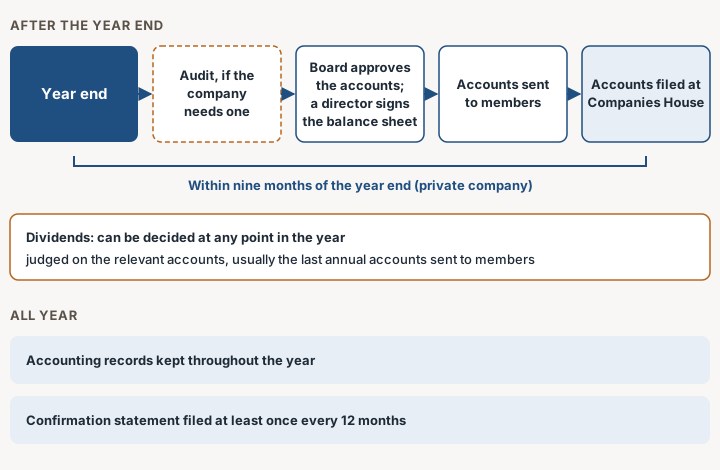
Most director obligations in the UK arrive in a fixed order after the year end, and two run all year: keeping the records and filing the confirmation statement.
Keeping accounting records
Every company must keep adequate accounting records: enough to show and explain its transactions, to disclose its financial position with reasonable accuracy at any time, and to enable the directors to make sure the accounts comply with the Act (s386(1)–(2)). The Act requires a private company to keep them for three years from when they are made and a public company for six (s388(4)), but HMRC's guidance asks for six years from the end of the last financial year they relate to, for tax. A failure to keep them is an offence by every officer in default (s387). The routine that produces the records, from month end to year end, is in the guides for finance teams.
Approving the accounts
The directors prepare accounts for each financial year (s394) and must not approve them unless satisfied that they give a true and fair view of the company's assets, liabilities, financial position and profit or loss (s393(1)). The board approves them and a director signs the balance sheet on its behalf (s414(1)–(2)). A director who knew the accounts did not comply with the Act, or was reckless about it, and failed to take reasonable steps to make them comply or to stop them being approved commits an offence (s414(4)). Where the company is audited and prepares a directors' report, the report must state that, so far as each director is aware, the auditor has all the relevant audit information, and that each has taken the steps they ought to have taken to make sure of it (s418(2)). And in preparing accounts under FRS 102, management (in most companies, the directors) must assess whether the company is a going concern, looking at least 12 months from the date the accounts are authorised for issue (FRS 102 para 3.8).
Having the accounts audited, unless the company is exempt
Most small private companies do not need one. The Act requires an audit unless the company is exempt (s475(1)), and the exemptions are for small, subsidiary and dormant companies (ss477, 479A, 480). A company in a group, a public company or a regulated business may not qualify, and members holding at least 10% of the nominal value of the issued share capital, or of any class of it, can require an audit by notice given no later than one month before the year end (s476). An exempt company's directors still put statements on the balance sheet that it is exempt, that the members have not required an audit, and that the directors acknowledge their responsibilities for the records and the accounts (s475(2)–(4)). The tests are set out in does your company need an audit. Where there is an audit, the directors prepare the accounts and the going concern assessment, and the auditor tests what they prepared, having regard to the directors' duty to approve only true and fair accounts (s393(2)).
If your board is preparing for an audit, Innate offers statutory audits signed by an ICAEW-registered partner firm, which your company appoints as its auditor, with our platform finding the documents and reconciling the numbers: get in touch.
Filing at Companies House
The directors must deliver the accounts to the registrar for each financial year (s441(1)), and a private company has nine months from the end of its accounting reference period to do it (s442(2)(a)). Copies must reach the members by that deadline, or by the day the accounts are filed if that is earlier (s424(2)). Missing the deadline is an offence by every person who was a director immediately before it passed (s451(1)), and the company is separately liable to a civil penalty (s453). The company must also file a confirmation statement within 14 days after the end of each 12-month review period (s853A).
How accounts are filed is changing. From 1 April 2028, accounts can be delivered to Companies House only through commercial software, in iXBRL; the plan to make small companies and micro-entities file their profit and loss account was paused on 23 October 2026. The detail is in Companies House accounts filing changes. Identity verification has been a legal requirement since 18 November 2025, with a 12-month transition: an existing director gives their Companies House personal code with the company's next confirmation statement, and a new company gives each director's code when it registers.
Paying dividends: only out of distributable profits
A company may make a distribution only out of profits available for the purpose (s830(1)), judged on the relevant accounts, normally the last annual accounts sent to members (s836). A member who receives a dividend knowing, or having reasonable grounds to believe, that it broke these rules must repay it (s847), and in a winding up a director who authorised it can be ordered to repay money misapplied (Insolvency Act 1986 s212). How to work out the figure is in the guide to distributable reserves. The government's Modernising corporate reporting consultation, open until 30 November 2026, says it is considering a move to a solvency-based regime; until legislation follows, Part 23 of the Act applies.
Loans between the company and its directors
A company may not make a loan to one of its directors, or to a director of its holding company, or guarantee or secure one, unless its members have approved it (s197(1)); no approval is needed from the members of a wholly owned subsidiary or of a company that is not UK-registered (s197(5)), and there are exceptions for small amounts and for business expenditure (ss204, 207). The accounts must disclose advances and credits to directors (s413), which is where an overdrawn director's loan account becomes visible: see directors' loan account disclosure. Where the director is also a shareholder, an overdrawn account can also mean extra Corporation Tax for the company (HMRC's guidance on director's loans).
Can a director be personally liable for company debts?
Ordinarily, no: a limited company's debts are its own. But a director can be made to pay or contribute where the law says so, and most of the routes open only when the company fails. So what are directors personally liable for?
- Breach of duty. The company, or its liquidator, can pursue a director for a breach of the general duties (s178). In a winding up, the court can order a director who has misapplied the company's money or breached a duty to repay it or to contribute compensation (Insolvency Act 1986 s212).
- Wrongful trading. If the company goes into insolvent liquidation or administration, a director who knew or ought to have concluded that there was no reasonable prospect of avoiding it can be ordered to contribute to its assets, unless they then took every step to minimise the creditors' loss that they ought to have taken (Insolvency Act 1986 ss214, 246ZB). What a director ought to have known is judged on the same two limbs as the duty of care.
- Fraudulent trading. Anyone knowingly party to carrying on the business with intent to defraud creditors can be ordered to contribute (Insolvency Act 1986 s213).
- Personal guarantees. A director who has guaranteed a company loan or lease has made it a personal liability, on the guarantee's own terms.
- Disqualification. A court must disqualify a director of a company that has become insolvent, or been dissolved without becoming insolvent, whose conduct makes them unfit, for between 2 and 15 years (Company Directors Disqualification Act 1986 s6). On the Secretary of State's application, the court can also order a disqualified person to compensate creditors who lost out because of that conduct (s15A), and someone who acts while disqualified is personally responsible for the company's debts incurred meanwhile (s15).
- Offences. Failures over the records (s387), approving accounts that do not comply (s414(4)), a false statement about disclosure to the auditor (s418(5)) and late filing (s451) are offences committed by directors or officers themselves.
An unlawful dividend can also come back to the directors who authorised it, as set out under dividends above.
Which guide answers your question
Each question below has a guide that answers it in full.
| If your question is | Read |
|---|---|
| Does the company need an audit? | Does your company need an audit |
| Is the company small enough to be exempt? | UK audit exemption thresholds |
| When are the accounts due, and what is changing? | Companies House accounts filing changes |
| How much can we pay as a dividend? | Distributable reserves |
| How do directors' loans appear in the accounts? | Directors' loan account disclosure |
| Month end, year end and audit readiness for the finance team | Guides for finance teams |
Guides
- Companies House accounts filing changes from April 2028: what goes ahead and what is pausedCompanies House accounts filing changes from April 2028: software-only filing starts; small-company P&L filing and the end of abridged accounts are paused.Last reviewed
- Directors' loan account disclosure: the note under FRS 102 Section 1A and FRS 105, with examplesWhat the directors' loan account disclosure note must show under FRS 102 Section 1A and FRS 105: example notes, credit balances and what an auditor checks.Last reviewed
- Distributable reserves: how to work out what your company can pay as a dividendA UK company may pay dividends only from distributable reserves. How to calculate them from the accounts, what is excluded, when the auditor must report.Last reviewed