UK audit requirements: does your company need an audit, and how to get a good one
By Alon Zieve FCA · Last reviewed
Does your company need an audit? Most UK private companies that qualify as small do not. Under the UK audit requirements in the Companies Act 2006, a company usually needs one when it has stopped being small (a change that counts only after two years running), when its group is too big or is an ineligible group, when it is a public company, bank, insurer or other excluded business, or when members holding at least 10% of the shares give notice in time. This page sets out the tests in the order they apply, then how to choose, budget for, prepare for and change an auditor, with a guide for each. Auditors looking for the standards want UK auditing standards.
Does your company need an audit?
Only if it cannot claim an exemption, and most small private companies can. A UK company's annual accounts must be audited unless it is exempt (s475(1)): in practice under one of three exemptions in the Companies Act 2006, for small companies (section 477), subsidiaries whose UK parent guarantees their liabilities (section 479A) and dormant companies (section 480). (A fourth, section 482, covers non-profit companies subject to public sector audit.) So for a limited company the real question is whether it can claim one of them this year.
A company usually needs an audit if any of these is true:
- It is not small. It has been over the size limits two years running or, in its first financial year, was over them in that year.
- Its group is not small, or is ineligible. A company that was in a group at any time in the year can use the small-company exemption only if the whole group is small and was never an ineligible group in that year.
- It is a kind of company that cannot use the small-company exemption: a public company, a bank, an insurer, an e-money issuer and a few other regulated businesses.
- Its members have asked, by a notice from holders of at least 10% of the shares given in time.
- Its articles require one. GOV.UK's guidance says a private company needs an audit "if your articles of association say you must or your shareholders ask for one".
A lender, investor or buyer may also require audited accounts under a contract. That is not a legal audit requirement, but it is often the one that decides the matter in practice.
Do all companies need to be audited, then? No: the statutory audit requirements turn on size, group, kind of company and the members' wishes. A company limited by guarantee follows the same rules; with no share capital, the right to require an audit belongs to 10% of the members by number (s476(2)(b)).
An exempt company still prepares and files its accounts, and its balance sheet must carry the directors' statements that it is exempt, that the members have not required an audit, and that the directors acknowledge their responsibilities for the accounting records and the accounts (s475(2)–(4)). The guide to UK audit exemption thresholds gives the wording.
UK audit requirements for companies: the tests in order
The UK audit requirements for companies apply as a sequence: whether the company is an excluded kind, then its group, then its own size, then whether the members have asked. A company that passes all four is exempt once the directors make the balance sheet statements; a dormant company has its own route out.
Is it an excluded kind of company?
Some companies cannot use the small-company exemption at any size. Section 478 excludes a company that was at any time in the year a public company; an authorised insurance company, banking company, e-money issuer, MiFID investment firm or UCITS management company; and a few others, such as a company carrying on insurance market activity. A dormant company in this list, a public company for example, may still be exempt as dormant, unless section 481 excludes it, as it does for a traded company, a bank or an insurer.
Is it part of a group?
For most subsidiaries this test decides the answer. A company that was a parent or a subsidiary at any time in the year can use the small-company exemption only if its group qualifies as small and was not at any time in that year an ineligible group (s479(1)), unless it was a dormant subsidiary throughout its time in the group (s479(3)). "The group" means the company and all its associated undertakings (s479(4)), and every body corporate in it, wherever it is incorporated, is tested as if it were a company under the Act (s479(6)). There is no line at the UK border, so for a UK company owned from overseas the size of the worldwide group usually decides it: see does my UK subsidiary need an audit.
A group is ineligible, whatever its size, if any member is, for example, a traded company, a person (other than a small company) with permission under Part 4A of the Financial Services and Markets Act 2000, or an e-money issuer (s384(2)). A group with a UK parent has one more option: the parent can spare a subsidiary its audit by guaranteeing its liabilities, on conditions that include every member's agreement each year and a guarantee with no cap, and a parent established outside the UK cannot give it directly. The conditions are in the s479A parent guarantee.
Is the company small?
A company is small if it meets at least two of three conditions: turnover of not more than £15 million, a balance sheet total of not more than £7.5 million and no more than 50 employees on average, for financial years beginning on or after 6 April 2025 (s382(3), as amended by SI 2024/1303). A change in size counts only once it has happened in two consecutive financial years (s382(2)), with the earlier years re-tested at the new limits (SI 2024/1303, reg 3). A new company is judged on its first financial year alone (s382(1)): there is no grace year.
The full tables, how the transition works and worked examples are in UK audit exemption thresholds. A company that has outgrown them faces its first statutory audit.
Have the members asked for one?
Shareholders can require an audit even of an exempt company. Members holding at least 10% in nominal value of the issued share capital, or of any class of it, can require one by notice; in a company without share capital, 10% of the members by number (s476(1)–(2)). The notice cannot be given before the financial year starts and must be given not later than one month before it ends (s476(3)). In a wholly owned subsidiary, the member is the parent.
Is it dormant?
A company that has had no "significant accounting transaction", one that section 386 requires to be entered in its accounting records, is dormant (s1169). It is exempt if it has been dormant since its formation, or since the end of the previous financial year provided it is entitled to the small companies regime (or would be, but for being a public company or a member of an ineligible group) and is not required to prepare group accounts (s480). Dormant subsidiaries have further options, set out in the guide to the s479A audit exemption.
The decision tree that puts these tests on one page is in the guide to UK audit exemption thresholds.
Which guide answers your question
Find your situation in the left column; the guide in the right column answers it in full.
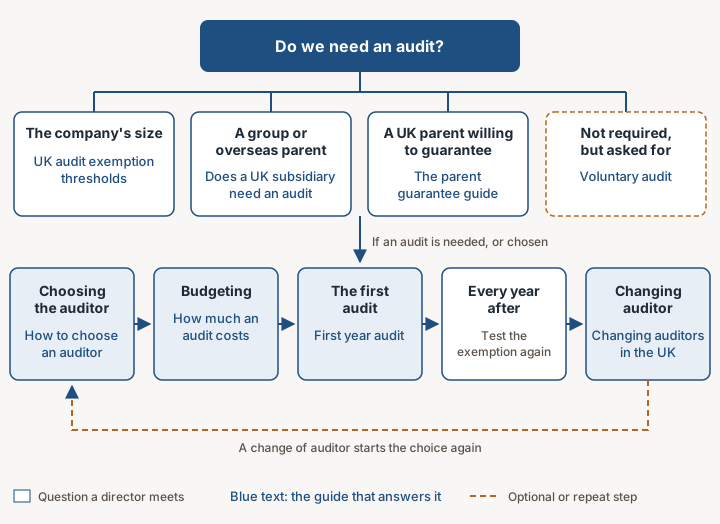
| If this is you | What usually applies | Read |
|---|---|---|
| The company has grown past the small-company limits | An audit once it has been over them two years running | UK audit exemption thresholds, then first year audit |
| A UK company owned by a US or other overseas group | The worldwide group's size usually decides | UK subsidiary of an overseas group |
| A UK group whose subsidiaries could skip their audit | The parent guarantee, if the parent is in the UK | Parent guarantee |
| Exempt, but a lender, investor or buyer wants audited accounts | A voluntary audit, statutory or under contract | Voluntary audit |
| Appointing an auditor for the first time | Check the register, meet the signer, compare firms | Choosing an auditor, then first year audit |
| Budgeting for the audit | What drives the fee; how to compare quotes | Audit fees |
| Unhappy with the current auditor | The members can change it; timing decides the paperwork | Changing auditor |
| Not sure whether the rules apply at all | Work through the tests in order | The tests in order |
Can a company have an audit when it doesn't need one?
Yes. A company that could claim the exemption can still have its accounts audited, usually because a lender, investor, buyer or overseas parent has asked for audited accounts. There are two ways to do it: not claiming the exemption, so the audit is a statutory audit under the Companies Act, or claiming it and commissioning a non-statutory audit under an engagement letter for the person who asked. Which one fits depends on the wording of the request; the guide to a voluntary audit sets out both, and the lighter options where "audited" is not actually required.
The audit year: appointing the auditor, the audit and filing
A private company must appoint an auditor for each financial year, unless the directors reasonably resolve that audited accounts are unlikely to be required (s485(1)), and the auditor must be a member of a recognised supervisory body such as ICAEW, eligible under its rules (s1212(1)).
Who appoints? The directors may appoint the auditor before the company's first period for appointing auditors, after a period in which the company was exempt and had no auditor, or to fill a casual vacancy (s485(3)). Otherwise the members appoint by ordinary resolution (s485(4)): in the "period for appointing auditors" (the 28 days beginning with the end of the time allowed for sending out the previous year's accounts, or with the day they were sent out, if earlier: s485(2)), or at another time if the company missed that period or the directors did not use their power. After that, a private company's auditor is deemed re-appointed each year unless an exception applies (s487(2)). One exception catches many first audits: there is no deemed re-appointment of an auditor the directors appointed (s487(2)(a)), so the members need to re-appoint for the second year.
Timing matters most for the first audit, because a firm appointed after the year end cannot attend the year-end stock count. The guide to the first year audit has the timetable.
The accounts then go to Companies House. A private company has nine months from the end of its accounting reference period to file them, and a public company six (s442(2)); first accounts covering more than twelve months have their own deadline (s442(3)). For a company that needs an audit, the accounts filed are the audited ones. A medium-sized company files the auditor's report with them (s445(2)), and so does a large unquoted company (s446(2)) and a small company that files its profit and loss account (s444(2)); a small company that files only its balance sheet instead states in the notes whether the report was qualified and names the auditor and the senior statutory auditor (s444(5A)–(5B)). So the audit has to be finished in time for the accounts to be filed by the deadline.
If your filing deadline is approaching and the audit has not started, Innate offers statutory audits signed by an ICAEW-registered partner firm, which your company appoints as its auditor, with our platform doing the legwork: ask for a quote.
How to get a good audit
An audit is a working relationship that often runs for years, and how it goes is decided mostly before the fieldwork: by the choice of firm, the budget and the state of the records.
Choosing the auditor
Check that the firm is on the public Register of Statutory Auditors (auditregister.org.uk), which covers all four recognised supervisory bodies. Where the auditor is a firm, the report is signed by the senior statutory auditor "in his own name, for and on behalf of the auditor" (s503(3)), so ask to meet that person before you appoint. Ask how the firm is independent of the company, and compare two or three firms on the same checklist and the same questions. Whether your accountant can also be your auditor turns on registration and independence; the guide on how to choose an auditor answers that and gives the register check step by step.
What it will cost
An audit fee follows the work the audit needs. What adds work is the size of the business, how many companies are in the group, whether this is a first audit, stock, the estimates and judgements in the accounts, how ready the records are and how tight the deadline is. Some of these the company controls. Give every firm the same facts so that each prices the same audit. The guide to how much an audit costs explains the published fee data and how to compare quotes.
Preparing for the first audit
A company audited for the first time after an exempt year starts from figures nobody audited, so the auditor needs evidence on the opening balances (ISA (UK) 510), and the report will say that last year's figures are unaudited (ISA (UK) 710), which is normal and not a qualification. Keep last year's stock records and the accountant's working papers, and appoint in time for the stock count: the first year audit guide lists what to have ready.
Changing auditor
The members appoint the auditor, so changing it is their decision, and the outgoing firm cannot block it. The cleanest time to change is the period for appointing auditors, when the members appoint the new firm and the old auditor's term simply ends (s487(1)(b)); mid-year, the auditor resigns or is removed, and the paperwork grows. The guide to changing auditors in the UK gives the window for each year end.
Not a company, or a change coming: LLPs, charities and the medium-sized proposal
Limited liability partnerships have the same three routes out of an audit: small, subsidiary and dormant. The Companies Act's audit provisions are applied to them, with modifications, by the LLP accounts and audit regulations (SI 2008/1911, Part 10). Charities have their own audit thresholds under charity law; in England and Wales they are in the Charities Act 2011 (s144).
The line for companies may move. The government's consultation Modernising corporate reporting, published on GOV.UK on 7 September 2026, asks whether the audit exemption should be extended to companies eligible for the medium-sized regime. It closes at 11:59pm on 30 November 2026. It is a consultation, not law, and nothing changes until legislation follows: the thresholds guide tracks it under do medium-sized companies need an audit.
Guides
- Audit exemption for UK subsidiaries: the s479A parent guaranteeHow the s479A audit exemption works: which UK subsidiaries qualify, what the parent guarantee covers, form AA06, the filing pack, and when to audit.Last reviewed
- Changing auditors in the UK: steps, letters and timingChanging auditors in the UK? When to decide for your year end, the resolution, what the old auditor sends and who must be told, including mid-year.Last reviewed
- Does a UK subsidiary of a US or overseas company need an audit?Does my UK subsidiary need an audit? Usually yes, once its worldwide group is over the small-group limits two years running. The tests, and the exemptions.Last reviewed
- First year audit: what happens in your company's first statutory audit, and how to prepareA UK company's first year audit can cover figures nobody audited last year. What happens, who appoints the auditor, the timetable, how to prepare.Last reviewed
- How much does an audit cost in the UK? Fees and what drives themHow much does an audit cost in the UK? The FRC's latest data puts the average SME audit fee at £21,200. What drives your fee, and how to compare quotes.Last reviewed
- How to choose an auditor in the UK: what to check and the questions to askHow to choose an auditor for a UK company: check the register and the signer, ask about independence, score firms on one checklist, and questions to ask.Last reviewed
- UK audit exemption thresholds: the small-company and group tests, and the proposal to exempt medium-sized companiesUK audit exemption thresholds for years starting on or after 6 April 2025: £15m turnover, £7.5m balance sheet total, 50 staff; groups; the medium proposal.Last reviewed
- Voluntary audit: audited accounts when the law does not require themA voluntary audit is one a UK company chooses when the law does not require it: who asks for one, the two ways to arrange it, and the lighter options.Last reviewed