Finance teams: month-end, year-end and audit readiness
By Alon Zieve FCA · Last reviewed
Audit readiness for finance teams comes down to this: by the year end every balance is already reconciled and supported, every judgement was written down when it was made, and every review left evidence, so the audit draws on work the team has already done instead of work squeezed into the weeks before fieldwork. It is built in the monthly close, not at the year end. This page shows how the month-end, the year-end and the audit connect, and which guide covers each step. Directors' legal duties are in UK company director responsibilities; whether a company needs an audit at all is in UK audit requirements.
What audit readiness means for a finance team
What does audit ready mean? A finance team is audit ready when the auditor can ask about any balance, judgement or approval in the accounts and be given, without delay, evidence that was prepared and reviewed in the ordinary course of the year. It is a state the team keeps up, not a project it runs in the last month.
Here "audit" means the statutory audit of the company's annual accounts under the Companies Act 2006. Readiness for a SOC 2 report, an ISO certification or a regulator's inspection is a different exercise with its own criteria, and this page does not cover it.
Three tests tell a finance director whether the team is there:
- Supported. Each balance is reconciled to something outside the general ledger, such as a bank statement, a supplier statement or a sub-ledger, and the reconciliation and its evidence are filed where someone else can find them.
- Explained. Estimates and unusual items (a provision, a write-down, a one-off receipt) are written up when they arise, with the reasoning and the information the team had at the time.
- Reviewed. Someone other than the preparer has looked at the work and signed it off, and the sign-off shows: a name and a date, not a recollection.
Two legal rules sit underneath these tests. Every company must keep adequate accounting records, meaning records sufficient "to show and explain the company's transactions" and to disclose its financial position with reasonable accuracy at any time (Companies Act 2006, s386(1)–(2)). Company law requires a private company to keep them for three years from the date they are made, and a public company for six (s388(4)), though tax rules generally require company records to be kept for six years from the end of the last financial year they relate to. And the auditor has "a right of access at all times to the company's books, accounts and vouchers (in whatever form they are held)", and may require the company's officers and employees to provide the information and explanations the auditor thinks necessary (s499(1)–(2)). Readiness is how a finance team meets both without a scramble: the records the law requires are much of the evidence the auditor asks for.
Audit readiness starts at month-end
Does the month-end close affect the audit? Directly. The close produces much of what the audit later relies on: the reconciliations, the cut-off between one period and the next, the accruals and prepayments, the review of manual journals, and the management accounts the board sees. A year end is a month end with more at stake. If each monthly close is done to the standard the year end needs, the year end is the last repetition of a routine rather than a separate project, and the questions it raises have mostly been answered already.
The map below ties each month-end output to what it later gives the audit. It says what each item supports, not how an auditor tests it: that is the auditor's judgement.
| At each month end | What it gives the audit | Guide |
|---|---|---|
| Bank reconciliations, cleared and reviewed | The cash balance, agreed to the bank | Year-end audit checklist |
| Balance sheet reconciliations for every account | Support for each closing balance | Year-end audit checklist; a reconciliations guide to come |
| Accruals and prepayments, with workings | Cut-off and completeness of costs | Year-end audit checklist |
| Manual journals reviewed and approved | Evidence that postings were authorised | Guide to come |
| Fixed asset register agreed to the ledger | The asset balance and the depreciation charge | Guide to come |
| Aged debt reviewed, with notes | Recoverability and the bad debt provision | Guide to come |
| The management accounts pack, reviewed | The board's view; the starting point for analysis | Management accounts pack |
| Board minutes and key contracts filed | Approvals, commitments, related parties | Year-end audit checklist |
What goes into the pack, and the review that makes it worth reading, is in the guide to the management accounts pack. A step-by-step guide to the month-end close itself is to come.
The finance year, from the monthly close to filed accounts
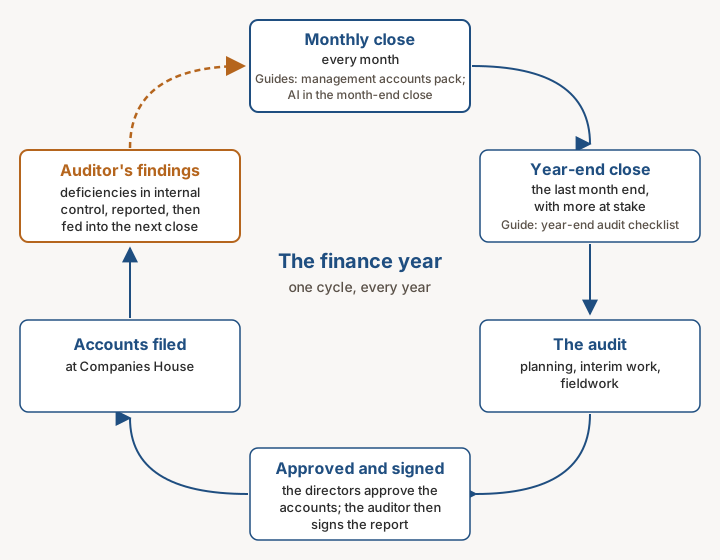
The audit sits inside the finance year, not at the end of it. The monthly closes lead into the year-end close, which produces the draft accounts and the schedules behind them. The audit runs alongside: the auditor sets an overall strategy for the scope, timing and direction of the work (ISA (UK) 300, para 7), and some of the work may be done at an interim date before the year end, with further work to carry the conclusions forward to the year end (ISA (UK) 330, para 22). Most of the work on the closing balances themselves follows the year end.
The directors then approve the accounts, and a director signs the balance sheet on the board's behalf (s414(1)–(2)). The auditor's report comes after that. The auditor plans the audit so that the directors have approved the accounts before the opinion is given (ISA (UK) 700, para A67-1), and the report is dated no earlier than the date on which the auditor has evidence that those with the authority to do so have taken responsibility for the accounts (para 49). Where the auditor is a firm, the senior statutory auditor signs "in his own name, for and on behalf of the auditor" (s503(3)).
The directors of a private company have nine months from the end of the accounting reference period to file the accounts at Companies House, and those of a public company six (s442(2)); a first period longer than twelve months, or a shortened period, has its own rule (s442(3)–(4)). The last step is the one that starts the next year: the auditor communicates significant deficiencies in internal control in writing to those charged with governance, and other deficiencies that merit attention to management (ISA (UK) 265, paras 9–10). The audit is not a review of the controls, though: the auditor considers them to design the audit, "not for the purpose of expressing an opinion on the effectiveness of internal control" (para 2). A short findings letter is useful feedback, not a clean bill of health.
The year-end and the audit request list
What will the auditor ask the finance team for? At the year end, the routine of the close is joined by work that happens once a year: the closing schedules that support each line of the accounts, the draft accounts themselves, and the auditor's request list, often called the PBC ("prepared by client") list, which sets out what the auditor wants and by when. Where the company deals in goods, the records must also contain the statements of stock held at the year end and the stocktakings behind them (s386(4)), and where stock is material the auditor attends the count unless that is impracticable (ISA (UK) 501, para 4). The request list, area by area, is in the year-end audit checklist.
Two things can make a year end heavier than the last. Accounts under FRS 102 face the Periodic Review 2024 amendments, which apply to accounting periods beginning on or after 1 January 2026 (the principal effective date), so the first year end under them brings new accounting to support, most visibly bringing most of a lessee's leases onto the balance sheet. Every amendment is set out in the guide to the FRS 102 changes, and the frameworks themselves in UK GAAP explained. And a company audited for the first time has to support its opening balances, which nobody audited the year before (ISA (UK) 510); the guide to a first year audit covers what that adds.
Audit ready all year: what makes the audit quicker
How do you stay audit ready all year? By giving the auditor fewer surprises to explain, not by working longer hours in the final weeks. Getting audit ready is mostly a matter of habits kept through the year, and five carry most of the weight. They are principles for the finance team; what the auditor tests, and how much, is the auditor's decision.
- Write up estimates when they are made. A provision, a stock write-down or a bad debt judgement is easiest to support in the month it was booked, with the facts the team had then. Rebuilt months later, the reasoning reads like hindsight, and it has to be explained afresh.
- Tell the auditor about one-off events when they happen. A refinancing, an acquisition, a new system, a restructuring or a large new contract changes what the audit needs to look at. Raised in the month it happens, it can be planned for; found at the final visit, it becomes the critical path.
- Give the audit one owner and one route for queries. Who in the finance team should own the audit? One person who holds the request list, sees every query and chases every answer. Queries sent to whoever is free get answered twice, or not at all.
- Close last year's findings before the next year end. The auditor's points on controls show where last year's audit found the weak spots. Each one closed, with the evidence that it is closed, is one the next audit can see has been dealt with.
- File the board minutes and contracts where finance can find them. The minutes record what the directors approved; the contracts set the terms behind the numbers. If they sit in one person's inbox, every request for them costs a day.
None of this is extra work. It is the work the close already does, done to a standard that survives being looked at by someone outside the team. An audit fee follows the work the audit needs, and how ready the records are is part of that; what else drives the fee, and how to compare quotes, is in the guide to how much an audit costs.
If you need an audit that meets the current standards, ask us: Innate offers statutory audits signed by an ICAEW-registered partner firm, which your company appoints as its auditor, with our platform doing the legwork to save you time and money.
Using AI in the close without making the audit harder
Can a finance team use AI in the close if the company is audited? Yes, as far as the audit goes: the auditing standards bind the auditor, not the finance team's choice of tools, and what they shape is the evidence the team will be asked for. A regulated business may have its own rules on systems and data; those are a separate question. When the auditor uses information the company produced, the auditor must evaluate whether it is reliable enough for the audit, including obtaining evidence about its accuracy and completeness where necessary (ISA (UK) 500, para 9). For a reconciliation matched by an AI tool, or variance commentary it drafted, that means the auditor may ask what data the tool was given, what it produced, and who in the team reviewed the output before it went into the ledger or the pack.
A finance team that keeps that trail has the answer ready; one that cannot show who checked the output has created a new question for the audit. The guide to AI in the month-end close covers where AI helps in the close and what to keep on file. How to use AI in a finance department covers the wider choices, from the data a tool may see to the policy around it. Both sit in the guides on AI in audit and finance.
Where the finance team's work meets the board's
Who answers for all of this? The directors. The company must keep adequate accounting records, and if it does not, every officer in default commits an offence, unless they show they acted honestly and the default was excusable (s386, s387); the board approves the accounts (s414). The finance team does the work the directors rely on, and the evidence it keeps is what lets them approve the accounts with confidence. The directors' side is in UK company director responsibilities, and whether, and how, the company is audited is in does your company need an audit. More guides for finance teams, on reconciliations, controls and the close, will be added here as they are published.
Guides
- The management accounts pack: what goes in it, with a monthly checklistWhat goes in a management accounts pack, how to lay it out, a monthly checklist with preparer and reviewer columns, and how your auditor reads it.Last reviewed
- Year-end audit checklist: how to prepare for your auditA year-end audit checklist for UK finance teams: what to do before and at the year end, what the auditor will ask for in each area, and how to prepare.Last reviewed