Year-end audit checklist: how to prepare for your audit
By Alon Zieve FCA · Last reviewed
This year-end audit checklist is for the finance team of a UK company whose accounts are audited every year. The short answer to how to prepare for an audit: agree the dates and the request list with your auditor before the year end; do the hard close well, with the stock count, cut-off and reconciliations; have draft accounts and a reconciled trial balance ready, with a schedule behind every balance-sheet line; and know, for each item you send, what it is meant to prove.
If this is your company's first audit, start with the guide to a first year audit, which covers appointment and opening balances. This page is about the audit you face every year, and sits with the other guides for finance teams.
How do you prepare for a year-end audit?
Prepare in five stages: agree the plan with the auditor before the year end, close the books carefully at the year end, finish the year-end accounts tasks, answer the request list area by area, then support fieldwork and completion. Start the first and fourth earliest.
| Stage | What it means | Where it is covered |
|---|---|---|
| 1. Before the year end | Dates, request list, last year's findings, new transactions, confirmations | Before the year end |
| 2. At the year end | Stock count, cut-off, cash, payroll and accruals at the date | At the year end |
| 3. The year-end accounts | Reconciliations, estimates, draft accounts, locked trial balance | Year-end accounts tasks |
| 4. The request list | Evidence by area: what is asked for and what it shows | Area by area |
| 5. Fieldwork and completion | Queries, adjustments, going concern, representations, signing, filing | Fieldwork and completion |
Used as an audit preparation checklist, the table is the order to work in; the detail follows.
Before the year end: agree the plan with your auditor
The work that saves most time happens in the months before the balance sheet date.
- Ask for the request list early. Auditors send a "prepared by client" (PBC) list: the schedules and documents they want from you. Ask for it before the year end, agree who owns each line, and agree the dates it is due.
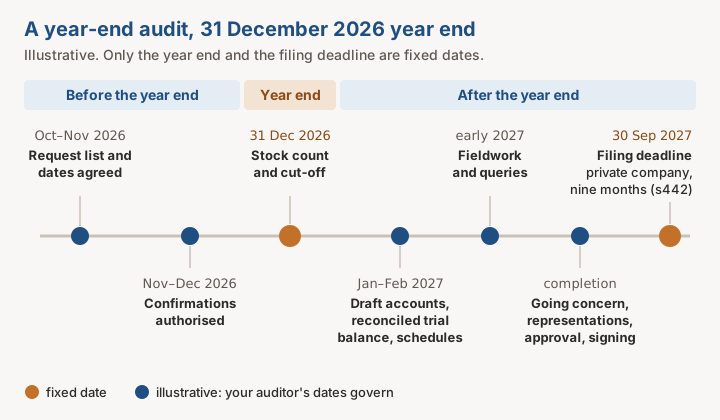
- Agree the dates. The planning meeting, any interim visit, the stock count, the start of fieldwork, the board meeting that approves the accounts, and the filing deadline. Work backwards from the filing date, or from any earlier date a lender or parent needs.
- Deal with last year's findings. Auditors must tell those charged with governance (usually the board) in writing about significant deficiencies in internal control found during the audit (ISA (UK) 265 para 9), and tell management about other deficiencies that merit its attention (para 10(b)). Show what you fixed. Look at last year's audit adjustments too: an adjustment that recurs points to a control that has not changed.
- Raise new matters now. Acquisitions, new borrowing or refinancing, restructurings, large or unusual contracts, and any estimate whose method changed.
- Authorise confirmations. The auditor controls external confirmations: it chooses what to confirm and whom to ask, designs the requests so that the replies come back directly to the auditor, and sends them (ISA (UK) 505 para 7). Some banks and other parties may only reply to a request that carries management's authorisation (para A4), so sign authorities promptly.
- Agree access. Decide what the audit team can take straight from the accounting system, with read-only access, instead of you exporting and sending it.
If you are changing firm this year, the guide on how to choose an auditor covers the questions to ask. Fees are set by the audit firm and depend on the work needed; the guide to how much an audit costs sets out what drives them.
At the year end: count, cut-off and the hard close
The stock count. If inventory is material to the accounts, the auditor must obtain evidence about its existence and condition by attending the physical count, unless that is impracticable, and must evaluate your count instructions, observe the count, inspect the stock and do test counts (ISA (UK) 501 para 4). "Impracticable" means something like a location that is unsafe to visit; general inconvenience to the auditor is not enough (para A12). If you count on a date other than the year end, the auditor also tests the movements between the count and the year end (para 5). Send your count instructions to the auditor well before the count.
Cut-off. Record the last despatch note and goods received note numbers at the year end, and keep the paperwork either side of the date. The auditor tests that sales and purchases near the year end fall in the right period, so a clean record of the last documents in and out shortens that work.
Cash, payroll and accruals at the date. Save bank statements to the year end for every account, including dormant ones, run payroll and pension reports to the date, and list accruals while the people who know about them are in the office.
Year-end accounts tasks before the auditor arrives
This is the year-end accounts checklist: the work that turns the ledger into draft accounts the auditor can test.
- Reconcile every bank account, control account and the VAT and payroll accounts to the ledger, and clear the suspense account.
- Post accruals and prepayments, with support for each material item.
- Set out each provision and estimate with its basis: bad debts, stock obsolescence, warranties, dilapidations, holiday pay, bonuses. Say what changed from last year and why.
- Agree the fixed asset register to the ledger, with additions, disposals and the depreciation charge.
- Agree intercompany balances with the other side, in writing.
- Prepare the corporation tax computation and deferred tax, or agree the timetable with your tax adviser.
- Review the directors' loan accounts and list related-party transactions.
- Lock the trial balance, map it to the accounts, and prepare the draft accounts and notes.
- Put a schedule behind every balance-sheet line that ties to the trial balance.
A good monthly close makes the year end shorter: the management accounts pack your board already reads is the starting point. If reconciliations are now prepared with AI tools, expect the auditor to ask how they were reviewed; AI in the month-end close covers the controls.
Your year-end audit checklist, area by area
What documents auditors ask for depends on the company's risks, so your auditor's own list governs. The table is the usual list for a UK trading company, with what each item shows and whether the audit team can get it without you. The auditor decides what to test and how much; nothing here describes how items are selected.
| Area | What the auditor asks for | What it shows | Usually prepared by | Can the auditor get it without you? |
|---|---|---|---|---|
| General | Trial balance and draft accounts | The figures being audited, and that the accounts agree to the books | Finance team | Partly: the trial balance, with read-only ledger access |
| General | Board minutes for the year and up to signing | Decisions, approvals, commitments and events after the year end | Company secretary | No, only you hold them |
| General | Significant contracts and agreements | Obligations and rights the accounts must reflect | Finance and legal | No |
| General | Correspondence with lawyers; legal costs | Claims or disputes that may need a provision or disclosure | Finance and legal | Where needed, by a letter to your lawyers that you prepare and the auditor sends |
| Revenue | Sales listing and revenue contracts | Revenue is real, complete and in the right period | Finance team | Often, with ledger access; contracts no |
| Debtors | Aged debtors listing; receipts after the year end | Debtors exist and will be collected; bad-debt provision is enough | Finance team | Often, with ledger and bank access |
| Debtors | Credit notes raised after the year end | Sales were not overstated at the year end | Finance team | Often, with ledger access |
| Cash | Bank reconciliations and statements | Cash exists and is complete at the year end | Finance team | Balances, yes, by confirmation direct from the bank; the reconciliation, no |
| Stock | Count sheets and final stock listing | The stock counted is the stock in the accounts | Operations and finance | No |
| Stock | Costing and obsolescence workings | Stock is at the lower of cost and estimated selling price less costs to complete and sell | Finance team | No |
| Fixed assets | Register; invoices for additions; disposal records | Assets exist, belong to the company and are correctly valued | Finance team | Partly: the register, with ledger access |
| Leases | Lease schedule, contracts and the borrowing rate used | Lease liabilities and right-of-use assets are complete and correctly measured | Finance team | No |
| Creditors | Aged creditors listing; supplier statement reconciliations | Liabilities are complete | Finance team | Often, with ledger access; some by confirmation |
| Accruals | Accruals listing; payments after the year end | Costs belong to the right period and nothing is missing | Finance team | Payments, with bank access |
| Payroll | Payroll reconciled to the ledger and to HMRC submissions; bonuses; pensions | Staff costs are real, complete and correctly recorded | Payroll and finance | Partly, with payroll system access |
| Tax | Corporation tax computation; VAT returns reconciled; deferred tax | Tax balances are at the right amount | Finance team or tax adviser | No |
| Loans | Facility agreements, covenant calculations, interest | Borrowings are complete; covenants met or breaches disclosed | Finance team | Balances by confirmation from the lender |
| Equity | Share capital changes; dividend paperwork | Equity movements are authorised and recorded | Company secretary | Partly, from the public register |
| Directors | Directors' loan account; directors' pay | Transactions with directors are recorded and disclosed | Finance team | No |
| Related parties | List of related parties and transactions | Related-party disclosures are complete | Finance and board | No: the auditor must ask management |
| Group | Intercompany balances agreed by both sides | Balances agree and eliminate | Finance teams on both sides | By confirmation from the other company |
| Going concern | Forecast and cash flow, with assumptions; facility terms | The going concern basis is appropriate | Finance team and board | No |
| Subsequent events | Management accounts and board minutes after the year end | Events after the year end are adjusted for or disclosed | Finance team | No |
| Journals | Full journal listing; who can post and approve | Entries are authorised and the listing is complete | Finance team | Often, with ledger access |
| Representations | Letter of representation, signed | Management confirms what only it can confirm | Board | No |
Send each item with the reconciliation that ties it to the trial balance, and label each file by area and balance-sheet line, matching the request list's numbering.
If you keep the table as your own audit preparation checklist, add a column for the owner and the date sent.
If you would rather spend year end on the accounts than on chasing documents, Innate offers statutory audits signed by an ICAEW-registered partner firm, which your company appoints as its auditor, while our platform finds the documents and reconciles the numbers: see how it works.
What changes for a 31 December 2026 year end, and after
Two sets of changes start at different times. The revised FRS 102 starts with the accounting period that begins on or after 1 January 2026, unless the company chose to apply all the amendments early (FRS 102 para 1.37(b)). The revised auditing standards start with audits of periods beginning on or after 15 December 2026. Both tests look at when the period starts, not when it ends.
| Change | Applies to | What the auditor will ask for |
|---|---|---|
| FRS 102 Section 20, leases | Periods beginning on or after 1 January 2026: a 31 December 2026 year end is the first for a calendar-year company | A lease schedule, the contracts, the borrowing rate used and the opening adjustment to retained earnings |
| FRS 102 Section 23, revenue | Same date | A review of revenue contracts against the five-step model, and how the transition was made |
| ISA (UK) 240 (Revised March 2026), fraud | Periods beginning on or after 15 December 2026: first twelve-month year end 14 December 2027; a 31 December 2027 year end is affected, a 30 November 2027 one is not | How journals are initiated, processed, recorded and corrected, and evidence that the journal listing is complete |
| ISA (UK) 570 (Revised March 2026), going concern | Same date; early adoption not permitted | Evidence that any parent or owner-manager whose support the plans rely on intends and is able to give it |
| ISA (UK) 700 (Revised May 2026), auditor's report | Periods commencing on or after 15 December 2026; early adoption permitted | Changes to the form of the auditor's report |
Leases. Under the revised Section 20 a lessee recognises a right-of-use asset and a lease liability for its leases (para 20.45), unless it elects not to for short-term leases or leases of low-value assets (paras 20.5–20.7). On transition a lessee does not restate the comparatives; it puts the cumulative effect into opening retained earnings at the date of initial application (para 1.47), which for a 31 December 2026 year end is 1 January 2026. For leases previously treated as operating leases, the liability is measured using the lessee's incremental borrowing rate or obtainable borrowing rate (para 1.51(a)), so the auditor will ask how you set that rate. A company included in group accounts prepared under IFRS may instead, for all its leases, use the carrying amounts calculated under IFRS 16 for those group accounts (para 1.48). More in FRS 102 lease changes.
Revenue. The revised Section 23 sets out five steps: identify the contract, identify the performance obligations, determine the transaction price, allocate it, and recognise revenue as each obligation is satisfied (para 23.4). On transition a company either applies it fully retrospectively or recognises the cumulative effect in opening retained earnings (para 1.61). FRS 102 revenue recognition explains the model.
Fraud and going concern. For a 31 December year end, the revised ISA (UK) 240 and 570 first apply to the year ending 31 December 2027, so plan the 2027 request list with them in mind. The auditor already asks people involved in financial reporting about unusual journal activity; the revised fraud standard spells out for journals the understanding ISA (UK) 315 requires, of how journals are initiated, processed, recorded and corrected (para 35), and requires evidence that the population of journals is complete (para 49(b)). The revised going concern standard requires evidence of the intent and ability of anyone, "including the entity's owner-manager", whose financial support the plans depend on (para 28), so a parent's support letter may need backing. The practitioner guides to the revised ISA (UK) 240 and the revised ISA (UK) 570 set out the changes in full.
During fieldwork: queries, adjustments and sample requests
Name one person who owns queries, keep a shared query log with an owner and a date for every item, and agree a turnaround time with the audit team. How long fieldwork takes depends on the company's size, the auditor's plan and how much of the request list is ready on the first day of fieldwork, which is the part you control.
The auditor chooses which transactions and balances to test, and will ask for invoices, contracts or bank records for the items chosen. Send what is asked for, not a substitute. Where a listing or report from your system is used as evidence, the auditor must evaluate whether it is reliable enough, including its accuracy and completeness (ISA (UK) 500 para 9), so expect to show how a report was run.
The audit team may propose adjustments. The auditor must tell management about the misstatements it finds and ask for them to be corrected (ISA (UK) 450 para 8), so discuss each one as it arises, not at the end. Any left uncorrected go to the board, and the directors confirm in the letter of representation whether they believe their effect is immaterial (paras 12 and 14).
What questions do auditors ask?
Auditors ask what changed in the business, what judgements were made in the accounts and whether there were unusual or one-off transactions. They must ask management who the related parties are and what transactions there were with them (ISA (UK) 550 para 13). They ask management about its own assessment of the risk of fraud, and management and others in the company whether they know of any actual, suspected or alleged fraud (ISA (UK) 240 paras 18–19 of the current edition); the revised edition asks management and other appropriate individuals for their views on whether and how the accounts could be materially misstated through fraud (para 33(b)).
Completion: going concern, representations, sign-off and filing
Going concern. Management, in practice the directors, must assess whether the company is a going concern, looking at least twelve months from the date the accounts are authorised for issue (FRS 102 para 3.8). If the assessment covers less than twelve months from the date the accounts are approved, the auditor must ask management to extend it to at least twelve months (ISA (UK) 570 para 14-1 in the edition that applies to a 31 December 2026 year end; para 21 of the revised edition). Have the forecast, assumptions and facility terms ready before completion.
Events after the year end. The auditor's work on subsequent events runs from the year end to the date of the auditor's report, or as near as practicable to it, and includes reading the minutes of board meetings held after the year end (ISA (UK) 560 paras 6–7). Keep the minutes current.
The letter of representation. The directors confirm in writing, among other things, that they have given the auditor all relevant information and access (ISA (UK) 580 para 11). The letter is dated as near as practicable to, but not after, the date of the auditor's report (para 14), so in practice it is usually signed when the accounts are approved.
Approval, signing and filing. The board approves the accounts and a director signs the balance sheet on its behalf (Companies Act 2006 s414). The auditor's report cannot be dated before the directors have taken responsibility for the accounts (ISA (UK) 700 para 49), so the auditor signs on or after the date the board approves them. A private company must file its accounts within nine months of the end of its accounting reference period (s442(2)(a)): for a 31 December 2026 year end, by 30 September 2027. A first period longer than twelve months, or a shortened period, has its own rules (s442(3)–(4)).
Questions finance teams ask about the year-end audit
What documents do auditors ask for?
The trial balance and draft accounts, board minutes, significant contracts, and for each balance-sheet area a listing, its reconciliation to the trial balance and the documents behind it. The table above is the usual audit document request list; your auditor's own list governs.
Why do auditors ask for board minutes?
Because the board records decisions the accounts may need to reflect: new borrowing, dividends, contracts, disputes, restructurings. The auditor reads minutes for the year and for meetings after the year end to find events that need adjustment or disclosure (ISA (UK) 560 para 7(c)), and reviews them for litigation and claims (ISA (UK) 501 para 9(b)).
Does the company have to give the auditor system access?
The law gives the auditor a right of access at all times to the company's "books, accounts and vouchers (in whatever form they are held)", and to require information and explanations from officers and employees (Companies Act 2006 s499). It does not prescribe read-only system access, but agreeing it usually shortens the request list. Knowingly or recklessly giving the auditor a statement that is misleading, false or deceptive in a material particular is an offence (s501).
Can the auditor rely on our reconciliations?
They are the starting point, not the evidence on their own. The auditor tests them against bank confirmations, statements and source documents, and evaluates whether reports from your system are accurate and complete (ISA (UK) 500 para 9).