ISA (UK) 570 revised: going concern changes, and how to apply them on a smaller audit
By Alon Zieve FCA · Last reviewed
ISA (UK) 570 (Revised March 2026) is the FRC's going concern standard for audits of financial statements for periods beginning on or after 15 December 2026, so a calendar-year company's first affected year end is 31 December 2027. The ISA 570 revised text brings the UK back into line with the IAASB's ISA 570 (Revised 2024), which itself caught up with much of what the UK added in 2019. For most UK auditors the work changes less than the paragraph numbers do. On a smaller audit, three things change the file: the disclosure of significant judgements where there is no material uncertainty, audit evidence of an owner-manager's intent and ability to support the company, and the report's new "Going Concern" heading and statements.
This guide compares the March 2026 text with the edition it replaces, ISA (UK) 570 (Revised September 2019) (Updated September 2025), requirement by requirement; several things IAASB-based material presents as new have been UK requirements since 2019. For the wider set of UK auditing standards, see the hub.
When does ISA (UK) 570 revised take effect?
The revised standard applies to audits of financial statements for periods beginning on or after 15 December 2026 (paragraph 8). What matters is the first day of the period, not the year end. A twelve-month period ending 30 November 2027 began on 1 December 2026 and stays on the 2019 edition; the first twelve-month year end under the revised standard is 14 December 2027.
| Year end (12-month period) | Period began | Edition that applies |
|---|---|---|
| 30 November 2027 | 1 December 2026 | 2019 edition |
| 13 December 2027 | 14 December 2026 | 2019 edition |
| 14 December 2027 | 15 December 2026 | Revised March 2026 |
| 31 December 2027 | 1 January 2027 | Revised March 2026 |
| 31 March 2028 | 1 April 2027 | Revised March 2026 |
| 30 June 2028 | 1 July 2027 | Revised March 2026 |
Long and short periods follow the same rule: a 15-month period from 1 December 2026 to 29 February 2028 is on the 2019 edition; a nine-month period from 1 January 2027 to 30 September 2027 is on the revised one.
Early application. It is not permitted. The standard itself states only its effective date, but the FRC's Staff Guidance Note on early adoption of ISA (UK) 700 (Revised May 2026), published on 13 October 2026, says of ISA (UK) 570 (Revised March 2026) that "early adoption is not permitted for this ISA (UK)" (paragraph 8). The reporting standards revised in May 2026 are different: ISA (UK) 700 (paragraph 5) and ISA (UK) 720 (paragraph 10) each say "Early adoption is permitted", and the note says the same of ISA (UK) 701. ISA (UK) 700 (Revised May 2026) paragraph 29 requires going concern reporting under the revised ISA (UK) 570, so for a firm adopting ISA (UK) 700 early the note says the auditor "continues to report in accordance with the requirements in ISA (UK) 700 (Revised November 2019)" (paragraph 9): the going concern reporting stays on the earlier requirements until the revised ISA (UK) 570 applies. The same note covers the explanation of how far the audit was capable of detecting irregularities, which early adopters keep for public interest entities and publicly traded entities.
The FRC revised its fraud standard on the same timetable: see ISA 240 revised. The effective dates of the current and announced editions are in the auditing standards effective dates table on the UK auditing standards hub.
Why the FRC revised a standard the UK changed in 2019
The UK rewrote ISA (UK) 570 in 2019, after high-profile collapses including Carillion, with a more robust risk assessment, a more challenging mindset and enhanced reporting. The IAASB then revised the international standard to reflect much of that: ISA 570 (Revised 2024), issued in April 2025 and effective for periods beginning on or after 15 December 2026.
The FRC consulted from October 2025 on re-aligning the UK text. Its consultation table listed eight enhancements in the IAASB standard and ticked seven as already in the UK standard. The one left unticked was "Enhanced requirements for evaluating adequacy of disclosures, including significant going concern-related judgements made by management".
The FRC's announcement of 30 April 2026 says it "anticipates that the final revisions will result in minimal additional work for auditors beyond that required by the international standards themselves". That compares the UK text with the IAASB one. It does not mean nothing changes: the numbering, the report heading and several requirements differ.
What changed in ISA 570 revised: old paragraph to new
Summary of changes:
- the material uncertainty definition is reworded, "management bias" is no longer defined, and the objectives are reordered;
- risk assessment now identifies events or conditions before taking management's plans into account;
- two new requirements (procedures not biased towards corroborative evidence, and control deficiencies) arrive from the IAASB text;
- support from owner-managers and other parties becomes a requirement;
- disclosure of significant judgements is evaluated where there is no material uncertainty;
- the report section is renamed and restated;
- several UK additions move to application material or go.
The table maps the main requirements, old paragraph to new. Requirements carried over in substance and not listed include remaining alert throughout the audit (13) and the period beyond management's assessment (20).
| Requirement | 2019 edition | March 2026 edition | Status |
|---|---|---|---|
| Definition of material uncertainty | 9-2(b): defined by whether disclosure is necessary | 10: defines "may cast significant doubt" by magnitude and likelihood, unless management's plans mitigate | Reworded |
| "Management bias" as a defined term | 9-2(a) | Not defined in this standard; bias indicators still evaluated at 30(a) | Removed |
| Identifying events or conditions | 10-1, 10-2 | 11–12: identified before considering mitigating factors in management's plans; understanding restructured on ISA (UK) 315 lines | Reworded, gross basis now explicit |
| Separate evaluation of risk of management bias | 10-5 | No separate requirement | Removed |
| Control deficiencies over management's assessment | 15-1(b): a significant deficiency determination, only where management would not make or extend its assessment and management or those charged with governance did not provide sufficient information | 15: determined from the ISA (UK) 315 evaluation of each component | New |
| Procedures not biased towards corroborative evidence | None at design stage | 18 | New |
| Scepticism when reviewing future cash flow | 12-3 | 18-1 | Unchanged (UK addition kept) |
| Method, significant assumptions and data | 12-2(a)–(c) | 19: nature and extent take into account the results of the risk assessment procedures | Reworded |
| Auditor covers the same period as management | 13-1(a) | A34-1, including a longer period management chooses | Moved to application material |
| Additional facts since management's assessment | 12-2(e) | A57-2 (the proposed paragraph 24-1 was dropped) | Moved to application material |
| At least twelve months from date of approval | 14-1 | 21 | Unchanged |
| Management unwilling to make or extend its assessment | 10-3, 15-1 | 16, 22–23 | Reworded |
| Events or conditions management did not identify | 11-1, including asking why the assessment missed them | 14: determine from the risk assessment whether there are any; 25: discuss, decide whether to ask for a revised assessment, further procedures | Reworded |
| Management's plans: intent and ability | 12-2(d); intent and ability in A8-10 | 26(c); 27 applies the 19(b)–(c) work to the plans' assumptions and data | Promoted to a requirement |
| Support from third or related parties, including the owner-manager | A8-11, A8-13 (guidance) | 28 | New requirement |
| Disclosure where there is no material uncertainty | 20 | 32: includes significant judgements made in concluding there is none | New element |
| UK Corporate Governance Code viability work and "nothing to add" statements | 16-1, 21-1(c), 22(c), 24-1–24-2 | A57-3 to A57-6, linked to ISA (UK) 720 | Moved or removed |
| Report where there is no material uncertainty | 21-1: "Conclusions relating to Going Concern" | 34: "Going Concern", three statements | Reworded |
| Explanation of how the auditor evaluated the assessment | 21-1(d) | 34(b), 35(b): same UK scope, still unconditional | Unchanged in scope |
| Report outcomes: material uncertainty disclosed or not, disclaimer, basis inappropriate | 21, 22, 23 | 35–38: 35(d) and 36(c) add the basis-appropriate and "not a guarantee" statements, 36(c) a separate section, 37 the disclaimer case | New elements |
| Written representations | 12-2(f): plans and feasibility | 39–40: four matters on every audit, three more where events or conditions exist | Expanded |
| Communication with those charged with governance | 25: all of it subject to the exception where all those charged with governance manage the entity | 41–42: "on a timely basis", plus an overview of procedures, the disclosure of significant judgements and any unwillingness to make or extend the assessment; the exception now opens 41 only | Expanded |
| Significant delay in approval | 26 | No requirement; A66 mentions a delay between the report date and issue as an ISA (UK) 560 example | Removed |
| Documentation | 26-1 | 44: significant professional judgements on the conclusions and disclosures | Narrowed |
What is genuinely new for a UK auditor
- Disclosure of significant judgements (paragraph 32). Where events or conditions exist but the auditor concludes there is no material uncertainty, the auditor evaluates whether the disclosures are adequate "including, as applicable, when significant judgments are made by management in concluding that there is no material uncertainty". A75 adds that extra disclosure may be needed where the framework does not explicitly require it. The written representations follow at 39(d), and communication with those charged with governance at 42(d).
- Support from the owner-manager and other parties (paragraph 28). If management's plans include financial support by third parties or related parties, "including the entity's owner-manager", the auditor "shall obtain audit evidence about the intent and ability of those parties to maintain or provide the necessary financial support". In 2019 this sat in application material. A63 and A64 describe what the evidence may include, and A65, on scalability, now says the auditor "evaluates" the owner-manager's ability to meet a support obligation where the entity depends on it; the 2019 wording was "may evaluate". How to evidence a director support letter is covered separately.
- Events or conditions before mitigation (paragraph 11). The identification "shall be before consideration of any related mitigating factors included in management's plans for future actions". A file that lists only the risks left after the plans have been counted does not meet the requirement.
- Unbiased procedures (paragraph 18) and control deficiencies (paragraph 15). Both come in from the IAASB text.
What was removed or moved
The UK same-period rule became application material because, in the FRC's words, "this expectation is inherent in the existing requirements"; A34-1 keeps it, including any longer period management chooses. The proposed paragraph 24-1 on additional facts was dropped after consultation in favour of A57-2. Documentation is narrowed to significant professional judgements, but ISA (UK) 230 still requires the file to show the work done.
How the auditor's report changes
Where the basis is appropriate and there is no material uncertainty, paragraph 34 requires a separate section headed "Going Concern" (the 2019 text required "Conclusions relating to Going Concern", or other appropriate heading). It contains three statements: that the auditor concluded management's use of the going concern basis is appropriate; that, based on the evidence obtained, the auditor has not identified a material uncertainty; and, new, that the conclusions "are based on the audit evidence obtained up to the date of the auditor's report and are not a guarantee as to the entity's ability to continue as a going concern".
The twelve-month statement. The 2019 paragraph 21-1(a) required the "no material uncertainty" statement to refer to "a period of at least twelve months from when the financial statements are authorized for issue". Paragraph 34(a) does not include it, so it is no longer a required statement. The twelve-month assessment period itself is unchanged (paragraph 21). The appendix illustrations in the revised standard and in ISA (UK) 700 (Revised May 2026) are not tailored for the UK. For UK-tailored reports, ISA (UK) 570 refers to the current version of the FRC's Compendium of Illustrative Auditor's Reports, listed on the FRC's bulletins page as 18 October 2016, and ISA (UK) 700 to the current version of the FRC's Bulletin on illustrative auditor's reports on UK private sector financial statements, whose latest listed edition is dated 20 August 2021. Both predate the revision, so the FRC has published no UK-tailored illustration of the new section (checked 22 October 2026). A79 and A80 allow information that supplements the required statements, but none of the FRC material checked for this guide says whether firms should keep the twelve-month reference. Treat that as unsettled.
The explanation of how the auditor evaluated management's assessment (34(b), 35(b)) still applies to listed entities, public interest entities, entities reporting on the UK Corporate Governance Code and entities under the Companies (Miscellaneous Reporting) Regulations 2018, and still applies whether or not there was a close call. The FRC kept both the wider scope and the unconditional form, although a substantial number of consultation respondents preferred the IAASB version, which requires the explanation only where management made significant judgements, and several wanted the scope cut back to listed entities. For a typical small private company it does not apply, unless law requires it or the auditor chooses to give it (A82).
The wording for the material uncertainty cases is covered in the material uncertainty going concern report guide; the report as a whole is covered in the UK auditor's report example under ISA (UK) 700.
The ISA 570 decision tree: which going concern outcome applies
Paragraphs 34 to 38 set which going concern section the report carries, and when the opinion is modified, by three questions: is management's use of the going concern basis appropriate, is there a material uncertainty, and is it adequately disclosed? A disclaimer of opinion is a separate case, and a qualified, adverse or disclaimed opinion is also governed by ISA (UK) 705 (Revised June 2016). The diagram shows each outcome, and the same logic follows in words.
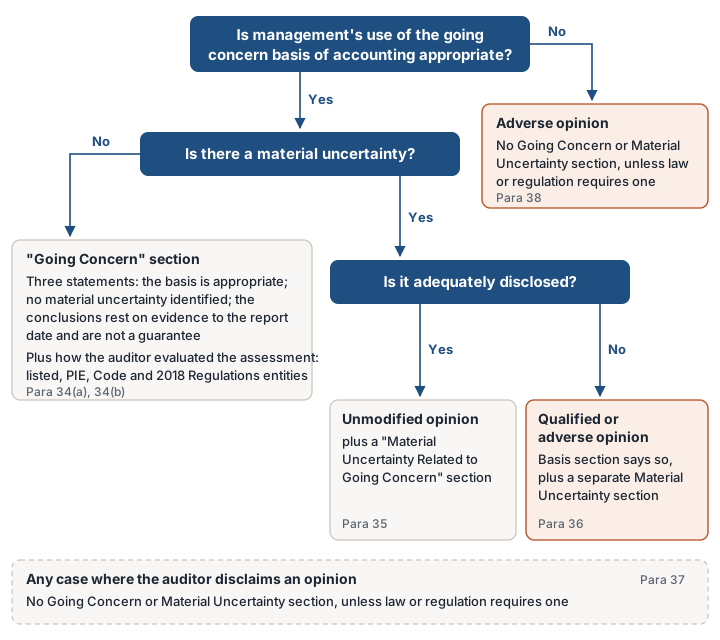
The same logic in words, from paragraphs 34 to 38:
- Is management's use of the going concern basis appropriate? If not, the auditor expresses an adverse opinion, and the report has no Going Concern or Material Uncertainty Related to Going Concern section unless law or regulation requires one (38).
- If it is appropriate, is there a material uncertainty? If not, the report has a "Going Concern" section with the three statements, plus the explanation for the entities in scope of 34(b) (34).
- If there is a material uncertainty, is it adequately disclosed? If yes, the opinion is unmodified and the report has a "Material Uncertainty Related to Going Concern" section (35). If no, the opinion is qualified or adverse, as appropriate under ISA (UK) 705, the basis section says a material uncertainty exists and is not adequately disclosed, and the report also has a separate Material Uncertainty Related to Going Concern section (36). That separate section is new.
- Where the auditor disclaims an opinion, neither section is included unless law or regulation requires it (37, also new).
Applying it on a smaller audit: a worked example
Hollowmere Joinery Ltd is invented for this example. The figures are illustrative.
Hollowmere is a small private company preparing FRS 102 Section 1A accounts for the year ended 31 December 2027. It does not take the small companies audit exemption. Its period began on 1 January 2027, so the revised standard applies. The owner-manager is the sole director and shareholder. Revenue is £3,200,000, of which 41% (£1,312,000) comes from one customer. The bank overdraft facility of £300,000 is up for renewal on 31 March 2029. The director has lent the company £220,000, repayable on demand. The accounts are expected to be approved on 30 June 2028.
Events or conditions, gross (11–12). Before looking at any plans, the auditor identifies three: a facility renewal inside the assessment period, a director's loan repayable on demand, and customer concentration, which A15 names for smaller entities. A14 expects less extensive risk assessment procedures for a simple business with uncomplicated borrowing, but that does not remove these.
The assessment period (21). Management's first forecast runs to 31 December 2028, which covers only six months after the expected approval date. The auditor asks for it to be extended to at least 30 June 2029. A52 suggests discussing the expected approval date with management early, and the engagement letter can set the expectation.
Method, assumptions and data (19). The extended forecast shows a peak overdraft of £255,000 in February 2029, leaving headroom of £45,000, 15% of the facility. The significant assumptions are retention of the major customer and renewal of the facility, and paragraph 19 requires the nature and extent of the work to take into account the risk assessment.
Plans and owner-manager support (26–28). If the director's loan were repaid, the forecast peak would be £475,000, £175,000 above the facility. The plan therefore depends on the director not calling the loan. Paragraph 28 now requires audit evidence of the director's intent and ability to maintain that support. A63 points to written confirmation covering its terms and the period of support; A65 points to documentary evidence of any subordination. The detailed going concern audit procedures are covered separately.
Disclosure where there is no material uncertainty (32). Suppose the auditor concludes there is no material uncertainty, but the conclusion turns on the renewal and the director's support. Those are significant judgements made by management in reaching that conclusion, and paragraph 32 requires the auditor to evaluate whether the accounts disclose them adequately (see going concern disclosure under FRS 102).
Report, representations and communication. The report carries the "Going Concern" section with the three statements in 34(a); 34(b) does not apply to Hollowmere. The written representations cover the four matters in 39 and, because events or conditions were identified, the three in 40. Paragraph 41 opens "Unless all those charged with governance are involved in managing the entity", which describes a sole director who runs the company. Paragraph 42 does not repeat that exception (in 2019 one exception, in paragraph 25, covered both), so because events or conditions were identified, its matters, from whether they amount to a material uncertainty to the adequacy of the disclosures, are communicated to the director, and the file should show that they were. Paragraph 44 then requires the significant judgements behind the conclusions and the disclosure assessment to be documented.
Updating your firm's going concern methodology
For a small firm the change is mostly to templates:
- Re-map paragraph references in every going concern work paper from the 2019 numbering to the 2026 numbering (the table above).
- Events and conditions list on a gross basis, recorded before management's mitigating plans (11).
- A step confirming procedures were not designed to favour corroborative evidence (18), and a control-deficiency conclusion drawn from the ISA (UK) 315 work (15).
- A support-evidence section for owner-manager, group or third-party support, covering intent and ability (28, A63–A65).
- A disclosure review step for significant judgements where there is no material uncertainty (32, A75).
- Representation letter template with the four plus three matters (39–40).
- Report template with the "Going Concern" heading and the three 34(a) statements; decide, and record, the firm's position on the former twelve-month wording.
- Engagement letter: the conforming amendments to ISA (UK) 210 list, among matters a letter may include, the expectation of a going concern assessment covering at least twelve months from the date of approval.
- Training on what moved to application material. A cold file review after the first year ends is a sensible check.
If you are updating your going concern approach for the revised standard, partner with Innate: the platform takes the hours out of the legwork, your team makes the judgements, and you remain the auditor and sign.
Questions auditors ask about ISA 570 revised
Does it apply to small companies?
Yes. Paragraph 1 says the standard "applies irrespective of the entity's size or complexity". It scales instead: A14 expects less extensive risk assessment procedures for simple entities with uncomplicated borrowing, and A65 is written for owner-managed companies. The particular considerations for listed entities, public interest entities, Code reporters and entities under the 2018 Regulations, chiefly the 34(b) and 35(b) reporting, apply only to them.
Is the assessment period still twelve months from approval?
Yes. Paragraph 21 requires the auditor to ask management to extend an assessment covering less than twelve months from the date of approval. FRS 102 (September 2024) paragraph 3.8 requires management to take into account all available information about the future, "which is at least, but is not limited to, 12 months from the date when the financial statements are authorised for issue".
Do I still evaluate management's assessment where there are no events or conditions?
Yes, as the UK has required since 2019. Paragraph 17 requires procedures to evaluate management's assessment on every audit, and A35 says management's analysis may be less extensive where the entity is profitable, has no liquidity concerns and its risk assessment process has identified no events or conditions.
Is it the same as the IAASB standard?
Largely. The main UK additions kept are the scepticism requirement (18-1), the wider, unconditional report explanation (34(b), 35(b)), the Code material (A57-3 to A57-6), and the same-period and additional-facts guidance (A34-1, A57-2).