UK auditing standards and audit regulation
By Alon Zieve FCA · Last reviewed
The UK auditing standards are the International Standards on Auditing (UK), the quality management standards ISQM (UK) 1 and 2, and the FRC's Ethical Standard. The Financial Reporting Council (FRC) issues all three. A firm that signs statutory audits also follows the rules of the body that registers it, which for ICAEW, ICAS and Chartered Accountants Ireland firms are the joint UK Audit Regulations and Guidance. This page maps both layers and shows which edition applies to which year-end, for responsible individuals, audit managers and practice partners. Directors asking whether their company needs an audit want UK audit requirements instead.
What are the UK auditing standards?
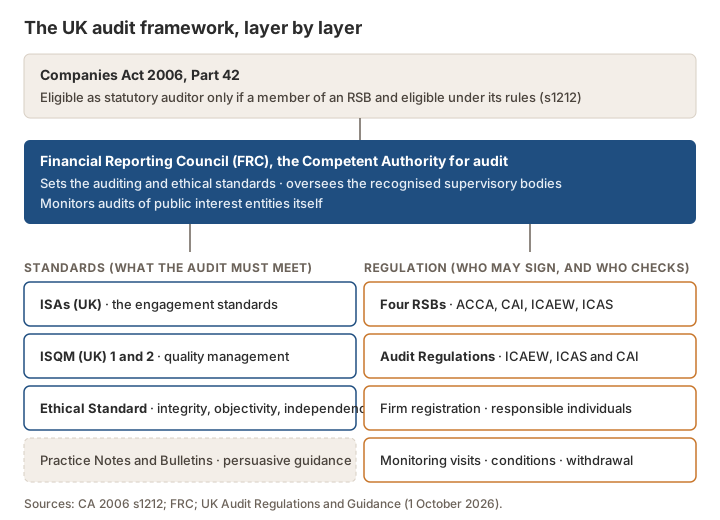
They are three families of FRC pronouncements that every statutory audit in the UK must meet: the ISAs (UK) for the engagement, ISQM (UK) 1 and 2 for quality management, and the Ethical Standard for integrity, objectivity and independence. Practice Notes and Bulletins sit beside them as guidance.
The FRC's statement on the scope and authority of its pronouncements (March 2023) says the Ethical Standard and the ISAs (UK) apply to statutory audits of companies under the Companies Act, to audits required by other UK legislation (building societies, credit unions, friendly societies, pension funds, charities and registered social landlords, among others) and to public sector audits in the UK. The ISAs (UK) run from ISA (UK) 200, on the auditor's overall objectives, to ISA (UK) 805, on single financial statements and specific elements. ISA (UK) 250 comes in two sections: Section A on laws and regulations, and Section B on the auditor's statutory right and duty to report to regulators of public interest entities and of other entities in the financial sector.
The quality management standards work at two levels. ISQM (UK) 1 governs the firm's whole system of quality management, ISQM (UK) 2 governs engagement quality reviews, and ISA (UK) 220 (Revised July 2021) applies the same thinking to each audit: the engagement partner "shall take overall responsibility for managing and achieving quality on the audit engagement" (paragraph 13).
Who sets UK auditing standards, and who regulates auditors?
The FRC sets the UK auditing standards as the Competent Authority for audit; four recognised supervisory bodies (RSBs) register and supervise the firms. Under the Companies Act 2006, an individual or firm is eligible for appointment as a statutory auditor only if it is a member of a recognised supervisory body and eligible under that body's rules (s1212(1)), and acting while ineligible is an offence (s1213).
The four RSBs are ACCA, Chartered Accountants Ireland (CAI), ICAEW and ICAS, according to the FRC's Key Facts and Trends 2026. The FRC delegates registration, audit monitoring, complaints and discipline, and continuing professional development to them, checks periodically that they still meet the Companies Act's recognition requirements, and keeps some work for itself, including independent monitoring of audits of public interest entities. The FRC's figures show 3,421 audit firms registered by the RSBs in the UK and Republic of Ireland in 2025, down 9% on the year.
The FRC's own legal footing is unsettled. On 19 January 2026 Blair McDougall, a Department for Business and Trade minister, wrote to the Business and Trade Committee that the government had decided not to consult on its major package of audit and corporate governance measures, but would "still look to put the Financial Reporting Council on a proper statutory footing, as soon as parliamentary time allows". The letter sets no date; until Parliament legislates, the arrangements above continue.
The framework, layer by layer
ISAs (UK)
The ISAs (UK) are the engagement standards: what the auditor must do, document and report. Most current editions carry the label "Updated September 2025" because the FRC reissued the suite on 25 September 2025 with conforming amendments arising from ISQM (UK) 1 and 2, ISA (UK) 220 and ISA (UK) 600. Those amendments took no new effective date: they apply from 15 December 2022 for the quality management changes and 15 December 2023 for the group audit changes.
Quality management: ISQM (UK) 1, ISQM (UK) 2 and ISA (UK) 220
ISQM (UK) 1 required each firm's system of quality management to be designed and implemented by 15 December 2022, with the first evaluation of the system within one year after that date (paragraph 13), and an evaluation at least annually since. The system has eight components, from the firm's risk assessment process to monitoring and remediation; one of them is resources, which the application material says include human, technological and intellectual resources. ISQM (UK) 2 deals with the appointment and eligibility of the engagement quality reviewer and the reviewer's responsibilities for performing and documenting the review.
The Ethical Standard
The Revised Ethical Standard 2024 became effective on 15 December 2024 (paragraph 1.73). Engagements for periods that began before that date could be completed under the previous standard (paragraph 1.74). Section 6, "Provisions Available for Audits of Small Entities", gives alternative provisions for small entity audits; it does not apply to audits of public interest entities. The ISAs (UK) make clear that auditors in the UK are subject to ethical requirements from two sources: the Ethical Standard and the ethical pronouncements of their professional body.
Practice Notes, Bulletins and the Glossary
Practice Notes and Bulletins are, in the FRC's words, "persuasive rather than prescriptive". An auditor who does not apply a relevant Practice Note "should be prepared to explain how the engagement standards have been complied with". For smaller audits, the FRC published Practice Note 28, Guidance for audits of small and medium-sized entities, on 24 March 2026. The Glossary of Terms (Auditing and Ethics) 2024 defines the terms the standards share.
What the UK has not adopted
The IAASB's separate standard for audits of less complex entities, ISA for LCE, was not among the FRC's auditing standards when this page was last reviewed, although the FRC ran a call for views on it ("How to Enhance Usability") from 26 March to 21 May 2026.
How ISAs (UK) differ from the IAASB's ISAs
The ISAs (UK) are based on the IAASB's corresponding international standards, with UK material added. The FRC's scope and authority statement says the international standards have been "augmented with additional requirements and application and other explanatory material that is appropriate in the UK national legislative, cultural and business context", and that this material is shown in grey shading. An example is paragraph 1-1 of ISA (UK) 701 (Revised May 2026), which extends the standard to communicating other audit planning and scoping matters, matters relating to significant deficiencies in internal controls, and the extent to which the audit was considered capable of detecting irregularities, including fraud.
When it published the September 2026 revisions, the FRC said it "strongly supports maintaining alignment with international standards issued by the IAASB unless there is an overriding public interest reason for taking a UK-specific approach". UK editions carry their own names and effective dates, and the FRC says how each may be adopted: its staff guidance note of October 2026 states that ISA (UK) 570 (Revised March 2026) cannot be adopted early.
On a file, cite the UK edition by its full FRC title, as the standards cite each other: "ISA (UK) 570 (Revised March 2026)", not "ISA 570". When updating a methodology, read the grey-shaded UK material as well as the international text.
UK auditing standards effective dates: which edition applies to which year-end
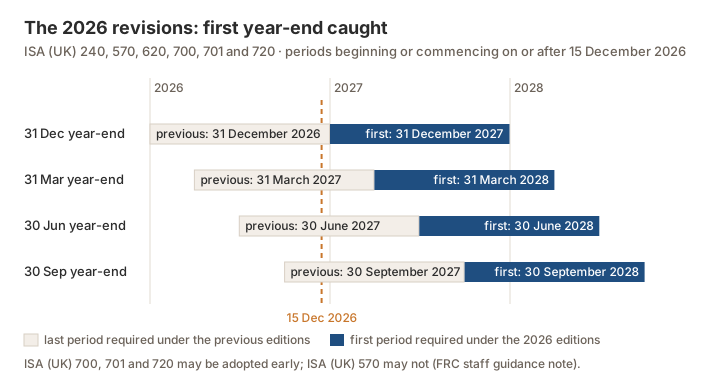
Most UK auditing standards take effect for audits of financial statements for periods beginning (or commencing) on or after a date, usually 15 December. So a 15 December 2026 effective date first catches a calendar-year company's year ending 31 December 2027, not 31 December 2026; the 2026 year-end is audited under the previous editions even if the work happens in 2027, unless the firm adopts early a standard that permits it. Table 1 lists each current and announced edition, the period it applies to, the first 31 December year-end it catches and when each row was last checked against the standard itself.
Table 1. Effective dates of the current and announced editions
| Standard | Edition | Published | Applies to | First 31 December year-end | Early application | Last verified |
|---|---|---|---|---|---|---|
| ISQM (UK) 1 | Issued July 2021 (Updated September 2025) | 25 September 2025 | Systems designed and implemented by 15 December 2022; first evaluation within one year after that date (para 13) | n/a (not tied to a period) | strongly encouraged (date passed) | 2026-10-22 |
| ISQM (UK) 2 | Issued July 2021 (Updated September 2025) | 25 September 2025 | Audits and reviews of financial statements for periods beginning on or after 15 December 2022; other assurance and related services engagements beginning on or after that date (para 11) | 31 December 2023 | strongly encouraged (date passed) | 2026-10-22 |
| ISA (UK) 220 | Revised July 2021 (Updated September 2025) | 25 September 2025 | Audits of financial statements for periods beginning on or after 15 December 2022 (para 10) | 31 December 2023 | strongly encouraged (date passed) | 2026-10-22 |
| ISA (UK) 315 | Revised July 2020 (Updated September 2025) | 25 September 2025 | Audits of financial statements for periods beginning on or after 15 December 2021 (para 10) | 31 December 2022 | not stated (date passed) | 2026-10-22 |
| ISA (UK) 600 | Revised September 2022 (Updated September 2025) | 25 September 2025 | Audits of group financial statements for periods beginning on or after 15 December 2023 (para 12) | 31 December 2024 | permitted (date passed) | 2026-10-22 |
| Ethical Standard | Revised Ethical Standard 2024 | 15 January 2024 | Effective 15 December 2024; engagements for periods commencing before that date may be completed under the previous standards (paras 1.73-1.74) | 31 December 2025 | not stated (date passed) | 2026-10-22 |
| ISA (UK) 505 | Revised October 2023 (Updated October 2025) | 7 October 2025 | Audits of financial statements for periods commencing on or after 15 December 2024 (para 4) | 31 December 2025 | not stated (date passed) | 2026-10-22 |
| ISA (UK) 240 | Revised May 2021 (Updated September 2025) | 25 September 2025 | Audits of financial statements for periods commencing on or after 15 December 2021 (para 10) | 31 December 2022 | not stated (date passed) | 2026-10-22 |
| All other ISAs (UK) | Current editions (Updated September 2025) | 25 September 2025 | FRC auditing standards page, general position: effective for audits of financial statements for periods commencing on or after 15 December 2019 (unless otherwise stated). Each standard's own effective-date paragraph gives its date: periods ending, beginning or commencing on or after dates from 15 December 2010 to 15 December 2019; later conforming amendments carry their own dates. All have passed. ISA (UK) 800 permits early adoption | n/a (all passed) | n/a (all passed) | 2026-10-22 |
| ISA (UK) 240 | Revised March 2026 | 30 April 2026 | Audits of financial statements for periods beginning on or after 15 December 2026 (para 16) | 31 December 2027 | not stated | 2026-10-22 |
| ISA (UK) 570 | Revised March 2026 | 30 April 2026 | Audits of financial statements for periods beginning on or after 15 December 2026 (para 8) | 31 December 2027 | not permitted (FRC staff guidance note para 8) | 2026-10-22 |
| ISA (UK) 700 | Revised May 2026 | 24 June 2026 | Audits of financial statements for periods commencing on or after 15 December 2026 (para 5) | 31 December 2027 | permitted | 2026-10-22 |
| ISA (UK) 701 | Revised May 2026 | 24 June 2026 | Audits of financial statements for periods commencing on or after 15 December 2026 (para 6) | 31 December 2027 | permitted | 2026-10-22 |
| ISA (UK) 720 | Revised May 2026 | 24 June 2026 | Audits of financial statements for periods commencing on or after 15 December 2026 (para 10) | 31 December 2027 | permitted | 2026-10-22 |
| ISA (UK) 620 | Revised September 2026 | 23 September 2026 | Audits of financial statements for periods commencing on or after 15 December 2026 (para 4) | 31 December 2027 | not stated | 2026-10-22 |
| ISAE (UK) 3000 | Revised September 2026 | 23 September 2026 | Assurance engagements where the report is dated on or after 15 December 2026 (para 9) | n/a (not tied to a period) | not stated | 2026-10-22 |
| UK Audit Regulations and Guidance (ICAEW/ICAS/CAI) | Version 12 | 16 September 2026 (ICAEW announcement) | In force from 1 October 2026 for firms registered with ICAEW, ICAS or CAI (cover; ICAEW news 16 Sep 2026) | n/a (not tied to a period) | n/a | 2026-10-22 |
Source for each row: the standard's own effective-date paragraph, linked from the edition, except the "All other ISAs (UK)" row, which summarises the FRC auditing standards page's general statement, not one paragraph. "Applies to" follows the source's own wording.
Reading the dates in Table 1
Five kinds of date appear in Table 1, and they work differently:
- Period start. Most ISAs (UK) apply to audits of financial statements for periods beginning or commencing on or after the date. What matters is when the client's financial period starts, not when the audit is done or the report is signed.
- Period end. Some older ISAs (UK), for example ISA (UK) 500 and 580, apply to audits of financial statements for periods ending on or after the date.
- Firm date. ISQM (UK) 1 applies to the firm, not to an engagement: the system had to exist by 15 December 2022.
- Report date. ISAE (UK) 3000 (Revised September 2026), for assurance engagements other than audits, applies where the assurance report is dated on or after 15 December 2026, whatever period it covers.
- Transition. The Ethical Standard took effect on a fixed date but let engagements for earlier periods finish under the old rules.
The standards differ on early application. Of the 2026 revisions, ISA (UK) 700, 701 and 720 say early adoption is permitted; the FRC's staff guidance note says it is not permitted for ISA (UK) 570; ISA (UK) 240 and 620 do not mention it, so the prudent course is to apply them from the stated date.
How this table is kept current
The table is generated from a register that records, for each edition, the effective-date paragraph, its source and when that paragraph was last read. When the FRC issues or reissues a standard, the row and this page's "Last reviewed" date change. A row that cannot be confirmed in the issuer's own text is removed, not guessed.
What changes for periods beginning on or after 15 December 2026
The new auditing standards of 2026 are six revised ISAs (UK) for periods beginning or commencing on or after 15 December 2026: ISA (UK) 240, 570, 620, 700, 701 and 720. For a calendar-year client the first file that must apply them is the year ending 31 December 2027; for a 31 March client it is 31 March 2028.
- Fraud. ISA (UK) 240 (Revised March 2026), published on 30 April 2026, replaces the May 2021 edition; what changes, and how to apply it on a smaller audit, is in ISA 240 revised.
- Going concern. ISA (UK) 570 (Revised March 2026), published the same day, replaces the September 2019 edition; the paragraph-by-paragraph changes are in ISA 570 revised.
Auditor's reports: ISA (UK) 700, 701 and 720 (Revised May 2026). The FRC published these on 24 June 2026 to make auditor's reports shorter and clearer and, for companies that follow the UK Corporate Governance Code, to require auditors to describe how the company's controls affected the audit. The explanation of the extent to which the audit was considered capable of detecting irregularities, including fraud, is no longer required in every auditor's report: it now sits in ISA (UK) 701 (paragraph 16-1), which applies to publicly traded entities, public interest entities and entities that report on how they have applied the UK Corporate Governance Code, among others. Early adoption is permitted, and the FRC's staff guidance note, published on 13 October 2026, explains what early adoption of ISA (UK) 700 means for the report, including continuing to report on going concern under the existing requirements because ISA (UK) 570 (Revised March 2026) cannot be adopted early.
Experts: ISA (UK) 620 (Revised September 2026). Published on 23 September 2026 with ISAE (UK) 3000, it keeps the UK standard aligned with the IAASB's equivalent changes, which follow the international ethics code's new requirements for using the work of external experts. The FRC says the changes clarify the auditor's responsibilities when using an external expert's work and reinforce evaluation and documentation.
A firm with a spread of year-ends meets the new editions across 2027 and 2028, not all at once; methodology and templates need to be ready before the first affected file is planned.
Audit regulation: registration, responsible individuals and the Audit Regulations
The UK Audit Regulations and Guidance are the rulebook that ICAEW, ICAS and Chartered Accountants Ireland apply to the firms they register for audit; ACCA is not a party to them. The current edition, Version 12, took effect on 1 October 2026, and its regulations "apply to all firms regardless of the registering Institute, unless stated otherwise".
The regulations turn the standards into conditions of registration. Regulation 3.10 requires a registered auditor to comply with the auditing standards and the quality management standards; regulation 2.01 bars any individual or firm from accepting an audit appointment unless registered. A firm must monitor its compliance with the regulations at least once a year (regulation 3.20).
Responsible individuals. "Only responsible individuals can be responsible for an audit and sign an audit report" (regulation 4.04). The firm's audit compliance principal may designate as RIs those principals or employees who hold an appropriate qualification, are competent and fit and proper, meet their institute's CPD requirements and are allowed to sign audit reports in their own name on the firm's behalf (regulation 4.01); a designation takes effect only once the registration committee has approved it (regulation 4.05). That matches the Companies Act: where the auditor is a firm, the senior statutory auditor signs the report "in his own name, for and on behalf of the auditor" (s503(3)), and the regulations require that individual to be a responsible individual.
The October 2026 change. ICAEW describes the main change in the 1 October 2026 edition as regulation 2.19. Where an individual responsible for statutory audit work ceases to be eligible, or a firm fails the audit-qualified majority ownership test, a dispensation can last no more than 90 days and cannot be extended; if the position is not put right, the registration committee will move to withdraw registration. The same edition removed two transitional provisions that had become redundant, including the one for a sole practice's alternate. A sole practitioner must already have formal arrangements with an alternate to act on death or incapacity (regulation 2.02A); a guide to that requirement is planned.
Monitoring. Each RSB monitors the audits of the firms it registers, other than the public interest entity audits the FRC monitors itself, through visits that can lead to conditions on a registration or its withdrawal. At ICAEW this is the Quality Assurance Department (QAD); ICAEW's annual Audit Monitoring Report publishes the results.
Quality management and file review at a small firm
Two pieces of work hold a small firm's quality management together, and each has its own guide. ISQM 1 annual evaluation covers the yearly evaluation of the system, worked for a firm with one responsible individual. The cold file review guide covers the file reviews that feed it, cold and hot, and what reviewers find. ICAEW's Audit Monitoring Report and the FRC's Annual Review of Audit Quality, published on 22 July 2026, are the annual sources of what inspectors found.
Technology and AI on the audit file
The FRC's 2025 guidance on AI in audit says it is not prescriptive: the requirements against which firms are assessed "remain only those in the ISQMs and ISAs (UK)"; ISQM (UK) 1 counts IT applications among a firm's technological resources. What a firm should record centrally and on the file is in FRC AI audit guidance, and the wider picture is in AI in auditing.
Running an audit practice
Running a registered firm involves decisions the standards only frame: whether to keep audit registration, how to staff work, whether to partner. Two guides cover them. Give up audit registration sets out the routes out of audit, from surrendering registration to handing over clients or selling. Audit outsourcing in the UK compares the models for buying in help and shows who stays responsible under ISA (UK) 220 when someone else does the work.
If your firm could take on more audits, or wants to implement cutting-edge technology designed to save material man hours, partner with us: we bring clients and a platform that does the legwork, saving your team time, and you remain the auditor and sign.
Guides
- Audit outsourcing in the UK: the models, and who stays responsibleAudit outsourcing in the UK: who does the work, who is responsible, and what the FRC expects. Four models compared, from offshore support to partnering.Last reviewed
- Cold and hot file reviews: what reviewers find, and how to fix it firstWhat cold and hot file reviews check, how often an ICAEW firm needs a cold file review, who may do it, and what ICAEW reviewers find, with the fix.Last reviewed
- FRC AI audit guidance: documenting AI tools, centrally and on the audit fileThe FRC's AI audit guidance (June 2025, March 2026): what firms document about an AI tool centrally under ISQM (UK) 1, on the file, and if bought in.Last reviewed
- ISA (UK) 240 revised: what changes on fraud, and how to apply it on a smaller auditISA 240 revised: what the March 2026 UK edition changes on fraud, when it takes effect, what the UK kept, and how to apply it on an owner-managed audit.Last reviewed
- ISA (UK) 570 revised: going concern changes, and how to apply them on a smaller auditISA (UK) 570 revised applies to periods beginning on or after 15 December 2026. What changed from the 2019 UK text, and how to apply it on a smaller audit.Last reviewed
- Leaving audit: give up audit registration, hand over your audit clients, or sellShould you give up audit registration? What keeping it costs, how to hand over or sell your audit clients, and ICAEW's withdrawal steps and deadlines.Last reviewed
- The ISQM (UK) 1 annual evaluation for small firms and sole practitioners, workedHow a sole practitioner or small audit firm does the ISQM (UK) 1 annual evaluation: what it draws on, how to choose the conclusion, and a worked memo.Last reviewed