Leaving audit: give up audit registration, hand over your audit clients, or sell
By Alon Zieve FCA · Last reviewed
You can give up audit registration by applying to the body that registered your firm. At ICAEW, the Audit Compliance Principal files the voluntary withdrawal form, and it takes effect only once ICAEW accepts it. Before then, every audit client needs a new auditor or a reason not to need one: the clients appoint their auditors, the law makes a firm that becomes ineligible resign at once, and the form asks what has happened to each client. Time it to the fee year, too. ICAEW bills by calendar year and does not refund, and in its end-of-year billing period a withdrawal must be confirmed by 31 January or the firm may still have to pay that year's fee.
This guide covers what keeping registration costs, the three ways out, how the appointments end, the timetable, and what still applies afterwards. It is written for a sole practitioner or a small firm with a handful of audits. Firms are leaving in numbers: the FRC's Key Facts and Trends in the Accountancy Profession 2026 records 408 firms voluntarily surrendering audit registration across the four recognised supervisory bodies (ACCA, CAI, ICAEW and ICAS) in 2025, 235 of them with ICAEW, after 430 in 2024. The number of audit firms those bodies register in the UK and the Republic of Ireland fell by 9% in 2025, to 3,421. For the wider picture of how audit is regulated, see UK auditing standards and audit regulation.
Keep or give up audit registration: what each costs
Keeping registration is worth it while the audit work earns more than the fixed cost of being allowed to do it. Much of that cost comes with the registration rather than with each audit: the fee, monitoring, the quality management system, methodology and training. Fill in the last column from your own invoices and time records.
| Cost | Where the figure comes from | Goes if you give up audit? | Your figure (£) |
|---|---|---|---|
| ICAEW annual audit registration fee | ICAEW audit fee scale 2026 (members' area). Payable 1 January for the calendar year; not refunded | Yes, for the fee years after the withdrawal; in the end-of-year billing period, confirm by 31 January or that year's fee may still be due | |
| Audit affiliate fees, if any principal is an audit affiliate | ICAEW affiliate fee scale | Yes: audit affiliate status ends when the firm stops being a Registered Auditor (reg 5.07, subject to 5.08) | |
| Charges for a follow-up monitoring visit | Set by the Registration Committee (reg 2.15); an estimate is normally given | Yes | |
| Time preparing for, and responding to, monitoring visits | Your own time records | Yes | |
| Hot or cold file reviews | The reviewer's quote; see our guide to the cold file review | Yes | |
| Running the system of quality management for audit, including the ISQM 1 annual evaluation | Your own time records | Mostly; check what other assurance work you keep | |
| Audit methodology, software and technical updates | Supplier invoices | Yes | |
| Audit training for each responsible individual | Course fees and time | Yes: responsible individual status ends with the firm's registration (reg 4.08) | |
| A sole practitioner's alternate arrangement (reg 2.02A) | Any fee the alternate charges | Yes, for audit | |
| Professional indemnity insurance | Your broker | No. Ask your broker whether dropping audit changes the premium | |
| Practising certificate and anti-money laundering supervision | ICAEW | No, while you remain in practice |
Add up the rows that go, and divide by the number of audits you hold. That is what each audit carries before anyone opens a file. If that figure is more than a typical audit earns after its direct costs, the registration is costing the practice money.
Costs that go when registration goes
The registration fee, affiliate and responsible individual status, monitoring and its follow-up charges, file reviews and the audit methodology all go once the firm stops being a Registered Auditor. So does the audit requirement for a sole practitioner's alternate: regulation 2.02A applies to "a Registered Auditor" that is a sole practice. ICAEW still requires an alternate for other regulated work, for example where a sole principal holds clients' money (Clients' Money Regulations, regulation 31).
Costs that stay
Professional indemnity insurance, the practising certificate and anti-money laundering supervision belong to the practice, not to audit, and continue while you practise. Run-off cover becomes mandatory only when the practice ceases or you stop practising (see the last section).
What you can no longer do without registration
Only a registered firm may accept an audit appointment. "No individual or firm may accept an audit appointment unless registered by an RSB or the Competent Authority" (Audit Regulation 2.01), and the Companies Act 2006 makes eligibility depend on membership of, and eligibility under the rules of, a recognised supervisory body (s1212). So the statutory audits go. Some other work goes with them:
- Solicitors' accountant's reports. Under the SRA Accounts Rules, rule 12.5, the report must be "prepared and signed by an accountant who is a member of one of the chartered accountancy bodies and who is, or works for, a registered auditor".
- Charity audits. Where a charity in England and Wales needs an audit under the Charities Act 2011 s144 (for financial years ending on or after 30 September 2026, gross income over £1.5 million, or over the accounts threshold with gross assets over £5 million; £1 million and £3.26 million for earlier years), the auditor must be eligible as a statutory auditor under Part 42 of the Companies Act 2006, or a member of a body specified in regulations under s154 and eligible under its rules. Check whether any other membership keeps that work open to you before you assume it does.
- The description. A registered firm "may describe itself as a firm of registered auditors or statutory auditors". Once registration ends, the description is no longer true, so it comes off the firm's letterhead and website.
Look at the work that sits beside each audit, too. If a company's accounts, tax and payroll are done by the same firm, the client may move them all when the audit moves.
If you change your mind later, the route back is a new application. Regulation 2.21's guidance says a firm that is no longer registered "can apply in the normal manner".
Three ways out: give up registration, hand over your audit clients, or sell
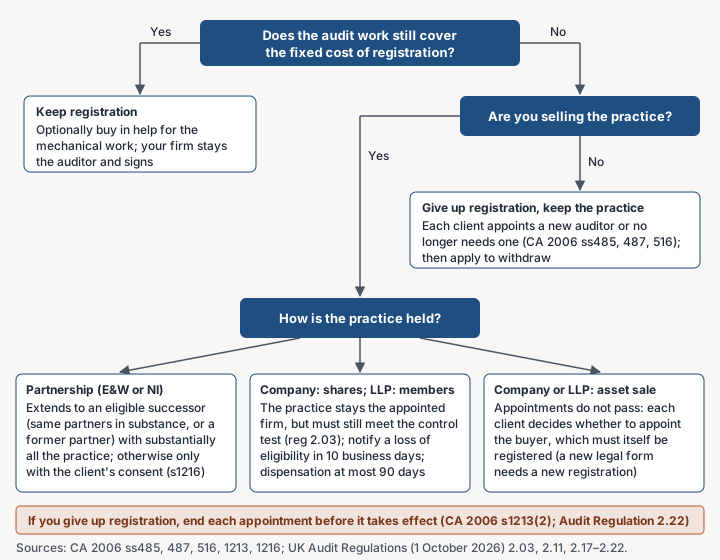
Give up registration and keep the practice
The practice carries on with accounts, tax and advisory work; the audits end. Each audit client appoints a new auditor, or stops needing one. It suits a practice whose audits are a small part of its work.
Merge or hand over to a registered firm
The practice joins, or refers its audit clients to, a firm that stays registered. The clients still appoint the new firm themselves; a merger does not move an appointment unless the law moves it (the partnership rule in s1216, below).
Sell the practice
A buyer takes the practice, including the audit clients' other work. What happens to each audit appointment depends on how the practice is held, which the sale section sets out.
Keep registration but buy in help
If the cost is the problem but the work is not, a firm can keep registration and bring in outside help for the mechanical parts of the audit, while the firm stays the auditor and its responsible individual signs the report on the firm's behalf. Our guide to audit outsourcing covers the models and what stays with the firm.
How to hand over your audit clients
You cannot transfer an audit appointment: the company makes it (the partnership rule in s1216, below, is the exception). For a private company, the members appoint by ordinary resolution during the period for appointing auditors, and the directors may fill a casual vacancy (Companies Act 2006 s485(3)–(4)). So handing over means telling each client early enough to appoint someone else, and making the change of auditor easy.
- Write to each client with your plan and the date your firm's last audit for it will be signed. Tell clients before the year end where you can, so that the new firm can plan the first audit and attend the stocktake.
- Check whether the client still needs an audit. Some will have fallen below the audit exemption thresholds; see audit exemption thresholds. Where the company is, or is to become, exempt from audit and intends to include the audit exemption statement in its balance sheet, that is also an exempt reason for the auditor ceasing to hold office (s519A(3)(b)).
- Answer the new firm's enquiries. The ICAEW Code of Ethics (Section 320) requires the proposed auditor at least to seek to contact the existing auditor and, for an audit, to ask it for any facts that, in the existing auditor's opinion, the proposed auditor needs to know before accepting (R320.5, R320.8). With the client's consent, the existing auditor provides the information "honestly and unambiguously"; if the client refuses permission, the existing auditor says so (R320.8, which has separate rules for suspected non-compliance with laws and regulations). You must also "deal promptly with any reasonable request for the transfer of records" (R320.7C).
- Give the successor access to the working papers. Once the new firm is appointed, Audit Regulation 3.09 requires the predecessor to allow it access to "all relevant information held by the predecessor in respect of its audit work" if it asks in writing. The successor's work on the opening balances falls under ISA (UK) 510, Initial Audit Engagements—Opening Balances.
The withdrawal form asks you to confirm, for audit clients, "what is happening to the firm's regulated clients, indicating if they have been transferred to, or engaged by another firm". Keep a list as you go: client, new auditor, date your office ended, and how it ended.
If you want help finding a firm for clients who still need an audit, note that each client decides whether to appoint the firm it is introduced to, and that firm accepts the appointment on its own terms. If you are weighing up leaving audit, talk to us: we can introduce your audit clients to an ICAEW-registered partner firm, or partner with your firm so that you keep auditing and signing, with our platform taking the hours out of the legwork.
Resigning or not seeking reappointment: s516, s519 and s522
For a private company, simply not seeking reappointment does not end your office. There are two clean ways to leave: the company appoints your successor in the period for appointing auditors, or you resign.
Under s487(2), if no auditor has been appointed by the end of the next period for appointing auditors, the auditor in office is deemed re-appointed, unless one of six exceptions applies: the auditor was appointed by the directors, the articles require actual re-appointment, members holding at least 5% of the votes (or a lower percentage set by the articles) have given notice under s488, the members have resolved against re-appointment, the directors have resolved that no auditor is to be appointed, or re-appointment would breach s485C. None of those is in the auditor's hands.
The company appoints your successor in the period for appointing auditors. Your term ends at the end of that period (s487(1)(b)). Ceasing to hold office "at the end of a period for appointing auditors" is the first condition in s519(2A), so for a company that is not a public interest company no s519 statement is needed.
You resign. A resignation is a notice sent to the company, effective when received or on a later date it specifies (s516). The directors can then fill the casual vacancy. You must send a s519 statement of your reasons unless the second condition in s519(2B) is met: all your reasons are exempt reasons, and there are no matters connected with your leaving that you consider need to be brought to the attention of members or creditors. "A is no longer to carry out statutory audit work" is an exempt reason (s519A(3)(a)). If you do send a statement, it goes with the notice of resignation (s519(4)(a)), and s522 requires a copy to go at the same time to the appropriate audit authority, which for a non-public interest company is your supervisory body (s525(1)(b)). Audit Regulation 3.08's guidance gives this case as its example of an exempt reason: "the registered auditor has resigned because it has ceased to be a registered auditor". Where the company reasonably believes the only reasons are exempt reasons, it need not notify the audit authority itself either (s523(1A)).
Do not let registration lapse while you still hold an appointment. If a statutory auditor becomes ineligible during its term, it must immediately resign with immediate effect and give written notice to the audited person that it has resigned because it became ineligible (s1213(2)). Acting while ineligible, or failing to give that notice, is an offence (s1213(3)). End the appointments first.
The full rules on the statement, and an example, will be in our guide to the s519 statement. For the client's side of the change, see how to change your auditor.
Selling a practice with audit clients
An audit book cannot be sold like a block of fee income. Each appointment is made by the client company (by its members, or by its directors in the cases s485(3) allows), not by the firm, and the Act extends it to a successor only in the partnership cases in s1216. What a buyer gets depends on how the practice is held.
- A partnership (England and Wales or Northern Ireland). The appointment is of the partnership as such (s1216(2)). If the partnership ceases, the appointment extends to a successor partnership whose members are substantially the same, or to another person who succeeds to the practice having carried it on in partnership. Either way the successor must take the whole or substantially the whole of the business, be eligible as a statutory auditor and not be barred by s1214(1) (s1216(3)–(4), (6)). Otherwise the appointment may extend to a successor only with the audited company's consent (s1216(5)).
- A company or LLP. The practice is itself the appointed firm: the Act's "firm" includes a body corporate (s1173), and an LLP is a body corporate with legal personality separate from its members (Limited Liability Partnerships Act 2000 s1(2)). Section 1216 does not deal with it, and neither the Act nor the regulations deal with a share sale in terms. What the regulations test is who owns and controls a registered firm. Each principal (a director, for a company; a member, for an LLP) must be a member of an Institute or ACCA, an audit affiliate of the registering Institute or a Registered Auditor where the firm is registered by ICAEW or ICAS (reg 2.03a), and a member or affiliate of CAI or a Registered Auditor where it is registered by CAI (reg 2.03aa). Individuals with an appropriate qualification and Registered Auditors, or a combination of them, must hold at least a majority of the voting rights, and of the voting rights in any management board (reg 2.03b–c). An LLP has no shares: the regulations' "corporate practice" is "A body corporate, excluding a limited liability partnership", so for an LLP the sale is a change of members, and each new member is a new principal to notify within ten business days (reg 2.11d(3)). A corporate practice's articles must require the board to approve any share transfer that would give a shareholder an interest of more than 3% of the issued share capital (reg 2.03d(6)), and the firm must tell its Institute of changes in shareholdings within ten business days (reg 2.11f). If the sale breaks the control test, the firm must notify the Registration Committee in writing within ten business days, saying what it proposes to do (reg 2.17); any dispensation lasts at most 90 days and cannot be extended, after which the committee will take steps to withdraw registration (reg 2.19 and guidance). The regulations' guidance asks firms to notify the Institute "as soon as possible if they are planning any changes so that registration is not interrupted". Speak to the Institute before you exchange.
- An asset sale by a company or LLP, or a change of legal form. The buyer takes the business, not the appointments. Each audit client decides whether to appoint the buyer. (For a partnership, s1216 above decides.) A firm that changes its legal status (for example from partnership to LLP, or from sole practice to company) needs a new registration; the old one "does not carry over" (reg 2.11 guidance).
Two terms follow from this. Price the audit fees with retention or clawback, because the buyer cannot be sure the clients will appoint it. And keep the audit working papers: regulation 3.11 requires them to be kept for at least six years from each auditor's report, and the firm that did the audits must answer a successor's requests for access under reg 3.09, even after it de-registers (reg 2.23b). A sale agreement that hands over "all client records" needs an exception for audit files.
If your firm, or an associate, receives a fee, commission or other benefit for referring its own clients to another firm, the ICAEW Code requires the firm to obtain each client's explicit written consent to keep it, and "This requirement exists regardless of the amount of the commission" (R330.5B). Consent can come from an engagement letter clause, from specific advance consent, or by disclosing the payment afterwards and asking for consent. The Code does not say how this applies to the price paid for a practice as a whole. On value, practice sale prices are a subject of their own, which our guide to how much accounting practices sell for will cover.
How to surrender audit registration with ICAEW
ICAEW's "Application for voluntary withdrawal" form is online. It must be completed by the firm's Audit Compliance Principal, and the application "is only effective once it has been accepted by ICAEW"; some are referred to the relevant regulatory committee for approval. The form asks for:
- the firm name and firm number;
- which services are being withdrawn (audit, investment business, probate and oaths, ATOL);
- whether the firm is ceasing to be an ICAEW firm, and if so the cessation date;
- the reason for withdrawal and the requested withdrawal date;
- any principals leaving the firm as part of the withdrawal, with their ICAEW numbers;
- what will happen to the firm's ICAEW training office, if it has one;
- for each area withdrawn, what is happening to the regulated clients ("none" if there are none);
- the name, compliance roles and date of the person submitting.
Three conditions shape the timing. If the firm is due a monitoring visit by the Quality Assurance Department, or one is under way, the application "will not be considered until the visit is concluded". In the end-of-year billing period, withdrawals must be confirmed by 31 January "or the firm may still be required to pay the annual fee for the year". And the Registration Committee "may require a firm which has ceased to be registered to provide evidence that it has resigned from all audit appointments" (reg 2.22). Have the client list ready before you file.
If you are registered with ICAS, CAI or ACCA
The UK Audit Regulations and Guidance are one document for ICAEW, ICAS and the Institute of Chartered Accountants in Ireland (CAI), so the same rules on ceasing registration (regs 2.21–2.24) apply to firms registered by ICAS or CAI; apply to the Institute that registered you. ACCA registers firms under its own rules: ask ACCA for its current process before you plan around it.
When to do it: a timetable around your clients' year ends
Plan for every audit appointment to end before the withdrawal takes effect. In ICAEW's end-of-year billing period, confirm the withdrawal by 31 January or the firm may still have to pay that year's fee. Where clients have different year ends, the latest one sets your withdrawal date.
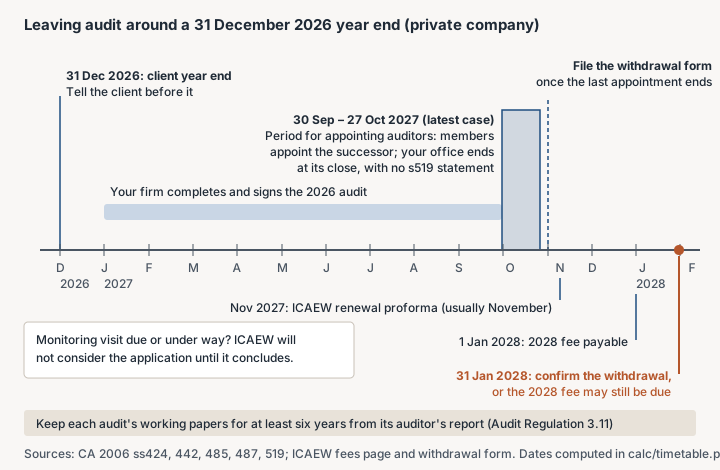
The example above is a private company with a 31 December 2026 year end, where your firm signs the 2026 audit and the new auditor takes the 2027 one:
- Before 31 December 2026: tell the client, so the successor can plan the 2027 audit.
- 2027: sign the 2026 audit report.
- The period for appointing auditors. It runs for 28 days beginning with the end of the time allowed for sending out the 2026 accounts, or with the day they are sent out if earlier (s485(2)). For a private company that time ends with the filing deadline, nine months after the year end, or earlier if the accounts are delivered sooner (ss424(2), 442(2)(a)). At the latest, the period runs from 30 September to 27 October 2027. The members appoint the successor in it, and your office ends at its close with no s519 statement (for a company that is not a public interest company).
- Once the last appointment has ended (or earlier, with a requested withdrawal date after it): file the withdrawal form. Leave time for any monitoring visit that is due, because the application waits for it.
- November 2027: ICAEW usually sends the renewal proforma invoice, for 2028.
- 1 January 2028: the 2028 fee is payable. Confirm the withdrawal by 31 January 2028, or the firm may have to pay it. ICAEW does not refund annual regulatory fees, in part or in full.
If you want out sooner, resign after signing the last report and let the directors fill the vacancy. Ceasing to do statutory audit work is an exempt reason, so no s519 statement is needed if it is your only reason and there are no matters to bring to members' or creditors' attention.
After you give up audit registration: what still applies
Withdrawal ends the registration, not the record: enquiries, successors' requests, disciplinary action and unpaid fees all survive it, and so does the practical need to keep audit files for six years. Under the Audit Regulations:
- Enquiries. The firm must still respond to enquiries from the Registration Committee or the Competent Authority about the time it was registered (reg 2.23a).
- Successors. It must still respond to requests from a successor auditor under reg 3.09 (reg 2.23b).
- Discipline. Disciplinary action, including a regulatory penalty, or action by the Competent Authority can still be taken for failures while registered, for breaches of any regulation that continues to apply after registration ends, and for any failure to keep confidential information received in audit work (reg 2.23c). In the guidance after regulation 2.24, "a firm cannot escape disciplinary action by de-registering".
- Fees. The Institute's right to recover unpaid fees survives (reg 2.24).
- Working papers. Regulation 3.11 sets at least six years from the date of each auditor's report, and successors can still ask for access, so keep the files for that period. Decide before destroying anything, and keep a record of what was destroyed.
- Your letterhead and website. Remove the registration wording ("registered to carry on audit work in the UK by…") and the audit register reference, and stop describing the firm as registered or statutory auditors.
Insurance depends on whether the practice carries on. If it ceases altogether, ICAEW's PII Regulations require the members in practice at the date of cessation to have cover for at least two years, and then to take all reasonable steps to keep cover for a further four years (reg 2.8). If only the audit work stops, the run-off rule does not apply, but tell your broker, because claims about audits already signed can arise later.