UK GAAP explained: FRS 102, FRS 105 and Section 1A
By Alon Zieve FCA · Last reviewed
UK GAAP is the body of accounting standards that the Financial Reporting Council (FRC) issues for UK companies that do not report under UK-adopted IFRS, read together with the Companies Act 2006. Its principal standard is FRS 102; small companies may apply it with the lighter notes of its Section 1A, and micro-entities may use the simpler FRS 105. This page explains what it is, which standard your company uses and what each one asks of the directors, with a guide for each topic.
What is UK GAAP?
UK GAAP is short for UK generally accepted accounting practice: the accounting standards the FRC issues, FRS 100 to FRS 105, applied alongside the Companies Act 2006's rules on accounts. No statute defines the term, but the FRC uses it for its own standards (its advisory group on them is the UK GAAP Technical Advisory Group), and so does ICAEW.
The two halves work together. The Act sets the duties: directors must not approve accounts unless they are satisfied that the accounts give a true and fair view of the assets, liabilities, financial position and profit or loss (section 393). It also sets the formats and many of the notes, through regulations. The standards say how to recognise and measure what goes into the accounts, and what more to disclose. They are not confined to companies: FRS 102 is written for "entities including those that are not constituted as companies and those that are not profit-oriented", which is why charities and LLPs use it too.
It also crosses a border. FRS 102's full title is The Financial Reporting Standard applicable in the UK and Republic of Ireland, and it applies in Ireland under the Companies Act 2014.
Two things it is not. It is not a short list of principles: lists of "nine principles" (regularity, sincerity, non-compensation and the like) circulate online, but none of those words appears as a principle in FRS 102. The standard's own concepts are in its Section 2, Concepts and Pervasive Principles: the objective of financial statements, relevance and faithful representation, prudence, going concern, and the definitions of assets, liabilities, income and expenses. And it is not the pre-2015 rule book. FRS 102 has applied to accounting periods beginning on or after 1 January 2015, and the Financial Reporting Standard for Smaller Entities (FRSSE) was withdrawn with effect from 1 January 2016, when Section 1A and FRS 105 took over the small and micro regimes.
The UK GAAP standards: FRS 100 to FRS 105
The UK accounting standards are six FRSs, plus the sector SORPs (Statements of Recommended Practice) that sit on top of FRS 102. In the FRC's words, FRS 102 "applies to the financial statements of entities that are not applying adopted IFRS, FRS 101 or FRS 105".
| Standard | Who it is for | Built from | Read more |
|---|---|---|---|
| FRS 100 Application of Financial Reporting Requirements | Every reporter under these standards: it sets out which applies | The rules of the regime itself | The route below |
| FRS 101 Reduced Disclosure Framework | Qualifying subsidiaries and parents, individual accounts only | Adopted IFRS, amended for company law, fewer disclosures | — |
| FRS 102 The Financial Reporting Standard applicable in the UK and Republic of Ireland | Every company not using IFRS, FRS 101 or FRS 105 | The IFRS for SMEs, substantially modified | FRS 102 changes from 2026 |
| FRS 102 Section 1A Small Entities | Small companies and small LLPs that choose it | Full FRS 102 measurement, fewer required notes | Section 1A disclosure checklist |
| FRS 103 Insurance Contracts | FRS 102 reporters that issue insurance contracts | Applied alongside FRS 102 | — |
| FRS 104 Interim Financial Reporting | Interim reports of FRS 102 reporters | Applied alongside FRS 102 | — |
| FRS 105 The Financial Reporting Standard applicable to the Micro-entities Regime | Micro-entities that choose the micro regime | FRS 102, simplified for micro-entities | FRS 105 vs FRS 102 |
| SORPs | Charities, LLPs, pension schemes and other sectors | Applied on top of FRS 102 | — |
Is FRS 102 UK GAAP or IFRS? The former: accounts prepared under FRS 102 are "Companies Act" accounts under section 395(1)(a), not IFRS accounts. FRS 101 is the one that confuses people, because it applies the recognition and measurement of adopted IFRS. It is still UK GAAP: FRS 101 says plainly that accounts prepared under it "are not accounts prepared in accordance with adopted IFRS", and a company's FRS 101 accounts are Companies Act accounts.
The SORPs are written by bodies the FRC recognises, among them the charity regulators, the CCAB (for LLPs), the Pensions Research Accountants Group and the housing federations. An entity within a SORP's scope states which SORP it follows and explains any departure (FRS 100 para 6).
Which standard does your company use?
The Companies Act and FRS 100 decide it in an order. Group accounts of a parent whose securities are admitted to trading on a UK regulated market must use IFRS; a qualifying member of a group may use FRS 101 in its individual accounts; a micro-entity or small company has a lighter option; everyone else uses full FRS 102. So a private company that is not choosing IFRS or FRS 101 ends at FRS 105, Section 1A or full FRS 102.
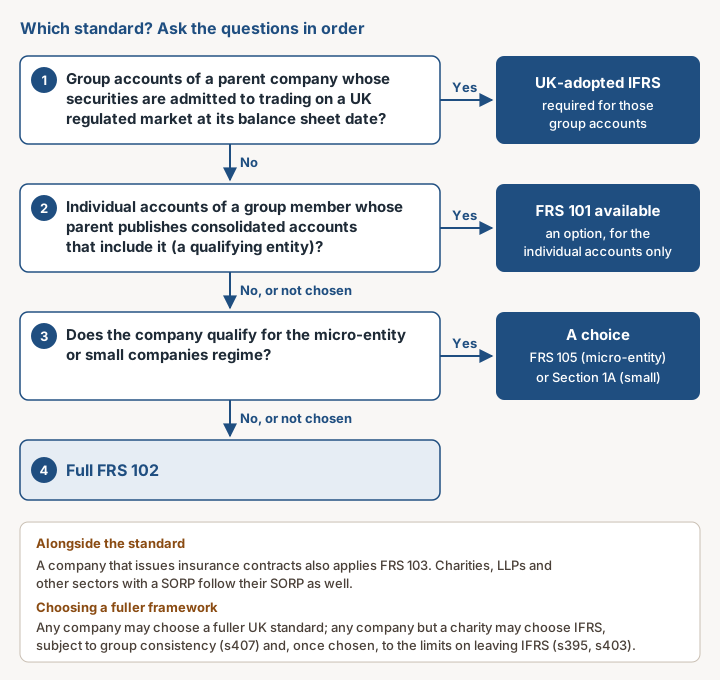
Must the company use UK-adopted IFRS?
The Companies Act requires it in one case. The group accounts of a parent company whose securities are admitted to trading on a UK regulated market at its balance sheet date must be prepared under UK-adopted international accounting standards (section 403(1)): the IFRS standards adopted for use in the UK, being those the EU had adopted by the end of 2020 and those adopted since, which the UK Endorsement Board now decides (section 474(1)). Other legislation or regulation can also require IFRS (FRS 100 para 4). Otherwise every company, and the listed parent's own individual accounts, may choose either Companies Act accounts or IFRS accounts (sections 395(1) and 403(2)), except a charity, whose accounts must be Companies Act accounts (sections 395(2) and 403(3)).
So does the UK use GAAP or IFRS? Both, by type of company: listed groups use IFRS for their consolidated accounts, and other companies may choose either. Those are the only two frameworks the Act offers, so US GAAP accounts cannot serve as a UK company's statutory accounts, even in a US group. For what that means for the audit of a company owned from overseas, see does my UK subsidiary need an audit.
Can a group company use FRS 101?
A "qualifying entity" can, in its individual accounts only: FRS 100 defines it as a member of a group whose parent prepares publicly available consolidated accounts, intended to give a true and fair view, that include it, and a charity cannot be one. FRS 101 then lets it apply adopted IFRS recognition and measurement with fewer disclosures, provided it amends IFRS where company law requires and says in its notes which exemptions it has taken (FRS 101 para 5). It is written for subsidiaries and parents that would otherwise apply adopted IFRS in full (para 1), so a subsidiary of a group that reports under IFRS can follow the group's IFRS accounting with fewer notes.
Is it a micro-entity or a small company?
For financial years beginning on or after 6 April 2025, a company is small if it meets at least two of: turnover not more than £15 million, balance sheet total not more than £7.5 million, and no more than 50 employees (section 382(3)). It is a micro-entity if it meets at least two of: turnover not more than £1 million, balance sheet total not more than £500,000, and no more than 10 employees (section 384A(4)). In both cases a change in size counts only once it has happened in two consecutive financial years, and a new company is judged on its first year alone (sections 382(1) and (2), 384A(1) and (3)). A parent company qualifies as small, or as a micro-entity, only if the group it heads qualifies as small (sections 383 and 384A(8)). The same size tests feed the audit exemption, set out in UK audit exemption thresholds.
A micro-entity may use FRS 105 and a small company may use Section 1A, and neither has to: both may use the fuller framework. Not every small company may use Section 1A: a company excluded from the small companies regime, such as a public company or a member of an ineligible group, may not (section 384). Not every micro-entity may use FRS 105 either. Section 384B shuts out, among others, charities, investment and financial holding undertakings, insurers, and a company that is not a parent but whose accounts are included in consolidated group accounts for the year. Which of the two to choose, and who is excluded, is the subject of FRS 105 vs FRS 102.
Everyone else: full FRS 102
Companies that are not small and do not use IFRS or FRS 101 apply full FRS 102, as does any small company that chooses not to use Section 1A. A company that issues insurance contracts applies FRS 103 to them as well (FRS 102 para 1.6). Where a SORP covers the sector, such as the Charities SORP or the LLP SORP, it applies on top.
Can a company change framework?
Within limits. A company that has moved to IFRS can return to Companies Act accounts after a relevant change of circumstance, such as becoming a subsidiary of a parent that does not prepare IFRS individual accounts, or otherwise only if it has not already switched back to Companies Act accounts in the previous five years (section 395(3) to (4B); section 403 has the same rule for group accounts). And where group accounts are prepared, the parent's directors must use the same framework for the parent and its subsidiaries' individual accounts unless they have good reasons not to (section 407). Moving between FRS 105, Section 1A and full FRS 102 follows the size tests above and each standard's transition rules, covered in FRS 105 vs FRS 102.
UK accounting guides: which one answers your question
Find your situation; the guide on the right answers it in full.
| If this is you | What usually matters | Read |
|---|---|---|
| A company with property, vehicle or equipment leases | Most leases now come onto the balance sheet | FRS 102 lease changes |
| You want the lease numbers worked through | A full transition, with journals | FRS 102 lease accounting example |
| Revenue from contracts, subscriptions or bundles | When and how much revenue to recognise | FRS 102 revenue recognition |
| Your first year under the revised FRS 102 | Every change and how it is first applied | FRS 102 changes from 2026 |
| A micro or small company choosing its framework | FRS 105 or Section 1A, and who may use each | FRS 105 vs FRS 102 |
| A small company preparing its notes | Which notes Section 1A requires | FRS 102 Section 1A disclosure requirements |
| Not sure which standard applies | Work through the route in order | Which standard does your company use? |
FRS 102 explained: the main UK standard
FRS 102 is the principal UK standard, and most of the guides in this series are FRS 102 guides. The FRC built it from the IASB's IFRS for SMEs Accounting Standard and then, in its own words, "modified the IFRS for SMEs Accounting Standard substantially", both in who may use it and in the accounting it allows. It is organised by topic, one numbered section each, from Section 1 Scope to Section 35 Transition to this FRS, with Section 1A for small entities and Section 2A on fair value measurement.
Much of the recent change sits in two sections, and two more carry much of the judgement:
- Leases (Section 20). A lessee now recognises a right-of-use asset and a lease liability at the start of a lease (para 20.45), apart from short-term and low-value leases it chooses to exempt. What moves onto the balance sheet, and what that does to covenants, is in FRS 102 lease changes; the numbers worked through, with journals, are in the FRS 102 lease accounting example.
- Revenue (Section 23). Revenue now follows a five-step model, from identifying the contract to recognising revenue as each performance obligation is satisfied (para 23.4). FRS 102 revenue recognition works through the steps.
- Financial instruments (Sections 11 and 12) and income tax, including deferred tax (Section 29), which most trading companies' accounts draw on.
The main amendments from the FRC's Periodic Review 2024 apply to accounting periods beginning on or after 1 January 2026; every change, and how each is first applied, is in FRS 102 changes from 2026.
Section 1A and FRS 105: the small and micro regimes
Section 1A is disclosure relief, not a separate standard
Section 1A is part of FRS 102. A small company that chooses it applies "all of the requirements of this FRS", including recognition and measurement, and gets relief on presentation and notes: it need not present a cash flow statement, and its minimum notes are the ones listed in Appendix C to the section (paras 1A.1, 1A.7A and 1A.16A). Two consequences follow. A small company is affected by every change to FRS 102's accounting, including leases and revenue. And the accounts must still give a true and fair view, so a small company may need to give notes beyond the minimum where they are relevant to material transactions (para 1A.17). The minimum list is in FRS 102 Section 1A disclosure requirements.
FRS 105 is a separate, simpler standard for micro-entities
FRS 105 is "based on FRS 102", with its accounting adapted to the law for micro-entities and to their simpler nature. The differences are real: a micro-entity may not use the fair value or alternative accounting rules, so no revaluations, and measures at historical cost (FRS 105 para A3.8); it does not recognise deferred tax (para 24.7); and the law presumes its minimum accounting items give a true and fair view (Companies Act section 396(2A)). Using the regime is optional, but a micro-entity that chooses it must apply FRS 105. How it compares with Section 1A, line by line, is in FRS 105 vs FRS 102 Section 1A.
What UK GAAP means for the accounts, the audit and the filing
The framework shapes everything that follows. The directors approve the accounts only if they are satisfied the accounts give a true and fair view (section 393), and the notes say which framework was used: FRS 100 requires a statement of compliance with FRS 101 or FRS 102, and a small company using Section 1A states above the director's signature on the balance sheet that the accounts are prepared under the small companies regime (para 1A.6A).
Where the company is audited, the auditor's report describes the financial reporting framework applied and states whether, in the auditor's opinion, the accounts give a true and fair view and have been properly prepared in accordance with that framework and the Act (section 495). Whether your company needs an audit at all is covered in UK audit requirements. The accounts then go to Companies House; a private company normally has nine months from the end of its accounting reference period to file them (section 442(2)), with different rules for a long first period or a shortened one. The directors' wider duties on accounts are covered in company directors' responsibilities.
The first year under the revised FRS 102 is a transition year: the amendments apply retrospectively except where the standard sets its own transition, as it does for leases (FRS 102 para 1.39), so it is worth planning early between the finance team and the auditor. The FRS 102 changes from 2026 sets out how each change is first applied.
If your company's next audit is its first under the revised FRS 102, Innate offers statutory audits signed by an ICAEW-registered partner firm, which your company appoints as its auditor, with our platform finding the documents and reconciling the numbers: ask for a quote.
Where the UK standards sit beside IFRS and US GAAP
FRS 102 aims to give "succinct financial reporting requirements" and began from the IFRS for SMEs, so it is shorter than full IFRS and differs from it in places; the FRC publishes a table of the differences. FRS 101 sits between the two, with IFRS numbers and fewer notes. A UK company in a US group still prepares its statutory accounts under a UK standard or UK-adopted IFRS, while the figures it reports for a group that uses US GAAP follow US GAAP, so the two sets are prepared under different rules and any differences have to be tracked.
Guides
- FRS 102 lease accounting example: a full transition, step by step, with journalsAn FRS 102 lease accounting example, step by step: five leases through the 1 January 2026 transition, the journals, the first-year figures and the notes.Last reviewed
- FRS 102 lease changes: what moves onto the balance sheet, the exemptions and your covenantsFRS 102 lease changes for periods beginning on or after 1 January 2026: which leases go on the balance sheet, the exemptions, transition and covenants.Last reviewed
- FRS 102 revenue recognition: the five-step model, with worked examplesFRS 102 revenue recognition from 2026: the Section 23 five-step model, five worked examples with journals, transition routes and IFRS 15 differences.Last reviewed
- FRS 102 Section 1A disclosure requirements: the full checklist for small companiesFRS 102 1A disclosure requirements: every note a Section 1A company must give, with paragraph references, what is new from 2026 and what is not required.Last reviewed
- FRS 105 vs FRS 102 Section 1A: which should your company use?FRS 105 vs FRS 102 Section 1A for micro-entities: the differences after the 2026 changes, the group rules, switching frameworks and a worked balance sheet.Last reviewed