FRS 102 lease accounting example: a full transition, step by step, with journals
By Alon Zieve FCA · Last reviewed
This FRS 102 lease accounting example takes an invented UK company with a 31 December year end through its first year under the revised Section 20, which applies to accounting periods beginning on or after 1 January 2026. At 1 January 2026 the company recognises lease liabilities of £181,430 and right-of-use assets of £171,430 for its two former operating leases, carries a former finance lease across unchanged, and its retained earnings do not change. Its 2026 profit before tax is £4,317 lower than under the old rent charge, and its EBITDA is £44,000 higher.
Every figure in this FRS 102 lease transition example is computed and checked in code. For the rules and why they changed, see FRS 102 lease changes.
The FRS 102 lease transition example: the company and its leases
The company is a private company applying FRS 102, the main standard in UK GAAP. It did not adopt the amendments early, so its date of initial application, the first day of the first period under the new rules, is 1 January 2026 (paragraphs 1.37(b) and 1.40(a); the other amendments and dates are in FRS 102 changes from 2026). The lease figures are the same whether it reports under full FRS 102 or Section 1A, which keeps the recognition and measurement requirements (paragraph 1A.1); only the notes differ. A micro-entity on FRS 105 still sorts its leases into finance and operating leases (FRS 105 paragraphs 15.5 and 15.14; see FRS 105 vs FRS 102).
The company, its leases and every figure in this FRS 102 leases worked example are invented and illustrative. VAT is ignored throughout.
| Lease | What it is | Key terms | On the balance sheet at 31 December 2025 |
|---|---|---|---|
| A | Head office | 1 January 2021 to 31 December 2030; £40,000 a year, £10,000 a quarter in advance on 1 January, 1 April, 1 July and 1 October; first six months rent-free; tenant break at 31 December 2027 | Rent accrual (credit) £10,000 |
| B | Van on contract hire | 1 July 2023 to 30 June 2027; £500 a month in arrears | Nothing |
| C | Storage unit | Ends 31 March 2026; £1,500 a quarter | Nothing |
| D | Staff laptops | 1 October 2024 to 30 September 2027; £600 a quarter in advance | Nothing |
| E | Forklift | Finance lease from 1 January 2024; five annual payments of £6,000 in arrears; rate implicit in the lease 8% | Asset £14,374; lease liability £15,463 |
The office accrual comes from the rent-free period. Under the old Section 20 the company spread the £20,000 rent-free benefit over the ten-year term, so its rent charge was £38,000 a year (£380,000 of payments over ten years). By 31 December 2025 it had charged £190,000 and paid £180,000, leaving a £10,000 accrual.
Step 1: sort the leases and choose the expedients
Two leases go onto the balance sheet at 1 January 2026, the office and the van. The forklift is already there and carries across. The storage unit and the laptops stay off, with the rent expensed as before.
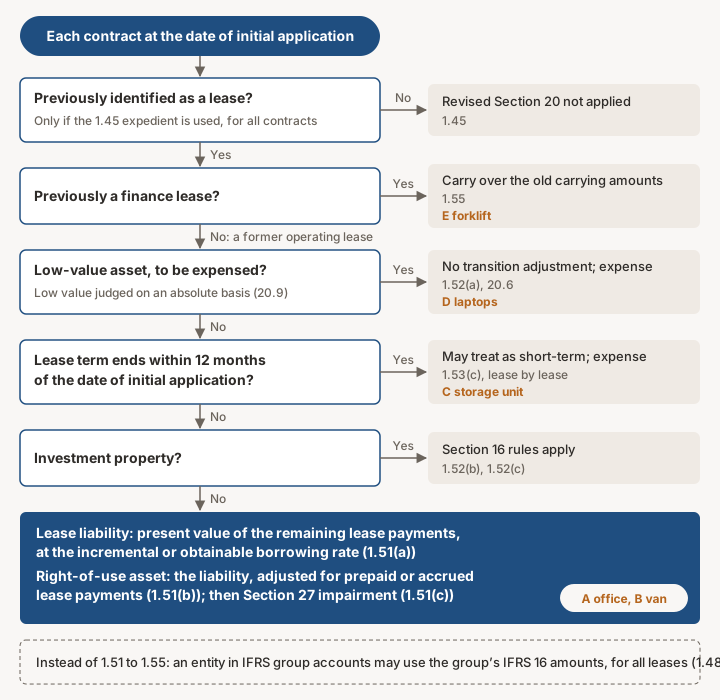
| Lease | Treatment at 1 January 2026 | FRS 102 paragraph |
|---|---|---|
| A office | Lease liability and right-of-use asset | 1.51 |
| B van | Lease liability and right-of-use asset | 1.51 |
| C storage unit | Ends within 12 months of the date of initial application: treated as a short-term lease and expensed | 1.53(c) |
| D laptops | Low-value assets, expensed: no transition adjustment | 1.52(a), 20.6 |
| E forklift | Former finance lease: old carrying amounts carried over | 1.55 |
Which contracts count. The company uses the paragraph 1.45 expedient: it does not reassess which contracts are leases, and applies the revised Section 20 to those already identified as leases. It must apply this to all contracts and disclose it.
The forklift. A former finance lease is recognised at the carrying amounts of the leased asset and the finance lease liability immediately before the date of initial application (paragraph 1.55), so it gives no adjustment to retained earnings (FRC Factsheet 9).
The laptops and the storage unit. Low value is judged "on an absolute basis" (paragraph 20.9), and the FRC says the exemption for personal computers "would therefore be acceptable" (Basis for Conclusions B20.10). The storage lease ends within 12 months of the date of initial application, so the company may treat it as a short-term lease and include its cost in the short-term lease expense it discloses for 2026 (paragraph 1.53(c)). The 1.53 expedients are chosen lease by lease.
Investment property (paragraph 1.52) and the IFRS 16 group option (paragraph 1.48) do not apply here; both are under "What would change the answer?".
Step 2: the lease term and the discount rate
The office's lease term. The company can break the lease at 31 December 2027. The period after the break counts only if the company is reasonably certain not to exercise it (paragraph 20.38(c)), weighing factors such as the rent against market rates, significant leasehold improvements, the cost of leaving and how important the asset is (paragraph 20.41). It is the head office, fitted out in 2021, so the company judges the break reasonably certain not to be exercised, and at transition it may use hindsight in doing so (paragraph 1.53(d)). The term runs to 31 December 2030: 20 quarterly payments remain.
The rate. A former operating lease is discounted at the incremental or the obtainable borrowing rate at the date of initial application (paragraph 1.51(a)); the rate implicit in the lease is not an option at transition. The company uses the obtainable borrowing rate: what it "would have to pay to borrow, over a similar term, an amount similar to the total undiscounted value of lease payments" (Glossary). Its bank indicated 6.5% for about £200,000 over five years (the office) and 7.5% for about £9,000 over 18 months (the van). Both are the company's judgements, kept with their evidence.
The convention. Each annual rate becomes a periodic rate as (1 + r)^(1/4) − 1 for quarterly payments (1.5868%) and (1 + r)^(1/12) − 1 for monthly ones (0.6045%), and each payment is discounted by whole periods from 1 January 2026. FRC Factsheet 11 notes that spreadsheet PV, NPV and XNPV formulae each assume different cash flow timing, so check which one a schedule uses.
How to calculate the lease liability and the right-of-use asset under FRS 102
At the date of initial application the lease liability is the present value of the remaining lease payments, discounted at the chosen rate (paragraph 1.51(a)). The right-of-use asset is that liability, adjusted by any prepaid or accrued lease payments for the lease on the balance sheet immediately before that date (paragraph 1.51(b)). For the office, a liability of £172,927 less the £10,000 accrual gives an asset of £162,927 at 1 January 2026.
The first payment falls on 1 January 2026, the date of initial application itself, so it is not discounted:
| Payment | Date due | Quarters from 1 January 2026 | Payment | Discount factor | Present value |
|---|---|---|---|---|---|
| 1 | 1 Jan 2026 | 0 | £10,000 | 1.0000 | £10,000 |
| 2 | 1 Apr 2026 | 1 | £10,000 | 0.9844 | £9,844 |
| 3 | 1 Jul 2026 | 2 | £10,000 | 0.9690 | £9,690 |
| 4 | 1 Oct 2026 | 3 | £10,000 | 0.9539 | £9,539 |
| 5 | 1 Jan 2027 | 4 | £10,000 | 0.9390 | £9,390 |
| 6 | 1 Apr 2027 | 5 | £10,000 | 0.9243 | £9,243 |
| 7 | 1 Jul 2027 | 6 | £10,000 | 0.9099 | £9,099 |
| 8 | 1 Oct 2027 | 7 | £10,000 | 0.8956 | £8,956 |
| 9 | 1 Jan 2028 | 8 | £10,000 | 0.8817 | £8,817 |
| 10 | 1 Apr 2028 | 9 | £10,000 | 0.8679 | £8,679 |
| 11 | 1 Jul 2028 | 10 | £10,000 | 0.8543 | £8,543 |
| 12 | 1 Oct 2028 | 11 | £10,000 | 0.8410 | £8,410 |
| 13 | 1 Jan 2029 | 12 | £10,000 | 0.8278 | £8,278 |
| 14 | 1 Apr 2029 | 13 | £10,000 | 0.8149 | £8,149 |
| 15 | 1 Jul 2029 | 14 | £10,000 | 0.8022 | £8,022 |
| 16 | 1 Oct 2029 | 15 | £10,000 | 0.7897 | £7,897 |
| 17 | 1 Jan 2030 | 16 | £10,000 | 0.7773 | £7,773 |
| 18 | 1 Apr 2030 | 17 | £10,000 | 0.7652 | £7,652 |
| 19 | 1 Jul 2030 | 18 | £10,000 | 0.7532 | £7,532 |
| 20 | 1 Oct 2030 | 19 | £10,000 | 0.7415 | £7,415 |
| Total | £200,000 | £172,927 |
Rounded present values do not add exactly to the total. For the van, 18 monthly payments of £500 in arrears discounted at 7.5% give a liability of £8,503, and with nothing accrued or prepaid the asset is the same.
| Lease | Undiscounted remaining payments | Lease liability | Accrued rent derecognised | Right-of-use asset | Adjustment to retained earnings |
|---|---|---|---|---|---|
| A office | £200,000 | £172,927 | £10,000 | £162,927 | £0 |
| B van | £9,000 | £8,503 | £0 | £8,503 | £0 |
| E forklift (carried over) | £18,000 | £15,463 | — | £14,374 | £0 |
| Total | £227,000 | £196,893 | £10,000 | £185,804 | £0 |
The check: the office liability of £172,927 plus £27,073 of interest to come equals the £200,000 still to be paid.
Why retained earnings do not move: the modified retrospective approach
The lessee does not restate its 2025 comparatives. It puts the cumulative effect of the change in opening retained earnings (or another component of equity, as appropriate) at the date of initial application (paragraph 1.47). Because the asset for a former operating lease is built from the liability (paragraph 1.51(b)), the asset, the derecognised accrual and the liability net to nil, and so does the adjustment here. This FRS 102 leases modified retrospective approach moves equity only when something breaks that symmetry:
- an impairment of the right-of-use asset at transition, under Section 27 (paragraph 1.51(c));
- a below-market lease that carried a government grant, where the asset is adjusted for the non-exchange element (paragraph 1.51(b));
- a lease that will be investment property, where the asset is measured at fair value (paragraph 1.52(c));
- the IFRS 16 group figures, if they differ from what 1.51 would give (paragraph 1.48).
The rent-free accrual
Under the old rules the office's rent charge ran ahead of the cash paid, because the rent-free months were spread over the term. The £10,000 credit at 31 December 2025 is that difference. Paragraph 1.51(b) adjusts the asset for "prepaid or accrued lease payments". The paragraph does not mention incentives by name; the example reads the accrual as accrued lease payments, because it is exactly the excess of the lease payments charged over those paid. It comes off the asset, not off equity. Its 2026 release, the £2,000 a year that used to reduce the rent charge, must no longer be posted.
A dilapidations provision is different: paragraph 1.51(b) adjusts the asset only for prepaid or accrued lease payments, so the example does not add a provision to the asset at transition.
The journals: transition entries and the 2026 entries
These are the FRS 102 Section 20 journal entries the example posts. On 1 January 2026 it credits lease liabilities £181,430, debits right-of-use assets £171,430 and clears the £10,000 rent accrual. The 2026 entries come from the office's quarterly schedule:
| Quarter | Liability at start | Payment | Interest | Liability at end | Depreciation | Asset at end |
|---|---|---|---|---|---|---|
| Q1 | £172,927 | £10,000 | £2,585 | £165,512 | £8,146 | £154,781 |
| Q2 | £165,512 | £10,000 | £2,468 | £157,980 | £8,146 | £146,634 |
| Q3 | £157,980 | £10,000 | £2,348 | £150,328 | £8,146 | £138,488 |
| Q4 | £150,328 | £10,000 | £2,227 | £142,555 | £8,146 | £130,342 |
Interest runs on the balance after each quarter-day payment, at a constant rate (paragraph 20.63); the asset is depreciated straight-line over the five years left (paragraphs 20.57 and 20.58).
Illustrative entries; account names are generic and a company uses its own chart of accounts:
| Date | Entry | Debit | Credit |
|---|---|---|---|
| 1 Jan 2026 | Office: transition | Right-of-use asset £162,927; rent accrual £10,000 | Lease liability £172,927 |
| 1 Jan 2026 | Van: transition | Right-of-use asset £8,503 | Lease liability £8,503 |
| 1 Jan 2026 | Forklift: reclassification, only if it presents leases separately | Right-of-use asset £14,374; finance lease obligation £15,463 | Plant held under finance lease £14,374; lease liability £15,463 |
| 1 Jan 2026 | Office rent paid | Lease liability £10,000 | Bank £10,000 |
| 31 Jan 2026 | Van hire paid | Lease liability £500 | Bank £500 |
| 31 Jan 2026 | Van: January interest and depreciation | Interest on lease liabilities £51; depreciation £472 | Lease liability £51; accumulated depreciation £472 |
| 31 Mar 2026 | Office: first-quarter interest and depreciation | Interest on lease liabilities £2,585; depreciation £8,146 | Lease liability £2,585; accumulated depreciation £8,146 |
| 31 Dec 2026 | Presentation: amount due within one year | Lease liability £40,428 | Lease liabilities due within one year £40,428 |
For 2026 the three leases give £11,299 of interest and £43,046 of depreciation (rounded quarterly figures may differ from the annual totals by £1).
If the ledger has already posted the 2026 rent to the rent nominal, reverse it: debit lease liability £40,000 (office) and £6,000 (van), credit rent expense £46,000, and post the interest and depreciation instead. Reconcile the liability to the schedule at each month end. The storage unit and laptop rents (£1,500 and £2,400) stay in the profit and loss account, outside the schedule, so nothing is counted twice.
The first year: 2026 profit, EBITDA and the 31 December 2026 balance sheet
Profit before tax is £4,317 lower than under the old rules, because depreciation plus front-loaded interest exceeds the old rent. EBITDA is £44,000 higher, because the office and van rent leaves operating costs. At the year end the liability exceeds the asset, and £40,428 of the £156,192 lease liability falls due within one year.
| Lease | Depreciation | Interest | New charge | Old charge | Difference |
|---|---|---|---|---|---|
| A office | £32,585 | £9,628 | £42,213 | £38,000 | £4,213 |
| B van | £5,669 | £434 | £6,103 | £6,000 | £103 |
| C storage unit | — | — | £1,500 | £1,500 | £0 |
| D laptops | — | — | £2,400 | £2,400 | £0 |
| E forklift | £4,791 | £1,237 | £6,028 | £6,028 | £0 |
| Total | £43,046 | £11,299 | £58,245 | £53,928 | £4,317 |
| Lease costs inside EBITDA | £3,900 | £47,900 | −£44,000 |
Each total is rounded from the unrounded figures, so a column may not add to it by £1. The Difference column is the new charge less the old: on the last row, −£44,000 is a fall in the costs inside EBITDA, so EBITDA is £44,000 higher.
The office's old charge is the £40,000 rent less the £2,000 release of the rent-free accrual. The forklift's charge does not change, because it was already depreciation and interest. Whether higher EBITDA and higher debt matter depends on the facility agreement; see how the lease changes affect covenants.
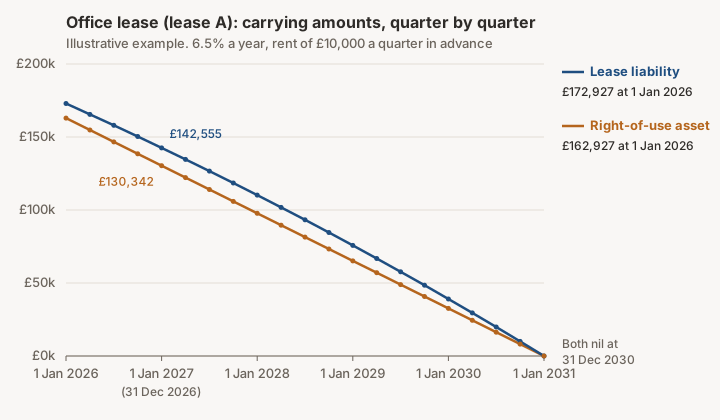
The gap is why the first years cost more than the old rent: depreciation is even, while interest is highest when the liability is largest.
| Lease | Right-of-use asset | Lease liability | Due within one year | Due after more than one year |
|---|---|---|---|---|
| A office | £130,342 | £142,555 | £32,346 | £110,209 |
| B van | £2,834 | £2,938 | £2,938 | £0 |
| E forklift | £9,583 | £10,700 | £5,144 | £5,556 |
| Total | £142,759 | £156,192 | £40,428 | £115,764 |
Totals are rounded from the unrounded figures, so the liability columns do not add by £1.
The amount due within one year is the liability at 31 December 2026 less the liability the schedule shows a year later: the principal the 2027 payments repay. It goes under "Creditors: amounts falling due within one year" and the rest under "Creditors: amounts falling due after more than one year" (the Companies Act balance sheet formats).
Cash flow statement. The principal part of the lease payments is a financing cash flow (paragraph 7.6(e)); the interest part is interest paid, classified as operating or financing by the company's policy, applied consistently (paragraphs 7.14 and 7.15). A small company using Section 1A need not present a cash flow statement (paragraph 1A.7A).
Tax. Nothing is taken to equity in this example, so the rule in Finance Act 2019, Schedule 14, paragraph 13, which spreads the tax effect of amounts taken to equity on transition, has nothing to spread here. How the 2026 depreciation and interest are treated for corporation tax, and whether deferred tax arises, depends on the tax treatment of each lease, which this example does not cover.
If you would rather spend year end on the accounts than on chasing documents, Innate offers statutory audits signed by an ICAEW-registered partner firm, which your company appoints as its auditor, while our platform finds the documents and reconciles the numbers: see how it works.
The notes: what the 2026 accounts disclose
A Section 1A company describes its significant leasing arrangements, adds information where needed to understand them, and gives the expense for short-term leases, low-value leases and variable lease payments (paragraphs 1AC.31A, 1AC.31B and 1AC.32A). Off-balance sheet lease commitments count towards its financial commitments (paragraph 1AC.29). The full checklist is in FRS 102 Section 1A disclosure requirements.
Illustrative Section 1A note, leases (year ended 31 December 2026):
The company leases its head office under a lease ending on 31 December 2030, with a tenant break at 31 December 2027 that it does not expect to exercise; a van on contract hire ending on 30 June 2027; and a forklift under a lease ending on 31 December 2028. Right-of-use assets and lease liabilities are recognised for these leases. The company has chosen not to recognise leases of low-value assets, and on transition treated a storage lease ending within 12 months as a short-term lease. Expense for the year: short-term leases £1,500; leases of low-value assets £2,400; variable lease payments £nil. Financial commitments not included in the balance sheet: £1,800 under the laptop rental.
A company applying full FRS 102 also discloses, among other things:
- right-of-use assets and lease liabilities as separate lines, or the lines that include them (paragraph 20.74);
- the types of discount rate used and the share of the total lease liability under each; here, the obtainable borrowing rate for the office and the van (£145,493, 93%) and the rate implicit in the lease for the forklift carried over from finance lease accounting (£10,700, 7%) (paragraph 20.77(c));
- interest expense on lease liabilities, £11,299 here (paragraph 20.80(a));
- the total cash outflow for leases (paragraph 20.80(f));
- for each class of right-of-use asset, the gross carrying amount and accumulated depreciation at both ends of the year, and a reconciliation showing additions, depreciation and other movements (paragraph 20.81);
- that it uses the short-term or low-value exemption, and the commitments under those leases in time bands (paragraph 20.82).
The transition note. Instead of the usual change-of-policy disclosures in paragraph 10.13(b) to (d), the company discloses the effect on profit or loss for the current period, where practicable (paragraph 1.44), describes the transitional provisions used (paragraph 1.50) and discloses the 1.45 expedient. These are in Section 1, outside the Sections 8 to 35 disclosures that paragraph 1A.17 relieves small companies of, so the example gives them:
The company applied the revised Section 20 of FRS 102 from 1 January 2026 without restating comparatives. Leases previously classified as operating leases were measured at the present value of the remaining lease payments, discounted at the company's obtainable borrowing rates at that date (6.5% and 7.5%), and right-of-use assets at the same amount, less £10,000 of accrued lease payments on the office lease. A lease previously classified as a finance lease was carried over at its existing carrying amounts. There was no adjustment to retained earnings. The company did not reassess whether existing contracts contain a lease, used hindsight in setting the lease term of its office lease, and treated a lease ending within 12 months as a short-term lease. Applying the revised Section 20 reduced profit before tax by £4,317 for 2026.
What would change the answer?
Four inputs move the figures: the discount rate, whether the office break is expected to be exercised, whether rent was accrued or prepaid at transition, and the year end, which sets the date of initial application. The break matters most: expected to be exercised, it cuts the office liability at transition by more than half (from £172,927 to £75,760).
Each row re-runs the office lease through the same engine with one input changed:
| Case | Lease liability at transition | Right-of-use asset at transition | First-year interest | First-year depreciation | First-year charge less old charge |
|---|---|---|---|---|---|
| As in the example (6.5%, break not exercised) | £172,927 | £162,927 | £9,628 | £32,585 | £4,213 |
| Rate 7.5% instead of 6.5% | £169,353 | £159,353 | £10,843 | £31,871 | £4,714 |
| Rate 5.5% instead of 6.5% | £176,644 | £166,644 | £8,350 | £33,329 | £3,678 |
| Break at 31 December 2027 expected to be exercised | £75,760 | £65,760 | £3,312 | £32,880 | −£1,808 |
| No rent-free period; January 2026 rent paid in December 2025 (old charge £40,000) | £162,927 | £172,927 | £9,628 | £34,585 | £4,213 |
| 31 March year end: date of initial application 1 April 2026 | £165,512 | £156,012 | £9,146 | £32,845 | £3,991 |
- A higher rate gives a smaller liability and asset but more interest, so the first-year charge rises; a lower rate does the opposite.
- The break exercised cuts the term to two years and the liability to £75,760, and the first-year charge falls below the old £38,000 charge.
- Prepaid rather than accrued. Without a rent-free period and with January's rent paid on 24 December 2025, the company holds £10,000 of prepaid rent. The remaining 19 payments give a liability of £162,927, and the asset is the liability plus the prepayment, £172,927: the asset starts above the liability.
- A 31 March year end. The first period beginning on or after 1 January 2026 is the year ending 31 March 2027, so the date of initial application is 1 April 2026 (FRC Factsheet 9, example 1). The office then has 19 payments left and an accrual of £9,500, after one more quarter's release.
- A UK subsidiary of a group reporting under IFRS. It may instead take the IFRS 16 carrying amounts calculated for the group accounts, for all its leases, and disclose that it has done so (paragraph 1.48). The FRC says that leases eliminated on consolidation do not necessarily preclude this (Factsheet 9).
- Investment property. A lease previously accounted for as investment property at fair value needs no transition adjustment (paragraph 1.52(b)); a former operating lease that will be investment property has its right-of-use asset measured at fair value (paragraph 1.52(c)).
- An onerous lease provision held at 31 December 2025 could reduce the asset instead of an impairment review (paragraph 1.53(b)); none exists here.
Lay out your own lease schedule from this FRS 102 lease example
Everything above comes from one schedule per lease, and the layout works in any spreadsheet. Keep the inputs together at the top: dates, the lease term judgement and its evidence, the payment amount, frequency and timing (in advance or in arrears), the rate and its source, and any accrued or prepaid lease payments at the date of initial application.
Then one row per payment period, with these columns:
- period and payment date;
- periods from the date of initial application;
- payment;
- discount factor, (1 + periodic rate) to the power of minus the periods;
- present value of the payment;
- liability at the start of the period;
- interest on the balance outstanding during the period;
- liability at the end of the period;
- depreciation;
- right-of-use asset at the end of the period.
Three checks should each come to nil: opening liability plus total interest less total payments; the liability after the last payment; and the asset at the end of the term. If the company is audited, these are the workings its auditor will usually want to see, with the lease and the rate evidence.