FRS 105 vs FRS 102 Section 1A: which should your company use?
By Alon Zieve FCA · Last reviewed
If your company qualifies as a micro-entity, its directors can prepare the accounts under FRS 105 or under FRS 102 Section 1A. That is the FRS 105 vs FRS 102 choice, and FRS 105 is optional. FRS 105 is simpler: fewer notes, and accounts presumed by law to give a true and fair view. But it allows no fair values, no revaluations and no deferred tax, and it keeps operating leases off the balance sheet, while from 2026 FRS 102 brings most leases on. Section 1A keeps FRS 102's measurement rules and mainly cuts the disclosure. Some types of company, and some parents and subsidiaries, cannot use FRS 105 at all. For how the standards fit together, see UK GAAP.
Rules described. FRS 105 and FRS 102 (September 2024 editions, which include the Periodic Review 2024 amendments) for accounting periods beginning on or after 1 January 2026; company size limits for financial years beginning on or after 6 April 2025. FRS 105's February 2026 clarification applies from the same date (paragraph 1.10 as amended). Last checked: 26 October 2026.
FRS 105 vs FRS 102 Section 1A at a glance
| FRS 105 | FRS 102 Section 1A | |
|---|---|---|
| Who may use it | A micro-entity that is not excluded (Companies Act 2006 ss384A–384B) | A small company; a micro-entity may choose it |
| What the accounts contain | Balance sheet and profit and loss account, with a few notes at the foot of the balance sheet (FRS 105 6.2) | Balance sheet, profit and loss account and notes; minimum notes in Appendix C to Section 1A (1A.16A) |
| True and fair view | Presumed in law if the minimum items are included (s393(1A); 3.2) | Required; the directors may need to add disclosures (1A.5, 1A.17) |
| Fair value and revaluation | Not allowed: historical cost only (A3.8) | Allowed, and required for some items |
| Investment property | Cost less depreciation and impairment (12.14) | Fair value through profit or loss (16.7) |
| Deferred tax | Not recognised (24.2) | Recognised on timing differences (29.6) |
| Leases (as lessee) | Finance or operating; operating leases off the balance sheet (15.5) | Most on the balance sheet; short-term and low-value exemptions (20.5) |
| Revenue | Five-step model, for contracts beginning after first applying the 2024 amendments (1.11) | Five-step model, applied retrospectively (1.61) |
| Loans | Transaction price; interest-free loans not discounted (9.5) | Present value for financing transactions (11.13); a small entity option for some directors' loans (11.13A) |
| Borrowing and development costs | Always expensed (20.2, 13.4–13.5) | May be capitalised (25.2, 18.8H) |
| Share schemes and defined benefit pensions | Equity-settled awards ignored until shares are issued (21.2); pensions as contributions, plus agreed deficit funding (23.12–23.13) | Full measurement (Sections 26 and 28) |
| Group accounts | None: a company that prepares them is outside the regime (7.3) | A small parent is usually exempt (s399(2A)), but may prepare them |
Above the small limits, full FRS 102 (without Section 1A) is the usual UK GAAP framework; a small company may also choose it.
Can your company use FRS 105? Size, exclusions and groups
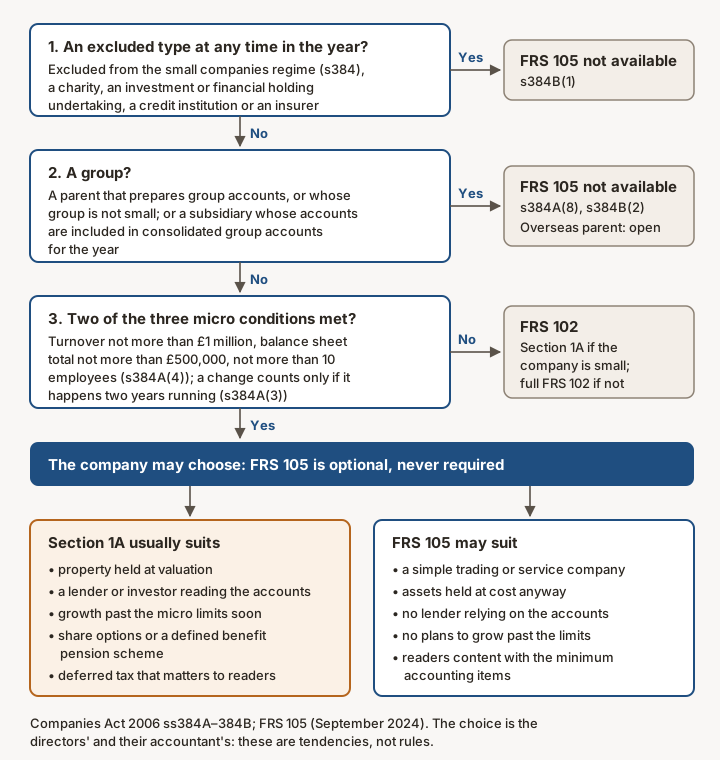
Only if it qualifies as a micro-entity for the year and nothing excludes it. It must meet the size test (a parent's group must also qualify as small), must not be an excluded type, and must not be a parent preparing group accounts or a subsidiary included in consolidated group accounts.
| Test | Rule | Source |
|---|---|---|
| Size | Two or more of: turnover not more than £1 million; balance sheet total not more than £500,000; not more than 10 employees on average (financial years beginning on or after 6 April 2025) | s384A(4) |
| Timing | First financial year: that year alone. After that, a change counts only once it happens in two consecutive years | s384A(1)–(3) |
| Excluded types | At any time in the year: excluded from the small companies regime by s384 (a public company, for example); an investment or financial holding undertaking; a CRR credit institution; an insurance undertaking; a charity | s384B(1) |
| Parents | Only if the group it heads qualifies as small; out if it prepares group accounts | s384A(8); s384B(2)(a) |
| Subsidiaries | Out if it is not itself a parent and its accounts are included in consolidated group accounts for the year | s384B(2)(b) |
| If not micro | Section 1A is open to a small company: two or more of turnover not more than £15 million, balance sheet total not more than £7.5 million, not more than 50 employees | s382(3) |
The balance sheet total is "the aggregate of the amounts shown as assets in the company's balance sheet" (s384A(6)). For a year beginning on or after 6 April 2025, earlier years are judged as if the new limits had applied (SI 2024/1303 reg 3). LLPs and qualifying partnerships can use the regime, and FRS 105, on equivalent conditions (FRS 105 1.5, A3.6). Qualifying as a micro-entity is a separate question from audit exemption: see audit exemption thresholds.
UK subsidiaries of overseas groups
Section 384B(2)(b) shuts out a subsidiary whose "accounts are included in consolidated group accounts for that year". The Act defines that as inclusion "by the method of full (and not proportional) consolidation" (s474(1)), so proportional consolidation does not trigger it. What the Act does not say is whether the consolidated accounts must be UK accounts, and neither FRS 105 ("those included in group accounts", A3.5) nor Companies House guidance settles whether an overseas parent's consolidation counts. Treat the point as open: a UK subsidiary fully consolidated by an overseas parent should take advice before using FRS 105, and Section 1A avoids the question. For the audit side, see whether a UK subsidiary needs an audit.
What is the difference between FRS 102 and FRS 105?
The difference between FRS 102 and FRS 105 that matters most is measurement, not disclosure: FRS 105 records almost everything at cost with no deferred tax; FRS 102 uses fair value where it requires or allows it, with deferred tax.
Investment property and revaluations
Under FRS 105, investment property is measured at cost less accumulated depreciation and impairment (12.14), so the building is depreciated, though land usually is not (12.15). Under FRS 102 it is measured at fair value at each reporting date, with changes in profit or loss (16.7), with exceptions for property let to another group company (16.4A) and for mixed-use property that cannot be valued reliably (16.4). FRS 102 also allows other property to be revalued (17.15); FRS 105 allows only the historical cost rules (A3.8).
Deferred tax
Does FRS 105 have deferred tax? No: its tax section "prohibits the recognition of deferred tax" (24.2). FRS 102 recognises deferred tax on timing differences, with limited exceptions (29.6), and on investment property at fair value usually uses the rates that apply to a sale (29.16).
Financial instruments and directors' loans
FRS 105 records a loan at "the amount borrowed or loaned" (9.5), undiscounted. FRS 102 measures a loan at a non-market rate at the present value of the payments (11.13), but a small entity may use transaction price for a loan from within a director's close family group that includes a shareholder (11.13A(a)). On the notes, see directors' loan account disclosure.
Leases and revenue from 2026
For periods beginning on or after 1 January 2026, an FRS 102 lessee puts most leases on the balance sheet, with optional exemptions for short-term leases and low-value assets (20.5); a car is not a low-value asset (20.11). FRS 105 keeps the finance and operating split (15.5), so operating leases stay off the balance sheet and the commitments go in the notes (6.2(d)). See FRS 102 lease changes.
From 2026 both standards use a five-step revenue model. FRS 105 applies its revised Section 18 only to contracts that begin after it first applies the 2024 amendments (1.11); FRS 102 applies Section 23 retrospectively, with or without restating comparatives (1.61). See FRS 102 revenue recognition.
Other differences
Borrowing and development costs are always expensed under FRS 105 and may be capitalised under FRS 102. FRS 105 ignores equity-settled share awards until shares are issued, where FRS 102 recognises the services as they are received (26.3), and it records pension contributions where FRS 102 measures the net defined benefit liability (28.15). Grants follow the accrual model under FRS 105 (19.7); FRS 102 also allows a performance model (24.4).
What the accounts show: disclosure, the true and fair presumption and filing
FRS 105 accounts can be limited to the minimum accounting items: the two statements and notes on off-balance-sheet arrangements, employee numbers, advances and guarantees to directors, and commitments and contingencies (6.2). They are then presumed in law to show a true and fair view (1.1, 3.2), and s393(1A) tells the directors to disregard any standard that would require more. If they add information, they must follow the standard that relates to it; FRS 105 points them to Section 1A (1.3).
Under Section 1A the accounts "shall give a true and fair view" (1A.5), and the directors may need disclosures beyond the minimum in Appendix C (1A.16A, 1A.17). See FRS 102 1A disclosure requirements.
At Companies House, a company in the small companies regime, micro-entities included, must deliver its balance sheet and may also deliver its profit and loss account and directors' report (s444(1)). On 23 October 2026 the government announced that it is pausing the requirement for small companies and micro-entities to file a profit and loss account from April 2028; see Companies House accounts filing changes.
One company, both frameworks: a worked example
An invented company prepares accounts for the year ended 31 December 2026. With turnover of £300,000 and three employees, it meets two of the three micro-entity conditions, this year and last, whatever its balance sheet shows. The assumptions:
- an investment property, let to an unrelated tenant, bought on 1 January 2021 for £400,000 (land £150,000, building £250,000) and valued at £650,000 at the year end; under FRS 105 the building is depreciated over 50 years, £5,000 a year;
- a five-year vehicle lease from 1 January 2026 at £6,000 a year, paid at each year end: discounted at 6% under FRS 102, an operating lease under FRS 105;
- an interest-free £30,000 loan from a director who is a shareholder, at transaction price under both;
- deferred tax under FRS 102 at the 25% main rate on the gain over cost, since the gain plus trading profit would exceed £250,000; reliefs ignored.
| Balance sheet at 31 December 2026 (£) | FRS 105 | FRS 102 Section 1A |
|---|---|---|
| Investment property | 370,000 | 650,000 |
| Right-of-use asset (vehicle) | – | 20,219 |
| Trade debtors | 20,000 | 20,000 |
| Cash | 45,000 | 45,000 |
| Balance sheet total | 435,000 | 735,219 |
| Trade creditors | (15,000) | (15,000) |
| Director's loan | (30,000) | (30,000) |
| Lease liability | – | (20,790) |
| Deferred tax | – | (62,500) |
| Net assets | 390,000 | 606,929 |
FRS 102 shows £216,929 more net assets: the £280,000 by which the valuation exceeds depreciated cost, less £62,500 of deferred tax and the £571 by which the lease liability exceeds the right-of-use asset. Under FRS 105 the lease is only a £24,000 commitment in the notes: a lender sees the property at £370,000 and no lease debt.
The extra net assets are not necessarily extra dividend capacity: only accumulated realised profits, less realised losses, can be distributed (Companies Act 2006 s830(2)), and whether a gain on an unsold property is realised is a matter of company law; FRS 105 says a company may refer to ICAEW and ICAS guidance TECH 02/17BL (A3.11). See distributable reserves.
The framework also moves the size test, which uses the assets "shown" in the balance sheet (s384A(6)): £435,000 under FRS 105, within the £500,000 limit; £735,219 under FRS 102, over it. This company still qualifies on turnover and headcount. The Act does not say which framework's balance sheet to test when deciding whether to switch; where it matters, take advice.
FRS 102 1A vs FRS 105: which should you choose?
If the company is eligible, the choice is the directors'. FRS 102 1A vs FRS 105 usually turns on who reads the accounts and what the company owns.
| Situation | Usually points to | Why |
|---|---|---|
| Property held at valuation, or a wish to revalue | Section 1A | FRS 105 allows cost only |
| A bank, investor or buyer reading the accounts | Section 1A | Values, leases and deferred tax are on the balance sheet |
| Growth past the micro limits within a year or two | Section 1A | Avoids two changes of framework in quick succession |
| Share options or a defined benefit pension scheme | Section 1A | FRS 105 records little of either |
| Part of a group, or a UK subsidiary of an overseas group | Section 1A | FRS 105 may be barred (s384A(8), s384B(2)) |
| An audit, required or chosen | Either | The auditor applies the same rules on what micro accounts must contain (s495(3A)) |
| A simple trading or service company with no property, lenders or growth plans | FRS 105 | Fewest notes, figures at cost |
Micro-entity accounts can be audited: see voluntary audit. Section 1A usually takes more preparation work. Take advice before choosing.
Can you change from FRS 102 to FRS 105?
Yes, for any financial year in which the company qualifies and is not excluded. Both are Companies Act individual accounts (s395(1); FRS 105 A3.7), and the limits on changing framework in s395 concern IAS accounts. The move is a first-time adoption of FRS 105 under its Section 28; a company that used FRS 105 before may instead apply it retrospectively (28.2).
Moving from FRS 102 to FRS 105
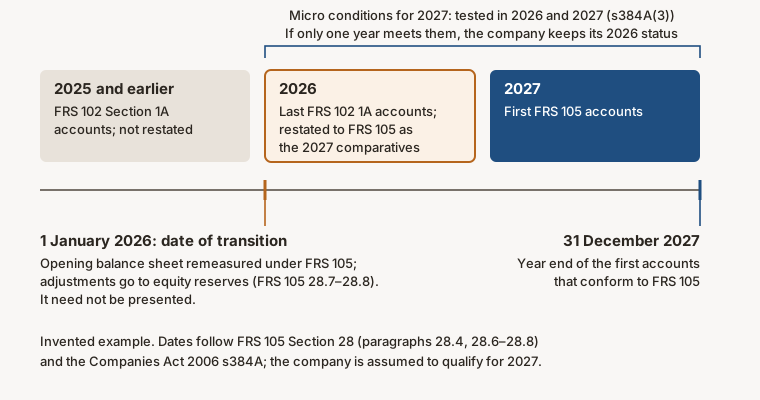
The date of transition is the start of the comparative year (28.6): the year of the last FRS 102 accounts, restated to FRS 105 (3.10, 28.6–28.7). At that date the company remeasures its balance sheet under FRS 105, removing what FRS 105 does not recognise, such as deferred tax (28.7). Valuations go back to depreciated cost, with a shortcut for investment property (28.10(c)). The adjustments go directly to equity reserves (28.8), and the opening balance sheet need not be presented (28.7).
FRS 105's transition section (28.1–28.12) requires no disclosure explaining or reconciling the move, unlike FRS 102 (35.13); anything the directors add is additional information (1.3).
Moving back to FRS 102
A company that stops qualifying must leave FRS 105; under UK GAAP that means FRS 102, with Section 1A while it is small: a first-time adoption under FRS 102 Section 35 (35.1). A company that used FRS 102 before may instead apply it as if it had never stopped (35.2); full FRS 102 also asks it to say why it stopped and why it is resuming (35.12C), which a Section 1A company gives only where a true and fair view needs it (1A.17). Section 1A requires an explanation of the transition's effect (1AC.41).
Timing
A change in size counts only once it has happened in two consecutive years (s384A(3)); an exclusion applies for any year in which it arises (s384B). For a year beginning on or after 6 April 2025, earlier years are judged at the new limits (SI 2024/1303 reg 3), so a company over the old limits may already qualify.
Tax
For a trading company, a change of accounting policy is a change of basis for corporation tax (Corporation Tax Act 2009 s180), and the adjustment is taxed as a receipt, or allowed as an expense, of the first period on the new basis (s181). A UK property business has equivalent rules (ss261–262); other income has its own. Take tax advice before the move.
When your company outgrows the micro and small regimes
Failing the micro-entity conditions in two consecutive years takes a company out of FRS 105, usually to FRS 102 with Section 1A while it stays small. Failing the small company conditions in two consecutive years takes it out of Section 1A, usually to full FRS 102, and, unless another exemption applies, an audit: see audit exemption thresholds.
Once the exemption no longer applies, Innate can arrange a statutory audit signed by an ICAEW-registered partner firm, which your company appoints as its auditor: get a quote. Our platform finds the data and documents and helps the audit team prepare its work, to save you questions, time and money.
A growing company also meets the 2026 lease and revenue changes when it moves to FRS 102: see FRS 102 changes.