Companies House accounts filing changes from April 2028: what goes ahead and what is paused
By Alon Zieve FCA · Last reviewed
Position at 26 October 2026. Software-only filing and three other changes are due to start on 1 April 2028. Profit and loss filing for small companies and micro-entities is paused, so abridged and filleted accounts continue. Change log.
Identity verification is a separate requirement: directors give their Companies House personal code with the company's next confirmation statement.
The Companies House accounts filing changes apply to every UK-registered company, including dormant ones, and to anyone who files accounts for them. Companies House has announced that from 1 April 2028 accounts can be delivered only through commercial software, in iXBRL; every company claiming an audit exemption will have to name the exemption and confirm it qualifies; the parts of the accounts will be filed together; and shortening the year end more than once in five years will need a business reason. The new audit exemption statement is already in legislation but awaits commencement regulations, and the regulations for the year-end limit have not yet been made. The plan to make small companies and micro-entities file their profit and loss account was paused on 23 October 2026. These are the accounts part of the Companies House changes under the Economic Crime and Corporate Transparency Act 2023 (ECCTA).
What are the Companies House accounts filing changes from April 2028?
Four measures go ahead on 1 April 2028: software-only filing, a stronger audit exemption statement, filing the parts of the accounts together and a limit on shortening the accounting reference period. Two are paused: profit and loss filing for small companies and micro-entities, and the removal of abridged accounts. One is expected to fall away, and one runs separately.
| Measure | What it means | Status at 26 October 2026 | Legal basis |
|---|---|---|---|
| Software-only filing | Accounts filed only through commercial software, in iXBRL; no web or paper accounts filing | Going ahead, 1 April 2028 | CA 2006 s1068(4), (4A): registrar's rules |
| Stronger audit exemption statement | Directors name the exemption and confirm the company qualifies | Going ahead, 1 April 2028 | ECCTA s57 (new CA 2006 s475(2)), prospective |
| Parts filed together | The component parts of the accounts and reports delivered together | Going ahead, 1 April 2028 | CA 2006 s1068A: registrar's rules |
| Limit on shortening the accounting reference period | A business reason to shorten more than once in five years | Going ahead, 1 April 2028 | "Subject to forthcoming regulations" (GOV.UK) |
| Profit and loss filing for small companies and micro-entities | P&L to be filed with Companies House | Paused | ECCTA ss53, 54, prospective |
| Removal of abridged accounts | Abridged accounts no longer allowed | Paused | ECCTA s58, prospective |
| Directors' report filing for small companies | Small companies to file the directors' report | Expected not to apply | ECCTA s54; directors' reports to be removed |
| Presenter identity checks; agents to be authorised (ACSP) | Whoever files must be verified; agents registered as authorised corporate service providers | No earlier than November 2027, with at least 6 months' notice | ECCTA ss66, 72 |
The four "going ahead" rows are the "From April 2028" list in Companies House's outline transition plan, as updated on 23 October 2026, which it calls "the current intended timetable".
What was paused on 23 October 2026, and why
The Small Business Regulatory Taskforce recommended (1a) that the government "should reverse the decision to remove the small company exemption from filing full accounts", because small businesses already give HMRC the same information. The government's response says it has "decided to pause implementing the P&L filing requirement while we explore options to streamline Companies House and HMRC filing processes", and "will provide further details about this in due course". The written ministerial statement of the same day (HLWS419) adds: "Other accounts reforms requirements, including mandatory software-only filing, will be implemented from April 2028 as planned."
When will small companies have to file their profit and loss account? No date has been set. The sections that would require it (ECCTA ss53 and 54) are in force only so far as they confer a power to make regulations; otherwise they are prospective, and the current rules continue. Companies House says that "as a minimum" a micro-entity or small company files its balance sheet and notes, and that both "will still be able to remove ('fillet') the profit and loss information" from the accounts they file.
Will my profit and loss account be published? Not if the company files filleted accounts. The June 2026 plan's opt-out from publication was designed for a filing requirement that is now paused. A pause is not a repeal: the provisions can still be commenced, and this page will be updated when the government says more.
Is this the end of abridged accounts?
No. The end of abridged accounts, announced in June 2026, is paused with profit and loss filing. Companies House now says companies "will continue to be able to file abridged and filleted accounts (without profit and loss data) at Companies House from April 2028", and the GOV.UK announcement says the government "will continue to allow companies to file abridged accounts". The provision that would remove them (ECCTA s58) has not been brought into force for that purpose.
What does change for these companies: from 1 April 2028 their accounts go through software, and if they claim an audit exemption they give the stronger statement.
Software-only filing from 1 April 2028
From 1 April 2028 every company's accounts go to Companies House through commercial software in inline XBRL (iXBRL), a format whose tagged figures a machine can read, whether the company or its accountant files.
Can I still file accounts on WebFiling or by paper? Only before the cut-over, and the two GOV.UK sources word it differently. Companies House's guidance "Using software to file your company's information" (updated 25 September 2026) says: "From this date, our web and paper-based services will be closed for accounts filings. This means there will be no transition period. Any accounts due after this date must be filed using software. This includes revised accounts." The Companies House campaign page says: "all accounts filings made on or after 1 April 2028 must be filed by commercial software". The first goes further: it adds a rule about accounts due after 1 April 2028, whenever they are filed. Neither source explains how the two fit together, so meet both: use software for any filing made on or after 1 April 2028, and for any accounts due after that date, even if you file early.
For a private company, which has nine months from its year end to file:
| Year end | Filing deadline | Web or paper possible? |
|---|---|---|
| 31 March 2027 | 31 December 2027 | Only if filed before 1 April 2028 |
| 30 June 2027 | 31 March 2028 | Only if filed before 1 April 2028 |
| 31 July 2027 | 30 April 2028 | No: due after 1 April 2028 |
| 31 December 2027 | 30 September 2028 | No |
In practice, 30 June 2027 is the latest month-end year end that can still go by web or paper, and only if filed before 1 April 2028. The table uses the ordinary nine-month deadline (s442(2) of the Companies Act 2006); first and shortened periods can differ (s442(3), (4)).
Package accounts (such as audit-exempt and dormant subsidiary packages and group package accounts) keep their own service, but must come from software that saves them as a ZIP file. WebFiling stays open for other filings, such as confirmation statements. The joint online accounts and Company Tax Return service already closed on 31 March 2026.
GOV.UK has a list of software for filing company accounts; not every product files every type of accounts. Even with an accountant, directors are "still legally responsible" for the accounts (see company directors' responsibilities). The legal basis is s1068(4) of the Companies Act 2006, which lets the registrar set the means of delivery and the software; since 4 March 2024 (ECCTA s75) that must be done by registrar's rules.
The stronger audit exemption statement
Today, an audit-exempt company's balance sheet must carry a statement by the directors that the company is exempt (s475(2) of the Companies Act 2006, "a statement by the directors to that effect"), plus the statements that the members have not required an audit and that the directors acknowledge their responsibilities (s475(3)). ECCTA s57 substitutes a new s475(2): no company is entitled to the exemption "unless its balance sheet contains a statement by the directors— (a) identifying the exemption in question, and (b) confirming that the company qualifies for the exemption." GOV.UK says this applies "From 1 April 2028" to every company claiming an exemption: small (s477), subsidiary (s479A) or dormant (s480). On 26 October 2026 no commencement regulations had been made (legislation.gov.uk), so whether it attaches to accounts filed from that date or to financial years starting after it is not yet settled.
Seen from the audit side, a statement that the company "qualifies" is a statement of fact above a director's signature. Before signing it, the directors need to have checked the size tests (with the two-year rule), the group conditions and the exclusions: see audit exemption thresholds. A subsidiary relying on its parent's guarantee names that route, with its own conditions: see the s479A parent guarantee. A company that finds it no longer qualifies needs an auditor in time to finish before the filing deadline (see UK audit requirements).
Filing the parts together
From 1 April 2028 the component parts of the accounts and reports are to be delivered together (Companies House transition plan). The power is s1068A of the Companies Act 2006, which lets registrar's rules require documents to be delivered together; s1068A(2) says a rule under s1068A(1)(a), for documents a company is required to deliver, may not require any document "to be delivered earlier than it would otherwise be required to be delivered". The deadline does not move, but one part can no longer be filed now and another later. For dormant subsidiary packages Companies House puts it plainly: "Currently, you can send the component parts to us separately ... From 1 April 2028, you will need to deliver all component parts together." For an audited company, nothing goes in until the auditor's report is signed.
Limits on shortening the accounting reference period
Today a company can shorten its accounting reference period "as often as you like" (GOV.UK). From 1 April 2028, Companies House says, "you will need to give a business reason if you want to shorten your company's accounting reference period more than once in 5 years". Its guidance adds that this "is subject to forthcoming regulations", and there is no amending text on legislation.gov.uk yet. Shortening matters because a shortened period can bring a new, later filing deadline (s442(4)).
Extending is already limited to once in five years, with exceptions (s392(3)), and to 18 months unless the company is in administration (s392(5)).
Changes to filing accounts, company by company
What each kind of company files now, and what changes on 1 April 2028 (software in every row).
| Company | Files now | Changes on 1 April 2028 |
|---|---|---|
| Micro-entity | Balance sheet and notes; P&L and directors' report optional; software or WebFiling | Software only; stronger statement if audit-exempt |
| Small, filleted or abridged | Balance sheet and notes (abridged with members' consent); P&L and directors' report optional | Software only; no change to what is filed while the pause lasts |
| Small, full accounts filed | Balance sheet, P&L and notes; directors' report optional | Software only |
| Small and audited | As above. If the P&L is filed, the auditor's report goes with it; if not, the notes name the auditor and say whether the report was qualified | Software only; all parts in one filing |
| Audit-exempt small company | Accounts with the s475 statements on the balance sheet | Software only; name the exemption and confirm the company qualifies |
| Medium or large | Full accounts, directors' report, strategic report, auditor's report unless exempt (medium may file a reduced P&L) | Software only; all parts together |
| Dormant | Dormant balance sheet; WebFiling if never traded | Software only; stronger statement for the dormant exemption |
| Subsidiary exempt under s479A | Its accounts, plus members' consent, form AA06 and the parent's consolidated accounts | Package service continues (ZIP from software); all parts together |
| UK subsidiary of an overseas group | No special rule: as its size class | As its size class |
The "files now" column follows s444 of the Companies Act 2006 and Companies House's guidance as updated on 23 October 2026. The s479A route needs a UK parent.
What directors should do before 1 April 2028
- Find out who files, and with what: you, your accountant or the group; WebFiling, paper or software.
- If you use WebFiling or paper, choose software now and file one set of accounts with it before the cut-over, checking it handles your type (abridged, audited, dormant or package).
- Map your year end to the table above. Accounts due after 1 April 2028 need software, however early you file.
- If you claim an audit exemption, check each year that the company qualifies, so that the new statement is true when a director signs it.
- If the company is audited, plan the audit back from the filing deadline. The auditor's report has to be signed before the accounts can go in, and from 1 April 2028 the parts are filed together.
- From 1 April 2028, do not plan to shorten the year end twice in five years without a business reason you can state.
- Monitor the registered email address, where Companies House said it would write.
- Watch the change log below. Late filing still brings a penalty.
If your filing deadline is approaching and the audit has not started, Innate offers statutory audits signed by an ICAEW-registered partner firm, which your company appoints as its auditor, with our platform doing the legwork: ask for a quote.
How the timetable has moved, and what could still change
Have the 2028 filing changes been delayed? Yes: from April 2027 to April 2028, and the profit and loss requirement is now paused.
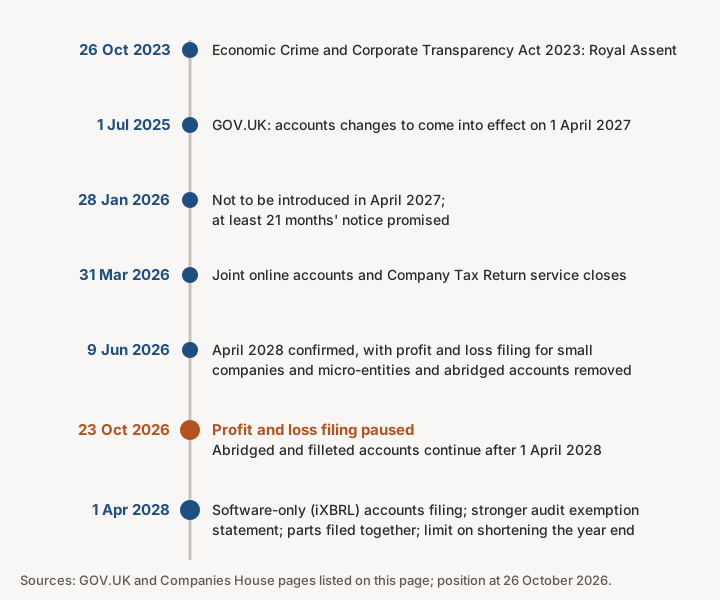
| Date | What GOV.UK said |
|---|---|
| 26 October 2023 | ECCTA received Royal Assent |
| 1 July 2025 | The accounts changes "will come into effect on 1 April 2027" |
| 28 January 2026 | "Changes to accounts filing will not be introduced in April 2027"; at least 21 months' notice promised |
| 31 March 2026 | The joint online accounts and Company Tax Return service closed |
| 9 June 2026 | April 2028 confirmed, with P&L filing for small companies and micro-entities (and an opt-out from publication) and the removal of abridged accounts |
| 5 August 2026 | Presenter identity checks and ACSP-only agent filing: no earlier than November 2027 |
| 23 October 2026 | P&L filing for small companies and micro-entities paused; abridged and filleted accounts continue; the other changes go ahead |
What could still change: any profit and loss requirement; the regulations behind the year-end limit and the commencement regulations for the new audit exemption statement, which is already in legislation; and the directors' report. Companies House expects the small-company directors' report filing change "will no longer apply" because the government intends to remove directors' reports altogether, which needs regulations not yet made.
This page's change log. 26 October 2026: first published, on the position of 23 October 2026.