Directors' loan account disclosure: the note under FRS 102 Section 1A and FRS 105, with examples
By Alon Zieve FCA · Last reviewed
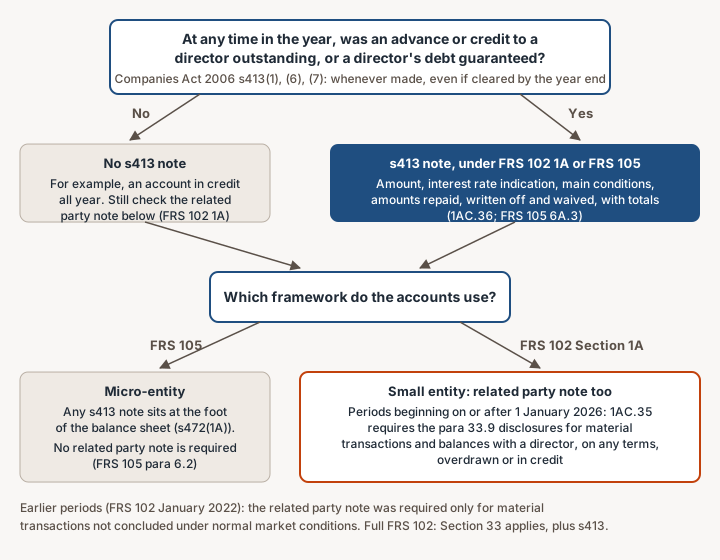
Every UK company that had an advance or credit to a director outstanding, or a guarantee of a director's debt in place, at any time in the financial year must give a directors' loan account disclosure in the notes to its accounts. That includes small companies using FRS 102 Section 1A and micro-entities using FRS 105. The note gives each advance's amount, an indication of the interest rate, its main conditions, and any amounts repaid, written off or waived, with totals (Companies Act 2006 s413); banking companies and the holding companies of credit institutions give only the totals of advances, credits and guarantees (s413(8)). It is needed even if the account was back in credit at the year end.
A directors' loan account (DLA) in credit, where the company owes the director, is not a s413 matter, though under the revised FRS 102 a small company may owe a related-party note on it. Below: what each note must say, one year of a DLA turned into both notes, and what an auditor looks at. For the wider duties, see company director responsibilities.
What a directors' loan account disclosure must show
Section 413 covers "advances and credits granted by the company to its directors" and guarantees given on their behalf. The Act does not define "advances and credits"; the everyday example is an overdrawn DLA: money the company has paid to or for a director that the director owes back.
| s413 item | What it means on a DLA | Where the figure comes from |
|---|---|---|
| (3)(a) its amount | What was advanced | Payments that took the account overdrawn |
| (3)(b) an indication of the interest rate | "Interest-free", or the rate charged | The loan terms, or the interest posted |
| (3)(c) its main conditions | For example, unsecured and repayable on demand | Board minute or loan agreement |
| (3)(d) any amounts repaid | Cash repaid, and salary, bonus or dividends credited to clear the balance | Credits to the account while overdrawn |
| (3)(e) any amounts written off | A balance the company has written off | Journal and board approval |
| (3)(f) any amounts waived | A balance the company has formally given up | Deed or resolution |
| (5) totals | Totals of (a), (d), (e) and (f), across all directors | Sum of the rows above |
For a guarantee, for example where the company guarantees a director's personal bank loan, the note gives its main terms, the maximum liability the company may incur, and anything paid or incurred under it, with totals of the last two (s413(4)–(5)).
The Act does not ask for the director's name, opening and closing balances, or the maximum balance in the year, and it has no de minimis. It also does not say how "its amount" is measured for a running account that goes up and down. A note that shows the opening balance, the amounts advanced, repaid, written off and waived, and the closing balance gives every figure s413 lists, whichever reading is taken.
Which balances need a note: overdrawn, in credit, and repaid before the year end
The note covers "every advance, credit or guarantee subsisting at any time in the financial year", whenever it was made and whether or not the person was a director when it was made (s413(7)). "Directors" means everyone who was a director at any time in the year (s413(6)). So the test is not the year-end balance.
| Situation in the year | s413 note? | Related-party note, FRS 102 1A (periods beginning on or after 1 January 2026)? |
|---|---|---|
| Overdrawn at the year end | Yes | Yes, if material |
| Overdrawn during the year, cleared by the year end | Yes | Yes, if material |
| In credit all year (the company owes the director) | No | Yes, if material, whatever the terms |
| In credit, interest-free or at a non-market rate | No | Yes, if material: the FRC names these loans (para B11.40) |
| Balance written off or waived | Yes: (3)(e) or (3)(f) | Yes, if material |
| Company guarantees a director's debt | Yes: s413(4) | Yes, if material |
| Director resigned during the year | Yes, if an advance subsisted in the year | Yes, if material, for the period as a director |
Under FRS 105 the right-hand column is "not required" in every row.
DLA disclosure under FRS 102 Section 1A
A small company using Section 1A meets s413 through paragraph 1AC.36 of FRS 102, which restates the section's requirements. The Periodic Review 2024 left the s413 note itself alone.
The related-party paragraph did change. For accounting periods beginning on or after 1 January 2026, or earlier where a company adopted the amendments early, which is permitted only if it applies all of them at the same time (FRS 102 para 1.37(b)), 1AC.35 reads: "A small entity shall provide the disclosures required by paragraphs 33.9 and 33.14, subject to the provisions of paragraphs 33.1A and 33.11." A director is key management personnel and so a related party (para 33.2(a)(iii)).
Paragraph 33.9 asks, at a minimum, for the nature of the relationship, the amount of the transactions, outstanding balances with their terms (including security and any guarantees), and any provision or expense for bad debts. Similar items may be aggregated unless separate disclosure is needed (para 33.14).
In the FRC's words, "For UK small entities, following the Periodic Review 2024 amendments, disclosure is now required of all related party transactions" (para B1A.10). Materiality applies to this disclosure (paras 1A.17A and 3.16B) but not to the s413 note: 1A.17A keeps disclosures "required by the Act regardless of materiality", and s413 has no materiality test.
For periods beginning before 1 January 2026, the January 2022 edition applied: a related-party note was required only for material transactions with a director "that have not been concluded under normal market conditions".
A small entity must also give anything else needed for a true and fair view (paras 1A.16 and 1A.17), and a medium-sized or large company using full FRS 102 applies Section 33 in full alongside s413. For the full Section 1A list, see FRS 102 1A disclosure requirements.
Example: an overdrawn directors' loan account disclosure note
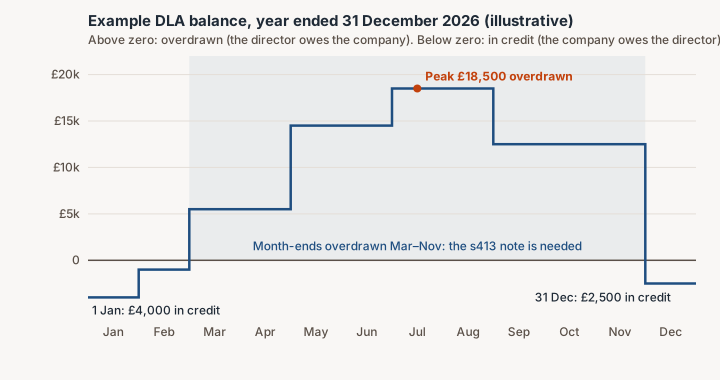
The figures below are illustrative, computed in code, for one director and the year ended 31 December 2026.
| Date | Entry | Balance after |
|---|---|---|
| 1 January | Opening balance | £4,000 in credit |
| February | Personal payments through the company, £3,000 | £1,000 in credit |
| March | Personal payments, £6,500 | £5,500 overdrawn |
| May | Personal payments, £9,000 | £14,500 overdrawn |
| July | Personal payments, £4,000 | £18,500 overdrawn |
| September | Repaid by the director in cash, £6,000 | £12,500 overdrawn |
| December | Dividend of £15,000 credited to the account | £2,500 in credit |
The payments total £22,500; the first £4,000 used up what the company owed the director, so £18,500 was advanced. The year end shows a £2,500 creditor, yet the account was overdrawn at nine month-ends, so the s413 note is required.
The DLA disclosure under FRS 102 Section 1A, as it might read:
Advances to directors. During the year the company advanced £18,500 to a director. The advances were interest-free, unsecured and repayable on demand. £18,500 was repaid in the year: £6,000 in cash and £12,500 by crediting part of a £15,000 dividend to the director's loan account. No amounts were written off or waived. The director is a related party. At 1 January 2026 the company owed the director £4,000; in the year the company paid £22,500 on the director's behalf, which settled that £4,000 and made up the £18,500 advanced. At 31 December 2026 the company owed the director £2,500, interest-free, unsecured and repayable on demand, included in other creditors; no guarantees were given or received and no provision for uncollectible amounts was needed.
With more than one director, totals follow. In the variant where no dividend is credited, the account ends the year £12,500 overdrawn: the note shows £18,500 advanced and £6,000 repaid, and the balance sits in other debtors.
A dividend credited to a DLA must itself be lawful, which depends on the company's distributable reserves.
Directors' loan disclosure under FRS 105 (micro-entities)
A micro-entity still gives the s413 note. FRS 105 keeps four notes for a UK micro-entity, and "advances, credit and guarantees granted to directors as required by section 413" is one of them (FRS 105 para 6.2(c), restated in para 6A.3 of FRS 105). The Act places it "at the foot of the balance sheet" (s472(1A)).
FRS 105 requires no related-party note. A micro-entity may add information, but is not required to (para 6.1), and in judging whether micro-entity accounts that contain only the minimum accounting items are true and fair, the directors disregard any accounting-standard provision that would require more (s393(1A)). A director's loan to the company, in credit, therefore needs no note under FRS 105.
The FRS 105 DLA disclosure for the same example:
| FRS 102 Section 1A | FRS 105 | |
|---|---|---|
| Where | Notes to the accounts | Foot of the balance sheet |
| s413 details | £18,500 advanced; interest-free, unsecured, repayable on demand; £18,500 repaid; nothing written off or waived | Same |
| Related-party paragraph | Relationship, the transactions (£22,500 paid on the director's behalf, of which £4,000 settled the opening balance owed to the director; the £6,000 repaid; the £15,000 dividend), year-end balance of £2,500 owed to the director and its terms (1AC.35, para 33.9) | Not required |
For choosing between the two standards, see FRS 105 vs FRS 102.
Is a directors' loan account a related party transaction?
Yes. A director is a related party, so movements on a DLA are related-party transactions, whichever way the balance runs. Whether they need a note depends on the standard, as set out above: under the revised Section 1A, material ones do, on any terms; under FRS 105, none do.
Take a director who lends the company £40,000, interest-free and repayable on demand. There is no s413 note, because the company has advanced nothing, but under the revised Section 1A a material loan of this kind needs a related-party note giving the relationship, the amounts lent and repaid, and the balance with its terms. The FRC says non-interest-bearing loans from directors "fall within the disclosure requirements of paragraphs 1AC.35 or 1AD.51" (para B11.40). How such a loan is measured is a separate question: FRS 102 para 11.13A lets a small entity measure initially at transaction price a basic loan from a person within a director's group of close family members (the director included), when that group contains at least one shareholder.
Where does a directors' loan account go on the balance sheet?
An overdrawn DLA is an asset: a debtor, under "Other debtors" in current assets in the statutory formats (SI 2008/409 Sch 1). Any part not due within a year is disclosed, usually in the notes, or on the face of the balance sheet if it is so material that readers might misread the accounts (FRS 102 para 4.4A).
A DLA in credit is a liability under "Other creditors". It falls due within one year unless the company has an unconditional right to defer settlement for at least 12 months (FRS 102 para 4.7), so a balance repayable on demand is a current liability.
Two directors' opposite balances are not netted without a legally enforceable right of set-off and an intention to settle net or simultaneously (FRS 102 para 11.38A).
What an auditor checks on a directors' loan account
Where the company is audited (see the audit exemption thresholds), DLA work in the audit centres on four points.
- Completeness of the movements. ISA (UK) 550 requires the auditor to ask management about related parties and their transactions (para 13) and to stay alert, when inspecting records, for ones management has not disclosed (para 15), such as personal spending never posted to the DLA.
- Recoverability. At each year end the company must assess whether there is objective evidence that a debtor at cost or amortised cost is impaired (FRS 102 para 11.21). For an overdrawn balance the auditor looks for evidence, such as repayment after the year end, that the director can repay.
- The disclosure itself. The auditor evaluates whether related-party transactions are "appropriately accounted for and disclosed" (ISA (UK) 550 para 25), checks the s413 details against the ledger, and obtains written representations from management (para 26).
- An omitted note. Section 498(4) requires the auditor to supply missing particulars of directors' remuneration, pensions and compensation for loss of office, not of s413 advances. If an omitted DLA note is a material misstatement, ISA (UK) 705 applies: the auditor discusses it with those charged with governance, describes the omission in the basis for opinion and, unless prohibited, includes the omitted disclosure where practicable and supported by sufficient appropriate audit evidence (para 23).
In its Audit Monitoring Report 2026, ICAEW reported "loans to/from directors and transactions with related companies not disclosed in the financial statements despite being evident from our review of information in the audit file" (p. 7). The cold file review guide for audit firms covers how reviewers test this.
A DLA reconciled to the bank every month makes this work faster; the year end audit checklist lists the rest of the file, and the first year audit guide covers a company's first. If your company's next audit is its first under the revised FRS 102, Innate offers statutory audits signed by an ICAEW-registered partner firm, which your company appoints as its auditor, with our platform finding the documents and reconciling the numbers: ask for a quote.
Common mistakes in the DLA note, and two figures that are not UK requirements
- Only the year-end balance. A DLA overdrawn mid-year and cleared by the year end still needs the note (s413(7)).
- No interest-rate indication, main conditions or totals. "Interest-free, unsecured, repayable on demand" takes one line, and s413(5) asks for the totals.
- No related-party paragraph under the revised Section 1A, especially for a director's loan to the company.
- Irish law in a UK note. Each director's name, opening and closing balances, a percentage of net assets and a €7,500 exemption are Republic of Ireland requirements under the Companies Act 2014 ss307–308, restated in FRS 105 Appendix B (paras 6B.19–6B.20). UK law asks for none of them, and has no de minimis.
- "£10,000" is not a disclosure threshold. Loans to a director whose aggregate value does not exceed £10,000 need no members' approval (s207), and a director has no taxable cheap-loan benefit while the total outstanding on all their cheap or interest-free employment-related loans stays at or below £10,000 throughout the tax year (ITEPA 2003 s180). A £2,000 advance still goes in the s413 note.
What sits beside the note: members' approval and tax
A company may not make a loan to a director unless the members have approved it by resolution, with a memorandum setting out the nature, amount and purpose of the loan (s197). No approval is needed from the members of a company that is not UK-registered or is a wholly-owned subsidiary (s197(5)). The Act sets further exceptions, such as the s207 one for small loans.
Tax is separate from the note. If a director who is also a shareholder still owes the company money nine months after the end of its Corporation Tax accounting period, the company may have to pay Corporation Tax on the loan; HMRC's guidance on director's loans sets out the rules for both the company and the director.