Distributable reserves: how to work out what your company can pay as a dividend
By Alon Zieve FCA · Last reviewed
A UK company can pay a dividend only out of its distributable reserves: its accumulated realised profits, less its accumulated realised losses (Companies Act 2006 s830). The figure is taken from the company's own last annual accounts, or from interim or initial accounts that meet the Act's conditions. It is often smaller than the retained earnings on the balance sheet, cash in the bank is not the test, and if the last audit report was qualified, the auditor must first say in writing whether the qualification matters for the dividend. This guide shows directors how to work out distributable reserves for dividends, step by step, with a worked example.
It is part of the series on company directors' responsibilities.
What are distributable reserves?
They are the profits out of which a company may lawfully make a distribution, such as a dividend, to its shareholders. The Act says "A company may only make a distribution out of profits available for the purpose", and defines those profits as "its accumulated, realised profits, so far as not previously utilised by distribution or capitalisation, less its accumulated, realised losses, so far as not previously written off in a reduction or reorganisation of capital duly made" (s830(1)–(2)). A dividend is a distribution; so, with listed exceptions such as bonus shares, is any other distribution of the company's assets to its members, in cash or otherwise (s829).
Four points follow from those words:
- Accumulated. All past years count together, so a loss this year does not by itself stop a dividend if enough earlier profit is left.
- Realised. As judged by accounting principles generally accepted when the accounts are prepared (s853(4)); the ICAEW and ICAS guidance is TECH 02/17BL.
- The company's own. Distributions are made by individual companies, not by groups, so group accounts are not relevant (TECH 02/17BL para 2.12).
- Measured from accounts. The items stated in the "relevant accounts" decide it (s836(1)).
Two further tests sit beside s830. A public company must also pass the net assets test in s831; this guide is about private companies. And the directors' duties still apply: before any distribution, directors "must therefore specifically consider whether the company will still be solvent following a proposed distribution" (TECH 02/17BL para 2.3A), and the general duty to promote the company's success gives way to any rule requiring them, in certain circumstances, to consider creditors' interests (s172(3)). A company can have the reserves and still not be able to afford the dividend.
Distributable reserves vs retained earnings: why they differ
Retained earnings, the profit and loss reserve under "Capital and reserves" on the balance sheet, is where the calculation starts, not where it ends. Two things open a gap.
Unrealised gains inside retained earnings. Some gains pass through profit or loss before they are realised. Under FRS 102, investment property is measured "at fair value at each reporting date with changes in fair value recognised in profit or loss" (FRS 102 para 16.7). TECH 02/17BL is direct about the result: "None of an increase in fair value of investment property is readily convertible to cash and is not therefore treated as a realised profit" (para 4.13). Those gains sit in retained earnings but normally cannot be paid out.
Realised amounts outside retained earnings. The revaluation reserve is unrealised when a building is revalued upwards. But each year the extra depreciation charged because of the revaluation is matched by a realised profit of the same amount (s841(5); TECH 02/17BL para 2.35). If the company has not moved that amount to retained earnings by a reserve transfer, part of the revaluation reserve is distributable.
Realised and unrealised is not a matter of whether cash has arrived. TECH 02/17BL treats a profit as realised where the company receives "qualifying consideration": cash, an asset readily convertible to cash, the release of a liability, or a receivable the debtor can settle within a reasonable period, is reasonably certain to be able to settle when called on, and is expected to settle (paras 3.9 and 3.11). The accounts themselves need not show which profits are realised (para 2.25), so the company should keep records that let it tell them apart (para 2.16).
How to calculate distributable reserves, step by step
Start from the right accounts
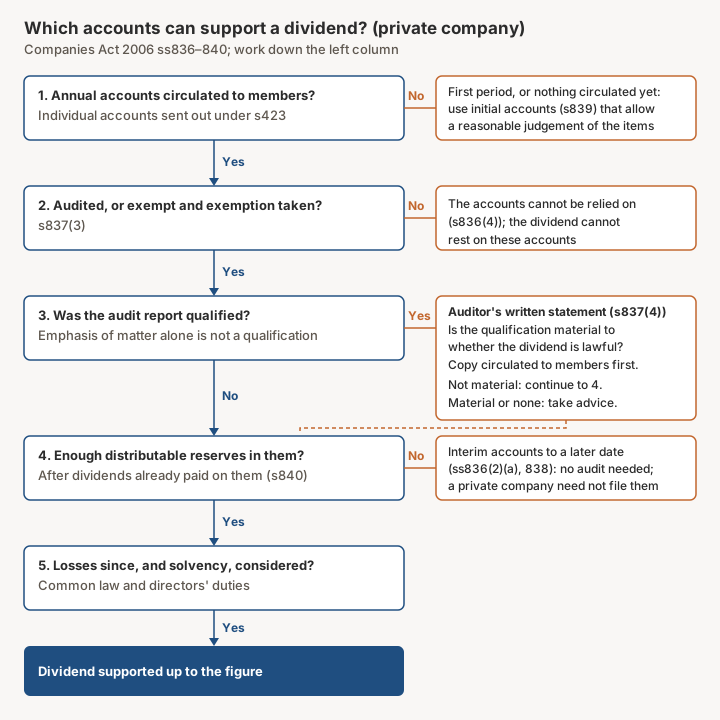
Use the company's individual accounts last sent to members under s423, not the group accounts and not a draft. In them, find "Capital and reserves" on the balance sheet and the statement of changes in equity, which shows how each reserve moved. The relevant accounts are the last annual accounts unless they do not show enough, in which case later interim accounts can be used, or, in a company's first accounting reference period or before any accounts for it have been circulated, initial accounts (s836(2)).
Take out what is not realised
Deduct unrealised gains inside retained earnings, such as fair value gains on investment property, net of the deferred tax on them (TECH 02/17BL para 3.10A(d)). Deduct profits on sales to group companies settled by a balance the other company cannot pay: the receivable is not qualifying consideration (para 3.11(d)). Add any realised part of other reserves, such as excess depreciation still in the revaluation reserve.
Deduct what has happened since
Two adjustments bring the figure up to date. Any dividend already paid by reference to the same accounts counts against them: the Act treats the proposed distribution as increased by earlier distributions made on the same accounts (s840(1)). And because a company cannot lawfully pay a distribution out of capital, directors must consider, both when the dividend is proposed and when it is made, whether losses since the balance sheet date have eroded the profits (TECH 02/17BL paras 2.2 and 2.28). The guidance gives no formula and says advice will be needed in specific cases (para 2.2); the worked example takes the cautious course and deducts the losses in full.
Check the result against cash and solvency
The figure is the legal ceiling. The board then checks the immediate cash effect and the company's continuing ability to pay its debts (TECH 02/17BL para 2.3A).
Worked example: from the balance sheet to the dividend limit
A hypothetical private company prepares FRS 102 accounts to 31 December 2025. They were audited, the report was unqualified, and they were circulated to members before the interim dividend shown below. Its profit and loss reserve was £480,000 at the start of 2025, and it made a loss of £68,000 in the year, leaving £412,000 on the balance sheet.
| Step | £ |
|---|---|
| Profit and loss reserve at 1 January 2025 | 480,000 |
| Loss for 2025 | (68,000) |
| Profit and loss reserve at 31 December 2025 | 412,000 |
| Less: fair value gains on investment property, net of deferred tax (unrealised) | (60,000) |
| Less: profit on equipment sold to a sister company, still owed and not collectable | (25,000) |
| Add: excess depreciation on the revalued building still in the revaluation reserve (s841(5)) | 9,000 |
| Distributable reserves per the 2025 accounts | 336,000 |
| Less: interim dividend already paid in March 2026 on these accounts (s840) | (50,000) |
| Less: losses January to June 2026, from the management accounts | (40,000) |
| Working limit for a further dividend now | 246,000 |
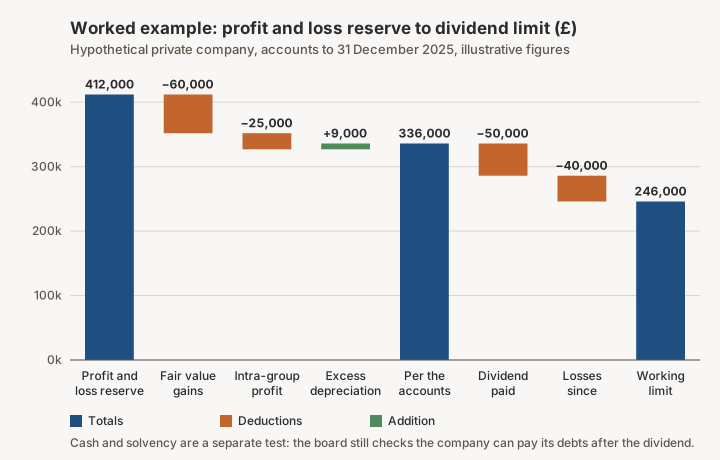
The gap between the balance sheet figure and the working limit is £166,000. The balance sheet also shows share premium of £50,000, which is not available, and a revaluation reserve of £120,000, of which only the £9,000 of excess depreciation is; the other £111,000 is not until it is realised, for example on a sale of the building.
If the profit were sitting in a subsidiary rather than in this company, it would first have to reach this company as a dividend before it could count here.
Which reserves are not distributable?
Share premium and the capital redemption reserve are not distributable. The revaluation reserve is not, except to the extent it has been realised, for example through excess depreciation or a sale of the asset. The profit and loss reserve is, less any unrealised profits in it, and the merger and fair value reserves depend on whether the profit in them has been realised. A reserve's name does not settle it. The common lines:
| Reserve | Distributable? | Why | Source |
|---|---|---|---|
| Profit and loss reserve (retained earnings) | Yes, less any unrealised profits in it | Usually realised trading profits, but can hold fair value gains | s830; TECH 02/17BL 4.13 |
| Share premium | No | The capital-reduction rules apply to it as if it were paid-up share capital | s610(4) |
| Capital redemption reserve | No | The capital-reduction rules apply to it as if it were paid-up share capital | s733(6) |
| Revaluation reserve | Not while unrealised; the excess-depreciation part is realised | Becomes realised through depreciation or disposal | s841(5); TECH 02/17BL 2.35, 3.9(f) |
| Merger reserve | Depends | In law a profit, initially unrealised; can become realised, for example on disposal or impairment of the investment | TECH 02/17BL 2.11, 9.44 |
| Fair value reserve | Depends | No specific legal bar; realised only if the gains are realised under the normal tests | TECH 02/17BL 4.25 |
| Cash flow hedge reserve | Generally not while in the reserve | Unrealised until the hedged transaction affects profit or loss | TECH 02/17BL 5.7 |
The articles and the common law can also restrict what may be paid, and those restrictions take precedence over the statutory figure (s851(1); TECH 02/17BL para 2.1B).
Relevant accounts: which accounts can justify a dividend
The Act names three kinds of relevant accounts (s836(2)): the last annual accounts, interim accounts and, for a new company, initial accounts. Each comes with conditions. If a condition is not met, the accounts cannot be relied on and the distribution is treated as contravening Part 23 (s836(4)).
| Accounts | When used | Conditions for a private company | Audit needed? | Filed? |
|---|---|---|---|---|
| Last annual accounts | The normal case | Individual accounts last circulated to members (s423); properly prepared, subject only to immaterial matters; audited unless exempt and the exemption taken; if the audit report was qualified, the auditor's s837(4) statement, circulated to members | Yes, unless exempt and the exemption taken | Yes, as annual accounts |
| Interim accounts | The last annual accounts do not show enough | Enable "a reasonable judgment" of profits, losses, assets, liabilities, provisions, share capital and reserves (s838(1)) | No | No |
| Initial accounts | First accounting period, or before any accounts are circulated | The same reasonable-judgment test (s839(1)) | No | No |
Accounts made up after the year end
The stricter interim-accounts rules in s838(2)–(6) apply only to public companies, so a private company's interim accounts need not be filed (TECH 02/17BL para 2.24), and no company's interim accounts need an audit (FRC bulletin para 16). TECH 02/17BL adds that "Reliable management accounts which deal with these matters will often satisfy this requirement", but warns that they sometimes leave things out, such as tax, and must then be adjusted. A management accounts pack that will support a dividend needs a full balance sheet, not just a profit and loss account.
When the audit report is qualified: the auditor's statement under section 837(4)
If the auditor's report on the last annual accounts was qualified, those accounts can support a dividend only once the company's auditor has stated in writing whether the qualification is material to whether the dividend would be lawful, and, for a private company, a copy of that statement has been circulated to members. The Act's words are that "the auditor must have stated in writing (either at the time of his report or subsequently) whether in his opinion the matters in respect of which his report is qualified are material for determining whether a distribution would contravene this Part", with the copy circulated to members under s423 (s837(4)). For a public company, the statement must be laid before a general meeting instead.
What counts as qualified. Part 23 has no definition of its own. The definition the Act gives for auditors' reports in Part 16 (s539) treats a report as qualified if it "does not state the auditor's unqualified opinion that the accounts have been properly prepared in accordance with this Act", which on its words takes in an "except for" opinion, an adverse opinion and a disclaimer. The FRC's bulletin on miscellaneous auditor reports (March 2020) says that a report expressing an unqualified opinion with an emphasis of matter or "other matter" paragraph "is not regarded as being qualified" (para 7).
What the auditor says. The statement says whether the qualification is material, either way; it is not a statement the auditor must make in one direction. A qualification is not material "if the financial effect of the matters giving rise to the qualification could not be such as to reduce the distributable profits below the levels required" for the distribution (para 10). Where its effect cannot be quantified, it would normally be material (para 12), and a disclaimer on the accounts as a whole would be material (para 13).
Future dividends. One statement can cover dividends not yet proposed if it "relates to distributions of a description that includes the distribution in question" (s837(5)). The FRC notes that the statement can be framed as the company's ability to pay up to a certain level (para 11).
Who gives it, and when. Only the statutory auditor who reported on those accounts can make it (para 15), as a separate statement or a paragraph at the end of the audit report (para 9), completed by the date of the distribution at the latest (para 14). It does not cover whether the company still has enough reserves when the dividend is paid; that remains the directors' job (Example 1).
If the auditor says it is material, the board should take advice before relying on those accounts. Interim accounts made up to a later date are the route the Act provides where the last annual accounts will not support the dividend (s836(2)(a)).
Companies exempt from audit. Where the company is exempt from audit and the directors take the exemption, the audit condition and the statement do not apply (s837(3)–(4); TECH 02/17BL para 2.19). That includes small companies under the audit exemption thresholds and subsidiaries using the s479A audit exemption.
A first audit is one place where a qualified opinion can arise, as the guide to a first year audit explains.
Before the accounts are signed: if the opinion will be qualified and a dividend is planned, ask the auditor for the s837(4) statement at the same time as the report.
Dividends in a group: subsidiaries, parents and overseas owners
A parent company can pay only out of its own distributable profits. A subsidiary's profit reaches the parent only when the subsidiary pays it a dividend, and that dividend income is a realised profit for the parent only if it is received in qualifying consideration (TECH 02/17BL para 9.5). A dividend from a subsidiary that is not in the parent's last annual accounts, for example one paid after the parent's year end, can count only through interim accounts that include it (s836(1); TECH 02/17BL para 2.14).
For an overseas group, the UK subsidiary's own individual accounts are the test, not the group reporting package: the last annual accounts are the company's individual accounts (s837(1)). If the subsidiary is audited, the s837 conditions apply to its audit report; whether it needs an audit at all is covered in the guide on whether a UK subsidiary needs an audit.
If a dividend exceeded the reserves. A shareholder who knew, or had reasonable grounds to believe, that a distribution was made in breach of Part 23 is liable to repay it, or the part made in breach (s847(2)). HMRC's manual says that for a director-shareholder of a private company it is expected that s847 will apply in the majority of cases, and that in a close company the amount is then regarded as a loan to the shareholder for corporation tax (HMRC CTM15205). The position of the directors who approved it is a matter for legal advice, taken early.
Approving the dividend: the minute, the voucher and what to keep on file
Who approves depends on the articles. Under the model articles for private companies, "The company may by ordinary resolution declare dividends, and the directors may decide to pay interim dividends", a declared dividend cannot exceed the amount the directors recommend, and, unless the resolution, the decision or the terms of the shares say otherwise, dividends are paid by reference to each shareholder's holding on the date of the resolution or decision (Model Articles, Sch 1 para 30(1), (2), (4)). A final dividend is made when it is declared; an interim dividend is normally made only when it is paid (TECH 02/17BL para 2.10). That date matters, because the reserves must be there when the distribution is made.
A board minute that will stand up later records:
- which accounts were used, their date, and whether the audit report on them was qualified (and, if so, the s837(4) statement);
- the distributable reserves figure and how it was reached, including dividends already paid on those accounts and losses since;
- that the directors considered the company's solvency and cash needs after the payment;
- the amount per share, the class, and the payment date.
The Act prescribes no voucher, but each shareholder usually receives one showing the company, date, shares held and amount. A voucher that still shows a "tax credit" is out of date: the dividend tax credit was replaced by the dividend allowance from April 2016. If a payment to a director-shareholder turns out not to be a lawful dividend, HMRC may treat it as a loan to them, as above, which brings in the rules on directors' loan account disclosure.
For an audited company, the last annual accounts, audited and circulated, are the usual relevant accounts. The articles and any shareholders' or lenders' agreements may add conditions of their own, so check them before the board meets.
If your investors have asked for an audit, tell us about your company: Innate offers statutory audits signed by an ICAEW-registered partner firm, which your company appoints as its auditor, with our platform doing the legwork to save you time and money.
What may change. The government's Modernising corporate reporting consultation, published on 7 September 2026, says it "is considering moving from the current dividend regime to a solvency-based regime" (para 113). The proposal "would be to require companies to state that the payment of the dividend will not affect the company's ability to continue as a going concern" (para 114), and question 16 asks whether respondents support it. The consultation closes at 11:59pm on 30 November 2026. Nothing has changed yet: until Parliament legislates, the realised profits test in s830 and the accounts rules in ss836 to 840 apply.