Does a UK subsidiary of a US or overseas company need an audit?
By Alon Zieve FCA · Last reviewed
Does my UK subsidiary need an audit? If the UK company belongs to a US or other overseas group, the answer usually turns on the size of the whole worldwide group, not the UK company. Broadly, a UK subsidiary of any size needs an audit once its group has been over at least two of three limits for two years running (£15 million turnover, a £7.5 million balance sheet total and 50 employees, for financial years beginning on or after 6 April 2025), unless it is dormant. The parent guarantee that UK groups use is not open to a parent established outside the UK. Below are the audit requirements for UK subsidiaries, in the order they apply, with a worked example of a group that reports in dollars.
This guide is part of our series on UK audit requirements.
Does my UK subsidiary need an audit? The short answer
Yes, unless it is exempt, and for a subsidiary the exemption depends on the group. A UK company's annual accounts must be audited unless it is exempt (Companies Act 2006, s475(1)). A small company is exempt (s477), but a company that was a group company at any time in the year keeps that exemption only if the whole group is small and not "ineligible" (s479(1)). So most UK subsidiaries of groups above the small-group limits (two years running, under the rule explained below) need an audit, however small they are on their own. The tests are the same whether the parent is a US company or any other overseas company.
Three exemptions can still apply to a UK subsidiary of a foreign company: small company in a small, eligible group (s477 with s479); dormant (s480); and the parent guarantee (s479A), which needs a parent established under UK law, so a US or other overseas parent cannot give it directly.
A UK branch is different: it is not a UK company. An overseas company (one incorporated outside the UK, s1044) with an establishment in the UK files its accounting documents under Part 5 of the Overseas Companies Regulations 2009 instead (reg 30), or Part 6 if it is a credit or financial institution.
The UK subsidiary audit requirements: four tests, in order
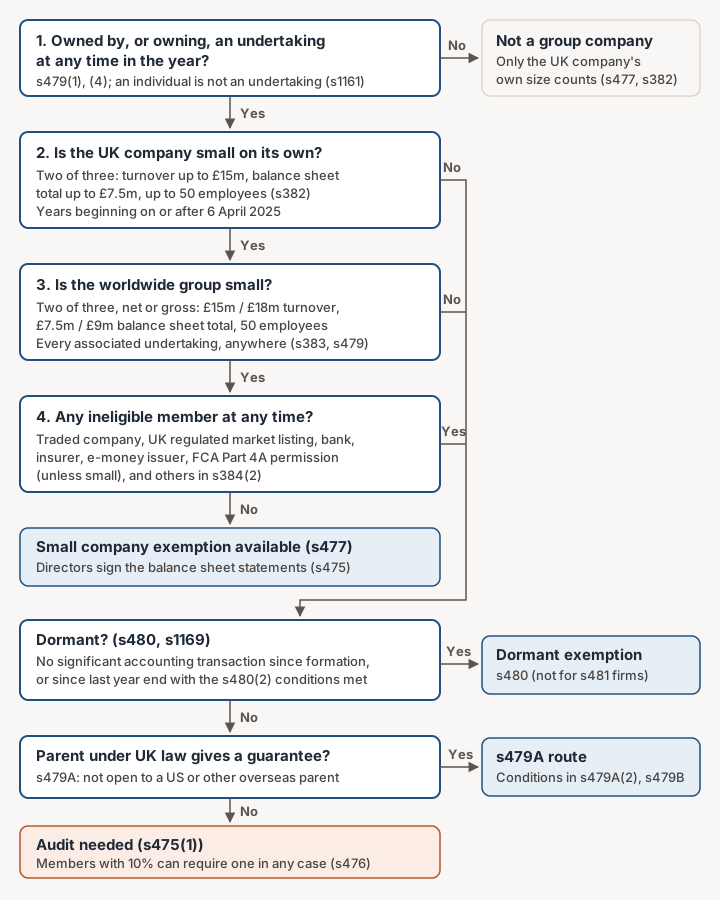
First, is the UK company a group company at all? It is if, at any time in the year, it was a subsidiary of a company or other undertaking (usually by being owned by it), or had a subsidiary of its own (s479(4), s1162). If not, only its own size counts. If it is, three tests follow. Fail any of them and the small company exemption is closed; the company then needs an audit unless it was dormant or a UK parent gives a guarantee.
Is the UK company small on its own?
A company is small if it meets at least two of three conditions: turnover of not more than £15 million, a balance sheet total (total assets) of not more than £7.5 million, and not more than 50 employees (s382(3)). These apply to financial years beginning on or after 6 April 2025; before that, the money limits were £10.2 million and £5.1 million. Our page on audit exemption thresholds has the full table.
A company qualifies in its first financial year on that year's figures (s382(1)). After that, a change counts only if it happens in two consecutive years (s382(2)). Some guides say a company must meet the conditions for two years before it can qualify at all; for a first year, the Act does not say that.
So, does a small subsidiary need an audit? Being small on its own is necessary but not enough: it still needs one if its group fails the next two tests.
Is the worldwide group small?
"The group" is the company and all its associated undertakings: its parent, its subsidiaries, and anything that shares a parent with it (s479(4)). That means the ultimate parent and every subsidiary it owns, anywhere in the world. The group must meet at least two of three conditions on aggregate figures: turnover of not more than £15 million net (or £18 million gross), a balance sheet total of not more than £7.5 million net (or £9 million gross), and not more than 50 employees (s383(4)).
Is the group ineligible?
Even a small group is closed to the exemption if, at any time in the year, any member was a traded company, a body corporate with shares admitted to trading on a UK regulated market, a person other than a small company with permission under Part 4A of the Financial Services and Markets Act 2000, an e-money issuer, a small company that is an authorised insurance company, bank, MiFID investment firm or UCITS management company, a person carrying on insurance market activity, or a Master Trust scheme funder (s384(2), applied by s479(5)(b)). For the group tests every body corporate in the group, wherever it is incorporated, is treated as if it were a company under the Act (s479(6)).
How to measure the worldwide group
Net or gross. "Net" means after eliminating transactions and balances between group members; "gross" means before. The group may use either for each condition, and may mix them (s383(6)).
Whose figures. The aggregate is the sum of each member's own figures (s383(5)), taken from each subsidiary's individual accounts for its year ending with the parent's, or the last one before it; if those cannot be obtained without disproportionate expense or undue delay, the latest available figures are used (s383(7)). Employees are each member's monthly average (s382(6)), added together.
Converting the group's dollars. Sections 382 and 383 state the limits in pounds and do not say which exchange rate to use. Our example uses the Bank of England's average US dollar rate for the year for turnover and its rate on the balance sheet date for assets. Whatever basis the directors choose, writing it down and using it every year makes the conclusion easy to check.
The two-year rule. After the first year, a change counts only if the group meets, or fails to meet, the conditions in two consecutive years (s383(3)). For years beginning on or after 6 April 2025, earlier years are judged as if the new limits had applied (SI 2024/1303, reg 3).
Worked example: a UK sales company in a US group
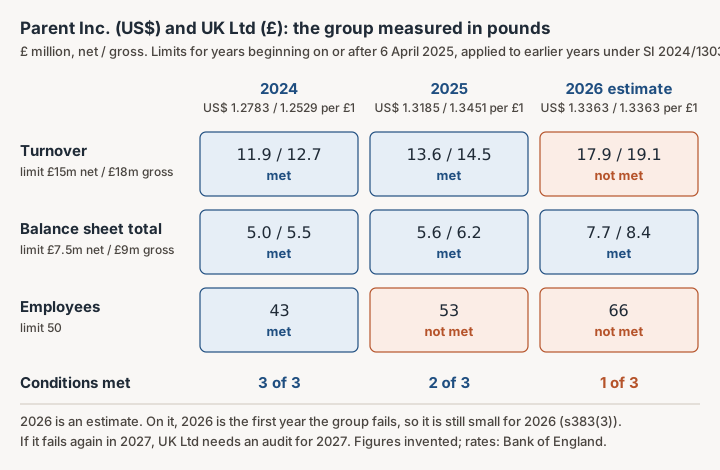
UK Ltd sells its US parent's products in the UK; Parent Inc. reports in US dollars, and both have 31 December year ends. In 2025 UK Ltd had turnover of £2.1 million, assets of £0.9 million and 6 employees, so it is small on its own. Assume the group was small in every year before 2024. The figures are invented; the rates are the Bank of England's. The 2026 column is an estimate: the group's budget, converted at the latest rate the Bank had published (22 October 2026) for both turnover and assets. The 2026 test itself is made on the actual figures and rates once the year has ended.
| £ million unless stated | 2024 | 2025 | 2026 estimate |
|---|---|---|---|
| Rate for turnover (US$ per £1) | 1.2783 (2024 average) | 1.3185 (2025 average) | 1.3363 (22 Oct 2026, stand-in) |
| Rate for balance sheet (US$ per £1) | 1.2529 (31 Dec 2024) | 1.3451 (31 Dec 2025) | 1.3363 (22 Oct 2026, stand-in) |
| Group turnover, net / gross | 11.9 / 12.7 | 13.6 / 14.5 | 17.9 / 19.1 |
| Group balance sheet total, net / gross | 5.0 / 5.5 | 5.6 / 6.2 | 7.7 / 8.4 |
| Group employees | 43 | 53 | 66 |
| Conditions met (new limits) | 3 of 3 | 2 of 3 | 1 of 3 |
- 2025, on the new limits: the group meets two conditions, turnover and balance sheet; 53 employees fails the third, which does not matter. This is how 2025 counts when 2026 is tested (reg 3).
- 2026 estimate: turnover fails on both bases. The balance sheet total fails net (£7.7 million against £7.5 million) but passes gross (£8.4 million against £9 million), so that condition is met. Employees fail. One of three: the group fails in 2026.
- The two-year rule: on the estimate, 2026 is the first year the group fails, so it is still small for 2026 and UK Ltd can still be exempt. If the group fails again in 2027, UK Ltd needs an audit for 2027.
- The old limits: the 2025 year began before 6 April 2025, so 2025 itself was measured on the old limits. On those the group failed for the first time in 2025 and was still small for that year: the same answer.
If the 2027 budget is also over the limits, plan to appoint an auditor during 2027.
Bought or sold during the year: the whole year counts
The group test applies to any financial year "during any part of which" the company was a group company (s479(1)). A UK company bought by a large group a week before its year end therefore needs an audit for that whole year, unless it was dormant or another exemption applies. A company sold out of a group during the year was also a group company for part of it, so the group test applies to that year too. The Act does not say which group is measured when a company has belonged to more than one during the year; that case is worth taking advice on.
The reverse case is the founder who owns a US company and a UK company personally. An "undertaking" is a body corporate, a partnership or an unincorporated association carrying on a trade or business (s1161(1)); an individual is none of these. Two companies owned by the same person are not associated undertakings: neither is the other's subsidiary, and they have no parent undertaking in common (s479(4)). Only the UK company's own size counts. Two traps: if the UK company owns a subsidiary itself, it is a parent and the group test applies; and if the founder holds the shares through a holding company or a partnership, that vehicle is an undertaking and the group test covers the whole structure.
Audit exemption for a subsidiary of a foreign parent: what is open
One subsidiary audit exemption UK groups rely on, the parent guarantee, is not open to a foreign parent directly. A UK company owned from abroad has three routes.
Small company in a small, eligible group: the tests above.
Dormant. A company is exempt if it has been dormant since formation, or since the end of the previous financial year and it meets the conditions in s480(2) (s480(1)). "Dormant" means no "significant accounting transaction", one that must be entered in the accounting records (s1169(1)-(2)). It does not mean no transactions at all: subscriber shares taken on formation, Companies House fees for a change of name, re-registration or the confirmation statement, and a late filing penalty are disregarded (s1169(3)). A subsidiary dormant throughout the time it is a group company is not caught by the group test (s479(3)), and a member of an ineligible group can still be exempt as dormant (s480(2)(a)(ii)); a traded company, bank, insurer and some other financial firms cannot (s481).
Parent guarantee. The s479A exemption needs a parent undertaking "established under the law of any part of the United Kingdom" (s479A(1)(b)). A group can put a UK holding company above the subsidiary to give the guarantee, but the subsidiary must then be included in that UK parent's consolidated accounts, and its directors must file a copy of those accounts and of the auditor's report on them at Companies House (s479A(2)(c), (e)): in effect, an audit of the UK parent's consolidated accounts in place of the subsidiary's own. A subsidiary that was at any time in the year a traded company, a bank, an insurer or one of certain other financial firms and bodies cannot use s479A (s479B). Our guide to the s479A audit exemption covers the conditions.
Does a US-listed parent make the group ineligible?
No, not on the listing alone. A parent whose shares trade only on the New York Stock Exchange or Nasdaq does not make the group ineligible for that reason. The ineligible-group test catches a "traded company" (s384(2)(a)): one any of whose transferable securities are admitted to trading on a UK regulated market (s474(1)). Transferable securities include bonds as well as shares (s1173(1); UK MiFIR, article 2(1)(24)). A UK regulated market is a regulated market that is a recognised investment exchange but not an overseas investment exchange (UK MiFIR, article 2(1)(13A)), and an overseas investment exchange has neither its head office nor its registered office in the UK (Financial Services and Markets Act 2000, s313(1)). An exchange based in the US is not a UK regulated market. A group member with shares or bonds admitted to trading on a UK regulated market, on the other hand, does make the group ineligible.
The test has not always read this way. Before SI 2015/980, s384(2)(a) caught "a public company" (the text at 1 January 2014), and s479(6) treats every body corporate in the group as a company, which is one reason older advice on overseas listed parents reads differently. SI 2015/980 substituted "a traded company" (reg 4(5)(b)) with effect for financial years beginning on or after 1 January 2016 (reg 2(2)); directors could apply the new rules to a year beginning in 2015, but not so as to gain an audit exemption the company would not otherwise have had (reg 2(3)).
A US group with a broker-dealer, a payments business or an insurer should still check each member against s384(2).
UK subsidiary requirements for a US company: the terms translated
For a UK subsidiary of a foreign company, the US terms map as follows.
| US term | UK position |
|---|---|
| Group audit of the parent (PCAOB or other) | Not a substitute. The UK company's own accounts need a UK statutory audit unless it is exempt (s475) |
| SOX 404 report | Management's assessment of internal control over financial reporting in a US issuer's annual report; its auditor attests to it unless the issuer is an emerging growth company or is neither an accelerated nor a large accelerated filer (15 U.S.C. 7262). No equivalent for a UK private subsidiary |
| PCAOB | The US board that oversees the audit of companies subject to the US securities laws and sets the auditing standards for issuers' audit reports (15 U.S.C. 7211(a), (c)(2)). A UK statutory auditor must instead be eligible under the Companies Act (s1212) |
| Reporting package | Not the statutory accounts, which the UK company prepares under the Companies Act |
| US GAAP | Not available for the UK company's accounts: Companies Act accounts (UK GAAP, such as FRS 102) or UK-adopted IFRS (s395(1)) |
| Group auditor, component auditor | The UK standard, ISA (UK) 600 (Revised), uses the same terms; a US parent's auditor works to its own, US, standards |
| Form 10-K deadline: 60, 75 or 90 days | Companies House: nine months after year end for a private company (s442(2)(a)) |
| Board of the Inc. | The UK company's own directors decide whether it is exempt and sign the statement (s475) |
None of the US audits is the audit of the UK company's own statutory accounts that s475 requires.
When your parent's auditor sends group instructions
Can the UK audit and the group audit be done together? Often, if they are planned early. The parent's auditor is the group auditor. It usually works to US auditing standards (for an SEC issuer, the PCAOB's: 15 U.S.C. 7211(c)(2)), decides whether to involve an auditor in the UK, and sends that auditor instructions. The UK standard, ISA (UK) 600 (Revised), uses the same words: the "group auditor" is the group engagement partner and team, and a "component auditor" is an auditor who performs audit work related to a component for the purposes of the group audit.
The timetables pull apart. A US company that reports to the SEC must file its Form 10-K within 60, 75 or 90 days of its year end, depending on filer status, so the group auditor needs the UK numbers within weeks. The UK company has nine months to file its audited accounts (s442(2)(a)). If the UK statutory auditor also acts as component auditor, with scope and timing agreed before the year end, one round of fieldwork can serve both: the group's deadline first, the UK accounts afterwards.
The instructions follow the group auditor's own standards, so they vary. Where a group audit is done under ISA (UK) 600 (Revised), as for a UK holding company's consolidated accounts, the group engagement partner must make sure component auditors know the ethical requirements, including independence, and confirm whether they will comply (para 25). Where the group's transactions, balances or disclosures are split across components for the audit work, the group auditor must also set a component performance materiality and a threshold for reporting misstatements, and give both to the component auditors (paras 35-36).
When the UK company needs an audit anyway, and what an exempt one still files
An audit anyway. Members holding at least 10% in nominal value of the issued share capital, or of any class, can require an audit by notice given no earlier than the start of the year and no later than one month before its end (s476). In a wholly owned subsidiary, that is the parent. Lenders, investors or the articles can also require one under their own terms. And some companies cannot use the small company exemption at any size: public companies, banks, insurers, e-money issuers, MiFID investment firms, UCITS management companies and a few others (s478).
What an exempt company still files. A private company still files its accounts at Companies House within nine months of its year end (s442(2)(a); a first period longer than twelve months has its own deadline, s442(3)). Its balance sheet carries the directors' statements: that the company is exempt, that the members have not required an audit, and that the directors acknowledge their responsibilities for the accounting records and accounts (s475(2)-(3)). Late accounts bring an automatic penalty for a private company: £150 up to one month late, £375 up to three months, £750 up to six months and £1,500 after that, doubled if accounts are late in two successive financial years (Companies House, January 2026).
Check the exemption every year. Whatever subsidiary audit exemption UK directors claim, the statements are a condition of it (s475(2)), not a substitute for qualifying. A company that does not meet s477 and s479 is not exempt, whatever its balance sheet says, and its accounts must be audited (s475(1)). The decision is the UK directors', not the group's: they sign the statement.
What to do next
| Situation | Audit needed? | What to do |
|---|---|---|
| Group over the limits this year and last | Yes | Appoint an auditor; plan the group and UK timetables together |
| Group over the limits for the first time | Not yet, if small last year | Re-test next year; budget for an audit |
| A member is UK-listed or a regulated financial firm (s384(2)) | Yes, unless dormant or a UK parent guarantees (s479A) | Check each member against s384(2) |
| Bought by a large group during the year | Yes, for that year | Appoint an auditor soon after completion |
| Dormant since formation, or since last year end with the s480(2) conditions met | No, unless excluded by s481 | File dormant accounts with the s475 statements |
| Owned by an individual, no subsidiaries | Only on its own size | Test the UK company's own figures |
| UK parent willing to guarantee | Possibly not | See the s479A route |
Gather: the group's figures for this year and last, with the exchange rate used; the ownership chain; any regulated or listed members; and the date the UK company joined the group.
Appoint: where a private company was exempt and had no auditor, its directors can appoint one at any time before the next period for appointing auditors (s485(3)(b)). Early in the first audited year lets the auditor plan around the group timetable.
For what the first year involves, see our guide to a first year audit; for budgeting, the average audit fee for UK companies; and for choosing, how to choose an auditor.
If your group's UK company needs a statutory audit, Innate offers one signed by an ICAEW-registered partner firm, which the UK company appoints as its auditor, with our platform doing the legwork to save you time and money: ask for a quote.