How much does an audit cost in the UK? Fees and what drives them
By Alon Zieve FCA · Last reviewed
How much does an audit cost in the UK? For a small or medium-sized company, the figure to start from is the Financial Reporting Council's: the average SME audit fee was £21,200 in 2024, 4.5% lower than in 2023. In the FRC's fee data, which uses the size limits in force before April 2025, medium-sized entities averaged £30,900 and small entities less. Your own fee depends on how much work your audit needs, and that turns on the size of the business, how many companies are in the group, the judgements in the accounts, how ready your records are and the deadline.
This guide is for directors and finance teams of UK private companies that need an audit, including UK subsidiaries of overseas groups. It explains what the FRC's figures do and do not tell you, what drives audit fees in the UK, why fees have moved, what a fee covers, and how to get quotes you can compare. For the wider picture, see UK audit requirements.
How much does an audit cost in the UK?
The short answer is the FRC's average: £21,200 for an SME audit in 2024. The FRC is the UK regulator for audit, and its SME Audit Market Study: Final Report (24 March 2026) is its most recent analysis of what small and medium-sized companies pay.
An average is a starting point for a budget, not a quote. Two companies with the same turnover can need very different amounts of work: one has a single bank account, clean reconciliations and no stock, while the other has three subsidiaries, a warehouse and a revenue line that depends on judgement. The section on what drives an audit fee sets out the factors and which of them you control.
Be wary of fee tables and "percentage of turnover" rules of thumb published online. A table published by a firm reflects that firm's own pricing, and a rule of thumb based on turnover leaves out most of what drives the work. Neither is market data.
Average audit fees in the UK: what the FRC's data shows
The FRC's final report gives these figures in its text.
| Measure | Figure | Year | Basis and source |
|---|---|---|---|
| Average audit fee, all SMEs | £21,200 | 2024 | 2% winsorised mean (para 17, footnote 6) |
| Change on the previous year | 4.5% lower | 2023 to 2024 | Nominal terms (para 17) |
| Average audit fee, medium-sized entities | £30,900 | 2024 | Still rising modestly in 2024 (para 18) |
| Average audit fee, small entities | Not stated in the text | 2024 | Fell between 2023 and 2024 (para 18) |
| Context: FTSE 350 companies | Around £3.9 million | 2024 | Footnote 5 |
| SME audits carried out | About 76,000 | 2024 | Up from about 62,500 in 2021 (para 8) |
| Audit firms active in the SME market | 2,638 | 2024 | Para 12 |
Four points matter when you use these numbers.
It is a trimmed average. The FRC used a 2% winsorised mean rather than a simple average, to reduce the influence of extreme outliers (footnote 6). It is neither a median nor a typical quote, and it hides a wide spread.
The size classes are the old ones. The data covers audits for 2024 year ends, so the FRC applied the size limits in force before 6 April 2025: small meant meeting two of turnover of £10.2 million or less, a balance sheet total of £5.1 million or less and 50 employees or less; medium meant two of £36 million, £18 million and 250 employees (footnote 3). The limits are now higher (next section), so some companies that count as small today were counted as medium in the FRC's data.
The FRC itself urges caution. It could not cross-check every data point, and it says some of the data "should be interpreted with a degree of caution" (footnote 2).
Earlier figures are superseded. The FRC's Emerging findings (July 2025) published averages for 2023 from the first phase of the study. Some of those earlier figures differ from the final report's, and the final report does not explain the difference. It builds on the earlier phase with further evidence (para 5) and is the one to rely on.
How much does an audit cost for a small company?
Less than for a medium-sized one, on the FRC's data. The report does not state the small-entity average in its text, so this guide does not give one; it says the small-entity average fell between 2023 and 2024 (para 18). With medium-sized entities at £30,900 and all SMEs at £21,200 (paras 17–18), the small-entity average sits below the SME figure.
First check whether you need an audit at all. A UK company qualifies as small if it meets two or more of these: turnover of not more than £15 million, a balance sheet total of not more than £7.5 million, and not more than 50 employees. Those limits apply to financial years beginning on or after 6 April 2025, and after the first year a change of size generally counts only once it has held for two consecutive years (Companies Act 2006 s382). A company that qualifies as small is exempt from audit (s477), subject to the exclusions in the Act: a company in a group, for example, generally keeps the exemption only if the group as a whole qualifies as small (s479). The guide to audit exemption thresholds covers the conditions.
Most micro and small companies can use an exemption, so an audit they obtain is voluntary (para 9). The FRC lists the usual reasons: requests from shareholders or other stakeholders, expected growth, and raising capital (para 10). In practice, stakeholders told the FRC that few are truly voluntary: most audits of small entities are due to group requirements (para 39). If your company is a UK subsidiary, see does my UK subsidiary need an audit; if a lender or investor has asked for one, see voluntary audit.
Why does a small audit still have a floor cost? The auditing standards, the ISAs (UK), apply to every statutory audit, whatever the size of the company. Stakeholders told the FRC the standards are written with larger audits in mind and that auditors may "over-audit" smaller companies as a result (para 22). The FRC disagrees that the standards cannot be scaled (para 63), and in March 2026 it published Practice Note 28, Guidance for audits of small and medium-sized entities, to help auditors scale the work proportionately (para 62).
What drives your audit fee
An audit fee follows the work the audit needs. The FRC's report links the two: limited preparation by an SME may cause inefficiencies, "resulting in higher audit fees and delays" (para 54), and the supervisory framework may discourage some auditors from a more proportionate approach, "leading to additional work being performed" (finding B). The engagement letter may set out the basis on which the fee is computed (ISA (UK) 210, para A24).
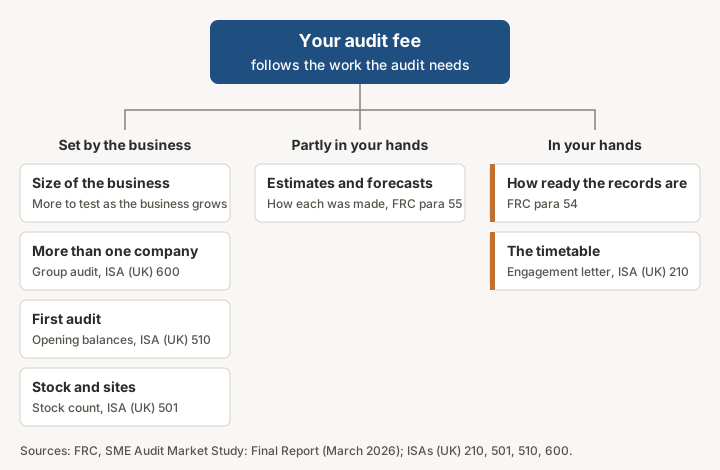
| Driver | Why it adds work | What you can do |
|---|---|---|
| Size of the business | More transactions and balances to test. The FRC's averages rise with the size class: £30,900 for medium-sized entities against £21,200 across all SMEs (paras 17–18) | Little, in the short term |
| More than one company | Group accounts are audited under ISA (UK) 600, and the group auditor's objectives include being sufficiently and appropriately involved in the work of any component auditors (para 13(c)). More entities, more work | Ask whether each subsidiary's audit and the group audit are quoted separately or together |
| First audit | In a first audit, or a first year with a new firm, the auditor must get evidence about whether the opening balances contain misstatements that materially affect this year's accounts (ISA (UK) 510, para 6). See first year audit | Keep good records of the prior year's closing balances |
| Stock | Where stock is material, the auditor attends the stock count unless that is impracticable (ISA (UK) 501, para 4). With several sites, ask how each count will be covered | Agree the count dates with the auditor before the year end |
| Estimates and forecasts | The FRC heard that SMEs may struggle to prepare forecasts and management assessments, including how to evidence an estimate (para 55) | Write down how each estimate was made, and prepare the going concern forecast early |
| How ready the records are | Limited preparation may cause inefficiencies, higher fees and delays (para 54) | Reconciliations done, supporting documents to hand, one person answering queries |
| The timetable | The engagement letter can record that management will provide the draft accounts and the information behind them in time for the agreed timetable (ISA (UK) 210, para A24) | Agree the timetable when you appoint, and keep to it |
Turnover is a proxy for the first row of this table only, so a fee band based on turnover cannot reflect the others. The quote checklist below asks for the facts behind every row, so that each firm prices the same audit.
Why have audit fees gone up?
For SMEs, they went up from 2021 to 2023 and then fell 4.5% in 2024, in nominal terms, on the FRC's figures (para 17). The FRC does not say what caused the rise. What it does set out is why SME audits can involve more work than necessary (auditing standards that stakeholders see as hard to scale, and an inspection regime that may discourage a proportionate approach), and that smaller firms' limited resources for technology could reduce their ability to achieve cost efficiencies.
If you have read that audits have become so expensive, check which market the figures describe. The Quoted Companies Alliance's research on listed companies, reported by ICAEW in March 2024, found fees rising sharply and attributed the rise to several factors, including fewer available auditors, increased financial reporting requirements and auditing standards, and fewer people entering the profession. Public Sector Audit Appointments appoints auditors to the local public bodies that opt into its national scheme and publishes a scale of fees for them, so stories about council audit fees describe a different system.
The FRC's findings on that extra work:
- Standards written for bigger audits. Stakeholders told the FRC that auditors struggle to scale the ISAs (UK) for smaller companies and "may 'over-audit'" (para 22). About half (52%) of SMEs surveyed thought company-law audit requirements caused excessive costs, and 29% wanted quicker, more efficient audits (para 24). The FRC itself disagrees that the standards cannot be scaled (para 63).
- Inspection pressure. The FRC found that the supervisory framework for SME audits "may discourage some auditors from adopting a more proportionate approach", leading to additional work being performed (finding B). Stakeholders described inspections focused on checklists and documentation (paras 34–36).
- Technology costs for smaller firms. Smaller audit firms may lack the resources to invest in audit technology, which could reduce their ability to achieve cost efficiencies (para 40).
Separately from the FRC's study, the standards themselves change. ISA (UK) 315 on risk assessment changed for periods beginning on or after 15 December 2021, and the revised standards on fraud (ISA (UK) 240 revised) and going concern (ISA (UK) 570 revised) apply to periods beginning on or after 15 December 2026. New requirements change the work.
Next, the FRC has sought views on the IAASB's standard for less complex entities, and said it would set up a working group with the professional bodies in the second half of 2026 to make inspections more proportionate (paras 61–71). It has not forecast the effect on fees, and neither does this guide.
What an audit fee includes, and what it doesn't
The terms of an audit, including its scope, are recorded in an engagement letter or a similar written agreement (ISA (UK) 210, para 10). The letter may also set out the basis on which fees are computed and any billing arrangements (para A24). Read it for three things:
- What is in scope. The audit of the accounts and the auditor's report. Ask whether the letter on internal control findings, group reporting for an overseas parent, and any separate subsidiary audits are included.
- What is not. Preparing the accounts, tax work and other services are not part of the audit. The FRC's Ethical Standard limits the other services an auditor may provide to an audited company, with extra flexibility for audits of small entities in its Section 6 (FRC final report, footnote 10).
- What triggers an extra fee. Ask for the triggers in writing: late or incomplete information, a change of scope and an issue found during the audit are the ones to cover.
Who agrees the fee? If the members appoint the auditor, the members fix the remuneration by ordinary resolution, or in the way they decide by ordinary resolution; if the directors appoint, the directors fix it (Companies Act 2006 s492). The fee is also disclosed: a medium-sized company's accounts must disclose the audit fee in a note, and a larger company's accounts must also disclose fees for other services from the auditor and its associates, with an exemption, on conditions, for the individual accounts of a parent required to prepare, and preparing, group accounts under the Act and of a subsidiary included in them (SI 2008/489, regs 4 to 6). A small company no longer has to disclose its audit fee (SI 2016/649, reg 18).
How to compare quotes from audit firms
Send every firm the same pack, so that each prices the same audit.
What to send:
- the last two sets of accounts, and the latest management accounts or trial balance;
- a group chart showing every company, and which need their own audit;
- the year end, the filing deadline and any deadline from a parent, lender or investor;
- the accounting system and any other systems that hold financial data;
- stock: whether it is material, and how many sites;
- known issues: a first audit, a change of accounting framework, an acquisition, a dispute, a large estimate;
- whether an overseas parent's auditor will send group reporting instructions.
What to ask:
- Is the fee fixed, or an estimate? What would change it?
- Which work is included, and which is quoted separately?
- Who will do the work, and who signs the report?
- What does the firm need from you, and by when?
For questions beyond price, see how to choose an auditor; if you are moving from an existing firm, see changing auditors.
Keeping the fee down
Preparation is the driver most in your hands, and the FRC links limited preparation to higher fees and delays (para 54).
- Have reconciliations done and supporting documents to hand on the first day. The year-end audit checklist lists what to prepare.
- Name one person to answer the auditor's queries.
- Agree the timetable, including the stock count, before the year end.
- Document how estimates and forecasts were made before the audit starts.
If you would rather spend year end on the accounts than on chasing documents, Innate offers statutory audits signed by an ICAEW-registered partner firm, which your company appoints as its auditor, while our platform finds the documents and reconciles the numbers: see how it works.
Is an audit worth what it costs?
Most of the audited SMEs the FRC surveyed thought so. In that survey of 400 SMEs that had been audited (para 5), 61% thought their audit fee was fair and 65% thought it reflected the audit quality, that is, good value for money. The FRC adds that the survey findings may not be representative of the whole market ("At a glance"). About half (52%) also thought company-law audit requirements caused excessive costs, yet 82% felt audit regulation was necessary for stakeholder confidence (paras 24–25).
Audit firms and the professional bodies told the FRC that audits were widely seen as delivering clear value, which may be particularly true where financial information is relied on for lending, capital raising or debt restructuring (para 47). Some firms added covenant tests that depend on audited figures (para 48). Some stakeholders had suggested that for smaller SMEs the cost of an audit could be disproportionate and outweigh its value (para 46).
If your company is exempt, check before you pay for an audit you do not need (audit exemption thresholds). If a lender or investor wants one anyway, the drivers and the quote checklist above apply to a voluntary audit just as they do to a statutory one.