Changing auditors in the UK: steps, letters and timing
By Alon Zieve FCA · Last reviewed
Yes, you can change your auditor. A UK company's auditor is appointed by its members (the shareholders), so changing auditors is the members' decision, and the outgoing firm cannot block it. There are three routes. The cleanest is to appoint the new firm during the period for appointing auditors: the 28 days that begin when your accounts are sent to members, or on the last day for sending them, if that comes first. The old auditor's term then simply ends, with no statement and no notice for most private companies. Mid-year, the auditor resigns or is removed at a general meeting, and the paperwork grows. This guide on how to change your auditor covers private companies, including UK subsidiaries of overseas groups; a public company follows the same pattern around its accounts meeting. It is part of our guide to UK audit requirements.
Can I change my auditor?
Yes. The members of a private company appoint its auditor by ordinary resolution (Companies Act 2006 s485(4)), and they can remove an auditor at any time (s510(1)). The directors appoint only before the company's first period for appointing auditors, after a period in which the company was exempt from audit and had no auditor, or to fill a "casual vacancy", when the office falls empty mid-term, for example because the auditor resigned (s485(3)).
How often should you change auditors? The law sets no interval for a private company. The Companies Act's limit on how long one firm may stay, the "maximum engagement period" (s494ZA), restricts reappointment only where the company is a public interest entity (s485C for a private one): broadly, companies with securities traded on a UK regulated market, banks and insurers (s494A). For everyone else a periodic review of the auditor is a governance choice, not a legal duty.
Does the old firm have to "clear" the change? No. The incoming firm must seek to contact the outgoing one before it accepts, but that is an enquiry about whether there is anything it should know, not a consent. The outgoing firm has no veto.
The three ways an auditor leaves office
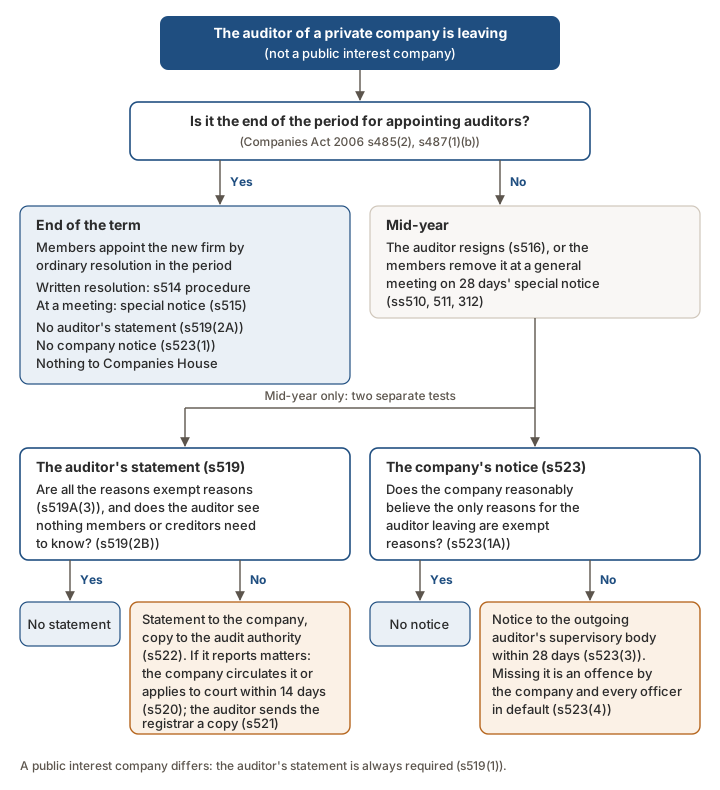
The route decides what each party must do.
| End of the term | Resignation | Removal | |
|---|---|---|---|
| Who acts | The members appoint the new firm during the period for appointing auditors (s485(4)(a)); the old auditor's term ends with that period (s487(1)(b)) | The auditor sends the company a notice of resignation (s516(1)); the directors may fill the casual vacancy (s485(3)(c)) | The members remove the auditor (s510(1)); the vacancy is then filled, often at the same meeting (s513(1)(b)) |
| Resolution or notice | Ordinary resolution; at a general meeting it needs special notice (s515(1)) | The auditor's notice, effective when received or on a later date it states (s516(3)) | Ordinary resolution at a meeting, on 28 days' special notice (ss510(2), 511, 312) |
| Written resolution allowed? | Yes, using the s514 procedure | No resolution needed to resign; the replacement is appointed to the casual vacancy | No (s288(2)(b)) |
| Outgoing auditor's statement (s519) | Not required (s519(2A)(a)) | Required, with the notice (s519(4)(a)), unless all reasons are exempt and there is nothing to report (s519(2B)) | Required within 14 days (s519(4)(c)), on the same exception |
| Company's notice to the audit authority (s523) | Not required (s523(1)(a)) | Required within 28 days, unless the company reasonably believes the only reasons are exempt (s523(1A), (3)) | Required within 28 days, on the same exception |
| Anything to Companies House from the company? | No | No (s517 repealed) | No (s512 repealed) |
For a public interest company the outgoing auditor must send a statement every time (s519(1)), a resignation is not effective without it (s516(2)), and the company's notice goes to the Secretary of State or the body the function is delegated to (s525(1)(a)); the Financial Reporting Council's (FRC) change of auditor flow chart tells a public interest company to notify the FRC.
Which route suits which case? If you can wait for the end of the term, wait: for a company that is not a public interest company it is the only route that never needs a statement or a notice. Resignation suits a change both firms agree on mid-year. Removal is for the rare case where the auditor will not resign and the members will not wait.
Changing auditors at the end of the term: the process step by step
This is the change of auditors procedure most private companies should use.
1. Choose the new firm before the window opens
The window is only 28 days, and nothing can be done inside it unless the new firm is ready to be appointed. Our guide on how to choose an auditor sets out what to check. A larger company may run a formal audit tender, which takes longer.
2. Let the new firm complete its acceptance
Before accepting, the new firm checks its independence from your company, its capacity and skills, and your identity under the anti-money laundering rules. It must also seek to contact your current auditor (ICAEW Code of Ethics R320.5) and, for an audit, ask for any facts it should know before deciding whether to accept (R320.8). It will usually need your permission, preferably in writing (320.5 A1). It then issues an engagement letter setting out the terms of the audit.
3. Pass the resolution in the period for appointing auditors
The members appoint the new firm by ordinary resolution during the period (s485(4)(a)), in one of two ways:
- As a written resolution, under the s514 procedure: the company sends a copy of the proposed resolution to the new firm and to the outgoing auditor; the outgoing auditor has 14 days from receiving it to make written representations; and the company circulates them with the resolution (s514(3)–(5)). If any step is missed the resolution is ineffective (s514(8)), which can leave the old auditor deemed reappointed. Send the copies early enough for the members to sign inside the window.
- At a general meeting, with special notice (s515(1)): notice of the intention to move the resolution must reach the company at least 28 days before the meeting (s312(1)), and the company sends a copy to both firms (s515(3)).
Members holding at least 5% of the voting rights (or less, if the articles say so) can also stop a deemed reappointment by notice received before the end of the accounting reference period immediately preceding it (s488). And if your articles require the auditor to be actually reappointed each year, there is no deemed reappointment at all (s487(2)(b)).
4. The old auditor's term ends
The old auditor leaves at the end of the period because it was not reappointed (s487(1)(b)), and the new firm takes office then (s487(1)(a)). For a company that is not a public interest company, no statement of reasons is needed (s519(2A)(a)) and no notice to the audit authority (s523(1)(a)).
5. Tell the people who rely on the accounts
The Act does not require it, but your bank, parent company and investors will want to know who the new auditor is. Check whether facility agreements, a shareholder agreement or group reporting instructions say anything about the auditor or the timetable.
When to decide: the window for your year end
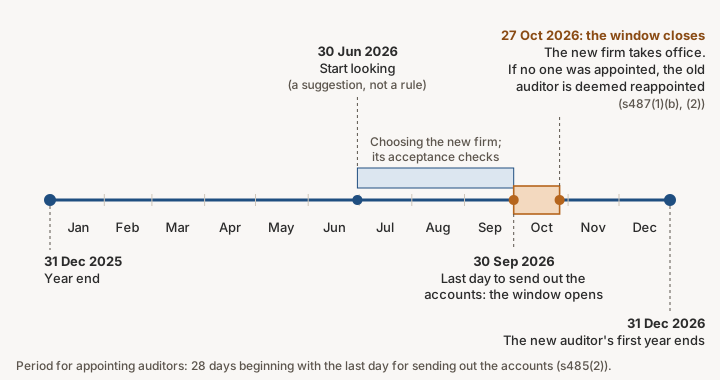
The period for appointing auditors is 28 days beginning with the end of the time allowed for sending out the previous year's accounts or, if earlier, the day they are actually sent out (s485(2)). For a private company, the time allowed ends with its nine-month filing deadline, or earlier if the accounts are filed at Companies House first (ss424(2), 442(2)(a)). The table gives the latest possible window for common year ends, assuming the accounts are not filed early, the accounting reference date has not changed and there is no filing extension. A firm appointed in that window audits the year already under way.
| Accounts for the year ended | Last day to send out the accounts | Latest period for appointing auditors | The new auditor's first year ends | Start looking by (a suggestion) |
|---|---|---|---|---|
| 31 December 2025 | 30 September 2026 | 30 September 2026 to 27 October 2026 | 31 December 2026 | 30 June 2026 |
| 31 March 2026 | 31 December 2026 | 31 December 2026 to 27 January 2027 | 31 March 2027 | 30 September 2026 |
| 30 June 2026 | 31 March 2027 | 31 March 2027 to 27 April 2027 | 30 June 2027 | 31 December 2026 |
| 30 September 2026 | 30 June 2027 | 30 June 2027 to 27 July 2027 | 30 September 2027 | 31 March 2027 |
| 31 December 2026 | 30 September 2027 | 30 September 2027 to 27 October 2027 | 31 December 2027 | 30 June 2027 |
| 31 March 2027 | 31 December 2027 | 31 December 2027 to 27 January 2028 | 31 March 2028 | 30 September 2027 |
| 30 June 2027 | 31 March 2028 | 31 March 2028 to 27 April 2028 | 30 June 2028 | 31 December 2027 |
| 30 September 2027 | 30 June 2028 | 30 June 2028 to 27 July 2028 | 30 September 2028 | 31 March 2028 |
"Start looking by" is three months before the latest window opens: a planning suggestion, not a rule.
Sending the accounts out early moves the window earlier. If a company with a 31 December 2025 year end sends its accounts to members on 15 June 2026, its period for appointing auditors runs from 15 June 2026 to 12 July 2026. Agree the new firm before you circulate the accounts, and put the appointment resolution in the same pack.
The deemed-reappointment trap. If the window closes with no appointment, the auditor in office is deemed reappointed (s487(2)) unless an exception applies, such as an auditor appointed by the directors. The company is then committed for another year, and changing sooner means a resignation or a removal.
Two cases that differ. In a company's first financial year, and when a company returns to audit after a period of exemption, the directors appoint the auditor at any time before the first or next period for appointing auditors (s485(3)(a)–(b)).
How long does it take to change auditors? The law sets no timetable beyond the window. The time goes on choosing the firm and its acceptance checks.
Changing auditor mid-year: resignation or removal
Changing auditor mid-year means the auditor leaves before its term ends, which brings duties the end-of-term route avoids. Either the auditor resigns, usually by agreement, or the members remove it.
By agreement: the auditor resigns
The auditor sends a notice to the company, effective on receipt or on a later date it states (s516(1), (3)). The directors can then fill the casual vacancy by appointing the new firm (s485(3)(c)), or the members can if the directors do not (s485(4)(c)). The auditor must send a statement of its reasons with the notice (s519(4)(a)) unless all its reasons are exempt and it sees no matters that members or creditors need to know (s519(2B)). If the statement reports matters, the auditor may requisition a general meeting to explain them, which the directors must convene within 21 days for a date not more than 28 days after the notice of it (s518(2), (5)).
Removal at a general meeting
How do you remove an auditor? By ordinary resolution at a meeting (s510(2)), never by written resolution (s288(2)(b)).
- Special notice. Notice of the intention to move the resolution must reach the company at least 28 days before the meeting (s312(1)); the company immediately sends a copy to the auditor (s511(2)).
- Representations. The auditor may make written representations, which the company must send to members with the notice of the meeting or have read out at it (s511(3)–(5)).
- The auditor's rights. A removed auditor can attend and be heard at the meeting where its term would have ended or the vacancy is filled (s513).
- Compensation. Removal does not take away compensation or damages due under the appointment (s510(3)), so read the engagement letter first.
The auditor's statement is then due within 14 days (s519(4)(c)), on the same exempt-reasons test.
The cost of changing mid-audit
Once the audit has started, the new firm repeats work the old one may already have done, and both firms' time has to be paid for. Unless something has gone wrong, it is usually better to let the current audit finish and change at the next window.
What your old and new auditor exchange, and why it can delay you
Before appointment: the professional enquiry. The new firm writes to your current auditor (often called a professional clearance letter) to ask whether there are facts it should know before accepting (ICAEW Code of Ethics R320.8). Your consent matters. If you give it, the current auditor must answer "honestly and unambiguously"; if you refuse, the current auditor tells the new firm so, and the new firm must weigh that before it accepts (R320.8(a)–(b)). If the current auditor does not reply, the new firm writes by recorded delivery, saying it will accept unless it hears within a specific and reasonable period (R320.6A).
After appointment: access to the audit work. Once formally appointed, the new firm can ask in writing for access to "all relevant information held by the predecessor in respect of its audit work", and the predecessor must allow it (Audit Regulation 3.09 of ICAEW, ICAS and Chartered Accountants Ireland, October 2026). The new firm uses this for the opening balances, the figures brought forward from last year, which the auditing standard on initial engagements requires it to cover (ISA (UK) 510); our guide to a first year audit explains what that involves.
What often causes delay is on the company's side: consent not given, the outgoing firm's last invoice in dispute, or records slow to arrive. The Code requires the outgoing firm to deal promptly with any reasonable request for the transfer of records, but it "may have the right of particular lien if there are unpaid fees" (R320.7C). Settling or agreeing the final invoice early removes that friction.
Who must be told when the auditor leaves
Do you need to notify Companies House of a change of auditor? No form goes from the company to Companies House. The sections that required the registrar to be told of an auditor's removal or resignation (ss512 and 517) were repealed from 1 October 2015 by the Deregulation Act 2015, and the confirmation statement does not record the auditor: it checks the registered office, directors, secretary, records address, share capital and shareholders, SIC code and people with significant control. On a resignation or removal, the law now requires:
- The outgoing auditor's statement (s519), unless all the reasons are exempt and the auditor sees nothing to report. A required statement with nothing to report says so (s519(3B)); one that reports matters gives details (s519(3A)). The auditor sends a copy to the audit authority at the same time (s522).
- The company's response to a statement that reports matters (s520). Within 14 days the company sends a copy to everyone entitled to receive the accounts, or applies to the court; otherwise every officer in default commits an offence (s520(2), (6)). Unless the auditor receives notice of a court application within 21 days of sending the statement, it sends a copy to Companies House within a further seven days (s521(1)).
- The company's notice to the audit authority (s523), in the box below.
The company's duty, and the directors' exposure: the s523 notice
When it applies. The auditor of a private company leaves at any time other than the end of a period for appointing auditors, and the company does not reasonably believe that the only reasons are exempt reasons (s523(1), (1A)).
What it says. What the company believes the reasons are, with the auditor's name and address, its number on the register of auditors, and the company's name and registered number. If the auditor's s519 statement arrived on time and the company agrees with it, a copy endorsed with the company's agreement will do (s523(2A)–(2C)).
When and to whom. Within 28 days beginning with the day the auditor leaves (s523(3)). For a company that is not a public interest company, to the outgoing auditor's recognised supervisory body: ICAEW, ICAS, ACCA or Chartered Accountants Ireland (s525(1)(b); FRC flow chart for companies). A public interest company notifies the authority named under the route table.
If it is missed. The company and every officer in default commit an offence (s523(4)), with a defence for anyone who took all reasonable steps and exercised all due diligence (s523(5)).
Reasons for changing auditors, and the exempt reasons that simplify it
Is it bad to change auditors? No. Companies change auditor because the business has grown, a group wants one auditor for all its companies, the service or fee no longer fits, or the firm stops doing audit work.
Four reasons are exempt reasons (s519A(3)). When every reason for a mid-year departure is exempt, the auditor need not send a statement if it sees nothing to report, and the company need not notify the audit authority if it reasonably believes those are the only reasons:
- The auditor is no longer to carry out statutory audit work (s519A(3)(a)), for example a firm that gives up audit registration.
- The company is, or is to become, exempt from audit under the small-company, subsidiary or dormant-company exemption (ss477, 479A, 480), or s482, and intends to include the exemption statement in its balance sheet (s519A(3)(b)). See the audit exemption thresholds and, for a subsidiary whose parent guarantees it, the s479A audit exemption.
- A subsidiary moving to the group auditor (s519A(3)(c)), but only where the parent is incorporated in the UK and prepares group accounts, and the group auditor also audits every UK subsidiary in the consolidation that has an audit (s519A(4)).
- The company is being wound up, or a winding-up petition is pending (s519A(3)(d)).
For a UK subsidiary of an overseas group, the third reason usually does not apply, because the parent must be incorporated in the UK. Moving a UK company to the overseas group auditor's UK firm mid-year is therefore not an exempt reason on that ground, unless a UK intermediate parent prepares group accounts and meets the condition. Align at the end of the term instead, and neither the statement nor the notice is needed. For the audit itself, see does my UK subsidiary need an audit.
The first year with a new auditor
The new auditor has to learn your business, systems and controls from scratch and obtain evidence on the opening balances, which takes more of your finance team's time. Ask the new firm early what it will need and when, and ask for the first-year fee and its assumptions in writing; our guide on how much an audit costs explains what drives fees. A handover pack saves time:
- last year's signed accounts and auditor's report;
- the trial balance and year-end reconciliations;
- the management letter (the auditor's points on controls) and your responses;
- the fixed asset register, loan agreements and significant contracts;
- board minutes and members' resolutions for the year;
- for a subsidiary, the group reporting instructions and timetable.
Switching to an auditor that uses Innate
Audits through Innate follow the same law as any other change of auditor. The auditor is an ICAEW-registered partner firm, which your company appoints, and which signs the audit report. Innate is a software company, not an audit firm, and is never the appointee. The partner firm runs its own acceptance and independence checks and makes the professional enquiry of your current auditor, and your members appoint it by the routes above, or your directors do if there is a casual vacancy. The handover is between the two firms. Innate's platform does the legwork for the partner firm's audit team: it gets the data and documents the audit needs from your records, reconciles the figures and helps the team prepare its work for review, and the team reviews that work and makes every judgement.
If you are looking for a new auditor, Innate offers statutory audits signed by an ICAEW-registered partner firm, which your company appoints as its auditor, with our platform finding the documents and reconciling the numbers: ask for a quote.