How to choose an auditor in the UK: what to check and the questions to ask
By Alon Zieve FCA · Last reviewed
How to choose an auditor for a UK company's statutory audit comes down to four things: confirm the firm is on the public Register of Statutory Auditors, know who will sign your report, ask how the firm is independent of you, and compare two or three firms against the same checklist and the same questions. This guide is for directors and finance directors choosing a statutory auditor (also called an external auditor) for a first audit or to replace a firm, including for a UK subsidiary of an overseas group. It gives the register check step by step, a checklist to score each firm, and the questions to ask before you hire. It sits in the UK audit requirements section.
How to choose an auditor: five steps
Choosing a statutory or external auditor takes five steps; most of the effort is in steps 3 and 4.
- Confirm that you need an audit, and by when. A company that qualifies as small is generally exempt from audit (Companies Act 2006 s477), but members holding at least 10% of the issued share capital can require one by notice given no later than one month before the year end (s476), and a lender, investor or parent may require one by contract; see the audit exemption thresholds. Then fix the date the audited accounts are needed. If this is your company's first statutory audit, allow more time.
- Shortlist two or three registered firms that audit companies of your size, sector and framework.
- Check each firm against the same checklist below.
- Meet the person who would sign your report, and ask each firm the same questions.
- Compare proposals on the same scope, then appoint.
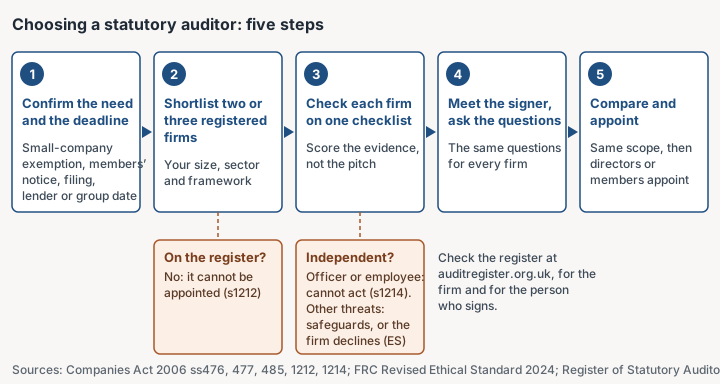
For a private company, the Companies Act prescribes a selection procedure only where the company is a public interest entity, and not even then for every such company (ss485A and 485B). Other private companies can run a short version of these steps; a formal audit tender is the longer version.
A note on our interest: Innate, which publishes this guide, is a software company. We introduce companies to an ICAEW-registered audit firm that uses our platform (our partner firm), and that firm, not Innate, is appointed as the auditor. Every check and question on this page applies to that firm as much as to any other.
Is the firm a registered auditor, and who will sign?
Only a firm or individual that is a member of a recognised supervisory body, and eligible under its rules, can be appointed as a statutory auditor (Companies Act 2006 s1212). When the auditor is a firm, the report is signed by the senior statutory auditor "in his own name, for and on behalf of the auditor" (s503(3)), and that person must also be eligible for appointment (s504(2)).
There are four recognised supervisory bodies: ICAEW, ICAS, ACCA and Chartered Accountants Ireland (CAI). A firm is registered by one of them, not by the Financial Reporting Council (FRC) directly: the FRC is the competent authority, which oversees the bodies and is responsible for the registration arrangements for audits of public interest entities. Under the audit regulations of ICAEW, ICAS and CAI, only a responsible individual can sign an audit report (regulation 4.04), and a firm is registered only if it has the professional indemnity insurance, or other arrangements, the regulations require (regulation 2.02(b)).
How to check an auditor is registered
- Go to the Register of Statutory Auditors at auditregister.org.uk, which covers all four bodies. On 26 October 2026 it showed 3,125 firms and 9,040 statutory auditors (last updated 23 October 2026).
- Search for the firm by name or registration number. One trading name can belong to several registered companies, so open the entry for the legal entity that will sign your engagement letter.
- On the firm's page, check the registration number, the registering body and the linked individuals. The "Statutory Auditor" column shows which of them are statutory auditors.
- Search for the person who would sign, by name. Their page shows their firm and whether they are a statutory auditor (the register says this is also known as the senior statutory auditor or responsible individual).
- If anything does not match, ask the firm, or the body that registers it.
Meeting the person who signs
Ask each firm to bring the person who would sign your report to the first meeting, and ask how you will reach them when a difficult accounting question comes up.
Can my accountant be my auditor?
An outside accountancy firm can be your auditor only if it is a registered audit firm, and it then has to address the threats to its independence that doing both creates. An officer or employee of the company, such as your finance director, cannot be its statutory auditor, and nor can a partner or employee of such a person; the same applies to officers and employees of its parent, its subsidiaries and its fellow subsidiaries (Companies Act 2006 s1214).
The FRC's Revised Ethical Standard 2024 says that keeping a company's records or preparing its accounts creates "principally self-review and management threats" (para 5.123). For a company that is neither listed nor a public interest entity (for which the Standard prohibits bookkeeping and preparing the accounts, Appendix B), the audit firm may still do this work if it does not take on management's role or initiate transactions, the work is "only of a routine or mechanical nature", and safeguards are applied (para 5.128), such as having the accounts work done or reviewed by people outside the audit team (para 5.131).
For small companies that are not public interest entities, Section 6 of the Standard offers an alternative: the firm need not apply those safeguards if the company has "informed management" and the firm extends its inspection of completed audits (para 6.7). In practice, someone in your company has to make the judgements and decisions on what the accounts present and disclose, and the file has to show it (para 6.8). Section 6 also has exemptions, for example letting the firm provide services that involve part of management's role if it discusses the independence issues with you and confirms that management accepts responsibility for the decisions (para 6.11); where a firm uses one of them, the audit report says so (para 6.15).
So ask a registered accountant which route it will use and who in your company will be the informed management. If your accountant is not registered, keep them for the accounts and tax and appoint a separate registered firm.
Big Four, mid-tier or a smaller firm: matching the firm to the company
Choosing an auditor by firm size is less useful than choosing by fit, which depends on what your company needs:
- Group structure. If your company is a UK subsidiary whose results feed a group audit, ask whether the firm has worked to a group auditor's instructions and timetable, and whether the group auditor expects a firm in its own network. See whether a UK subsidiary needs an audit first.
- Frameworks. FRS 102, FRS 105 or IFRS for the UK accounts, and perhaps a parent's reporting pack under another framework.
- Who reads the accounts. A facility or shareholders' agreement may say which firms a lender or investor will accept. Read it before you shortlist.
- Sector and public interest. Regulated sectors need a team that knows the rules. A public interest entity may face a selection procedure (ss485A and 485B), and the Ethical Standard's small-company provisions do not apply to it.
- Capacity. A firm that cannot staff your audit in your timetable is the wrong firm, whatever its size.
What to check: a checklist to score each firm
For each row, give each firm 0 (no evidence), 1 (a promise) or 2 (evidence you have seen).
| What to check | Why it matters | Good evidence | Score: A · B · C |
|---|---|---|---|
| Register entry | Only a registered firm can be appointed (s1212) | The register page, the registering body, the legal entity on the engagement letter | _ · _ · _ |
| The person who signs | They sign in their own name for the firm (s503(3)) | A named statutory auditor on the register, at the meeting | _ · _ · _ |
| Experience with companies like yours | The audit tests judgements specific to your business | Current audits of similar size, sector and framework, described without breaching confidentiality | _ · _ · _ |
| Quality and monitoring | A firm registered by ICAEW, ICAS or CAI must monitor its compliance at least once a year (Audit Regulation 3.20) and is subject to monitoring visits | How it reviews its own files; whether it will share the outcome of its last external review (it may decline) | _ · _ · _ |
| Capacity and timetable | Your filing, lender or group deadline | A dated plan from planning to signing, with a named team | _ · _ · _ |
| Your team's workload | Requests drive your finance team's time | A request list in advance, with dates; see the year-end audit checklist | _ · _ · _ |
| Data location and access | Your records leave your systems | Where data is held, who can see it, how long it is kept | _ · _ · _ |
| Software and AI tools | ISQM (UK) 1 requires appropriate technological resources; the FRC's June 2025 guidance covers documenting AI tools | What each tool does and who reviews its output; see the FRC's guidance on AI tools in audit | _ · _ · _ |
| Independence | s1214 and the Ethical Standard restrict who can audit you | A written list of other services, threats and safeguards | _ · _ · _ |
| Fee basis | You need to know what the fee covers | Fixed or estimated, the scope, rates for extra work | _ · _ · _ |
| Continuity | A new team each year relearns your business | A plan to keep the signer and the manager | _ · _ · _ |
Questions to ask an auditor before hiring
Good questions to ask an auditor have answers you can check. Ask every shortlisted firm the same ones.
About the people
- Who will sign our report, and how much will they review? Good answer: a named person on the register, and the stages they will be involved in.
- Who will run the audit day to day? Good answer: a named manager with experience of companies like yours.
- Will the same people be on the audit next year? Good answer: a continuity plan, honest about staff moves.
- Who will do the work, and where? Good answer: which parts, if any, another office, firm or contractor will do, and how the signer reviews them. Under the ICAEW, ICAS and CAI regulations, consultants and sub-contractors cannot be responsible individuals (regulation 4.03). See the guide to audit outsourcing.
About the work and the timetable
- When can you start, and when will you sign? Good answer: dates in writing that work back from your deadline.
- What will you need from us, and by when? Good answer: a request list before fieldwork, not a stream of emails during it.
- How will you raise and close queries? Good answer: one channel, a named contact, regular status updates.
- What happens if the timetable slips, on either side? Good answer: what triggers a re-plan and whether the fee changes.
- Which software and AI tools will the team use, and who reviews what they produce? Good answer: what each tool does, that the team reviews its output, and that people make the judgements. See how auditors use AI.
About independence, data and terms
- What other services do you provide to us or our group? Good answer: a written list and, if the firm prepares your accounts, its route under the Ethical Standard.
- Where will our data be held, and who can see it? Good answer: specific. A firm registered by ICAEW, ICAS or CAI keeps audit working papers for at least six years from the auditor's report (Audit Regulation 3.11), so ask what that covers.
- What is the fee basis, and what would change it? Good answer: the scope separated from the extras, with rates.
- What will the engagement letter cover? Good answer: a draft before you appoint.
How do you compare audit proposals and fees?
Compare proposals only once every firm has priced the same scope: the same entities, framework, deliverables and deadline. Then compare the fee basis, the timetable the firm commits to, what the request list asks of your team, and the people. What drives the fee is covered in how much an audit costs in the UK.
Read the scope wording too. An auditor is responsible for obtaining reasonable assurance that the financial statements as a whole are free from material misstatement, "whether caused by fraud or error" (ISA (UK) 240, para 5); the primary responsibility for preventing and detecting fraud rests with management and those charged with governance (para 4). A proposal that describes the audit as less, or more, than that deserves a question.
If you want an audit where software does the legwork and people make the judgements, Innate offers statutory audits signed by an ICAEW-registered partner firm, which your company appoints as its auditor: find out more.
Appointing the auditor you choose
For a private company, the directors may appoint the first auditor before the company's first period for appointing auditors, an auditor after a period in which the company was exempt and had none, or one to fill a casual vacancy (Companies Act 2006 s485(3)). Otherwise the members appoint by ordinary resolution (s485(4)), normally within the period for appointing auditors: 28 days beginning with the end of the time allowed for sending out the previous year's accounts, or with the day they were sent, if earlier (s485(2)).
A private company's auditor leaves office at the end of the next period for appointing auditors unless re-appointed (s487(1)(b)). If no auditor has been appointed by then, the auditor in office is deemed re-appointed unless an exception in s487(2) applies, and one exception is that the directors appointed it (s487(2)(a)). So if your board appointed the auditor, the members need to re-appoint it for the following year.
Before accepting, the firm runs its own checks. Auditors must apply customer due diligence when they take on a client (Money Laundering Regulations 2017, regs 8 and 27), which for a company means verifying its name, number and registered office and identifying its beneficial owners (reg 28(3) and (4)). If you are replacing an auditor, see changing auditors in the UK.
The terms are then agreed in writing. Under ISA (UK) 210 the engagement letter sets out the scope of the audit, the auditor's responsibilities and those of management (in the UK, of those charged with governance), the accounting framework and the expected form of the report (para 10). Read it before the board signs.