First year audit: what happens in your company's first statutory audit, and how to prepare
By Alon Zieve FCA · Last reviewed
A UK company's first year audit is an ordinary statutory audit with, for a company that was exempt last year, one extra job: last year's figures were never audited, so the auditor has to get evidence that the balances the company starts the year with are right. Where the audit arrives because the company stops qualifying as small, that takes two consecutive years over the limits; a new company that is too big from the start needs one in its very first year. The directors can appoint the first auditor. Appointing before the year end lets the auditor attend the year-end stock count, and where last year was unaudited the report on your first statutory audit will say that the comparative figures are unaudited. That statement is normal, and it is not a criticism.
Below: what changes, the legal points that catch companies out, a timetable and what to have ready. For the wider picture, see UK audit requirements.
When does a company need its first audit?
A UK private company needs an audit once it stops qualifying as small under the Companies Act 2006. To be small it must meet two or more of these: turnover not more than £15 million, balance sheet total not more than £7.5 million, and not more than 50 employees on average. These limits apply to financial years beginning on or after 6 April 2025. A small company stops being small only when it fails the test in two consecutive financial years (s382(2)); the audit exemption in s477 then no longer applies.
For a year beginning on or after 6 April 2025, earlier years are also judged against the new limits (SI 2024/1303, reg 3). See audit exemption thresholds for the limits.
Other routes lead to an audit even for a small company. A group company is exempt only if the group qualifies as small and is not an ineligible group (s479); see does a UK subsidiary need an audit. Members holding at least 10% of the nominal value of the issued share capital, or of any class of it, can require an audit by notice, given during the year and not later than one month before it ends (s476). Public companies and businesses such as banks, insurers and e-money issuers are excluded (s478). An investment or loan agreement can also require audited accounts; see voluntary audit.
Does a new company need an audit in its first year?
It can. A company's first financial year is judged on that year alone (s382(1)): there is no grace year and no separate first-year exemption. A new company that meets fewer than two of the conditions in its first financial year is not small, and needs an audit unless another exemption applies. There are then no prior-year figures, so the work on last year's balances and the statement about unaudited comparatives described below do not apply.
What if our first accounts cover more than 12 months?
A company's first accounting period can run for more than six and up to 18 months from incorporation (s391(5)). Where a financial year is not in fact a year, the turnover limit is adjusted in proportion (s382(4)). For an 18-month first period the turnover limit becomes £22.5 million; for 15 months, £18.75 million. Only turnover is adjusted; the balance sheet total and employee limits stay as they are.
What makes a first year audit different
Four things take extra time the first time.
Last year's figures were never audited. The exempt year's closing balances are this year's opening balances and feed into this year's profit, so the auditor needs evidence on them (next section).
The auditor starts from nothing. The audit team has to learn how sales, purchases, payroll and stock flow through your records, usually by following a transaction from start to finish.
Acceptance comes first. The audit firm runs its own checks before taking the appointment: independence checks, and the identity checks the Money Laundering Regulations 2017 require of an auditor taking on a new client (regs 8(2)(c) and 27(1)(a)). The terms are then agreed in writing, normally in an engagement letter (ISA (UK) 210, para 10).
Records are tested for the first time. Gaps that never mattered, such as missing stock sheets, unsigned contracts or an unreconciled directors' loan account, surface during the audit.
So year one usually takes longer than later years; on fees, see how much an audit costs.
Last year's unaudited figures: what the auditor checks
The governing standard is ISA (UK) 510, Initial Audit Engagements—Opening Balances, which applies where the prior period was not audited or was audited by another firm. The aim is enough evidence that the opening balances contain no misstatement that materially affects this year's accounts, and that accounting policies have been applied consistently (para 3).
In practice the auditor checks that last year's closing figures were brought forward correctly and reflect appropriate accounting policies, then gets evidence on them from this year's work or from procedures aimed at the opening balances (para 6).
Why stock is the hard one. Debtors collected and creditors paid during the year give some evidence on the opening amounts (para A6). Stock is different. Counting this year's closing stock says little about what was on hand a year earlier, and opening stock goes straight into this year's cost of sales and profit. If nobody from an audit firm watched last year's count, the auditor needs other evidence. The standard gives examples: observing a current count and reconciling it back to the opening quantities, testing the valuation of the opening items, and testing gross profit and cut-off (A6).
Other balances that commonly need work are fixed assets (cost and title, from the accounting records and invoices), loans and investments (sometimes confirmed with the lender or holder, A7), accruals, tax, and directors' loan accounts.
Will the audit report say last year was unaudited?
Yes. ISA (UK) 710 para 14 requires an "Other Matter" paragraph in the report saying the corresponding figures are unaudited. In the UK comparatives are usually corresponding figures (para 2-1), so the opinion covers this year only. The statement is not a qualification, and the same paragraph says it does not reduce the work on the opening balances.
Can a first year audit report be qualified?
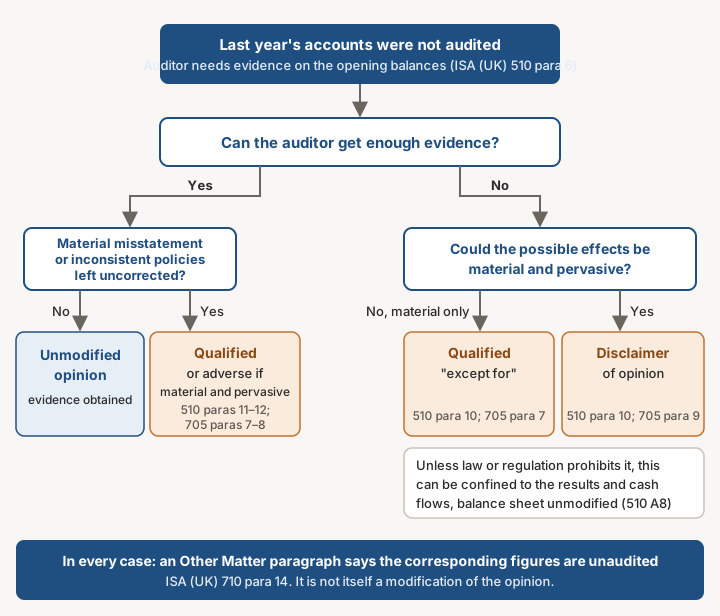
Yes, in three situations, all set out in ISA (UK) 510 and applied through ISA (UK) 705.
If the auditor cannot get enough evidence on the opening balances, the opinion is qualified ("except for") where the possible effects could be material but not pervasive, and disclaimed where they could be both material and pervasive (510 para 10; 705 paras 7 and 9). "Pervasive" means, broadly, not confined to particular items or, if confined, a substantial part of the accounts (705 para 5(a)). Unless law or regulation prohibits it, the qualification or disclaimer can cover only the profit and loss account and cash flows, with an unmodified opinion on the year-end balance sheet (510 para A8). The standard's own illustration shows this outcome: opening stock that could not be verified, a fairly presented balance sheet, and a qualification on profit and cash flows (there, the prior year had been audited by another firm).
If the auditor finds a misstatement in the opening balances that materially affects this year and it is not properly corrected or disclosed, the opinion is qualified, or adverse if the effect is material and pervasive (510 para 11; 705 paras 7 and 8).
If this year's accounting policies are not applied consistently with the opening balances, or a change of policy is not properly accounted for or disclosed, the opinion is likewise qualified or adverse (510 para 12).
Much of this is in the company's hands: keep last year's stock records and the accountant's working papers, and appoint the auditor in time for the year-end count.
Appointing your first auditor
The directors can appoint the first auditor. After a period in which the company was exempt from audit and had no auditor, the Companies Act lets them appoint "at any time before the company's next period for appointing auditors" (s485(3)(b)); for a new company's first financial year, "at any time before the company's first period for appointing auditors" (s485(3)(a)). If the directors do not appoint, the members can, by ordinary resolution (s485(4)). The appointment must be of a person or firm eligible under s1212: a member of a recognised supervisory body, such as ICAEW, who is eligible under that body's rules.
- Minute it. Record the appointment in a board minute, naming the firm and the financial year.
- Allow for acceptance. Expect the firm to finish its acceptance checks before it accepts, since the identity checks normally come before the business relationship is established (MLR 2017 reg 30(2)), and to send the engagement letter before the audit work begins (ISA (UK) 210, para A23).
- Appoint before the year end. The Act ties each year's appointment to a 28-day "period for appointing auditors" after the previous year's accounts are due to be sent out, or are sent out if that is earlier (s485(2)), but it does not say which window the "next period for appointing auditors" in s485(3)(b) means after an exempt year; if it has passed, the members can still appoint (s485(4)(b)). The practical deadline is the stock count: a firm appointed after the year end cannot attend it, and the stock problem described above then applies to the closing stock too.
- Year two needs a decision. A private company's auditor can be deemed reappointed each year without a resolution (s487(2)), but not where the auditor "was appointed by the directors" (s487(2)(a)). So after a first appointment by the board, the members need to reappoint for the second audited year.
Whether your current accountant can act is answered below; see also how to choose an auditor.
If this will be your company's first audit, tell us about it: Innate offers statutory audits signed by an ICAEW-registered partner firm, which your company appoints as its auditor. Our platform gets the information and documents for the audit team, to save you time and money.
First year audit timetable: from appointing the auditor to filing
Illustrative, for a private company with a 31 December 2026 year end that was exempt for 2025. Only the year end and the filing deadline are fixed.
| Stage | When (illustrative) | What the company does | First year only? |
|---|---|---|---|
| Forecast whether the audit is needed | During 2026 | Forecast the small-company test on 2025 and 2026; the 2026 result is certain only at the balance sheet date (s382(2)) | No |
| Choose and appoint the auditor | Before 31 December 2026 | Board minute (s485(3)(b)) | Yes |
| Acceptance and engagement letter | Before / on appointment | Identity documents; sign the engagement letter | Yes |
| Planning and walk-throughs | Before the year end | Explain systems; provide prior-year records for the opening balances | Opening balances: yes |
| Stock count | 31 December 2026 | Count with the auditor attending, where stock is material (ISA (UK) 501 para 4) | No |
| Draft accounts and schedules | Weeks after the year end | Trial balance, draft accounts, supporting schedules | No |
| Fieldwork | After the draft accounts | Answer queries; provide samples and confirmations | No |
| Completion | Before filing | Representation letter, going concern review, directors approve the accounts, the auditor signs | No |
| Filing at Companies House | By 30 September 2027 | Deliver the audited accounts (s442) | No |
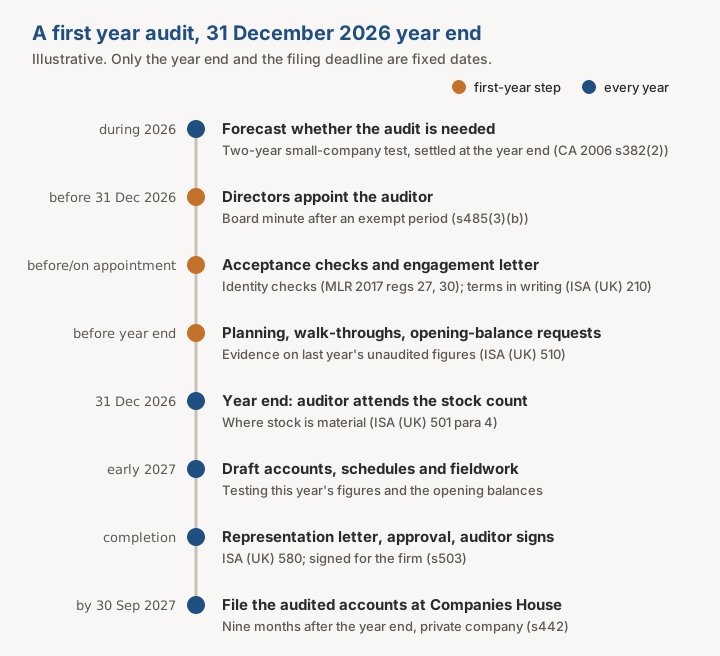
A private company files within nine months of the period end (s442(2)(a)): 30 September 2027 here. A first accounting period longer than 12 months has its own rule: the later of nine months from the first anniversary of incorporation and three months after the period ends (s442(3)). A different company, incorporated on 15 July 2025 with a first period ending 31 December 2026, would have until 15 April 2027.
At completion, the auditor asks the directors for a representation letter, dated as close as practicable to the date of the audit report but not after it (ISA (UK) 580, para 14). For the going concern review, management is asked to look at least twelve months ahead from the date the accounts are approved. The report is signed by the senior statutory auditor in their own name, for and on behalf of the audit firm (s503(3)).
How to prepare for your first audit
To prepare for your first audit, find last year's records before the auditor asks, appoint the auditor before the year end, and give one person in finance ownership of the requests. Many of the requests are for documents an exempt company never needed to produce.
What the auditor asks for that an exempt company may never have produced
| Item | Why it is needed | Who usually holds it |
|---|---|---|
| Prior-year stock count sheets and valuation | Evidence for opening stock, which drives this year's profit | Operations or warehouse; finance |
| Prior-year trial balance and the accountant's working papers | Shows the opening balances were brought forward correctly | The external accountant |
| Bank reconciliations at both year ends | Opening and closing cash | Finance |
| Aged debtors and creditors at both year ends | Payments after each date support the balances | Finance |
| Fixed asset register, with purchase invoices and title documents | Cost and ownership of the assets | Finance; company secretary |
| Loan, lease and hire purchase agreements | Terms, balances and security | Directors; finance |
| Significant customer contracts | When revenue is earned and on what terms | Sales; directors |
| Directors' loan account and related-party details | Disclosure, and possible tax consequences | Directors; finance |
| Board minutes, including approval of last year's accounts | Decisions, commitments and authority | Company secretary |
| Payroll reconciliations | Agree payroll costs to the payroll records | Payroll provider; finance |
| Going concern forecast | At least twelve months from approval of the accounts | Finance director |
| Letter of representation | Directors' written confirmations, signed at the end | Directors |
Agree the timetable in writing with the audit firm, and raise known problems before fieldwork rather than during it. A useful step before the audit is to read last year's balance sheet line by line and ask, for each figure, what the company would show to prove it. Where the answer is "nothing", fix it before the audit starts. For the checklist you will use every year, see the year-end audit checklist.
After the first audit: the management letter, filing and year two
During the audit, the auditor must tell those charged with governance in writing about any significant deficiencies in internal control it has found (ISA (UK) 265, para 9). This letter, which can also cover smaller points, is commonly called a management letter. Because the systems are being examined for the first time, the first one can be longer than later ones.
The audited accounts are then filed at Companies House with the auditor's report (s445(2) for a medium-sized company, s446(2) for a large one). The balance sheet no longer carries the statements that s475(2) and (3) require of a company claiming exemption from audit.
In year two, the opening balances have been audited, so the Other Matter paragraph about unaudited comparatives falls away and the opening-balances work shrinks. The audit team already knows your systems. One caution: if the first report was qualified over opening stock and the matter is unresolved, ISA (UK) 710 para 11 requires the second year's opinion to be modified as well. That applies even where the matter no longer affects the second year's own figures, because of its possible effect on the comparison between the two years (paras 11(b) and A4).
Questions directors ask about a first year audit
Does the auditor have to attend our stock count?
Where stock is material, yes, unless attendance is impracticable (ISA (UK) 501, para 4); inconvenience to the auditor is not enough (A12). If attendance is impracticable and alternative procedures do not give enough evidence, the opinion is modified (para 7).
Can our accountant also be the company's auditor?
Only if the accountant's firm is registered as an auditor (s1212), and no officer or employee of the company can be its auditor (s1214). Under the FRC's Ethical Standard, an audit firm may provide accounting services to a non-listed audited company only where they are routine or mechanical, do not take on part of management's role or initiate transactions, and safeguards are applied (paras 5.124 and 5.128). The extra dispensations for small entities apply only to companies that qualify as small (para 6.4), which a company audited because it has outgrown the limits does not.
Does it cost more the first time?
Usually, because of the opening-balances work, the walk-throughs and the acceptance checks; see how much an audit costs.
How long does it take the first time?
Longer than later audits, for the same reasons. The steps marked "first year only" in the timetable above are where the extra time goes.
Do we still need an audit if we drop back below the limits?
Yes, at first. A company that has stopped being small becomes small again only when it meets the conditions in two consecutive financial years (s382(2)).