Voluntary audit: audited accounts when the law does not require them
By Alon Zieve FCA · Last reviewed
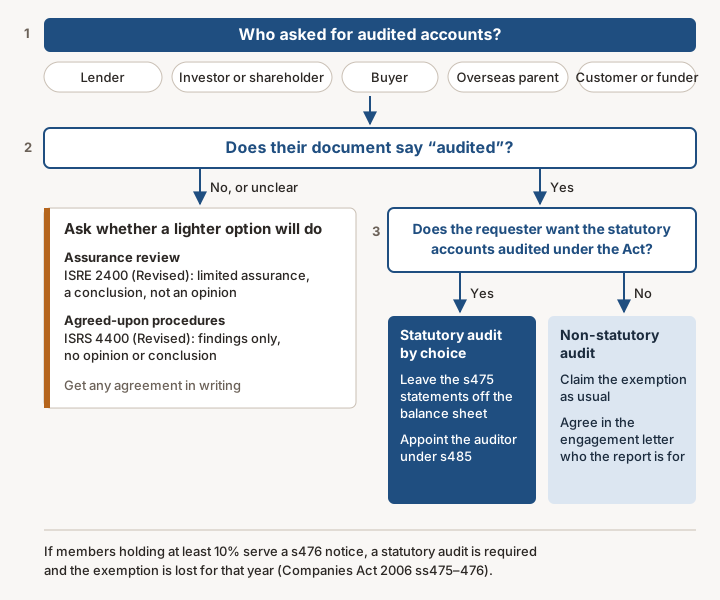
A voluntary audit is an audit of a UK company that is entitled to the audit exemption but has chosen, or been asked by a lender, investor, buyer or parent, to have its accounts audited anyway. It is the same audit work: a statutory audit follows the ISAs (UK), and a non-statutory one follows the standards its engagement letter sets. What makes it voluntary is the reason for it, not the work. There are two ways to have one. The company can simply not claim the exemption, so the audit is a statutory audit under the Companies Act 2006, or it can claim the exemption and commission a non-statutory audit under contract for the person who asked. And if the request does not actually say "audited", a review or agreed-upon procedures may be enough.
What is a voluntary audit?
It is a full audit of accounts that the law would let the company leave unaudited. The auditor follows the International Standards on Auditing (UK), the ISAs (UK) (on the non-statutory route, the standards the engagement letter sets), and gives an opinion based on "reasonable assurance": a high level of assurance, but, as ISA (UK) 200 puts it, "not an absolute level of assurance", because of the inherent limitations of an audit: most audit evidence is persuasive rather than conclusive.
Whether the law requires an audit depends on the audit exemption thresholds and the group test, which that guide sets out, within the wider picture of UK audit requirements; this page starts from the point where the answer is "no".
Many companies sit there. The Financial Reporting Council's SME Audit Market Study (final report, March 2026) counts about 76,000 audits of small and medium-sized entities in 2024 and says that most of the circa 1.3 million SMEs can use an exemption, so any audit they obtain "would be on a voluntary basis". The reasons it gives include requests from shareholders or other stakeholders, anticipated growth and raising capital. The study's emerging findings (July 2025) reported an interim survey result: of the surveyed SMEs that had had an audit, about 9% obtained one not required by statute. The final report does not restate that figure, and records stakeholders' opinion that there are few "truly" voluntary audits, because most audits of small entities are due to group requirements.
The line may move. The government's consultation Modernising corporate reporting (open from 7 September to 30 November 2026) asks whether the audit exemption should be extended to companies eligible for the medium-sized regime, and whether a voluntary assurance standard could give lenders the assurance they need at lower cost. It is a consultation, not law; the thresholds guide tracks it.
Two ways to have one: a statutory audit by choice, or a non-statutory audit
The choice is about the balance sheet statement. Under section 475 of the Companies Act 2006, a company is entitled to the exemption only if its balance sheet carries the directors' statements that the company is exempt, that members have not required an audit under section 476, and that the directors acknowledge their responsibilities for the records and accounts. Leave the statements out and the accounts "must be audited in accordance with this Part".
| Statutory audit by choice | Non-statutory audit | |
|---|---|---|
| Does the company claim the exemption? | No: the s475 statements are left off the balance sheet | Yes: the s475 statements stay on the balance sheet |
| How the auditor is engaged | Appointed under s485: by the directors where the company, being exempt, had no auditor (before the next period for appointing auditors, s485(3)(b)), or by the members by ordinary resolution in the cases s485(4) sets out | Under an engagement letter. The Act's appointment rules cover the company's auditor under Part 16: a private company's auditor may only be appointed under s485, s486 or s486A (s485(5)), and Part 42 of the Act defines a "statutory auditor" as a person appointed as auditor under Part 16 (s1210(1)(a)). This engagement is not made under those rules |
| Who the report is addressed to | The company's members (s495(1)) | Whoever the engagement terms name (ISA (UK) 700 para A21) |
| What the report says | Whether the accounts give a true and fair view, have been properly prepared under the framework and have been prepared in accordance with the Act (s495(3)) | What the engagement letter specifies |
| What goes to Companies House (small companies regime) | The auditor's report, if the profit and loss account is filed; if it is not, the balance sheet notes state whether the report was qualified and name the auditor and senior statutory auditor (s444(2), (5A)–(5B)). A micro-entity using the micro-entity provisions does not have to add those notes (s444(5C)) | The balance sheet with the exemption statements. The Act does not require an auditor's report to be filed when the exemption is taken (s444(2)) |
| Can members still require a statutory audit? | Not needed: the accounts are being audited under the Act | Yes: members holding at least 10% of the nominal value of the issued share capital, or of any class, can serve a s476 notice, and the company then loses the exemption for that year (s475(3)(a)) |
| Removing the auditor mid-term | Ordinary resolution with special notice (ss510–511) | As the engagement letter provides. Section 510 covers removing an auditor from office, and an auditor appointed under the Act holds office on the terms of that appointment (s487(1)) |
| Statement on leaving | A s519 statement, unless the auditor leaves at the end of a period for appointing auditors, or for exempt reasons with nothing to report (s519(2)–(2B)) | As the engagement letter provides. Section 519 covers an auditor ceasing to hold office |
| Stopping the next year | The auditor leaves office at the end of the next period for appointing auditors unless re-appointed (s487(1)(b)). There is no deemed re-appointment if the directors appointed the auditor, or if they resolve that no auditor be appointed for the year (s487(2)(a), (e)); s485(1) lets them so resolve where they reasonably decide that audited accounts are unlikely to be required | The engagement is not renewed |
The Act does not say in terms how it treats an audit commissioned purely by contract. The right-hand column says what the Act's provisions cover; for everything else, the engagement letter governs.
Not claiming the exemption
This route produces the ordinary statutory accounts and auditor's report that everyone recognises, on the public record. It suits a requester who wants "audited statutory accounts", and a company that expects to need an audit soon. The cost of the choice is the machinery: once appointed, the auditor holds an office under the Act, with the removal and resignation rules that go with it, and, unless the directors appointed it, it can be deemed re-appointed each year (s487(2)).
A non-statutory audit for one reader
Here the company files exempt accounts as usual and engages an auditor privately for the person who asked. ISA (UK) 700 says the report is addressed as the circumstances of the engagement require (para 22), and that law, regulation "or the terms of the engagement" may specify to whom (para A21). ICAEW's technical release on auditors' duty of care to third parties (TECH 01/03AAF) notes that in a non-statutory audit the usual "use of our report" wording refers to the purpose of the report instead of the Companies Act (para 12). This route keeps the public filing unchanged, and the engagement is not an appointment under the Act's appointment rules (s485(5)).
Which route the requester wants is usually in their own document. "Audited statutory accounts" or "accounts filed at Companies House with an auditor's report" points to the first. "Audited financial statements delivered to us" may be satisfied by either; ask before you choose.
Benefits of a voluntary audit, and what it will not do
The benefits are practical:
- Credibility with people who rely on the figures. Lenders, investors and buyers get an independent opinion, given under standards they know.
- Findings on controls. An audit is not designed to give an opinion on internal control (ISA (UK) 265 para 2), but the auditor must tell those charged with governance, in writing, about significant deficiencies found during the audit (para 9).
- Audited opening balances for a later statutory audit. When a company first needs an audit, the auditor must obtain evidence about the opening balances (ISA (UK) 510 para 6), and an engagement where the prior year was not audited is an "initial audit engagement" (para 4). If the immediately preceding year was audited, even voluntarily, that work is easier to support, and if the same firm did it the first required audit is not an initial engagement at all. The guide to your first statutory audit covers the rest.
- Group reporting. An overseas parent may want its UK company audited even where the law does not require it. For when the law does, see does a UK subsidiary need an audit.
What it will not do:
- It gives reasonable, not absolute, assurance (ISA (UK) 200 para 5).
- It does not make the accounts more private. On the non-statutory route the filing is unchanged. On the statutory route the filing usually adds to the public record: the auditor's report, or the details of it in the balance sheet notes (s444).
- A statutory audit report is not a report to a lender or buyer. ICAEW's recommended wording says the report is made "solely to the company's members, as a body", and the same release says this "simply clarifies to whom auditors owe duties as established by" Caparo Industries plc v Dickman. Where lenders or other third parties seek assurance, ICAEW says auditors "may discuss the possibility of separate engagements to provide specific assurances to them" (TECH 01/03AAF, paras 10, A3, A5). On the non-statutory route, the report is for whoever the engagement letter names.
When a lender asks for audited accounts
Lenders usually ask in the facility agreement's information undertakings: annual accounts, often described as "audited", delivered within a set number of days of the year end. Read three things in the clause:
- The word used. "Audited" means an audit. "Reviewed", "certified by the directors" or "accompanied by an accountant's report" do not.
- The deadline. A late delivery can be a breach of the agreement, so the timetable has to work from the year end, not from the date someone remembers the clause.
- Reliance. A statutory audit report is made to the members. If the lender wants assurance addressed to it, that is for a separate engagement or a non-statutory audit for the lender, not something the statutory report gives (TECH 01/03AAF, A5).
If the clause does not say "audited", ask the lender whether a review would satisfy it before paying for an audit. Get any agreement in writing, as an amendment or a waiver.
Audited accounts for investors and shareholders
Equity investors usually write the requirement into the investment agreement or the shareholders' agreement, in the information rights clause: audited annual accounts within a set period. That is a contract, so the remedy for missing it is contractual. It does not by itself take away the statutory exemption; whether the company should still claim it depends on what the clause asks for.
Members also have a statutory right. Under section 476, members holding at least 10% of the nominal value of the issued share capital (or of any class), or 10% of the members if there is no share capital, can require an audit by notice. The notice cannot be given before the financial year starts and must be given no later than one month before it ends. Once it is given, the company cannot claim the exemption for that year, so the audit is a statutory one; the thresholds guide covers the members' 10% notice alongside the exemption itself.
Selling the business: when a buyer wants audited years
A buyer, and the buyer's lender, will want figures they can rely on: often audited accounts for the recent years, and warranties about the accounts in the share purchase agreement. The difficulty is timing: an audit is hard to do well after the event. Where stock is material, the auditor attends the count unless that is impracticable, and otherwise must find other evidence or modify the opinion (ISA (UK) 501 paras 4 and 7); without enough evidence of the opening balances, the auditor has to qualify or disclaim the opinion (ISA (UK) 510 para 10). If a sale is likely within a few years, start the audits now. The buyer's financial due diligence is a separate exercise that the audited accounts support but do not replace.
Audit vs review: is there a lighter option?
Yes: an assurance review or agreed-upon procedures, for a company that does not need a statutory audit, but only if the person asking will accept it. None of these replaces an audit where the law, or a document that says "audited", requires one.
| Audit | Assurance review | Agreed-upon procedures | Accounts preparation (compilation) | |
|---|---|---|---|---|
| Standard | ISAs (UK) | ISRE 2400 (Revised) | ISRS 4400 (Revised) | ISRS 4410; ICAEW AAF 2/10 |
| Assurance | Reasonable | Limited | None | None |
| Work | Testing the evidence behind the figures, including samples from the underlying records | Mainly "inquiry and analytical procedures" (ISRE 2400 para 7) | Only the procedures agreed in advance | Putting the figures into accounts; no verification |
| Output | An opinion | A conclusion: "nothing has come to our attention that causes us to believe…" (para 74) | Findings, with no opinion or conclusion | A compilation report, no conclusion |
| Suits | A requester whose document says "audited" | A lender or investor who wants independent comfort and will accept limited assurance | A grant funder, customer or lender who wants specific items checked | Directors who want the accounts properly put together |
A review report must say that the procedures "are substantially less than those performed in an audit" and that the practitioner "does not express an audit opinion" (ISRE 2400 para 86(g)). ICAEW describes the review conclusion as a report appended to the financial statements. Under ISRS 4400 (Revised), whether an agreed-upon procedures report is restricted to the parties who agreed the procedures is the practitioner's decision; the earlier standard required the report to say so. The test is always the requester's wording: if it says "audited", a review is not enough, however good.
How to arrange a voluntary audit
Read what was asked for
| Who asked | What to look for | What usually satisfies it | Route |
|---|---|---|---|
| Bank or other lender | The information undertaking in the facility agreement | An audit if it says "audited"; otherwise ask about a review | Either; statutory if "statutory accounts" are named |
| Equity investor | The information rights clause in the investment or shareholders' agreement | As the clause says | Either, unless the clause names one |
| Buyer | Heads of terms, the share purchase agreement, the buyer's lender | Audited years, decided early | Statutory, if the buyer wants the statutory accounts audited under the Act |
| Members with 10% | A s476 notice served in time | A statutory audit: the exemption is lost for the year | Statutory |
| Overseas parent | Group instructions or the parent's own audit requirements | As the group instructions specify | Either |
| Customer, tender or grant funder | The contract or grant conditions | Often agreed-upon procedures or a specific report | As specified |
Choose the route and appoint the auditor
For the statutory route, the directors can appoint the auditor where the company, being exempt, had no auditor, at any time before the next period for appointing auditors (s485(3)(b)); in the first financial year they can appoint at any time before the first such period (s485(3)(a)). The directors' power under s485(3)(b) ends when the next period for appointing auditors begins, on the earlier of the deadline for sending out the previous year's accounts and the day they are sent out; that period lasts 28 days (s485(2)). After that, the members appoint by ordinary resolution (s485(4)). For a non-statutory audit, the engagement letter is what engages the auditor. Either way, agree in writing who the report is for and what it covers. The guide on how to choose an auditor covers what to check.
Check independence early. The FRC's Ethical Standard applies to audits of financial statements carried out under the ISAs (UK), so it covers a statutory audit by choice, and a non-statutory audit whose engagement letter applies the ISAs (UK) (para I1, footnote 1). For a company that is not listed, a firm that audits it may also provide accounting services only if the work does not involve taking part of management's role or initiating transactions, is routine or mechanical, and is covered by safeguards against the self-review threat (paras 5.124 and 5.128). Section 6 relaxes some of this for audits of small entities that are not public interest entities. The firm need not apply safeguards against the self-review threat from non-audit services if the company has "informed management" and the firm extends its inspections of completed audits (para 6.7). If the firm uses one of the section's exemptions, such as the one for non-audit services that involve part of management's role, the auditor's report must say so (paras 6.3, 6.11 and 6.15).
Get the timing right
Appoint before the year end and, if the directors are to appoint, before the next period for appointing auditors begins (s485(3)(b)); after that it is for the members. If stock is material, the auditor needs to attend the count, unless that is impracticable (ISA (UK) 501 para 4). If last year was unaudited, budget for the opening balance work (ISA (UK) 510 para 6).
Budget and file
A voluntary audit is priced like a statutory one, by size, complexity and the state of the records: see audit fees in the UK. On the non-statutory route, the company files its exempt accounts as before and sends the auditor's report to the person who asked. On the statutory route, the filing follows s444 as it stands today; the filing rules for small companies are changing under the Economic Crime and Corporate Transparency Act 2023 (the new s444 is on the statute book but not yet in force for filing), covered in Companies House accounts filing changes.
If your investors have asked for an audit, tell us about your company: Innate offers statutory audits signed by an ICAEW-registered partner firm, which your company appoints as its auditor, with our platform doing the legwork to save you time and money.