The management accounts pack: what goes in it, with a monthly checklist
By Alon Zieve FCA · Last reviewed
A management accounts pack is the monthly report that tells a company's directors how the business performed and where it stands: the profit and loss against budget and last year, the balance sheet, cash and the forecast, working capital, a handful of KPIs and a page of commentary, issued within days of the month end. The Companies Act 2006 does not require one, but boards, lenders and parent companies run on it, and where the company is audited, the auditor reads it too.
This guide sets out what goes in, a page order and column set you can copy, a monthly management accounts checklist with preparer and reviewer columns, how an auditor uses the packs, and what the 2026 amendments to FRS 102 do to the figures. It is one of our guides for finance teams.
What is a management accounts pack?
It is the finance team's monthly report to the board: results for the month and the year to date against budget and the prior year, the financial position at the month end, cash and the outlook, and commentary that explains the differences and asks for decisions. The same pack, or a version of it, often goes to the bank, investors or an overseas parent.
Are management accounts a legal requirement?
The Companies Act 2006 does not mention management accounts. What it requires, in section 386, is that every company keeps adequate accounting records: records sufficient "to show and explain the company's transactions" and "to disclose with reasonable accuracy, at any time, the financial position of the company at that time". If a company fails to keep them, every officer in default commits an offence (s387), though it is a defence to show they acted honestly and the default was excusable in the circumstances in which the business was carried on (s387(2)). A monthly pack is not what the Act asks for, but it is the practical way a board sees that position each month.
There is a second reason to want current figures. In England, Wales and Scotland, if a company goes into insolvent liquidation, the court can, on the liquidator's application, declare a director who knew, or ought to have concluded, that there was no reasonable prospect of avoiding insolvent liquidation or administration liable to make such contribution (if any) to the company's assets as the court thinks proper (Insolvency Act 1986 s214); section 246ZB gives an administrator the same remedy where the company is in insolvent administration. The court makes no such declaration if, from that point, the director took every step to minimise the potential loss to creditors that they ought to have taken (s214(3); s246ZB(3)). What a director ought to have known, concluded and done is judged against a reasonably diligent person with the knowledge, skill and experience expected of someone doing that director's job, and with the director's own (s214(4)(a)–(b); s246ZB(4)). That is a reason to read the pack, not a substitute for advice if the company is in difficulty.
A lender or investor may also set reporting terms in its own documents: read the information covenants in your facility agreement or investment agreement, which say what you must send and when.
How soon after month end should the pack be ready?
As soon as the figures are reliable. There is no rule; working day 5 to 10 is a common target. Pick a working day, put it in the close timetable and hold it: a pack that arrives on day 20 is reporting history. Monthly is the usual rhythm, and some smaller companies report quarterly.
What goes in a management accounts pack
Monthly management accounts should include a one-page summary with commentary, the profit and loss against budget and prior year, the balance sheet, cash flow and forecast, working capital, three to six KPIs and, if the company borrows, covenant headroom. Each section needs a comparison and a named owner.
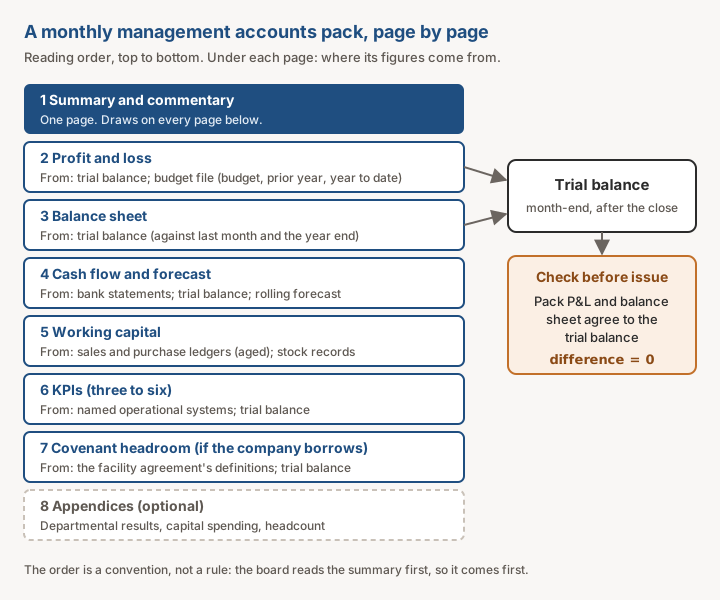
| Section | What it shows | Compared against | Comes from | Owner |
|---|---|---|---|---|
| Summary and commentary | Headline results, cash, the few points the board must know, decisions needed | Budget, prior year | Every page below | Finance director |
| Profit and loss | Revenue, gross margin, overheads, EBITDA, profit before tax; month and year to date | Budget, prior year, latest forecast | Trial balance; budget file | Financial controller |
| Balance sheet | Net assets, working capital, borrowings | Last month, last year end | Trial balance | Financial controller |
| Cash flow and forecast | Cash movement in the month; forecast ahead; headroom against facilities | Last month's forecast | Bank statements; trial balance; forecast model | Finance director |
| Working capital | Aged debtors and creditors, debtor and creditor days, stock | Last month, target | Sales and purchase ledgers; stock records | Credit control; financial controller |
| KPIs | Three to six measures that describe the business | Budget, prior year | Named operational systems | One owner per KPI |
| Covenant headroom (if the company borrows) | Each covenant, tested on the lender's definitions | The covenant level | Facility agreement; trial balance | Finance director |
| Risks and decisions | What needs the board this month | — | Finance and the business | Finance director |
Optional appendices: departmental results, capital spending and headcount.
Choose KPIs that describe your business rather than a generic list: for many companies gross margin, debtor days and one or two operational measures (orders, utilisation, revenue per head) are enough.
UK subsidiaries of overseas groups. The parent may set a reporting pack and calendar of its own. Build the UK pack so the parent's pack is a mapping of it, not a second set of numbers; agree intercompany balances with the other side before you issue; and state the exchange rates used.
What is the difference between a management accounts pack and a board pack?
A board pack is everything the directors receive for a board meeting: agenda, minutes, the management accounts pack and papers on other matters. The management accounts pack is its financial core.
A management accounts template: page order and columns
There is no file to download: the tables in this section and the checklist below are the management accounts template. Copy them into your own spreadsheet or reporting tool.
Page order. 1 Summary and commentary · 2 Profit and loss · 3 Balance sheet · 4 Cash flow and forecast · 5 Working capital · 6 KPIs · 7 Covenant headroom · 8 Appendices. The board reads the summary first, so it comes first.
Columns for the profit and loss.
| Month | Year to date | Full year |
|---|---|---|
| Actual · Budget · Variance £ · Variance % · Prior year | Actual · Budget · Variance £ · Variance % · Prior year | Latest forecast · Budget |
Show favourable variances as positive and adverse as negative, and say so on the page. Set a commentary threshold and print it in the pack: a variance gets a sentence only if it exceeds both a money limit and a percentage limit, in the month or the year to date. This is your reporting rule, chosen by the board; it has nothing to do with the materiality an auditor sets.
How long should a pack be? As short as the board will read: one summary page, then about a page per section, with detail pushed to appendices.
A management accounts pack example: the one-page summary
Illustrative figures for a fictional company with turnover of about £20m and a 31 December year end, for September 2026, in £000. The commentary threshold is more than £25k and more than 5%. All figures are computed in code.
| £000 | Actual | Budget | Variance | Var % | Prior year | YTD actual | YTD budget | YTD variance | YTD var % |
|---|---|---|---|---|---|---|---|---|---|
| Revenue | 1,742 | 1,640 | 102 | 6.2% | 1,590 | 14,960 | 15,120 | −160 | −1.1% |
| Gross profit | 627 | 623 | 4 | 0.6% | 588 | 5,540 | 5,746 | −206 | −3.6% |
| Gross margin | 36.0% | 38.0% | −2.0 pts | 37.0% | 37.0% | 38.0% | −1.0 pts | ||
| Overheads | −458 | −470 | 12 | 2.6% | −431 | −4,105 | −4,230 | 125 | 3.0% |
| EBITDA | 169 | 153 | 16 | 10.5% | 157 | 1,435 | 1,516 | −81 | −5.3% |
| Profit before tax | 107 | 93 | 14 | 15.1% | 99 | 887 | 976 | −89 | −9.1% |
Cash at 30 September £1,240k, with £2,000k of the facility undrawn: headroom £3,240k. Debtor days 53 (trade debtors of £2,890k divided by the last 12 months' revenue of £19,850k, times 365).
Three lines cross the threshold: revenue in the month, and EBITDA and profit before tax for the year to date. Gross profit does not cross it in the month, but the fall in margin behind it is the real story, so it gets a sentence anyway. The commentary would read:
Revenue was £102k (6.2%) ahead of budget in September, but gross margin was 36.0% against 38.0%, so gross profit was only £4k ahead. [Cause, in one sentence.] Year to date, EBITDA is £81k (5.3%) and profit before tax £89k (9.1%) behind budget, mostly margin. [Action, owner, date.] Cash headroom is £3,240k.
Writing the commentary the board reads first
Good management accounts commentary does three things for each point: what happened, why, and what happens next, with an owner and a date. It explains only the variances above the threshold, plus anything the board must know that the threshold misses, such as the margin in the example above. It connects the pages: a profit that is not turning into cash should send the reader to working capital.
Keep it to one page. It is the page the board reads first, and for some directors the only one, so write it last and check it hardest against the figures.
The same discipline applies to a monthly reporting pack sent to a lender or parent: the numbers are theirs to read, but the explanation is yours. AI tools can draft a first version of variance commentary from the figures; a person who knows the business still checks every cause and puts their name to it. See AI in the month-end close.
A monthly management accounts checklist, with preparer and reviewer
These are the checks to clear before the pack is issued. They are not the close itself (the next section), but they are what make the pack worth reading.
| # | Check | Why it matters | Preparer | Reviewer | Evidence kept |
|---|---|---|---|---|---|
| 1 | Pack agrees to the trial balance | The board sees the ledger, not a spreadsheet version of it | Management accountant | Financial controller | Tie-out schedule showing a difference of zero |
| 2 | Bank reconciled to the statement at month end | Cash is the figure everyone checks | Accounts assistant | Financial controller | Reconciliation, with unreconciled items listed and aged |
| 3 | Balance sheet accounts reconciled | No unexplained balances carried forward | Account owner | Financial controller | One reconciliation per account, dated and initialled |
| 4 | Accruals and prepayments posted from schedules | Costs fall in the right month | Management accountant | Financial controller | Schedules agreeing to the trial balance |
| 5 | Sales and purchase cut-off | Revenue and costs in the right month | Sales and purchase ledger | Financial controller | Invoices and deliveries either side of month end |
| 6 | Stock and work in progress | Margin depends on it | Stock controller | Financial controller | Count or system report; provisions schedule |
| 7 | Payroll, PAYE and VAT balances agree to returns | Liabilities to HMRC are right | Payroll | Financial controller | Payroll report and submissions |
| 8 | Fixed assets and depreciation | The balance sheet holds what the register holds | Management accountant | Financial controller | Fixed asset register agreed to the trial balance |
| 9 | Intercompany agreed; foreign currency balances revalued (groups) | Balances eliminate and translate | Management accountant | Financial controller | Counterparty confirmation; rate source and date |
| 10 | Budget version locked | Variances are against the approved budget | Planning | Finance director | Budget file version and approval date |
| 11 | KPIs taken from named sources | Each KPI can be traced | KPI owner | Financial controller | Source report saved with the pack |
| 12 | Covenant figures recalculated | Tested on the agreement's definitions | Financial controller | Finance director | Calculation citing the clauses |
| 13 | Cash forecast rolled forward | Last month's forecast is compared with what happened | Financial controller | Finance director | Forecast against actual |
| 14 | Commentary checked against the figures | Every number in the words is in the tables | Finance director | Chief executive or a director | Marked-up draft |
| 15 | Pack issued as a locked, dated version | One version of the figures | Financial controller | Finance director | PDF with version number and date |
Who should sign off the management accounts?
There is no rule. In the checklist above the finance director reviews the issued pack, and the chief executive or another director checks the commentary. In a small team the reviewer may be the finance director or a director. What matters is that nobody reviews their own work, and that the evidence is kept with the pack so the review can be seen later.
The close behind the pack
The pack is only as good as the month-end close that feeds it. Set a timetable by working day: sales ledger and cut-off, purchase ledger and accruals, payroll, bank, journals, review, then the pack, and fix the working day the pack is issued. When the close slips, the pack slips, and the temptation is to issue estimates in place of reconciled figures; if you do, label them.
The close task list is a separate subject, with its own checklist. The checks above are the gate between the close and the board.
How your auditor reads the management accounts
Does your auditor look at management accounts?
Yes. The auditing standards point the auditor to the information management uses to run the business, and in many companies that is the monthly pack. The auditor reads and uses it as the standards describe, and evaluates it rather than taking it on trust.
- Understanding the business (ISA (UK) 315). The auditor must understand "the measures used, internally and externally, to assess the entity's financial performance" (para 19(a)(iii)). The guidance lists budgets, forecasts, variance analyses, departmental reports and KPIs (A77), notes that targets can create pressures that make misstatement through bias or fraud more likely (A74), and that in some less complex entities bank covenants tied to performance measures can point to where misstatement is more likely (A78).
- Analytical procedures (ISA (UK) 520). Analytical procedures compare the figures with prior periods and with "budgets or forecasts" (A1). Where the auditor uses them as substantive procedures, it must evaluate the reliability of the data they rest on (para 5(b)); the guidance names as relevant whether budgets were set as "results to be expected rather than as goals to be achieved" and the controls over preparing and reviewing them (A12). It also performs analytical procedures near the end of the audit (para 6).
- After the year end (ISA (UK) 560). The auditor's work on events after the balance sheet date must include "reading the entity's latest subsequent interim financial statements, if any" (para 7(d)), and may include reading later budgets, cash flow forecasts and management reports (A8). Expect the auditor to ask for the packs issued after the year end.
- Going concern (ISA (UK) 570). The auditor must understand how the company measures its performance, "including forecasts, future cash flows, and management's budgeting processes". That is para 10-2(c) of the Revised September 2019 edition, and para 12(c) of the Revised March 2026 edition, which applies to periods beginning on or after 15 December 2026. If management's going concern assessment covers less than twelve months from the date the accounts are approved, the auditor asks for it to be extended (2019 edition para 14-1; 2026 edition para 21). A rolling cash forecast that already runs that far is the starting point.
Why don't the month-12 management accounts match the statutory accounts?
Because the year end brings adjustments the monthly pack does not carry: accruals and provisions finalised, tax computed, accounting policies applied in full, and adjustments agreed during the audit. Keep a bridge from the month-12 pack to the statutory accounts, with every adjustment named, so the difference between what the board saw and what the accounts say is a schedule, not a hunt.
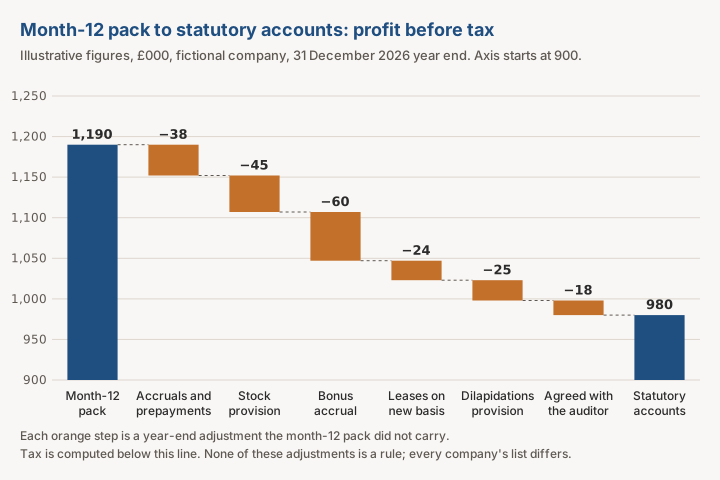
| Illustrative, £000 | Profit before tax |
|---|---|
| Month-12 pack | 1,190 |
| Accruals and prepayments trued up | −38 |
| Stock provision reviewed | −45 |
| Bonus accrual finalised | −60 |
| Leases on the new FRS 102 basis (pack kept the old basis all year) | −24 |
| Dilapidations provision | −25 |
| Adjustments agreed with the auditor | −18 |
| Statutory accounts | 980 |
None of these lines is a rule; every company's list differs. Tax, current and deferred, is computed below this line. For the rest of the year-end preparation, see the year-end audit checklist.
If your pack shows the company has outgrown the audit exemption, the first audit will lean on these packs: see the guide to a first year audit and the audit exemption thresholds. If this will be your company's first audit, tell us about it: Innate offers statutory audits signed by an ICAEW-registered partner firm, which your company appoints as its auditor. Our platform gets the information and documents for the audit team, to save you time and money.
What FRS 102's 2026 amendments do to the pack
The FRC's Periodic Review 2024 amendments to FRS 102 apply, in the main, to accounting periods beginning on or after 1 January 2026, with early application permitted if all the amendments are applied together. Two of them reach the monthly figures.
Leases. Under the revised Section 20 a lessee recognises a right-of-use asset and a lease liability (para 20.45), depreciates the asset (para 20.57) and charges interest on the liability (para 20.64). Leases of 12 months or less without a purchase option, and leases of low-value assets, can be left off the balance sheet (para 20.5). For what was an operating lease, the rent leaves operating costs; depreciation of the asset and interest on the liability replace it, both below EBITDA.
An illustration: an office lease with rent of £60k a quarter in advance, five years left, discounted at a borrowing rate of 6% a year. The lease liability starts at about £1,049k. In the first year EBITDA rises by £240k (the rent), while depreciation of £210k and interest of £54k (£264k together) reduce profit before tax by about £24k. Net debt rises by the liability, because FRS 102 counts lease obligations in it. EBITDA is not an FRS 102 term. FRS 102 does define net debt, as borrowings with any related derivatives and obligations under leases, less cash and cash equivalents (Glossary), but the net debt your lender tests is whatever the facility agreement defines. Where a company prepares a cash flow statement under Section 7, para 7.22 also asks for an analysis of the changes in net debt, new leases included; a small entity is not required to apply Section 7 (para 7.1B), and a qualifying entity may take the exemption from it (para 1.12(b)).
What to decide for the pack:
- When to switch. Follow the new basis from month 1 of the first year it applies, or keep the old basis in the monthly pack and adjust at the year end, as the bridge above does. Following it monthly avoids a surprise at the year end.
- Comparatives. On transition a lessee does not restate comparative figures (the amendments' transitional provisions, para 1.47), so last year's columns in the pack are on the old basis. Show the break, or add a pro forma prior year.
- Budget. Put the budget on the same basis as the actuals, or every lease becomes a variance.
- Lender tests. Read how the facility agreement defines the figures it tests. The agreement's own words decide which basis applies; if they are unclear, ask the lender before the first test date.
More in FRS 102 lease changes.
Revenue. The revised Section 23 uses a five-step model for revenue from contracts with customers. The FRC says the extent of any change "will depend on the nature of its contracts with customers"; for some contracts the timing of revenue moves, and with it the monthly figures. See FRS 102 revenue recognition.