FRS 102 revenue recognition: the five-step model, with worked examples
By Alon Zieve FCA · Last reviewed
FRS 102 revenue recognition now follows the revised Section 23, Revenue from Contracts with Customers, for accounting periods beginning on or after 1 January 2026. Revenue is recognised when (or as) the customer obtains control of each good or service it was promised, using a 5 step model drawn from IFRS 15, in place of the old risks-and-rewards tests. It applies to every company reporting under FRS 102, small companies included. For a calendar year, the first accounts under the new rules are those to 31 December 2026.
Below: each step in plain terms, five contracts worked through in pounds with their journals, the old and new answers side by side, the transition, and the differences from IFRS 15. All amounts are VAT-exclusive.
FRS 102 revenue recognition from 2026: what changed, and who must apply it
The old Section 23 was based on two international standards, IAS 18 and IAS 11, and recognised revenue when the significant risks and rewards of goods had passed, or by stage of completion for services and construction contracts. The Periodic Review 2024 amendments replaced it entirely with "a new five-step revenue recognition model based on IFRS 15" (FRS 102 (September 2024), B23.1). Paragraph numbers below are from that edition; "old" marks the superseded January 2022 edition.
When it applies. The amendments apply to accounting periods beginning on or after 1 January 2026 (para 1.37(b)). For a year that began on 1 April 2026, the first year end is 31 March 2027. The new model is in force now: it is not an "upcoming" change, as some pages still describe it. A company whose current year began before 1 January 2026 (a year to 30 November 2026, say) first applies it in its next period, unless it adopts early.
Early adoption. Early application is permitted only "provided that all these amendments are applied at the same time" (1.37(b)), so a company cannot adopt the revenue rules early on their own: it takes the FRS 102 lease changes and every other amendment with them, and must disclose that it has done so (1.38). The FRS 102 changes guide lists the rest, and the UK GAAP hub the other guides.
Who. Every entity applying FRS 102. That includes small companies using Section 1A: "all of the requirements of this FRS apply to a small entity, including the recognition and measurement requirements" (1A.1). Section 1A relieves disclosures, not the accounting. Leases, financial instruments and insurance contracts stay outside Section 23 (23.1).
The 5 step model under Section 23, applied to one contract
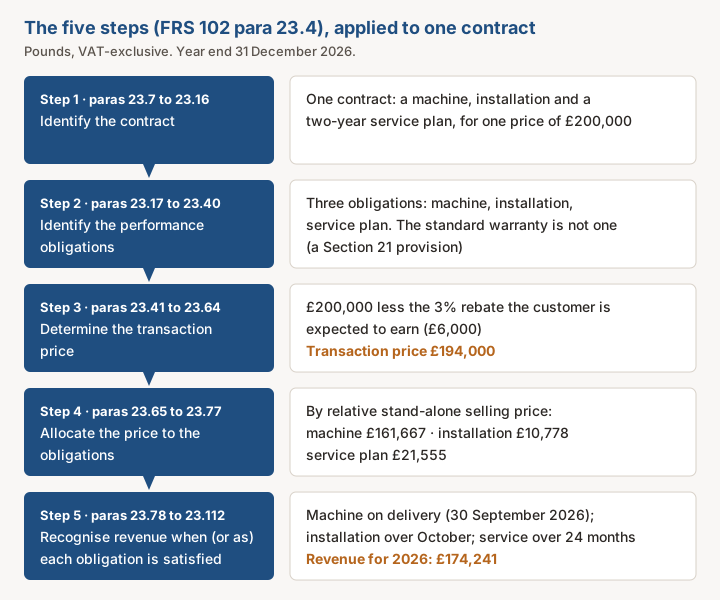
Paragraph 23.4 sets out the five steps:
| Step | The question, in plain words | Paragraphs | What it produces |
|---|---|---|---|
| 1. Identify the contract | Is there an enforceable agreement we account for? | 23.7 to 23.16 | The contract, or contracts combined |
| 2. Identify the performance obligations | What separate things have we promised? | 23.17 to 23.40 | A list of performance obligations |
| 3. Determine the transaction price | How much do we expect to be entitled to? | 23.41 to 23.64 | One price, including estimated variable amounts |
| 4. Allocate the transaction price | How much of that price belongs to each promise? | 23.65 to 23.77 | A price for each obligation |
| 5. Recognise revenue | When does the customer get control of each one? | 23.78 to 23.112 | Revenue at a point in time, or over time |
The running example. A machinery manufacturer agrees on 1 September 2026 to sell a customer a machine, install it and service it for two years, for one price of £200,000. It sells each separately for £180,000 (machine), £12,000 (installation) and £24,000 (a two-year service plan). The customer earns a rebate of 3% of the price if it orders a second machine by 31 August 2027, and the manufacturer expects it will. The machine is delivered on 30 September 2026, installed during October, and serviced from 1 November 2026 to 31 October 2028. It comes with the manufacturer's standard warranty that it works to specification.
Step 1: Identify the contract
A contract is accounted for only when the parties have approved it and are committed, each party's rights and the payment terms can be identified, it has commercial substance and it is probable that the customer will be able and intend to pay when due (23.7). Contracts made at or near the same time with the same customer are combined if, for example, they were negotiated as a package (23.12). If the parties approve a change in scope but have not yet agreed its price, the price change is estimated like variable consideration (23.14). Where contracts are similar, a company may apply the section to a portfolio rather than contract by contract, if the result would not differ materially (23.6).
Step 2: Identify the performance obligations
A performance obligation is a promise to transfer a distinct good or service (23.17). A good or service is distinct if the customer can benefit from it on its own or with resources readily available, and the promise is separate from the other promises in the contract (23.21). The machine, the installation and the service plan are each sold separately, and installation does not significantly modify the machine, so there are three performance obligations. The standard warranty only assures that the machine works as specified, so it is not a separate service: it is accounted for under Section 21 as a provision (23.27).
Step 3: Determine the transaction price
The transaction price is the consideration the company expects to be entitled to, excluding amounts collected for third parties such as VAT (23.41). A rebate is variable consideration (23.43). Where there are only two possible outcomes, the "most likely amount" is often the better estimate (23.44(b)); here that is the rebate being earned, so the price is £194,000 (£200,000 less £6,000). Variable consideration is included only to the extent that it is "highly probable" that the company will be entitled to the cumulative revenue recognised once the uncertainty is resolved (23.46); £194,000 is the lowest possible outcome, so that test is met. The estimate is updated at each reporting date (23.47). No adjustment for the time value of money is needed where, at the start of the contract, payment is expected within 12 months of transfer (23.60). The service plan is paid for up to two years before it is provided, but for a payment received in advance FRS 102 permits an adjustment without requiring one (23.59); the example makes none.
Step 4: Allocate the transaction price
The price is shared across the obligations in proportion to their stand-alone selling prices (23.65, 23.67): the price at which each would be sold separately (23.68). The stand-alone prices add up to £216,000, so the customer receives a reduction of £22,000 (the £16,000 bundle discount plus the £6,000 rebate). A discount or variable amount is spread over all the obligations on the same basis, unless that would not reflect what each obligation earns (23.74).
| Obligation | Stand-alone selling price | Allocated transaction price |
|---|---|---|
| Machine | £180,000 | £161,667 |
| Installation | £12,000 | £10,778 |
| Service plan | £24,000 | £21,555 |
| Total | £216,000 | £194,000 |
Allocation is not needed where a contract has a single obligation, or where every obligation is satisfied at the same point in time (23.66).
Step 5: Recognise revenue when (or as) each obligation is satisfied
Revenue is recognised when the customer obtains control: "the ability to direct the use of, and obtain substantially all of the remaining economic benefits" from the asset (23.78, 23.80). For each obligation the company decides at the start whether it is satisfied over time or at a point in time (23.79). It is satisfied over time if any one of three tests in 23.81 is met; otherwise control passes at a point in time, judged by indicators such as a present right to payment, legal title and physical possession (23.85).
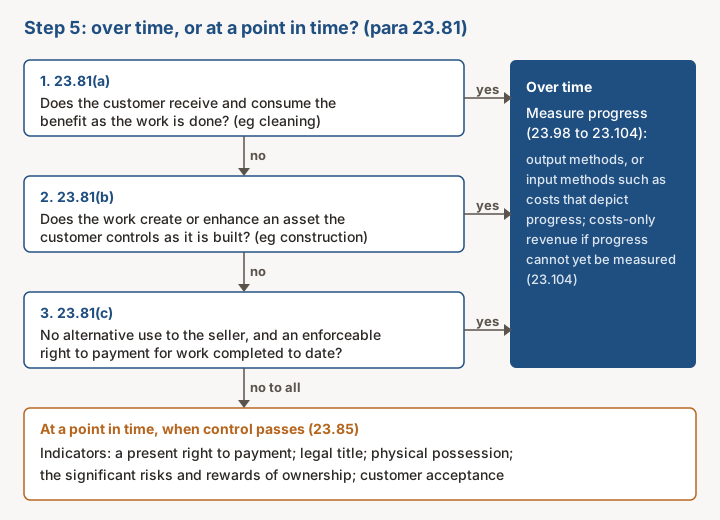
In the example, control of the machine passes at a point in time, on delivery on 30 September 2026: £161,667. The installation enhances an asset the customer already controls (23.81(b)) and is complete by 31 October: £10,778 in October. The service plan is consumed as it is provided (23.81(a)) and is measured by time elapsed (23.102(c)): 2 of 24 months in 2026, £1,796. Revenue for 2026 is £174,241; the rest of the service plan, £10,778 in 2027 and £8,981 in 2028, follows.
The customer paid the £200,000 invoice in November 2026. At 31 December 2026:
| Journal for 2026 | Dr | Cr |
|---|---|---|
| Cash | £200,000 | |
| Revenue: machine | £161,667 | |
| Revenue: installation | £10,778 | |
| Revenue: service plan | £1,796 | |
| Contract liability (service not yet provided) | £19,759 | |
| Refund liability (rebate expected to be paid) | £6,000 |
The contract liability is service paid for but not yet provided (23.125); the refund liability is consideration the company does not expect to keep (23.49).
FRS 102 revenue recognition examples: four common contracts
A software company's set-up fee and subscription
A software company signs a customer on 1 July 2026 to a 24-month subscription at £2,000 a month, billing the first year (£24,000) in advance, plus a non-refundable set-up fee of £6,000. The set-up work configures the company's own systems and gives the customer nothing it can use on its own. Assume the customer has no option to renew on favourable terms.
Set-up activities that transfer nothing to the customer are not a performance obligation (23.20). The fee is "an advance payment for future goods or services" and is recognised as those services are provided (23.30): £250 a month over the subscription. Revenue for 2026 is £12,000 of subscription plus £1,500 of set-up fee, £13,500. At 31 December 2026 the deferred revenue, a contract liability, is £16,500 (£12,000 of subscription billed in advance and £4,500 of set-up fee). Where a renewal option gives the customer a material right, the fee is spread beyond the initial term (23.30).
| Journal | Dr | Cr |
|---|---|---|
| Cash, 1 July 2026 (£24,000 billed + £6,000 fee) | £30,000 | |
| Contract liability | £30,000 | |
| July to December: contract liability | £13,500 | |
| Revenue: subscription | £12,000 | |
| Revenue: set-up fee | £1,500 |
The salesperson's commission of £4,800 (10% of the £48,000 subscription value; the commission terms leave out the set-up fee) is paid on signing and would not have been incurred without the contract, so it is a cost of obtaining the contract. The company may recognise it as an asset if it expects to recover it (23.113): it is a policy choice, applied to all such costs once chosen (23.114). Capitalised, it is amortised as the subscription service is provided (23.120), here evenly over the 24 months because no renewal is expected: £1,200 in 2026, leaving an asset of £3,600. Otherwise it is expensed when incurred.
A fit-out contractor's fixed-price contract
A contractor agrees a £500,000 fixed price to fit out a customer's offices, starting in September 2026, with expected costs of £400,000. By 31 December 2026 it has incurred £180,000, including £30,000 of materials delivered to site but not yet installed.
The customer controls the offices as the work is done, so the obligation is satisfied over time (23.81(b)). A cost-based measure of progress counts only costs that "reflect an entity's performance to date" (23.102(e)), so the uninstalled materials are left out: £150,000 of £400,000 is 37.5% complete. Revenue for 2026 is £187,500, cost of sales £150,000. The materials stay on the balance sheet under Section 13 until they are used (23.116). If progress could not yet be measured reasonably, early in a contract, revenue would be recognised only to the extent of costs incurred, as long as they are expected to be recovered (23.104).
The contractor has billed £160,000, of which the customer has paid £120,000. The £40,000 unpaid is a trade receivable, because only time stands between it and payment (23.127). The £27,500 of revenue not yet billed is a contract asset, because the right to it depends on further work (23.126).
| Journal for 2026 | Dr | Cr |
|---|---|---|
| Cash | £120,000 | |
| Trade receivables | £40,000 | |
| Contract asset | £27,500 | |
| Revenue | £187,500 |
Under the old section the answer here is the same: stage of completion by costs, excluding the cost of future activity such as materials (old 23.17 and 23.22(a)). What changes is the test that gets there, and the name of the balance, which was the "gross amount due from customers for contract work" (old 23.32).
A booking platform: gross or net?
A platform sells hotel stays online. A customer pays £1,000 for a room; the platform keeps a 15% commission of £150 and pays the hotel £850. The hotel provides the room and sets its price, and the platform never holds rooms of its own.
A company is a principal if it "controls the specified good or service before that good or service is transferred to a customer" (23.37); indicators include primary responsibility for providing it, inventory risk and discretion over the price (23.38). The platform has none of these, so it is an agent, and its revenue is the commission (23.40).
| Journal for one booking | Dr | Cr |
|---|---|---|
| Cash | £1,000 | |
| Payable to the hotel | £850 | |
| Revenue: commission | £150 |
On a year's bookings of £2,400,000, revenue is £360,000; as a principal it would have reported £2,400,000 with cost of sales of £2,040,000. The old section's test was risks and rewards (old 23A.38); the answer is often the same, but the reasoning is now about control.
A wholesaler that sells with a right of return
A wholesaler sells 1,000 units in December 2026 at £50 each (£50,000), at a cost of £30 each, with 30 days to return them. From experience it expects 4% back, 40 units, an expected-value estimate (23.44(a)).
The wholesaler recognises revenue only for products it does not expect to be returned, a refund liability for the rest, and a refund asset for the goods it expects to get back (23.53). The refund asset is measured at the goods' former carrying amount less the expected costs of recovering them, here £100, and less any expected fall in their value, here none (23.55). Revenue is £48,000, the refund liability £2,000, the refund asset £1,100 (£1,200 less £100), and cost of sales £28,900. Both estimates are updated at each reporting date (23.56).
| Journal | Dr | Cr |
|---|---|---|
| Trade receivables | £50,000 | |
| Revenue | £48,000 | |
| Refund liability | £2,000 | |
| Cost of sales | £28,900 | |
| Refund asset (inventory) | £1,100 | |
| Inventory | £30,000 |
FRS 102 revenue recognition changes from 2026: old rules against new
| Contract | Old Section 23 | Revised Section 23 | Effect in 2026 |
|---|---|---|---|
| Bundle: machine, installation, service plan | Servicing deferred at expected cost plus a reasonable profit (old 23A.19); assuming £15,000 of cost and a 20% mark-up on cost, £18,000 deferred | Price allocated on relative stand-alone selling prices (23.67, 23.74): £21,555 to the service plan | Revenue £174,241 against £177,500: £3,259 more deferred |
| Software set-up fee | Recognised when the set-up was done, if treated as a separate service (old 23.8, 23.14) | Spread over the subscription where set-up transfers nothing (23.20, 23.30) | Revenue £13,500 against £18,000 |
| Fit-out contract | Stage of completion (old 23.17) | Over time, cost-based progress that depicts performance (23.81(b), 23.102(e)) | No change: £187,500 both ways |
| Booking platform | Risks and rewards indicators (old 23A.38) | Control before transfer (23.37, 23.38) | Usually none; the test changes |
| Sales with a right of return | Revenue recognised, with a provision for returns under Section 21 (old 23.13) | Revenue net, refund liability and a separate refund asset (23.53) | Revenue £48,000 against £50,000, assuming the old provision was not deducted from revenue; the refund asset is now shown on its own |
| Sales commission | No general rule; for construction contracts, costs of securing the contract were included in contract costs (old 23.17A) | Policy choice to capitalise incremental costs (23.113, 23.114) | Depends on the policy chosen |
Because revenue and profit can move between years, check loan covenants, bonus schemes and KPIs defined on them, and the deferred tax effect of any opening adjustment.
Applying the five steps also needs data: an inventory of contracts by revenue stream, with their terms.
Moving to the new rules: restate comparatives or take the cumulative effect
FRS 102 gives a choice of two routes (1.61). The date of initial application is the beginning of the first period under the new rules: 1 January 2026 for a calendar year (1.40(a)).
Route (a), cumulative effect. The company applies the revised section retrospectively but does not restate comparatives (1.62(a)). It applies the section only to contracts not completed at 1 January 2026, and puts the cumulative effect through opening retained earnings (1.61(a), 1.62(b)). A completed contract is one where all the goods or services were transferred under the old rules (1.67). Two expedients are available (1.62(c), 1.65(b) and (c)). In the first year it discloses the effect on that year's revenue and profit, and the reasons for significant changes, in place of the usual change-of-policy amounts (1.63).
Route (b), full retrospective. The company restates comparatives under Section 10 (1.61(b), 10.12), with more expedients (1.65), and gives the adjustment for each line item for the immediately preceding period only (1.64).
Worked transition (route (a)). The software company above signed an earlier customer on 1 July 2025 to a 24-month subscription with a £6,000 set-up fee, which its old policy recognised in full in 2025. The contract is not completed at 1 January 2026. Under the revised section only six months of the fee (£1,500) would have been recognised by then, so £4,500 is restated:
| Journal at 1 January 2026 | Dr | Cr |
|---|---|---|
| Retained earnings (opening) | £4,500 | |
| Contract liability | £4,500 |
The fee then earns £3,000 of revenue in 2026 and £1,500 in 2027; 2026 revenue and profit are £3,000 higher than under the old policy, the figure 1.63(a) asks for. Under route (b) the 2025 comparative revenue would instead be restated down by £4,500 for this contract.
| Situation | Route that usually fits | Why |
|---|---|---|
| Few open contracts, records of old contracts thin | (a) cumulative effect | Only open contracts are revisited; no comparatives |
| Lenders or investors compare year on year | (b) full retrospective | Comparatives on the same basis |
Contract costs and the balance sheet: commissions, set-up costs, contract assets
Costs to obtain a contract, such as the commission in the software example, may be capitalised if they would not have been incurred without the contract and are expected to be recovered (23.113); costs that would be amortised over a year or less may still be expensed (23.114). Costs incurred whether or not the contract is won are expensed unless explicitly chargeable to the customer (23.115).
Costs to fulfil a contract go first to the section that covers them, such as inventories or fixed assets (23.116). Otherwise they are an asset only if they relate directly to a contract, create resources used to satisfy future obligations, and are expected to be recovered (23.117). Both are amortised as the related goods or services transfer, and tested for impairment (23.119 to 23.122).
Contract balances. A contract asset is a right to consideration "conditional on something other than the passage of time" (23.126); a trade receivable is unconditional (23.127). A capitalised fulfilment cost is not a contract asset, although some guidance calls it one: it is a cost asset under 23.117, disclosed separately (23.138). Other captions may be used on the balance sheet, provided contract assets and receivables can still be told apart (23.128).
Section 1A, FRS 105 and subsidiaries: what changes for you
Small companies (Section 1A). Revenue recognition under FRS 102 Section 1A is the same as for any other company (1A.1). The difference is disclosure: a UK small company gives the Section 23 disclosures about its performance obligations in 23.135(a) to (c) (when they are typically satisfied, significant payment terms, and the nature of what was promised, including agency) (1AC.32B), plus anything else needed for a true and fair view (1A.17). See FRS 102 1A disclosure requirements.
Subsidiaries using the reduced disclosure framework. A qualifying entity, broadly a group member whose parent's consolidated accounts include it, may skip 23.131, 23.132, 23.133(a), 23.135(a) to (c), 23.136, 23.137 and 23.139 (1.12(cB)), if it otherwise applies the standard and states the exemptions and the parent's name (1.11). Company law still requires the particulars of turnover (A3.38A). A subsidiary of a group reporting under IFRS 15 can generally use one revenue policy that meets both: the FRC designed Section 23 to "allow, but not require" that (B23.5(a), B23.9).
Micro-entities (FRS 105). FRS 105 has its own simplified five-step model in Section 18 from the same date (FRS 105 1.10, 18.3). Unlike FRS 102, it applies only to contracts that begin after the micro-entity first applies the amendments; contracts in progress keep their old treatment (1.11). FRS 105 vs FRS 102 compares the two frameworks.
How FRS 102 revenue recognition differs from IFRS 15
The 5 step model is the same in both. The differences are simplifications the FRC made: no requirement to adjust payments received in advance for the time value of money, more flexibility in allocating discounts, a policy choice on capitalising costs to obtain a contract, more hindsight on transition, and disclosures based on the IFRS for SMEs draft. The FRC lists them in B23.7 to B23.10:
| Point | FRS 102 Section 23 | Paragraph |
|---|---|---|
| Payments received in advance | No requirement to adjust for the time value of money (optional) | 23.59; B23.9(a) |
| Discounts and variable consideration | More flexibility in allocating them | 23.74; B23.9(b) |
| Costs to obtain a contract | A policy choice whether to capitalise | 23.113; B23.9(c) |
| Transition | More hindsight for variable consideration and modifications | 1.62, 1.65; B23.9(d), B23.12 |
| Disclosures | Based on the IASB's 2022 IFRS for SMEs draft, not IFRS 15 | B23.10 |
| Drafting | Licensing described more simply; the variable consideration constraint worded "in the positive", which the FRC says "generally has the same effect" | B23.7 |
Comparisons that set IFRS 15 against the old FRS 102 are out of date.
What to document, and what your auditor will ask for this year
Revenue gets particular attention in an audit (the independent examination of the accounts by the company's appointed auditor). Under ISA (UK) 240 the auditor works from "a presumption that there are risks of fraud in revenue recognition" (ISA (UK) 240 (Revised May 2021), para 27, the edition for periods beginning before 15 December 2026). Section 23 has no separate requirement to disclose judgements, but paragraph 8.6 applies to them (B23.11). Before the year end, record:
- a contract inventory, by revenue stream, with the terms that drive each step;
- the performance obligations identified and why;
- the evidence for stand-alone selling prices;
- the method of measuring progress for anything recognised over time;
- each principal-or-agent conclusion;
- the transition route, the open contracts it covered and the workings for the opening adjustment;
- the new disclosures (23.131 to 23.139), or the exemptions taken.
Illustrative accounting policy wording (for the software example only; not for any particular company): "Revenue comprises subscription and set-up fees, excluding VAT. Subscriptions are recognised evenly over the subscription period, as the customer receives and uses the service. Non-refundable set-up fees do not transfer a separate service and are recognised over the same period. Amounts invoiced in advance are shown as deferred income. Sales commissions on new contracts are capitalised and amortised over the contract term."
A company that has just lost its audit exemption can meet the revised section and its first year audit in the same year. If this will be your company's first audit, tell us about it: Innate offers statutory audits signed by an ICAEW-registered partner firm, which your company appoints as its auditor. Our platform gets the information and documents for the audit team, to save you time and money. The year end audit checklist covers the rest of the preparation.