FRS 102 Section 1A disclosure requirements: the full checklist for small companies
By Alon Zieve FCA · Last reviewed
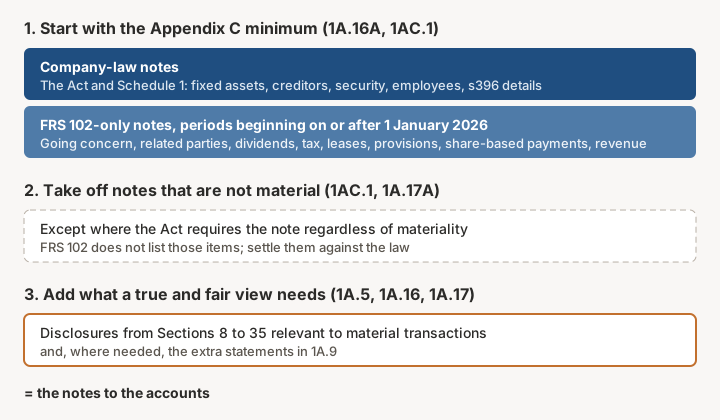
The FRS 102 1A disclosure requirements are the notes a UK company must give when it prepares small-company accounts under Section 1A of FRS 102. As a minimum it gives every note in Appendix C to Section 1A that is relevant to it, leaving out only immaterial ones the law does not require regardless, plus anything more a true and fair view needs. For accounting periods beginning on or after 1 January 2026, that minimum grew: there are now required notes on going concern, dividends, tax, leases, provisions, share-based payments and revenue, and a wider related party note. Below is the full 1A disclosure checklist, with paragraph references, what is new, what the law requires that Appendix C does not list, and what a small company can leave out.
What are the FRS 102 1A disclosure requirements?
A UK small entity that applies Section 1A must give, "as a minimum, when relevant to its transactions, other events and conditions", the disclosures in Appendix C (paragraph 1A.16A), and enough information in the notes for the accounts to give a true and fair view (1A.5, 1A.16; Companies Act 2006 s393). Section 1A changes presentation and disclosure only. All of FRS 102's recognition and measurement rules still apply (1A.1).
The accounts themselves are lighter than under full FRS 102:
- Required: a balance sheet, an income statement and notes (1A.8).
- Not required: a statement of cash flows, or full FRS 102's rules for the primary statements in Sections 4 to 6 (1A.7A); the company law formats apply instead (1A.12, 1A.14).
- Only if a true and fair view needs it: a statement of total comprehensive income (where gains or losses go to other comprehensive income) and a statement of changes in equity, or of income and retained earnings (1A.9).
- On the balance sheet, above the director's signature: a statement that the accounts are prepared in accordance with the provisions applicable to companies subject to the small companies regime (1A.6A; s414(3)).
That is the main difference between FRS 102 and FRS 102 1A: the same accounting, far fewer specified notes. Section 1A is open to companies within the small companies regime: broadly, those within at least two of three limits (turnover of £15 million, a balance sheet total of £7.5 million and 50 employees) for financial years beginning on or after 6 April 2025 (s382(3), as amended by SI 2024/1303). Micro-entities can instead use FRS 105, which this page does not cover (see FRS 105 vs FRS 102). Small entities in the Republic of Ireland follow Appendix D, not Appendix C (1A.16A). More on the wider framework is in the UK GAAP guides.
What changed in Section 1A from 2026?
For accounting periods beginning on or after 1 January 2026 (FRS 102 paragraph 1.37(b)), the Periodic Review 2024 amendments added required notes to Appendix C, among them going concern, dividends, tax, leases, provisions, share-based payments and revenue, and widened its related party note. A company may apply the amendments earlier only if it applies all of them at the same time, and must then disclose that it has done so (1.37(b), 1.38). The FRC's stated reason: once the UK left the EU it could set additional disclosures for UK small entities, and it expanded Appendix C "to reduce the amount of judgement" preparers exercise in deciding which notes a true and fair view needs (Basis for Conclusions B1A.3B). The change applies to UK small entities only (B1A.3C).
The Section 1A changes, compared with the January 2022 edition of FRS 102:
| Paragraph | Note now required | Cross-reference | Before 2026 |
|---|---|---|---|
| 1AC.2A | Explicit and unreserved statement of compliance with FRS 102, saying Section 1A has been applied | 3.3 | Encouraged |
| PBE1AC.2B | Statement that the entity is a public benefit entity | PBE3.3A | Encouraged |
| 1AC.2C | Going concern: basis, that management has considered the future, significant judgements, and material uncertainties | 3.8A, 3.9 | 3.9 material uncertainties encouraged; rest new |
| 1AC.11A | Deferred tax balances by type of timing difference, and unused tax losses and credits | 29.27(e) | New |
| 1AC.31A, 1AC.31B | Lessee: general description of significant leasing arrangements, and more if needed to understand them | 20.76, 20.77 | New |
| 1AC.31C | Provisions (reconciliation, nature, uncertainties, reimbursements), contingent liabilities and assets, financial guarantees | 21.14 to 21.17A | New |
| 1AC.31D | Share-based payments: description of arrangements, number and weighted average exercise price of options outstanding at the start and end of the period and exercisable at the end, expense and liability | 26.18(a), (b)(i), (vi), (vii); 26.23 | New |
| 1AC.32A | Expense for short-term leases, low-value leases and variable lease payments | 20.80(b) to (d) | New |
| 1AC.32B | Revenue: when performance obligations are satisfied, significant payment terms, nature of goods or services (including acting as agent) | 23.135(a) to (c) | New |
| 1AC.32C | Major components of tax expense, and a reconciliation of the tax charge to profit before tax at the applicable rate | 29.26, 29.27(b) | New |
| 1AC.35 | Related party transactions | 33.9, 33.14, subject to 33.1A and 33.11 | Previously only the legal minimum (Sch 1 para 66), which still applies |
| 1AC.40 | Dividends declared and paid or payable in the period | 6.5(b) | Encouraged |
| 1AC.41 | On first adopting FRS 102, how the transition affected financial position and performance | 35.13 | Encouraged |
"Encouraged" means the item was in the old UK Appendix E (1AE.1 of the January 2022 edition). That appendix now applies to the Republic of Ireland only (1A.16C).
Two of these trip preparers up. Related parties: 1AC.35 brings in paragraphs 33.9 and 33.14, but not 33.7, so there is no requirement to disclose key management personnel compensation (the FRC's clarification on its FRS 102 page). It does not mean every related party transaction is disclosed: transactions between group members are exempt where every subsidiary that is a party is wholly owned by a group member (33.1A), as are those with a government that has control, joint control or significant influence over the company and with other entities under that government (33.11), and an immaterial disclosure can be left out (1AC.1). Dividends: 1AC.40 asks only what was declared and paid or payable in the period; whether a dividend was lawful is a separate question (see distributable reserves).
The new notes sit beside recognition changes, chiefly leases on balance sheet and the new revenue model; those are covered in FRS 102 changes. One further amendment, issued on 18 February 2026, changes the minimum line items for a company that chooses to adapt the balance sheet or profit and loss format (Appendices A and B to Section 1A), for periods beginning on or after 1 January 2027, and reminds such a company to disclose material accounting policy information, which may include that choice (1AA.7, 1AB.6). It does not change Appendix C.
Which year end is first affected?
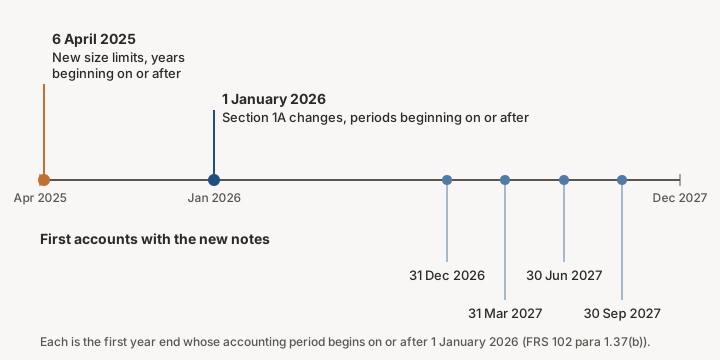
| Year end | First period under the new rules begins | First accounts with the new notes | Comparative period |
|---|---|---|---|
| 31 December | 2026-01-01 | 2026-12-31 | Year to 2025-12-31 |
| 31 March | 2026-04-01 | 2027-03-31 | Year to 2026-03-31 |
| 30 June | 2026-07-01 | 2027-06-30 | Year to 2026-06-30 |
| 30 September | 2026-10-01 | 2027-09-30 | Year to 2026-09-30 |
| 30 November | 2026-12-01 | 2027-11-30 | Year to 2026-11-30 |
A company incorporated in 2026 is inside the new rules from its first accounts. The two start dates differ: a company with a 30 June year end uses the higher size limits for the year to 30 June 2026 (it began on 1 July 2025, after 6 April 2025) but gives the new notes only from the year to 30 June 2027.
The full FRS 102 1A disclosure checklist
The 1A disclosure checklist below sets out the FRS 102 1A disclosure requirements row by row, in Appendix C's own order. Work through "applies when" first, then apply the materiality rule (see "When a small company must disclose more than the minimum", below). The wording is ours and short; the paragraph is the authority. "Sch 1" is Schedule 1 to the Small Companies Regulations (SI 2008/409).
Basis of preparation and compliance
| Para | What to disclose | Source | New 2026 | Applies when |
|---|---|---|---|---|
| 1A.6A | Small companies regime statement on the balance sheet, above the signature | s414(3) | No | Always |
| 1AC.2 | Notes in the order of the balance sheet and income statement items they relate to | Sch 1 para 42(2) | No | Always |
| 1AC.2A | Explicit and unreserved statement of compliance with FRS 102, stating Section 1A applied | FRS 102 | Yes | The accounts comply with FRS 102 |
| PBE1AC.2B | Statement that the entity is a public benefit entity | FRS 102 | Yes | It applies the PBE paragraphs |
| 1AC.2C | Going concern basis, management's consideration of the future, significant judgements, material uncertainties; or the basis used if not a going concern | FRS 102 (3.8A, 3.9) | Yes | Always |
| 1AC.10 | Particulars, reasons and effect of any departure from company law principles | Sch 1 para 10(2) | No | A true and fair override is used |
Policies, presentation changes and errors
| Para | What to disclose | Source | New 2026 | Applies when |
|---|---|---|---|---|
| 1AC.3 | Accounting policies, including depreciation and impairment | Sch 1 para 44 | No | Always |
| 1AC.4 | Write-off period and reasons for capitalising development costs | Sch 1 para 21(2) | No | Development costs are capitalised |
| 1AC.5 | Why development costs are an asset and not a realised loss | s844 | No | That treatment is relied on |
| 1AC.6 | Write-off period, and why, for intangibles (including goodwill) whose life cannot be reliably estimated | Sch 1 para 22(4) | No | Useful life not reliably estimable |
| 1AC.7 | Particulars of, and reasons for, a change in presentation | Sch 1 para 2(2) | No | Formats change |
| 1AC.8 | Non-comparable prior-year amounts and any adjustment | Sch 1 para 7(2) | No | A prior-year amount is adjusted (usually a policy change or error correction) |
| 1AC.9 | Effect of prior-period amounts in the income statement | Sch 1 para 61(1) | No | Such amounts exist |
Balance sheet notes
| Para | What to disclose | Source | New 2026 | Applies when |
|---|---|---|---|---|
| 1AC.11 | Assets or liabilities relating to more than one balance sheet item | Sch 1 para 9A | No | Such items exist |
| 1AC.11A | Deferred tax by type of timing difference; unused tax losses and credits | FRS 102 (29.27(e)) | Yes | Timing differences, or unused tax losses or credits, exist |
| 1AC.12, 1AC.13 | Fixed asset reconciliation: cost or valuation, additions, disposals, transfers, revaluations, depreciation and impairment | Sch 1 para 48 | No | Fixed assets, including right-of-use assets |
| 1AC.14 to 1AC.18 | Revalued assets: basis, years and values, valuer, historical cost comparison, revaluation reserve movements and tax treatment | Sch 1 paras 34, 35(6), 49, 54(2) | No | Fixed assets carried at revalued amounts (not investment property or biological assets at fair value through profit or loss) |
| 1AC.19 | Interest capitalised and its amount | Sch 1 para 27(3) | No | Borrowing costs capitalised |
| 1AC.20, 1AC.21 | Impairment provisions and reversals, if not shown on the income statement | Sch 1 paras 19(3), 20(2) | No | Impairment recognised or reversed |
| 1AC.22 to 1AC.24 | Fair value: assumptions, values and changes, derivatives by class, fair value reserve movements | Sch 1 para 51 | No | Items measured at fair value after initial recognition |
| 1AC.26 | The fair value disclosures of Section 11 | Sch 1 para 36(4) | No | Instruments carried at fair value under that paragraph, such as investments in subsidiaries at fair value through profit or loss |
| 1AC.27 | Creditors due after more than five years | Sch 1 para 55(1) | No | Such debts exist |
| 1AC.28 | Secured creditors, and the nature and form of the security | Sch 1 para 55(2) | No | Security given |
| 1AC.29, 1AC.30 | Off-balance-sheet commitments, guarantees and contingencies; pension commitments; group commitments; security given | Sch 1 para 57 | No | Such items exist |
| 1AC.31 | Nature and business purpose of off-balance-sheet arrangements | s410A | No | The risks or benefits are material |
| 1AC.31A, 1AC.31B | Lessee's significant leasing arrangements | FRS 102 (20.76, 20.77) | Yes | The company is a lessee (FRS 102 lease changes) |
| 1AC.31C | Provisions, contingent liabilities and assets, financial guarantee contracts | FRS 102 (21.14 to 21.17A) | Yes | Such items exist |
| 1AC.31D | Share-based payment arrangements, options outstanding and exercisable, expense and liability | FRS 102 (26.18, 26.23) | Yes | Share-based payments exist |
Income statement notes
| Para | What to disclose | Source | New 2026 | Applies when |
|---|---|---|---|---|
| 1AC.32 | Amount and nature of items of exceptional size or incidence | Sch 1 para 61(2) | No | Such items exist |
| 1AC.32A | Short-term, low-value and variable lease expense | FRS 102 (20.80(b) to (d)) | Yes | The company is a lessee |
| 1AC.32B | Performance obligations, payment terms, nature of goods or services | FRS 102 (23.135(a) to (c)) | Yes | Revenue from contracts with customers (FRS 102 revenue recognition) |
| 1AC.32C | Components of tax expense; tax reconciliation | FRS 102 (29.26, 29.27(b)) | Yes | Tax is charged or credited |
Employees, group and directors
| Para | What to disclose | Source | New 2026 | Applies when |
|---|---|---|---|---|
| 1AC.33 | Average number of employees in the year | s411(1) | No | Always |
| 1AC.34 | Name and registered office (or principal place of business) of the parent of the smallest group preparing consolidated accounts | Sch 1 para 65 | No | The company is a subsidiary |
| 1AC.35 | Related party transactions, balances and commitments | FRS 102 (33.9, 33.14; exemptions 33.1A, 33.11) | Yes | Related party transactions exist |
| 1AC.36 | Directors' advances and credits (amount, interest rate, main conditions, amounts repaid, written off and waived) and guarantees (main terms, maximum liability, amounts paid), with totals | s413 | No | Any subsisted in the year (directors' loan account disclosure) |
Other
| Para | What to disclose | Source | New 2026 | Applies when |
|---|---|---|---|---|
| 1AC.37 | Part of the UK registered in, registered number, public or private, limited by shares or guarantee, registered office, any winding up | s396(A1) | No | Always |
| 1AC.38 | Individual amounts of combined format items | Sch 1 para 4(3) | No | Items combined, unless not material |
| 1AC.39 | Nature and financial effect of material events after the reporting date not reflected in the balance sheet or income statement | Sch 1 para 64 | No | Such events occur |
| 1AC.40 | Dividends declared and paid or payable | FRS 102 | Yes | Dividends in the period |
| 1AC.41 | Effect of transition to FRS 102 | FRS 102 (35.13) | Yes | First FRS 102 accounts |
Legal disclosures Appendix C does not list
Appendix C reflects the Act and the Small Companies Regulations, but three legal requirements it does not list apply to some small companies:
| Requirement | What to disclose | Source | Applies when |
|---|---|---|---|
| Auditor's remuneration | Remuneration receivable by the auditor for auditing the accounts, including benefits in kind | SI 2008/489 reg 4 | The accounts are audited |
| Liability limitation agreement | Its principal terms and the date of the approving (or waiving) resolution | SI 2008/489 reg 8 | The company has made one with its auditor |
| Audit exemption statements | The directors' statements on the balance sheet, above the signature | s475(2) to (4) | The company claims an audit exemption (audit exemption thresholds) |
What Section 1A does not require
Beyond Appendix C, a small entity is "not specifically required" to give the disclosures in Section 3 (to the extent set out in 1A.7) and Sections 8 to 35 of FRS 102 (1A.17). It does not prepare a cash flow statement (1A.7A), and it presents the statement of changes in equity only where a true and fair view needs it (1A.9). The items readers most often ask about:
- Key management personnel compensation. Not required. 1AC.35 brings in 33.9 and 33.14, not 33.7, and the FRC says the two are "intended to be complementary, not duplicative". Transactions with directors that fall outside key management personnel compensation are still expected to be disclosed under 33.9.
- Directors' remuneration. The FRC states there is "no explicit requirement in FRS 102". The Small Companies Regulations' own directors' remuneration schedule was removed by the 2015 amending regulations (reg 5 and Schedule 3 omitted by SI 2015/980). Two things can still require it: Sch 1 para 66, which requires particulars of material transactions with directors not concluded under normal market conditions, and the true and fair requirement of s393, where the FRC says "judgement may be required".
- Staff costs and employee categories. A company subject to the small companies regime gives only the average number of employees; the analysis by category and the staff cost breakdown apply to other companies (s411(1A), (5)).
- Related undertakings. The Small Companies Regulations no longer require a list of subsidiaries and other related undertakings in individual accounts (reg 4 and Schedule 2 omitted by SI 2015/980). A subsidiary still names its parent (1AC.34).
- Non-audit fees. The analysis of the auditor's other services applies only to companies that are not small or medium-sized (SI 2008/489 reg 5). The audit fee itself is still disclosed (reg 4).
- Encouraged disclosures. Appendix E now applies to the Republic of Ireland only (1A.16C).
When a small company must disclose more than the minimum
Two rules move the list in opposite directions.
Materiality takes items off. A small entity need not give a specific disclosure in Appendix C "if the information resulting from that disclosure is not material, except when required by the Act regardless of materiality" (1AC.1; 1A.17A, applying 3.16B). FRS 102 does not list which legal requirements apply regardless of materiality. Some carry their own test: s410A applies only where the risks or benefits are material, and Sch 1 paras 4 (combined format items), 64 (post balance sheet events) and 66 (related party transactions) are framed by materiality. Where the law sets no such test, whether a small item can be left out is a question of law, not of FRS 102, and is worth settling before cutting a legal note.
A true and fair view adds items on. Because the disclosures in Sections 8 to 35 are "usually considered relevant to giving a true and fair view", a small entity may need to give any of them that relate to its material transactions, events or conditions (1A.17; 1A.6). The standard gives examples of where this bites: an abridged balance sheet may need more disaggregation in the notes (1AA.2), an abridged profit and loss account may need gross profit broken down or turnover disclosed (1AB.2), and information about judgements in applying policies "may be useful" (note to 1AC.3, referring to 8.6). Gains in other comprehensive income or movements in equity other than profit may need the extra statements in 1A.9.
Accounting software templates follow the minimum. They are a starting point, not the judgement.
Do the new notes need comparatives?
Yes, as a rule. A small entity presents comparative information for the preceding period for all amounts in the current period's accounts, "except when this FRS permits or requires otherwise" (1A.10, 3.14). Narrative information needs comparatives where it is relevant to understanding the current period (3.14). So the first accounts under the new rules generally need prior-year figures for related party transactions, dividends, the tax reconciliation and the components of tax.
The main exceptions the standard states:
- Fixed asset reconciliations "need not be presented for prior periods" (note to 1AC.13; 3.14A).
- Provisions: for the 21.14 disclosures, "comparative information for prior periods is not required" (21.14).
- Leases on transition: a lessee does not restate comparative information; it adjusts opening retained earnings at the date of initial application (1.47). The prior-year column of a lease note will therefore be on the old basis.
- Revenue on transition: a company that applies the revised Section 23 with the cumulative effect taken to opening retained earnings does not restate comparative information (1.61(a), 1.62(a)); one that applies it fully retrospectively does (1.61(b)).
- Uncertain tax treatments on transition: a company that applies 29.17A to 29.17C with the cumulative effect taken to opening retained earnings does not restate comparative information (1.68(b)).
The amendments are otherwise applied retrospectively (1.39). Where a small company gives the change-of-policy disclosures of 10.13, paragraphs 1.44 and 1.63 relieve parts of them for the lease and revenue changes (1.63 only for the cumulative-effect approach to revenue).
Which notes are filed at Companies House?
Under s444(1) as it stands on 26 October 2026, the directors of a small company must file the balance sheet and may choose not to file the profit and loss account or the directors' report. Where the profit and loss account is not filed, the filed balance sheet must say so, and for an audited company the notes to the balance sheet filed must state whether the auditor's report was qualified or unqualified, give the basis of any qualification, refer to any matter the auditor drew attention to by way of emphasis in an unqualified report, and name the auditor (and, where the auditor is a firm, the senior statutory auditor), unless the s506 conditions for omitting the names are met (s444(5A), (5B)). Abridged accounts also need a statement that all members consented (s444(2A)). Whatever is filed, the members receive the full accounts with every note (s423). Companies House reform will change what small companies file; see Companies House accounts filing changes.
How to use the checklist at year end
- Confirm the company is small and has chosen Section 1A. The limits apply on a two-year basis once a company has a history (s382(2)).
- Find the first period under the new rules from the table above, and decide whether the prior year's comparatives need new data.
- Tailor the checklist. Strike out rows whose "applies when" is not met, then apply the materiality rule, keeping any legal note the Act requires regardless.
- Collect the new data early: related party transactions and balances (including with directors and shareholders), dividends, the tax components and reconciliation, lease contracts and their short-term, low-value and variable payments, and each class of provision's movement, for both years where comparatives are needed.
- Draft the notes against the accounts, not the software defaults, then add whatever the true and fair view needs.
- Directors approve and sign the balance sheet, with the small companies regime statement and any audit exemption statements above the signature (s414; s475).
Where the company is audited, the auditor reads the disclosures against the requirements as part of the audit. What an audited company files refers to the signed auditor's report (s444(2), (5A), (5B)), so the audit has to finish before the filing deadline. The year-end audit checklist covers the rest of the preparation. If your filing deadline is approaching and the audit has not started, Innate offers statutory audits signed by an ICAEW-registered partner firm, which your company appoints as its auditor, with our platform doing the legwork: ask for a quote.