How to use AI in a finance department safely: uses, data rules and controls
By Alon Zieve FCA · Last reviewed
If you run the finance team of a UK company and want to know how to use AI in a finance department without creating a data, confidentiality or audit problem, the short answer is this. Use AI to draft, match, summarise and do first-pass analysis. Keep judgements, approvals, postings and payments with named people. Decide what data may go into which tool before anyone uses it, keep the evidence that a person reviewed each output, and expect your auditor to ask about it. This guide, part of our series on AI in audit and finance, takes each of those in turn, with the law as it stands on the date above.
AI use cases for finance teams: what it is good at
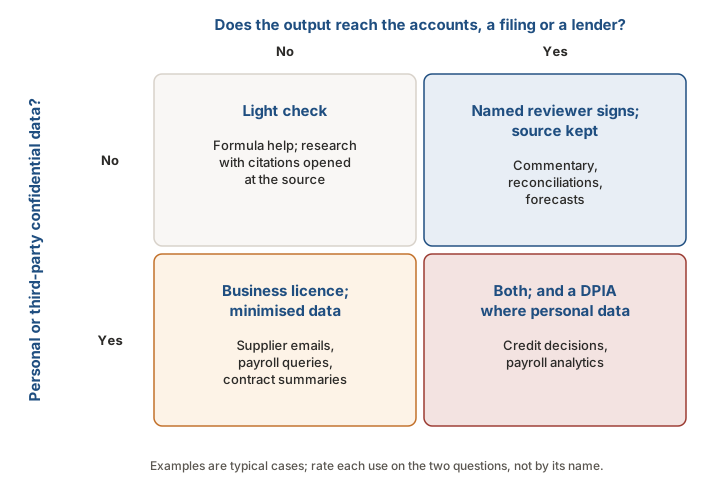
AI drafts and matches; people decide. The useful question for each task is not "can AI do this?" but "what data does it need, where does the output go, and who checks it?" The table rates common AI use cases for finance teams on those three points.
| Task | Data it needs | Does the output reach the accounts or a decision about a person? | Review it needs |
|---|---|---|---|
| Drafting monthly management accounts commentary | Internal | Reaches the board, and indirectly the accounts | The pack's owner checks every figure and statement to the ledger |
| Matching invoices to purchase orders and supplier statements | Internal; supplier names | Feeds postings | Exceptions reviewed by the AP team; sample of matches checked |
| Bank and balance sheet reconciliations (see AI in the month-end close) | Internal | Yes | Preparer and reviewer sign as for any reconciliation |
| Forecasts and scenario drafts | Internal | Reaches lenders and the board; supports going concern | Assumptions owned and approved by a named person |
| Reading contracts and leases for key terms | Confidential to a third party | Yes, through lease, revenue and provision accounting | Terms checked to the contract before use |
| Technical and policy research | Public | Can shape an accounting judgement | Every citation opened and read at the source |
| Excel formulas and macros | None, or a sample | Yes, if the spreadsheet feeds the accounts | Formula tested on known figures |
| Supplier and customer emails | Personal data (names, contact details) | No | Read before sending |
| Credit control prioritisation | Personal data where customers are individuals or sole traders | A decision about a person if it sets limits or stops supply | A person decides; see the automated decision rules below |
| Payroll and expenses queries | Personal data, sometimes special category | Yes, and decisions about people | Business licence only, minimised data, a person decides |
What should AI not be used for in finance?
AI should not, on its own, approve or release a payment, post a journal, choose an accounting estimate or judgement, sign off a reconciliation, or send anything to a lender, HMRC or Companies House. Nor should it take a decision about an individual that has a legal or similarly significant effect, such as refusing credit or changing pay, without a person meaningfully involved.
Posting is the line most teams cross first, because ledger software increasingly offers to post for you. Journals prepared by AI are covered in AI in the month-end close; the principle here is that a person with posting authority approves each one, as they would a journal prepared by a junior.
The other limit is accuracy. A general-purpose model can state a wrong figure or cite a paragraph that does not exist, with complete confidence, and its knowledge of rules stops at its training date. The control is simple: any figure is traced to the ledger or the source document, and any citation is opened and read before anyone relies on it.
AI for finance teams: which kind of tool
The same brand can sit in different tiers, and the tier decides the data rules. The table below states only what each provider's own pages said when checked on 26 October 2026; terms change, so check them again before you decide.
| Tier | What the provider says | What to allow |
|---|---|---|
| Consumer chatbot on a personal account (ChatGPT Free, Plus or Pro) | OpenAI says that for these plans "we may use your content to train our models", and that a user can opt out in Settings > Data controls, after which its new conversations are not used; a conversation the user sends feedback on may still be used. Its Data Processing Addendum is offered for ChatGPT Business, ChatGPT Enterprise and the API; individual plans are not listed. | Public information only. No company, customer or employee data |
| Business licence under the company's contract: ChatGPT Business or Enterprise | OpenAI says that by default it does not use business data for training, and that it will sign a Data Processing Addendum for ChatGPT Business, ChatGPT Enterprise and the API. For Enterprise, workspace admins control retention, and deleted conversations are removed within 30 days unless OpenAI is legally required to keep them. | Internal data, confidential data only if the contract or undertaking permits, and minimised personal data, once the addendum is signed and settings are checked |
| Business licence: Microsoft Copilot (formerly Microsoft 365 Copilot) used by an organisation | Microsoft says organisational use is covered by its Data Protection Addendum and Product Terms "with Microsoft acting as a data processor"; prompts, responses and data accessed through Microsoft Graph are not used to train foundation models; the company's permissions, sensitivity labels, retention policies and audit apply. Web search queries go to Bing, where Microsoft acts as an independent controller outside the addendum; the EU Data Boundary does not apply to them, or to Anthropic models in Copilot. | As for ChatGPT Business, with web search reviewed for confidential work |
| AI inside your ledger, spend or close software | Governed by that vendor's own terms and data processing agreement | Allowed once you have read the vendor's AI terms: whether your data trains models, where it is processed, which sub-processors are used |
| Agents that act: read mailboxes, post entries, make payments | The ICO says organisations "remain responsible for data protection compliance of the agentic AI they develop, deploy or integrate" | Only with limits on what the agent can do, a person approving each posting or payment, and logs kept |
An agent that reads supplier emails or documents can also be steered by text hidden in them (prompt injection), so it should never hold authority that a fraudulent email could exploit.
The data rules: UK GDPR and the ICO's guidance
UK data protection law changed in 2025 and 2026. The Data (Use and Access) Act 2025 replaced UK GDPR Article 22 with Articles 22A to 22D on automated decision-making, fully in force from 5 February 2026. From 30 September 2026 the regulator is the Information Commission, which took over the Information Commissioner's functions; its guidance is still published at ico.org.uk under the ICO name. The ICO's guidance on AI and data protection was last updated on 15 March 2023 and is marked as under review because of the 2025 Act, so it is a guide to the principles rather than the final word.
Is it safe to put company finance data into ChatGPT?
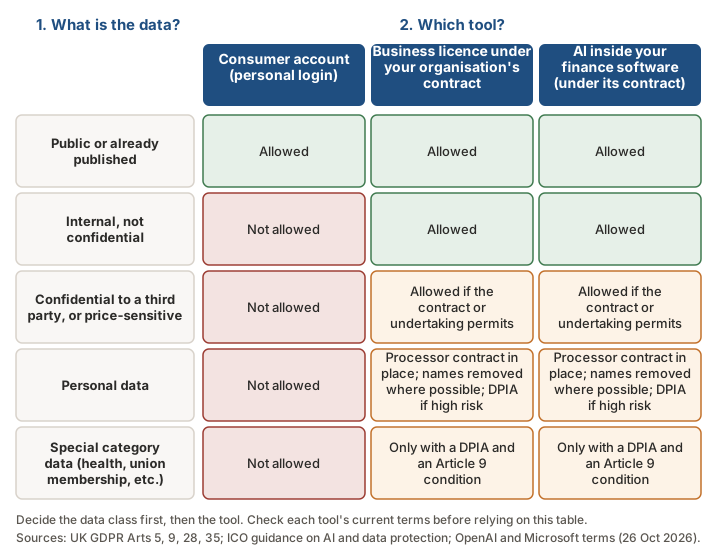
It depends on the account and its terms, then on the data. On a personal consumer account, company data is governed by the provider's consumer terms, may be used for training (an opt-out covers new conversations only, and not a conversation the user sends feedback on), and has no processor contract with your company behind it. On a business licence with a signed data processing addendum and training off, internal and confidential data can be used within the rules below. "Is Copilot GDPR compliant?" has the same answer: it is a property of the licence, the contract and the settings, not of the brand.
Personal data: controller, processor and the contract
In practice, yes on a business licence with an Article 28 processor contract, using only the data the task needs; no on a personal consumer account, which has no processor contract with your company behind it. When your team puts personal data (a customer's name, an employee's salary) into an AI tool, your company is the controller. A business AI provider acting on your instructions is a processor, and UK GDPR Article 28(3) requires a contract that, among other things, limits the processor to your documented instructions, binds its staff to confidentiality and makes it delete or return the data at the end. A transfer outside the UK needs UK adequacy regulations, appropriate safeguards or a specific derogation (Article 44A). Special category data, such as health information in sick pay records, also needs a condition under Article 9. Beyond the contract, the usual principles apply: a lawful basis, a privacy notice that covers the new use, and only the data needed (Article 5(1)(c)). Removing names and identifiers before upload is often the simplest step, though data that can still be linked back to a person remains personal data.
When you need a DPIA
A data protection impact assessment is required before processing that is likely to result in a high risk to individuals, "in particular using new technologies" (Article 35(1)). The ICO's AI guidance says that "in the vast majority of cases" the use of AI will involve processing likely to result in a high risk, and that where you assess a use as not high risk you "still need to document how you have made this assessment". Its AI and data protection risk toolkit is a practical starting point. For a finance team, analysing payroll or customers' payment behaviour with AI is the clearest case for a DPIA; drafting commentary from ledger totals is not.
Automated decisions about people
Under Article 22A, a decision is based solely on automated processing if there is "no meaningful human involvement", and it is significant if it has a legal or similarly significant effect on the person. Where such a decision uses personal data, Article 22C requires safeguards that tell the person about it and let them make representations, obtain human intervention and contest it. Article 22B restricts these decisions where special category data is involved. In finance, that can reach credit limits for sole-trader customers, payroll and expense rejections if a tool decides them. The ICO published draft updated guidance on automated decision-making on 31 March 2026 and consulted until 29 May 2026; the final version had not been published when this page was last reviewed. It is also drafting a statutory code of practice on AI and automated decision-making, due in 2028, and its call for evidence on agentic AI is open until 20 November 2026.
If something goes wrong
Personal data pasted into a consumer account may be a personal data breach, and should be assessed as one. If it is notifiable, Article 33 requires the controller to notify the regulator without undue delay and, where feasible, within 72 hours of becoming aware of it, unless it is unlikely to result in a risk to people's rights and freedoms. Every breach is recorded, notified or not.
Confidentiality beyond personal data
Most finance data is not personal data, and data protection law is not the only constraint. Customer and supplier contracts often carry confidentiality clauses, loan agreements carry information undertakings, and board papers are confidential by nature. For a company with securities on a UK market, inside information may not be disclosed outside the normal exercise of a person's employment, profession or duties (UK MAR Article 10). And if you are an ICAEW member, the Code of Ethics binds you personally not to disclose confidential information acquired through your work without authority (R114.2(a), R114.3), and its guidance expects you to take appropriate action to protect it "in the course of its collection, use, transfer, storage or retention, dissemination and lawful destruction" (114.1 A1).
The practical rule is to decide the data class first, then the tool.
Controls that make AI output usable
A reviewer, and later an auditor, will look for five things:
- An approved tools list. Which tools, on which licences, for which tasks. Anything else is not used on company data.
- A named reviewer for every output that reaches the accounts. The reviewer signs as they would for any preparer, and keeps the duties of preparing, approving and posting apart, as segregation of duties requires.
- The source kept with the output. The input data, the prompt or configuration, and the tool and date, filed with the schedule or commentary it produced.
- Access and admin settings. Business licences only, training off, retention set, logs on, and access limited to the people who need it.
- A register of uses, reviewed at least once a year. What each use is, who owns it and whether it still meets the rules.
Treat a first draft the same way whoever wrote it: the person who signs the pack owns every sentence in it. AI does not change that; it changes how many first drafts arrive. Training matters for the same reason: a team that knows what AI gets wrong checks the right things.
What your auditor will ask if you use AI in finance
Your auditor will want to know where AI touches the figures, and what evidence shows a person checked it. The questions follow from the auditing standards.
- Understanding your systems. ISA (UK) 315 (Revised July 2020) requires the auditor to understand the information system relevant to the financial statements, including how transactions are recorded, processed and corrected (paragraph 25). An "IT application" is any program used in initiating, processing, recording and reporting transactions or information (paragraph 12). An AI tool that prepares or changes figures is part of that picture, and if a control the auditor identifies depends on it, the auditor considers the risks arising from its use and the general IT controls over it (paragraph 26).
- Information produced by the company. ISA (UK) 500 paragraph 9 requires the auditor, when using information produced by the entity, to evaluate whether it is sufficiently reliable, including its accuracy and completeness. A schedule an AI drafted is still the company's information. Keep its source and its review, and the auditor can test it; without them, expect more testing.
- Journals and management override. The auditor must test the appropriateness of journal entries and other adjustments (ISA (UK) 240 (Revised May 2021) paragraph 33; ISA (UK) 240 (Revised March 2026) paragraph 48, for periods beginning on or after 15 December 2026). Who, or what, can post to your ledger is part of that work.
- Relying on controls. If the auditor plans to rely on a control, it must test whether the control operated effectively (ISA (UK) 330 paragraph 8). A control performed by an AI tool is tested like any other, and one that leaves no evidence is hard to test.
Audit firms face the same questions about their own tools. The FRC has issued guidance for audit firms on AI in 2025 and 2026, summarised in our guide to the FRC's AI audit guidance; the FRC states that "the human auditor is always accountable". The other side, how auditors use AI, is a separate guide. Where AI drafts parts of the annual report or the financial statements themselves, the same questions apply with more force, because the output is the document the auditor reports on.
The questions to be ready for:
- Which AI tools does the finance team use, on which licences?
- Which figures, schedules or disclosures did AI prepare or change?
- Who reviewed each one, and where is the evidence?
- Can each AI-prepared schedule be traced to the ledger or source documents?
- Can any AI tool or agent post journals or release payments?
- What data went into each tool, and under what contract?
- Did any AI tool take decisions about customers or employees?
- Has anything gone wrong, and what was done?
If your company is heading for its first audit and the team already uses AI to prepare its schedules, settle these questions with the auditor at the start. If this will be your company's first audit, tell us about it: Innate offers statutory audits signed by an ICAEW-registered partner firm, which your company appoints as its auditor. Our platform gets the information and documents for the audit team, to save you time and money.
Do you need an AI policy? The headings to cover
Yes, once more than one person uses AI on company data. It need not be long. Cover:
- scope and owner;
- approved tools and licences;
- data classes and what may go into which tool;
- review and sign-off of outputs;
- records kept with each output;
- training;
- reporting a mistake or a breach;
- the date the policy will next be reviewed.
A full AI policy template is the subject of a separate guide.
How to use AI in a finance department, step by step
Find out what is already in use
Ask the team, and check expense claims and software subscriptions. Personal accounts used for work are the first thing to move.
Choose one or two low-risk uses
Start where the data is internal and the output is reviewed before it goes anywhere: commentary drafts, formula help, research with citations.
Set up the business licence and settings
Sign the data processing addendum, turn training off where it is an option, set retention, switch on logs and restrict access. Check how web search and any connected agents are handled.
Write the rules and train the team
Put the policy headings above into one or two pages, and show the team examples of AI getting a figure or a citation wrong.
Tell your auditor before year end
Tell the auditor at planning which tools touch the figures and what evidence you keep, alongside the rest of your year-end audit checklist. For more on running the function, see our guides for finance teams.
Review after three months
Look at what was used, what went wrong and what saved time, update the register and the policy, and decide the next use.
Used this way, AI can save a finance team time without moving a single decision away from the people accountable for it.