Lease register template: the lease data to collect before your first FRS 102 year end
By Alon Zieve FCA · Last reviewed
This guide is for the financial controller of a UK company applying FRS 102 whose first year end under the revised Section 20 falls between 31 December 2026 and 30 September 2027. It is about the schedule of every lease the company holds as lessee, not about registering a lease at HM Land Registry. Before any lease liability can be calculated the company needs one register, one row per lease (also called a lease inventory): the contract facts, the balances at the date of initial application, and the judgements with who approved them. This lease register template lists the lease data to collect for FRS 102, says where each item sits in the documents, and gives the register as a CSV. It is one of our guides for finance teams; the rules are in FRS 102 lease changes, the numbers in the FRS 102 lease accounting example.
What is a lease register, and why does FRS 102 make you need one?
A lease register is the company's own schedule of every contract under which it is the lessee, one row per lease, holding the data Section 20 needs to recognise a right-of-use asset and a lease liability (FRS 102 (September 2024) paragraph 20.45) and to make the lessee disclosures (paragraphs 20.76 to 20.82). It is not the same as registering a lease: in England and Wales a lease granted for more than seven years out of a registered title is completed by registration at HM Land Registry (Land Registration Act 2002 s27(2)(b)), a conveyancing step your solicitor handles.
Until the Periodic Review 2024 amendments most of these contracts were operating leases, expensed as rent or hire, so their terms were seldom gathered in one place; for periods beginning on or after 1 January 2026 they must be (FRS 102 changes has the dates). Accounting records must show and explain the company's transactions (Companies Act 2006 s386), and the auditor has a right of access to the books, accounts and vouchers (s499): the register and its contracts are records, not workings.
Which date is the register as at? The year end and the date of initial application
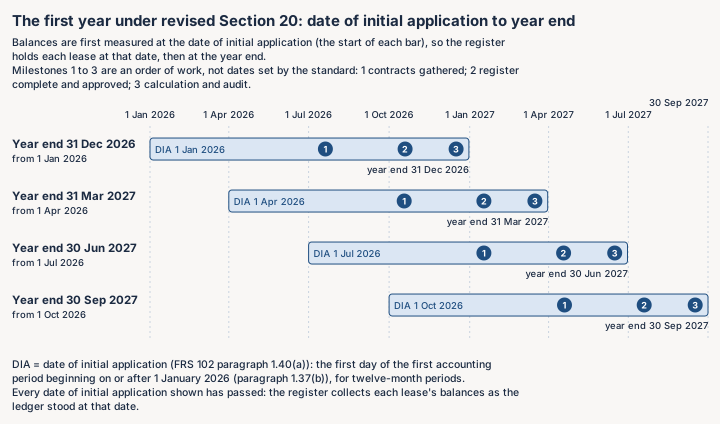
Two dates matter. Balances are first measured at the date of initial application, the beginning of the first reporting period in which the company applies the amendments (paragraph 1.40(a)), and comparatives are not restated: the cumulative effect goes to opening retained earnings at that date (paragraph 1.47). The register therefore holds each lease at that date, then at the year end. For a twelve-month period the date of initial application is the day after the previous year end.
| Year end | Date of initial application |
|---|---|
| 31 December 2026 | 1 January 2026 |
| 31 March 2027 | 1 April 2026 |
| 30 June 2027 | 1 July 2026 |
| 30 September 2027 | 1 October 2026 |
Table 1: four common year ends, twelve-month periods. Early application was permitted only for all the amendments together, except the supplier finance disclosures, which could be applied earlier on their own (paragraph 1.37).
Every measurement date in the table has passed, so the transition balances (prepaid or accrued rent, rent-free balances, onerous lease provisions, former finance lease carrying amounts) come from the ledger as it stood then, not from today's.
What lease data do you need to collect for FRS 102? The register, field by field
Forty-five fields in six groups: most are there because a paragraph of Section 20 or of the Section 1 transition provisions uses them; the rest identify the lease and its documents, or record who prepared and approved the row. This lease register template gives each field, the paragraph that needs it and the document it comes from; the CSV below carries the same names in the same order, one value per cell, dates as YYYY-MM-DD, money as numbers. Commencement is when the asset is made available, not when the lease is signed; the rent demand shows the service charge, insurance and VAT; the transition balances are the ledgers as they stood at the date of initial application.
| Field | Why FRS 102 needs it | Where it comes from |
|---|---|---|
| Identification | ||
| Lease reference | One row per lease | Your numbering |
| Asset description | The identified asset (20.19) | Demise clause, hire schedule |
| Asset class | Elections and disclosures by class (20.7, 20.33, 20.81) | Your classes |
| Location, registration or serial number | A floor is an identified asset, a share of capacity is not (20.22) | Lease plan, V5C, asset tag |
| Lessor | The counterparty | Parties clause |
| Related party lessor (yes/no) | Section 33 | Group chart |
| Contract reference and where held | Accounting records (s386); auditor's access (s499) | Legal or property file |
| Sublet (yes/no) | Never low value if sublet (20.12); income disclosed (20.80(e)) | Sublease granted |
| Dates and term | ||
| Inception date | Identified at inception (20.15) | The agreement |
| Commencement date | Term and accounting start (20.37, 20.45) | Completion statement, delivery note |
| Rent-free period (from, to) | Inside the term (20.37) | Heads of terms |
| Contractual expiry | Non-cancellable period (20.38(a), 20.39) | Term clause |
| Break option: date, notice, penalty | Counted if reasonably certain not to break (20.38(c)); penalty (20.51(e)) | Break clause |
| Extension or renewal option | Counted if reasonably certain to extend (20.38(b)) | Option clause |
| Purchase option and exercise price | In the liability if reasonably certain (20.51(d)); never short-term (Glossary) | Hire-purchase terms |
| Lease term used (end date) | The judgement (20.38–20.42); revised under 20.43–20.44 | Approved assessment |
| Months left at the date of initial application | Twelve or fewer may be short-term (1.53(c)) | Computed |
| Payments | ||
| Payment amount (£) | Fixed payments (20.51(a)) | Rent clause, invoice; record gross or net of VAT consistently |
| Frequency, timing and payment dates | Timing drives present value (20.49) | Rent clause, direct debit |
| Fixed uplifts | Fixed payments (20.51(a)); in-substance fixed (20.52) | Rent clause |
| Rent review type and next date | Index and market reviews at the commencement-date level (20.51(b), 20.53–20.54) | Review clause |
| Usage-based variable payments | Outside the liability; expensed, disclosed (20.64(b), 20.80(d)) | Turnover or mileage clauses |
| Non-lease components; separated? | Separated unless the 20.33 class election (20.27–20.28, 20.78) | Invoice split |
| Lease incentives (£) | Reduce the asset or payments (20.47(b), 20.51(a)) | Agreement for lease |
| Residual value guarantee (£) | In the liability (20.51(c)) | Contract-hire terms |
| Deposit (£) | A refundable deposit is not a lease payment (Glossary) but a receivable; a non-refundable one is a payment at or before commencement (20.47(b)) | Deposit clause |
| Payments at or before commencement (£) | Asset's cost (20.47(b)) | Completion statement |
| Initial direct costs (£) | Asset's cost, new leases only (20.47(c); not 1.51(b)) | Legal and agent invoices |
| Restoration or dilapidations estimate (£) | Section 21 estimate in the asset's cost (20.47(d), 20.48) | Yield-up clause, surveyor's estimate |
| Transition at the date of initial application | ||
| Previous classification (operating or finance) | Operating 1.51; finance 1.55 | Last year's lease note |
| Former finance lease carrying amounts (£) | Carried over (1.55) | Fixed asset register, lease creditor |
| Prepaid (+) or accrued (−) rent (£) | Adjusts the asset (1.51(b)) | Prepayments and accruals then |
| Rent-free or incentive balance (£) | Adjusts the asset if accrued rent (1.51(b)) | Accruals, deferred income |
| Onerous lease provision (£) | May reduce the asset (1.53(b)) | Provisions ledger |
| Transition expedients applied | 1.45; 1.52(a); 1.53(a)–(d); disclosed (1.50) | Transition paper |
| Judgements and rates | ||
| Exemption election | Short-term by class, low value by lease (20.5–20.7, 20.9–20.12); commitments (20.82) | Policy decision |
| Discount rate type | Implicit, else incremental or obtainable (20.49); disclosed (20.77(c)) | Rate paper |
| Rate (%) | Measures the liability (20.49; transition 1.51(a)) | Lender indication |
| Rate date and evidence | Revised only under 20.66–20.72 | Lender letter |
| Portfolio reference | Portfolio application (20.13); one transition rate for similar leases (1.53(a)); disclosed (20.78) | Portfolio definition |
| Control | ||
| Source documents held | The evidence trail | Your files |
| Prepared by, date | Who gathered the facts | — |
| Judgements approved by, date | Not the preparer | — |
| Status (current, ended, modified) | Modifications remeasure (20.70–20.73) | — |
| Last reviewed | A living record | — |
Table 2: the register, field by field. Paragraphs are FRS 102 (September 2024); s386 and s499 are the Companies Act 2006. A restoration estimate recognised under Section 21 joins the asset's cost when the obligation is incurred (paragraphs 20.47(d), 20.48). At transition a former operating lease is discounted at the incremental or the obtainable borrowing rate (1.51(a)); the choice and its evidence are the subject of our separate guide to lease discount rates under FRS 102.
Finding every lease: where they hide, and how to show the list is complete
Leases sit wherever a company pays to use what it does not own: property and licences to occupy, serviced offices, vehicle contract hire, plant hire, printers, IT and telephony, storage units, intra-group property, and contracts that contain a lease without saying so, such as logistics, warehousing and managed-service agreements. A contract contains a lease if it conveys the right to control the use of an identified asset for a period of time in exchange for consideration (paragraph 20.15): directing its use and taking substantially all the economic benefits (20.16); there is no identified asset where the supplier has a substantive right to substitute it throughout the period of use (20.20).
Under the practical expedient in paragraph 1.45 the company need not re-decide whether existing contracts contain a lease: it applies the revised Section 20 to those already treated as leases, for all its contracts, and discloses that. It must still find every one, including those expensed as rent, hire or equipment rental in the wrong account. In my years as a CFO the leases that surfaced late were rarely the property ones; they were printers and forklifts, paid monthly as "hire" from a cost centre finance seldom looked at.
The completeness check is the company's own control: reconcile the rent, hire, lease and prepayment accounts, and the direct debits, to the lease inventory; explain every payee not on it; ask facilities, operations, IT and the group for contracts finance has never seen; compare with last year's commitments note. Keep the reconciliation as the evidence.
The judgements in the register, and who approves them
Some fields are decisions, not facts, and each needs an owner, a date and a written reason:
- The lease term where there is a break or an extension option: an option period counts only if the company is reasonably certain to extend, or not to break (paragraph 20.38), weighing market terms, leasehold improvements, the cost of leaving, the asset's importance and any conditions on the option (20.41), and past practice (20.42); reassessed only on a significant event within the company's control (20.43) or a change in the non-cancellable period (20.44).
- The exemption elections: short-term by class, low value lease by lease (20.7).
- Not separating non-lease components, by class (20.33).
- The rate type and its evidence (20.49; at transition, 1.51(a)).
- The portfolio, one rate for similar leases (20.13, 1.53(a)).
- At transition, hindsight on options (1.53(d)) and the twelve-month treatment (1.53(c)), lease by lease.
The controller prepares, the finance director approves each judgement with a date, and the approval is a column in the register, so nobody approves their own judgement: segregation of duties applied to the register. Write the reason down when the judgement is made, not when the auditor asks.
A lease register example: the register for a company with five leases
The rows are the invented company from our FRS 102 lease accounting example, 31 December year end, date of initial application 1 January 2026: an office with a rent-free period and a break, a van on contract hire, a storage unit ending within twelve months, laptops as low-value assets, and a forklift that was a finance lease. Table 3 abridges the register to twelve columns.
| Ref | Asset | Class | Commencement | Expiry | Term used to | Payment | Review or incentive | Previously | Exemption | Rate type | Status |
|---|---|---|---|---|---|---|---|---|---|---|---|
| L-001 | Head office | Land and buildings | 2021-01-01 | 2030-12-31 | 2030-12-31 | £10,000 quarterly in advance | Rent-free Jan–Jun 2021; break 31 Dec 2027 | operating | none | Obtainable, 6.5% | current |
| L-002 | Van on contract hire | Vehicles | 2023-07-01 | 2027-06-30 | 2027-06-30 | £500 monthly in arrears | none | operating | none | Obtainable, 7.5% | current |
| L-003 | Storage unit | Land and buildings | — | 2026-03-31 | 2026-03-31 | £1,500 quarterly | none | operating | Short-term at transition (1.53(c)) | — | ended 2026-03-31 |
| L-004 | Staff laptops | IT and office equipment | 2024-10-01 | 2027-09-30 | 2027-09-30 | £600 quarterly in advance | none | operating | Low value (20.5(b)) | — | current |
| L-005 | Forklift | Plant and equipment | 2024-01-01 | 2028-12-31 | 2028-12-31 | £6,000 annually in arrears, 31 Dec | none | finance | none | Implicit, 8% | current |
Table 3: a lease register example, abridged. Illustrative: every term comes from the worked example, which calculates the liabilities and assets; the storage unit's commencement date is not stated there.
Download the lease register template (CSV): all forty-five fields in the same order, the five rows in full, and a first line saying it is an example, not advice. It opens in Excel or any spreadsheet; blank cells are items the worked example does not state. Replace the rows with your own leases.
Keeping the register right through the year, and what your auditor will look at
The register is a living record, updated for every new lease, modification, rent review that takes effect, break exercised or lapsed, and lease that ends. A modification (a change of scope or consideration not in the original terms) is either a separate lease or a remeasurement of the liability (paragraphs 20.70 to 20.73); an index-linked or market review remeasures it when the new cash flows take effect (20.68(b)); a modified short-term lease is a new lease (20.8). Review it at each month end.
For an audited company, expect the auditor to ask for all of this for leases in the first year under the revised Section 20: the register, how its completeness was checked, the contracts, the lease-term judgements, the evidence for each rate and the exemption elections. What the auditor does with them is the auditor's judgement. The rest of the request list is in the year-end audit checklist.
If your company's next audit is its first under the revised FRS 102, Innate offers statutory audits signed by an ICAEW-registered partner firm, which your company appoints as its auditor, with our platform finding the documents and reconciling the numbers: ask for a quote.
Questions controllers ask about the lease register
Is there a £5,000 low-value limit?
No. FRS 102 sets no monetary figure: low value is judged on an absolute basis, regardless of the lease payments (paragraph 20.9); paragraph 20.11 lists assets that are not of low value, from vans and forklifts to land and buildings, and the Basis for Conclusions accepts tablets, personal computers, small items of office furniture and telephones (B20.10). A £5,000 figure in a public-sector template is that template's own threshold, not anything in FRS 102.
Does a small company need one?
Yes, if it applies FRS 102: Section 1A changes the disclosures, not recognition or measurement (paragraph 1A.1), and a small lessee still describes its leasing arrangements and gives its short-term, low-value and variable lease expense (1AC.31A, 1AC.32A). A micro-entity on FRS 105 is different: its Section 15 was not amended (FRS 105 (September 2024), Basis for Conclusions paragraph 54); see UK GAAP explained.
Do we need lease software?
No. For a handful of leases a spreadsheet with one value per cell, a change log and a reviewer is adequate; what matters to the auditor is the data and the judgements, not the tool.
What about a lease that ended after the date of initial application but before the year end?
It stays in the register: unless it fell within the twelve-month expedient (1.53(c)), it was measured at the date of initial application, runs to its end and feeds the year's disclosures (20.80). Mark it ended and keep the contract.
Who should own the register?
One person, usually the controller, with the finance director approving the judgements. The contracts stay where legal or property keep them; the register says where.