Lease discount rates under FRS 102: the implicit rate, the IBR and the obtainable borrowing rate
By Alon Zieve FCA · Last reviewed
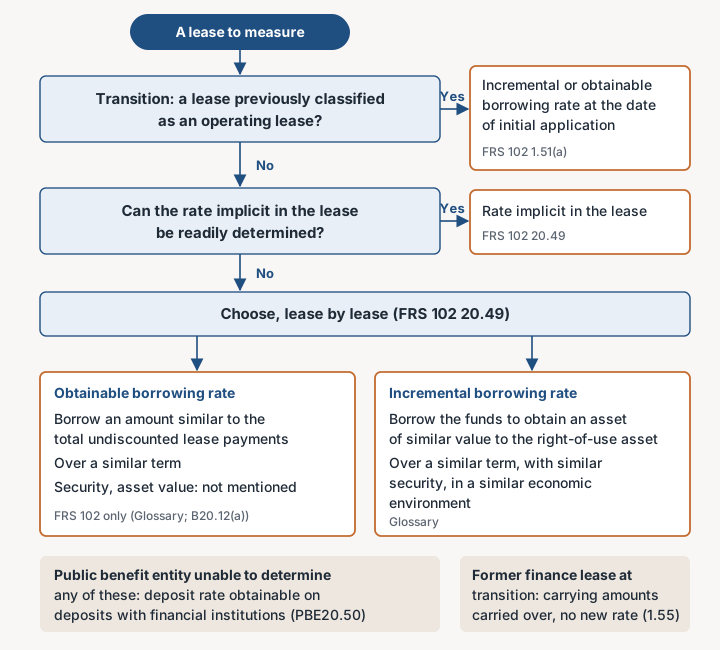
A company applying FRS 102 discounts each lease at the rate implicit in the lease if that rate can be readily determined. If it cannot, which is the usual case for a lessee, the company chooses, lease by lease, its incremental borrowing rate (IBR) or its obtainable borrowing rate (OBR) (FRS 102 paragraph 20.49). The obtainable borrowing rate is FRS 102's own option, not found in IFRS 16: the rate the company would have to pay to borrow, over a similar term, an amount similar to the total undiscounted lease payments. Nothing in it asks for security or an asset of similar value.
This guide sets the three lease discount rates side by side, shows which applies when, works one lease through at two rates, and lists the note disclosures and the evidence to keep. What the lease changes are, and which leases go on the balance sheet, is in FRS 102 lease changes; the rest of the series is in our UK accounting guides.
What is the obtainable borrowing rate under FRS 102?
The obtainable borrowing rate is defined in the FRS 102 Glossary as "The rate of interest a lessee would have to pay to borrow, over a similar term, an amount similar to the total undiscounted value of lease payments to be included in the measurement of the lease liability."
The Financial Reporting Council (FRC) added it in the Periodic Review 2024 amendments, which apply to accounting periods beginning on or after 1 January 2026 (earlier application is permitted if all the amendments are applied at the same time). In its Basis for Conclusions the FRC explains that "Whilst representing a broadly similar concept, the lessee's obtainable borrowing rate is expected to be simpler to determine and therefore represents a proportionate simplification" (B20.12(a)). It is an option, not a requirement: a company may still use its incremental borrowing rate.
Every lessee applying FRS 102 can use it where the implicit rate cannot be readily determined, including a small company using Section 1A, because Section 1A reduces disclosure but keeps all the recognition and measurement requirements (paragraph 1A.1). Micro-entities using FRS 105 do not have it: FRS 105 keeps finance and operating leases, and discounts a finance lease's minimum lease payments at the rate implicit in the lease or, if that cannot be determined, the incremental borrowing rate (FRS 105 paragraphs 15.10 and 15.11).
Which discount rate does FRS 102 require for a lease?
Paragraph 20.49 sets the order: "The lease payments shall be discounted using the interest rate implicit in the lease, if that rate can be readily determined. If that rate cannot be readily determined, the lessee shall choose, on a lease-by-lease basis, to apply either the lessee's incremental borrowing rate or the lessee's obtainable borrowing rate." The same paragraph measures the lease liability at the commencement date at the present value of the lease payments not paid at that date.
A public benefit entity, such as a charity, that cannot readily determine any of the three "shall use the rate of interest otherwise obtainable by the public benefit entity on deposits held with financial institutions" (paragraph PBE20.50). The FRC added this "on the basis that some public benefit entities may not borrow" (B20.12(a)). No other fallback exists: FRS 102 names no gilt or risk-free rate for a company.
"Lease by lease" means a company can use the obtainable borrowing rate for its property leases and the incremental borrowing rate for others; the mix is among the disclosures paragraph 20.77 lists when relevant (see what the notes disclose). Once set, the rate is used to charge interest on the liability (paragraph 20.63) and, in general, "is not re-assessed other than for certain reassessments of the lease liability … and certain lease modifications" (Factsheet 11), listed in the table of rate changes.
When can you use the rate implicit in the lease?
Only when it can be readily determined, and a lessee rarely has what it takes. The Glossary defines it as the rate that makes the present value of the lease payments and the unguaranteed residual value equal to the sum of the fair value of the underlying asset and any initial direct costs of the lessor. Those are the lessor's figures: what the asset is worth, what the lessor expects it to be worth at the end of the lease, and what the lessor spent arranging the lease.
A lessee can know it only if the lessor discloses the rate or the inputs behind it, as some vehicle and equipment finance agreements do. A rate printed in an agreement is the implicit rate only if it is the rate the Glossary describes; where it is, the company must use it rather than a borrowing rate. The implicit rate is not available for former operating leases at transition, which use a borrowing rate at the date of initial application (paragraph 1.51(a); see below).
Obtainable borrowing rate vs incremental borrowing rate: what is different?
Both borrowing rates start from what the lessee "would have to pay to borrow" over a similar term. They differ in what is borrowed and on what terms: the obtainable borrowing rate is the rate to borrow an amount similar to the total undiscounted lease payments, and its definition mentions no security; the incremental rate is the rate to borrow, with similar security, the funds to obtain an asset of similar value to the right-of-use asset, in a similar economic environment.
| Interest rate implicit in the lease | Incremental borrowing rate | Obtainable borrowing rate | |
|---|---|---|---|
| Amount | Not a borrowing: derived from the lease payments, the unguaranteed residual value, the asset's fair value and the lessor's initial direct costs | "the funds necessary to obtain an asset of a similar value to the right-of-use asset" | "an amount similar to the total undiscounted value of lease payments" |
| Term | The lease | "a similar term" | "a similar term" |
| Security | Not relevant | "with a similar security" | Not mentioned |
| Economic environment | Not relevant | "in a similar economic environment" | Not mentioned |
| Whose figures | The lessor's | The lessee's | The lessee's |
| Origin | Glossary | Glossary | Glossary; introduced by the Periodic Review 2024 as an alternative to the IBR, not in IFRS 16 (B20.12(a)) |
| At transition (former operating leases) | Not available (1.51(a)) | Yes | Yes |
Sources: FRS 102 Glossary; paragraphs 20.49 and 1.51(a); Basis for Conclusions B20.12(a).
Two differences matter in practice. First, the obtainable borrowing rate's amount is known before any calculation: it is the undiscounted total of the payments in the liability. The incremental borrowing rate's amount is the value of an asset similar to the right-of-use asset, which is the figure being measured, so it has to be estimated first. Second, the obtainable borrowing rate's definition mentions no security, so a lender's indication for an unsecured loan of that amount and term is consistent with its words. FRS 102 does not say whether security a lender would in practice ask for should be reflected.
Several published guides describe the obtainable borrowing rate as a secured rate, or one tied to the value of the leased asset. The Glossary says neither; those are the incremental borrowing rate's terms. Neither rate is defined as higher or lower than the other: each depends on the amount, the term, the company's credit standing and, for the incremental rate, the security.
How to set and evidence the obtainable borrowing rate
FRS 102 sets no method to calculate the obtainable borrowing rate: it defines the rate by what it represents and names no curve, index or formula. The question is one of fact: what would this company have to pay to borrow this amount over this term?
Start from what the company could actually borrow
The most direct evidence is a lender's indication for the amount and term. The FRC's own example does this: a lessee with a five-year lease of CU10,000 a year, "taking into account a quote from its bank to borrow CU50,000 over a similar term", concludes that its obtainable borrowing rate is 7% (Factsheet 11, Example 4). CU50,000 is the undiscounted total of the five payments.
Other evidence includes the pricing of an existing facility of similar term and amount (its reference rate and margin), and the rate on a recent loan. A build-up, a reference rate for the term plus the company's credit margin, is a way of evidencing the rate, not a formula the standard requires.
Match the term and the amount
The term is the lease term, which includes periods under an extension option the company is reasonably certain to exercise or a break option it is reasonably certain not to (paragraph 20.38). The amount is similar to the total undiscounted lease payments included in the liability, not the asset's value and not the annual rent. The definition says nothing about currency; where the payments are in euros or dollars, a sterling rate may not be what the company would pay to borrow that amount, so the file should explain the choice.
A company with no borrowings
The definition is hypothetical ("would have to pay"), so a company with no debt still has an obtainable borrowing rate, which can be evidenced, for example, by an indication sought from a lender for the purpose. The deposit rate in PBE20.50 is for public benefit entities only.
A UK subsidiary in a group
FRS 102 does not say whether a parent's or group's rate can be used, so the test is the definition: the rate this company would have to pay. A group funding rate can be good evidence where the subsidiary could actually borrow on those terms, for example under an intra-group facility it already uses. A parent's rate on its own borrowings reflects the parent's credit, not necessarily the subsidiary's.
One rate for a group of leases
Paragraph 20.13 allows Section 20 to be applied "to a portfolio of leases with similar characteristics (eg a similar lease term for a similar class of underlying asset in a similar economic environment)", using "estimates and assumptions that reflect the size and composition of the portfolio". Unlike FRS 102's revenue portfolio expedient (paragraph 23.6), it has no condition that the result "would not differ materially" from applying it lease by lease. At transition, paragraph 1.53(a) separately allows a single rate for a portfolio "with reasonably similar characteristics". A ten-year office lease and a three-year van lease, with different terms and classes of asset, would not normally form one portfolio.
Worked example: one lease, two rates
An invented company signs a new office lease starting on 1 January 2027: five annual payments of £50,000 in arrears, £250,000 in total. It cannot readily determine the implicit rate. It has two pieces of evidence, both invented:
- Obtainable borrowing rate, 7.0%: its bank's indication for an unsecured loan of £250,000 over five years.
- Incremental borrowing rate, 6.0%: the rate for a five-year loan secured on an asset of similar value to the right-of-use asset.
The right-of-use asset equals the liability (no incentives, initial direct costs or restoration costs) and is depreciated straight line over five years.
| Year to 31 December 2027 | Obtainable borrowing rate (7.0%) | Incremental borrowing rate (6.0%) |
|---|---|---|
| Lease liability and right-of-use asset at 1 January 2027 | £205,010 | £210,618 |
| Interest | £14,351 | £12,637 |
| Depreciation | £41,002 | £42,124 |
| Total charge | £55,353 | £54,761 |
| Charge above the £50,000 rent | £5,353 | £4,761 |
| Lease liability at 31 December 2027 | £169,361 | £173,255 |
| Interest over the five years | £44,990 | £39,382 |
Figures computed in code; inputs invented, not market rates.
One percentage point moves the opening liability by £5,608 (2.7% of the 7.0% figure). The higher rate gives a smaller liability and asset but more interest, so its first-year charge is higher. Over the five years both total £250,000, the payments, so the rate changes the timing of the charge, not its total. The 7.0% liability of £205,010 is five times the FRC's Example 4 (CU41,002 at 7%), which checks the arithmetic.
For a full transition worked through with journals, see our FRS 102 lease accounting example.
Which rate applies at transition?
Unless the company uses the IFRS 16 alternative in paragraph 1.48 or an exemption in paragraphs 1.52 and 1.53 (for example for low-value leases, or leases ending within 12 months), a lease previously classified as an operating lease is measured at the date of initial application, the start of the first period under the revised Section 20 (1 January 2026 for a 31 December year end that did not apply the amendments early), at the present value of the remaining payments, "discounted using the lessee's incremental borrowing rate or lessee's obtainable borrowing rate for each lease at the date of initial application", with PBE20.50 for a public benefit entity (paragraphs 1.40(a) and 1.51(a)). The rate is the one at that date: not the implicit rate, and not a rate from when the lease began, which some guides wrongly offer.
A former finance lease needs no new rate: its right-of-use asset and liability are the carrying amounts of the leased asset and finance lease liability immediately before that date (paragraph 1.55), with no adjustment to retained earnings (Factsheet 9).
For former operating leases, one rate may be applied to a portfolio with reasonably similar characteristics (paragraph 1.53(a)). Instead of a transition rate, a company included in consolidated financial statements prepared under IFRS Accounting Standards may take, for all its leases, the IFRS 16 carrying amounts calculated for that purpose, and disclose that it has done so (paragraph 1.48). A company adopting FRS 102 for the first time may use the Section 35 exemption: the incremental or obtainable borrowing rate for each lease at the date of transition to FRS 102, with the same single-rate option, or, if it applied IFRS 16 immediately before, its IFRS 16 amounts (paragraph 35.10(x)).
The full transition, step by step, is in the FRS 102 lease accounting example; the other amendments are in FRS 102 changes.
When does the discount rate change after commencement?
Only on certain reassessments and modifications. Factsheet 11 gives the principle: "A revised discount rate is used when there is a change in the underlying economics of the lease." The table sets out each event, the rate it uses and the paragraph.
| Event | Rate used | FRS 102 |
|---|---|---|
| Commencement | Implicit rate if readily determinable; otherwise the incremental or obtainable borrowing rate, lease by lease | 20.49 |
| Public benefit entity that cannot determine any of these | Deposit rate | PBE20.50 |
| Transition, former operating lease (unless 1.48 is used) | Incremental or obtainable borrowing rate at the date of initial application | 1.51(a) |
| Transition, former finance lease | No new rate: carrying amounts carried over | 1.55 |
| Change in the lease term | Revised rate: implicit rate for the remainder of the term, otherwise a borrowing rate at the date of reassessment | 20.66(a), 20.67 |
| Change in the assessment of a purchase option | Revised rate, as above | 20.66(b), 20.67 |
| Change in amounts expected under a residual value guarantee | Unchanged rate | 20.68(a), 20.69 |
| Payments change with an index or rate, including a market rent review | Unchanged rate, unless the change results from floating interest rates (then a revised rate reflecting the change) | 20.68(b), 20.69 |
| Modification treated as a separate lease (added assets at a commensurate price) | The separate lease takes its own rate under 20.49; the original lease's rate is unaffected | 20.70 |
| Modification not treated as a separate lease | Revised rate under 20.49 at the effective date of the modification | 20.71(c) |
| Modification adding insignificant consideration, cutting scope with a commensurate cut in consideration, or cutting consideration only | May keep the unchanged rate | 20.72(a) to (c) |
| Sublease, where the sublease's implicit rate cannot be readily determined | Intermediate lessor may use the head lease's rate, adjusted for the sublease's initial direct costs, to measure its net investment in the sublease | 20.94 |
A public benefit entity applies PBE20.50 at a reassessment and a modification too (paragraphs 20.67 and 20.71(c)).
A market rent review under the lease's existing terms keeps the old rate, and the liability is remeasured only when the new rent takes effect (paragraphs 20.68(b) and 20.69). The FRC also reduced "the number of situations in which a lease modification requires the determination of a revised discount rate" compared with IFRS 16 (B20.12(b)). The other differences between FRS 102 and IFRS 16 are set out in a separate guide.
What the notes disclose, and the evidence to keep for the audit
Paragraph 20.77 requires additional information "If necessary to enable users to understand its significant leasing arrangements", and "As a minimum, when relevant", including "(c) the types of discount rate (interest rate implicit in the lease, lessee's incremental borrowing rate or lessee's obtainable borrowing rate) used in calculating lease liabilities and the proportion of the total lease liability calculated using each of those types of discount rate". A company that uses the portfolio expedient in 20.13 discloses that fact (paragraph 20.78). One that keeps an unchanged rate on a modification under 20.72 discloses that, and the carrying amount at the period end of the liabilities remeasured that way (paragraph 20.79).
If the invented company above also leased a van whose finance agreement discloses the rate implicit in the lease, 8.0% (three annual payments of £12,000 in arrears from 1 January 2027), its total lease liability at 31 December 2027 would be £190,760, and the note could read: "Lease liabilities are measured using the lessee's obtainable borrowing rate (88.8% of total lease liabilities) and the interest rate implicit in the lease (11.2%)."
A small company using Section 1A gives additional information if necessary to understand its significant leasing arrangements, and paragraph 1AC.31B notes that "A similar disclosure requirement is set out in paragraph 20.77". The 20.77(c) items are a guide to what that information might include, not a list Section 1A requires (see FRS 102 Section 1A disclosure requirements).
For an audited company, the auditor will need audit evidence, the information that supports a figure, for the rates used. Keep, for each lease or portfolio:
- the rate, its type and the date it was set;
- the lender's indication or facility document it rests on, dated close to that date;
- how the term, amount and currency were matched to the lease;
- for a portfolio, the leases in it and why they are similar;
- for a reassessment or modification, why the rate was or was not revised; and
- who approved it.
These fields sit beside the rest of each lease's data in the lease register template; the rest of what the auditor will ask for at the year end is in the year-end audit checklist. Where bank covenants are tested on the accounts, the rate also moves the lease liability in them; the covenant effect is covered in FRS 102 lease changes.
A UK subsidiary that relies on its group's funding rate should keep the intra-group facility terms and a short note of why they reflect what it could borrow itself. If your group's UK company needs a statutory audit, Innate offers one signed by an ICAEW-registered partner firm, which the UK company appoints as its auditor, with our platform doing the legwork to save you time and money: ask for a quote.