FRS 102 changes from 2026: the main Periodic Review amendments in one table
By Alon Zieve FCA · Last reviewed
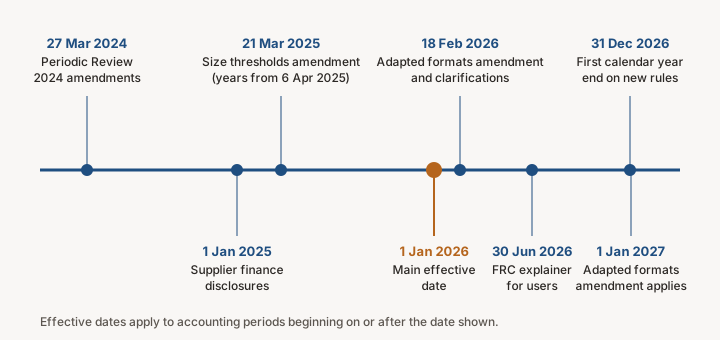
The FRS 102 changes apply to UK companies and other entities that report under FRS 102, including small companies using Section 1A. They come from the Financial Reporting Council's (FRC) Periodic Review 2024 amendments, issued on 27 March 2024, and apply to accounting periods beginning on or after 1 January 2026, so for a company with 12-month periods a 31 December 2026 year end is the first. Early adoption is allowed if every amendment is adopted together. Most leases come onto the balance sheet, revenue follows a five-step model, fair value gets a new section, and many other sections change in smaller ways. The table below sets out the main changes with how each is first applied.
What are the FRS 102 changes?
They are the result of the FRC's second periodic review of FRS 102, the main standard in UK GAAP. Three changes do most of the work, in the FRC's own description: new versions of Section 20 (leases) and Section 23 (revenue from contracts with customers), and a new Section 2A on fair value measurement. They bring FRS 102 closer to IFRS 16, IFRS 15 and IFRS 13, with simplifications, and the FRC expects them to "have a significant impact on some preparers". The rest are what the FRC calls "incremental improvements and clarifications": a clearer set of disclosures for small companies, uncertain tax treatments, supplier finance disclosures and many consequential changes across the standard.
The FRC says FRS 102 "is subject to a periodic review approximately every five years"; the first, the Triennial Review 2017, took effect from 1 January 2019. The second was completed in March 2024 "with a principal effective date of 1 January 2026".
Two later amendments matter to anyone planning a first year end under the new rules:
- UK company size thresholds (21 March 2025): updates FRS 102 and FRS 105 for the higher company law size limits, which apply to financial years beginning on or after 6 April 2025.
- Adapted formats (18 February 2026): changes the rules for companies that choose to adapt the balance sheet or profit and loss formats, following IFRS 18, for periods beginning on or after 1 January 2027. The same document makes limited clarifications to the 2024 amendments themselves, on consolidation exemptions and inventories. Those clarifications count as part of the Periodic Review 2024 amendments, so they apply from 1 January 2026, not 2027.
In June 2026 the FRC also published an explainer for readers of accounts.
The FRS 102 changes, section by section
The table lists the main areas where the Periodic Review 2024 amendments alter what a company recognises, measures or discloses. The amendments also touch most other sections of FRS 102; those changes are consequential on the new lease, revenue and fair value sections, or are smaller clarifications, and are not listed. "DIA" is the date of initial application: the start of the first period in which the company applies the amendments. "FRC amendment" in the last column means the FRC's amendment document itself.
| Area | What changes | Applies to periods beginning | How it is first applied | FRS 105 (micro-entities) | Read more |
|---|---|---|---|---|---|
| Paragraph 1.12 Reduced disclosures (qualifying entities) | New exemptions for qualifying entities, such as subsidiaries, from the total cash outflow for leases (20.80(f)), the lessor's lease income amounts (20.116) and many of the new revenue disclosures; the exemption from the supplier finance disclosures (7.20C) needs equivalent disclosures in the group accounts | 1 Jan 2026 | With the other changes | — | FRC amendment |
| Section 1A Small entities | Appendix C, the minimum notes for UK small entities, expanded with disclosures the FRC considers needed for a true and fair view, including all related party transactions | 1 Jan 2026 | With the other changes | — | FRS 102 Section 1A disclosure requirements |
| Section 2 Concepts | Updated to reflect the IASB's 2018 Conceptual Framework | 1 Jan 2026 | Retrospectively (general rule) | — | FRC amendment |
| Section 2A Fair value (new) | Replaces the appendix to Section 2; based on IFRS 13. Liabilities at transfer value, including own credit risk | 1 Jan 2026 | Prospectively from the DIA; no restatement | — | Profit, balance sheet and tax, below |
| Section 7 Cash flows | New supplier finance disclosures; lease principal payments become financing cash flows | Supplier finance: 1 Jan 2025. Rest: 1 Jan 2026 | Supplier finance: some comparatives not required in year one. Lease cash flows: with the lease transition, comparatives not restated | — | FRC amendment |
| Section 9 Consolidation | Exemptions from preparing group accounts restated, with separate rules for intermediate parents (clarified February 2026) | 1 Jan 2026 | Retrospectively (general rule) | — | FRC amendment |
| Sections 11 and 12 Financial instruments | The option to newly adopt IAS 39 recognition and measurement is removed, unless needed for consistency with group policies; existing users may continue | 1 Jan 2026 | Retrospectively (general rule) | — | FRC amendment |
| Section 13 Inventories | Refund assets for expected returns; right-of-use assets in production overheads; service-provider inventory paragraph deleted (February 2026) | 1 Jan 2026 | Retrospectively (general rule) | Matching deletion in FRS 105 Section 10 | FRC amendment |
| Section 16 Investment property | Any lease for which a right-of-use asset is recognised is in scope if the property otherwise meets the investment property criteria; the separate election for operating lease interests is deleted | 1 Jan 2026 | With the lease transition: no adjustment for leases already at fair value as investment property; a former operating lease newly treated as investment property is measured at fair value at the DIA | — | FRC amendment |
| Section 19 Business combinations | Guidance on identifying the acquirer; payments for future services are not part of the cost of a combination | 1 Jan 2026 | Combinations before the DIA are not reassessed, unless their initial accounting is still incomplete | — | FRC amendment |
| Section 20 Leases | Lessees put most leases on the balance sheet as a right-of-use asset and a lease liability; short-term and low-value leases may stay off | 1 Jan 2026 | Cumulative effect in equity at the DIA; comparatives not restated | No change: FRS 105 Section 15 not amended | FRS 102 lease changes |
| Section 23 Revenue | A five-step model for all contracts with customers | 1 Jan 2026 | Full retrospective, or cumulative effect at the DIA | Similar change, applied only to contracts that begin after the date the micro-entity first applies the amendments | FRS 102 revenue recognition |
| Section 26 Share-based payment | Additional guidance on applying the principles | 1 Jan 2026 | Retrospectively (general rule) | — | FRC amendment |
| Section 29 Income tax | New requirements for uncertain tax treatments | 1 Jan 2026 | Full retrospective, or cumulative effect at the DIA | — | FRC amendment |
| Section 34 Specialised activities | Improvements, clarifications and consequential changes | 1 Jan 2026 | Retrospectively (general rule) | — | FRC amendment |
| Section 35 First-time adoption | Transitional provisions for superseded frameworks deleted and new ones added for leases and revenue; a first-time adopter may choose the IAS 39 option only for consistency with the group accounts it is included in | 1 Jan 2026 | Applies to a company first adopting FRS 102 | — | FRC amendment |
| FRS 101 | Amended as part of the review | 1 Jan 2026 | Same early adoption condition and disclosure | — | FRC amendment |
| FRS 103 Insurance | Amendments, plus a new transition rule for insurers moving to FRS 103 from IFRS | 1 Jan 2026; the transition rule earlier, from 1 Jan 2024 | Same early adoption condition, except the transition rule | — | FRC amendment |
Read the table in two steps. Every recognition and measurement change applies to every FRS 102 company, including Section 1A small companies, because Section 1A changes only what a small company presents and discloses. A small company need not prepare a cash flow statement (paragraph 1A.7A), so the Section 7 changes reach it only if it chooses to present one. And where the "how it is first applied" column says "general rule", the change is applied retrospectively as a change of accounting policy (paragraphs 1.39 and 10.12), with comparatives restated back to the earliest date for which that is practicable; where restating a prior period is impracticable, the change is applied from the earliest period for which it is practicable, which may be the current one. FRS 105 also received consequential amendments to keep it consistent with FRS 102; the column shows only the changes a micro-entity would notice.
When do the FRS 102 changes apply? Effective dates by year end
The FRS 102 changes apply to accounting periods beginning on or after 1 January 2026. The test is when the period begins, not when it ends: a 31 March 2026 year end began on 1 April 2025, so it is still on the old rules unless the company adopted early. The supplier finance disclosures started a year earlier, for periods beginning on or after 1 January 2025.
| Year end | First period under the revised FRS 102 | Date of initial application | Comparative period | Supplier finance disclosures first required | Adapted formats amendment first applies (if adapted formats are used) |
|---|---|---|---|---|---|
| 31 Dec 2026 | 1 Jan 2026 to 31 Dec 2026 | 1 Jan 2026 | 1 Jan 2025 to 31 Dec 2025 | Year ending 31 Dec 2025 | Year ending 31 Dec 2027 |
| 31 Mar 2027 | 1 Apr 2026 to 31 Mar 2027 | 1 Apr 2026 | 1 Apr 2025 to 31 Mar 2026 | Year ending 31 Mar 2026 | Year ending 31 Mar 2028 |
| 30 Jun 2027 | 1 Jul 2026 to 30 Jun 2027 | 1 Jul 2026 | 1 Jul 2025 to 30 Jun 2026 | Year ending 30 Jun 2026 | Year ending 30 Jun 2028 |
| 30 Sep 2027 | 1 Oct 2026 to 30 Sep 2027 | 1 Oct 2026 | 1 Oct 2025 to 30 Sep 2026 | Year ending 30 Sep 2026 | Year ending 30 Sep 2028 |
| 31 Dec 2025 (early adopter only) | 1 Jan 2025 to 31 Dec 2025 | 1 Jan 2025 | 1 Jan 2024 to 31 Dec 2024 | Year ending 31 Dec 2025 | Year ending 31 Dec 2027, unless also adopted early |
The table assumes 12-month periods. A company with a short or long period applies the same test to the date its period begins. The supplier finance disclosures sit in the cash flow statement section, which a Section 1A small company need not apply.
The comparative period is the year before the first year. Whether its figures are restated depends on the area: lease comparatives never are, revenue comparatives are only under the full retrospective method, and fair value is applied prospectively.
Transition options: what is restated and what is not
The general rule is retrospective application, as for any change of accounting policy. The amendments then set out exceptions and choices by area (paragraphs 1.40 to 1.68).
Leases
Lessees have one method. They do not restate comparatives; they recognise the cumulative effect in opening retained earnings at the date of initial application. For leases previously treated as operating leases, the lease liability is measured at the present value of the remaining payments, and the right-of-use asset normally equals that liability, adjusted for prepaid or accrued rent. Optional practical expedients include:
- not reassessing which contracts contain a lease;
- one discount rate for a portfolio of similar leases;
- relying on an existing onerous lease provision instead of an impairment review;
- treating leases ending within 12 months of the date of initial application as short-term;
- using hindsight, for example on the lease term;
- for a subsidiary in a group reporting under IFRS, using its IFRS 16 carrying amounts.
Lessors make no transition adjustments, except intermediate lessors reassessing subleases. The FRS 102 lease accounting example works through a transition with figures.
Revenue
A company chooses between full retrospective application, restating the comparatives, and a cumulative-effect method that puts the adjustment in opening retained earnings and applies the new section only to contracts not completed at the date of initial application. Each comes with its own practical expedients and disclosures. FRS 102 revenue recognition covers the model itself.
Fair value, uncertain tax, business combinations and the rest
- Fair value: Section 2A applies prospectively from the date of initial application, with no transition adjustment.
- Uncertain tax treatments: retrospectively if possible without hindsight, or the cumulative effect in opening retained earnings without restating comparatives.
- Business combinations: combinations before the date of initial application are not reassessed, unless their initial accounting is still incomplete.
- Supplier finance: in the first year, some comparative disclosures are not required.
- Everything else: retrospectively, under the general rule.
In the first year a lessee also describes the transitional provisions it used, and discloses, where practicable, the effect of the new lease section on the current year's profit; a company using the cumulative-effect method for revenue makes a similar disclosure for revenue.
Early adoption: can you apply the changes before the effective date?
Yes. Any company can apply the amendments to a period beginning before 1 January 2026, provided all of them are applied at the same time; it cannot pick leases and leave revenue. It must disclose that it has adopted early. (Only a small entity in the Republic of Ireland is merely encouraged to.) The supplier finance disclosures can be adopted early on their own.
The obvious candidates are subsidiaries of groups that already report under IFRS 16 and IFRS 15, which can then bring their numbers closer to the group's. The trade-off is earlier alignment with the group against one less year on familiar rules. For most calendar year ends that question has now passed; a company whose current period began in 2025 and ends during 2026 can still choose while those accounts are being prepared.
What the changes do to profit, the balance sheet and tax
- Leases. The FRC's explainer lists what a lessee with former operating leases is likely to show: higher assets and liabilities, lower rent expense and higher depreciation and interest, and lease principal moving to financing cash flows. Interest is typically front-loaded, and gearing, interest cover, current ratio and EBITDA may all change, and the FRC notes that "entities may want to renegotiate covenants". The FRS 102 lease changes page covers the exemptions and covenants. A conversation with the lender is best held before the first covenant test under the new numbers, not after it.
- Revenue. Whether timing or amount changes "depends on its particular business model and contracts", in the FRC's words.
- Fair value. A liability's fair value becomes the price to transfer it, reflecting non-performance risk, including the company's own credit risk.
- Size. For company law size tests, the balance sheet total is "the aggregate of the amounts shown as assets" (Companies Act 2006 s382(5)). New right-of-use assets add to it, so a company near a limit should recheck its category; a change counts only after two consecutive years. The limits themselves are on the audit exemption thresholds page.
- Tax. For leases that would not be finance leases, Finance Act 2019 Schedule 14 spreads the tax effect of the transition adjustment made when the right-of-use asset is first recognised over a period based on the remaining terms of the leases concerned, weighted by each lease's share of the adjustment. Former finance leases generally carry over at their old carrying amounts. HMRC's manual says that under the 2024 amendments there should be "fewer situations where a transitional adjustment is likely to arise", because the right-of-use asset generally equals the liability. For a trading company, other transition adjustments, such as revenue, are generally dealt with under the change-of-basis rules for trading profits in the Corporation Tax Act 2009 (Part 3, Chapter 14). Other income has its own rules: a property business has sections 261 and 262, and loan relationships and derivative contracts have their own regimes (Parts 5 and 7 of the same Act). The timing of any adjustment needs checking with a tax adviser.
Small companies (Section 1A) and micro-entities (FRS 105)
Small companies apply all the recognition and measurement changes, leases and revenue included. On disclosure, small companies now have more required notes. Section 1A's minimum list of notes for UK small entities (Appendix C) is expanded with disclosures the FRC considers necessary for a true and fair view, including all related party transactions, not only those not concluded under normal market conditions; more may still be needed for a true and fair view. See FRS 102 Section 1A disclosure requirements for the list. The FRC has also noted that paragraph 1AC.35 does not require a UK small entity to disclose key management compensation, so there is no explicit FRS 102 requirement to disclose directors' remuneration; company law or a true and fair view may still require it.
Micro-entities using FRS 105 are affected too, but less. FRS 105's revenue section gets similar amendments with simplifications, applied only to contracts that begin after the date of first application, from the same 1 January 2026 date. Its lease section was not amended: the FRC judged the costs would "significantly exceed the benefits at this time". FRS 105 vs FRS 102 compares the two standards.
FRS 102 changes for charities
Charities preparing accruals accounts follow the Charities SORP (FRS 102). The Charity Commission's guidance, written for England and Wales, says SORP 2026 "applies to reporting periods starting on or after 1 January 2026", the same date as for companies. It lists among the key changes new rules on income and lease arrangements, and three reporting tiers by income: up to £500,000; between £500,000 and £15 million; and over £15 million. The full SORP 2026 is on the Charity SORP website.
What did not change, and what comes next
The FRC was explicit that the amendments "do not introduce an expected credit loss model" for impairing financial assets, and "do not introduce any alignment with IFRS 17". Either would be a future project, with consultation. Lessor accounting remains largely unchanged.
Next on the calendar is the adapted formats amendment, for periods beginning on or after 1 January 2027. It affects only companies that choose to adapt the statutory balance sheet or profit and loss formats, and it permits early application.
What to do before your first year end under the new rules
- Fix the date of initial application: the first day of your first period beginning on or after 1 January 2026, or of an earlier period if you adopt early.
- List your leases, with remaining terms, payments and break options, and decide which practical expedients to use.
- List your customer contracts with several deliverables, variable consideration or work over time, and choose the revenue transition method.
- Talk to lenders about covenant definitions before the first test date under the new numbers.
- Check the tax, including the lease spreading rule.
- Recheck your size if right-of-use assets lift the balance sheet total.
- Update accounting policies, the board's KPIs and budgets.
- Plan the audit. If the company is audited, its auditor will want the transition adjustments, the expedients chosen and the supporting schedules early in the first audit under the new FRS 102.
If you need an audit that meets the current standards, ask us: Innate offers statutory audits signed by an ICAEW-registered partner firm, which your company appoints as its auditor, with our platform doing the legwork to save you time and money.