FRS 102 vs IFRS 16: the differences that matter
By Alon Zieve FCA · Last reviewed
For accounting periods beginning on or after 1 January 2026, Section 20 of FRS 102 uses the same lessee model as IFRS 16: a right-of-use asset and a lease liability for most leases. So FRS 102 vs IFRS 16 is now a comparison of details, for accountants, auditors and group finance teams who work with both. The details are the Financial Reporting Council's (FRC's) simplifications, most of them optional: one more discount rate, fewer modifications that need a new rate, a simpler treatment of sale and leaseback gains, a wider view of low-value assets, one transition route and a different set of disclosures. This guide to FRS 102 leases vs IFRS 16 gives each difference with its paragraph in both standards, shows which ones a company can decline, and sets out what a subsidiary of an IFRS group does to keep one set of lease numbers.
Compared. FRS 102 (September 2024 edition, which includes the Periodic Review 2024 amendments; the FRC's later amendments, of March 2025 and February 2026, do not touch Section 20 or the lease transition paragraphs) and IFRS 16 Leases with the amendments issued in May 2020, August 2020, March 2021 and September 2022. The IFRS 16 paragraphs were read in the EU-endorsed consolidated text (Regulation (EU) 2023/1803, as amended by Regulation (EU) 2023/2579). The FRC's table in FRS 101 shows the September 2022 amendment as adopted by the UK in May 2023; the UK-adopted text was not compared line by line. Not covered: the IASB's Basis for Conclusions, and the consequential amendments made by IFRS 18. Last checked: 19 November 2026.
Is FRS 102 the same as IFRS 16?
No. FRS 102 is a separate UK and Ireland standard. Its new Section 20 has "an on-balance sheet lease accounting model based on that in IFRS 16" (FRS 102 Basis for Conclusions, B20.3), with simplifications the FRC made optional. A company that takes none of them is expected to reach an outcome "comparable with that of IFRS 16" (B20.6). Comparable is not identical: a few differences are not optional.
Does IFRS 16 apply to FRS 102 companies? No. A company that prepares FRS 102 accounts applies Section 20, the UK GAAP counterpart of IFRS 16. IFRS 16 itself applies in accounts prepared under UK-adopted international accounting standards, and in the individual accounts of a qualifying entity that uses FRS 101, which applies the recognition and measurement requirements of adopted IFRS with disclosure exemptions (FRS 101 paragraphs 1, 2 and 8(eB)). A micro-entity on FRS 105 applies neither model: its Section 15 still sorts leases into finance and operating leases (FRS 105 Basis for Conclusions, paragraph 55; see FRS 105 vs FRS 102). IFRS 16 vs FRS 102 matters to an FRS 102 company mainly when it reports to an IFRS group.
FRS 102 vs IFRS 16: the differences, with the paragraphs
The differences between FRS 102 and IFRS 16 are set out below, area by area, with the paragraph on each side. The Type column shows where the two say the same and, where they do not, whether the difference is optional, required or found in only one of the standards.
| Area | FRS 102 Section 20 | IFRS 16 | Type | Changes the numbers? |
|---|---|---|---|---|
| Lessee model | Right-of-use asset and lease liability at commencement (20.45) | The same (para 22) | Same | No |
| Scope | The same five exclusions (20.1(a) to (e)); optional for other intangibles (20.2). Also excluded: leases with non-typical terms, which go to Section 12 (20.1(f), 12.3(f)). Heritage assets follow Section 34 (20.3) | Five exclusions (para 3); optional for other intangibles (para 4) | FRS 102 only (two carve-outs) | Rarely: the FRC expects few leases in Section 12 (B20.2) |
| Identifying a lease | Right to control the use of an identified asset for a period (20.15 to 20.26) | The same test, with longer guidance (paras 9 to 11, B9 to B31) | Same test; shorter wording | Not shown to |
| Non-lease components | Separate them, or elect by class not to (20.28, 20.33) | The same; the election cannot cover some embedded derivatives (paras 12, 15) | Same; wording differs | Not shown to |
| Short-term leases | 12 months or less with no purchase option; election by class (20.5(a), 20.7, Glossary) | The same (paras 5(a), 8, Appendix A) | Same | No |
| Low-value assets | Absolute basis; examples of assets that are not low value; no "when new" test (20.9 to 20.11) | Absolute basis; value when new; examples of assets that are low value (B3 to B8) | Optional simplification (B20.8) | Yes |
| Portfolios | Allowed for leases with similar characteristics; disclosed (20.13, 20.78) | Allowed only if the result is not expected to differ materially (B1) | Optional; the condition differs | It can |
| Lease term | Non-cancellable period plus options the lessee is reasonably certain to use (20.37 to 20.44) | The same (paras 18 to 21, B34 to B41) | Same; shorter wording | Not shown to |
| Discount rate | Implicit rate if readily determinable; if not, the incremental or the obtainable borrowing rate, lease by lease (20.49) | Implicit rate if readily determinable; if not, the incremental borrowing rate (para 26) | Optional simplification (B20.12(a)) | Yes |
| Public benefit entities | Deposit rate where none of the three rates can readily be determined (PBE20.50) | No such paragraph | FRS 102 only | Yes, for those entities |
| Cost of the right-of-use asset | Liability, payments made less incentives, initial direct costs, restoration costs, plus any grant or non-exchange element (20.47, 20.35) | The first four (para 24) | FRS 102 only (the fifth element) | Yes, where it applies |
| Investment property held under a lease | Fair value model required, except some lettings to group entities (20.60, 16.4A(b)(ii)) | Fair value only if the lessee uses the IAS 40 fair value model for its investment property (para 34) | Required difference | Yes |
| Revaluation of right-of-use assets | Election by class of property, plant and equipment (20.61) | The same (para 35) | Same | No |
| Reassessment | Revised rate for a change in term or purchase option, which may be the obtainable borrowing rate (20.66, 20.67); unchanged rate for residual value guarantees and index or rate changes, market rent reviews included, unless floating interest rates (20.68, 20.69) | The same triggers; the revised rate is the implicit rate or the incremental borrowing rate (paras 40 to 43) | Same triggers; the rate option differs | It can |
| Modifications | Separate lease if scope and price rise together; otherwise a revised rate, except in three cases (20.70 to 20.72); use of the exception disclosed (20.79) | Separate lease on the same test; otherwise a revised rate (paras 44, 45(c)) | Optional simplification (B20.12(b)) | Yes |
| Sale and leaseback: is it a sale? | Tested under Section 23 (20.123) | Tested under IFRS 15 (para 99) | Required difference | Not compared here |
| Sale and leaseback: the gain | Policy choice between two treatments (20.123(a)) | One treatment (para 100(a)) | Optional simplification (B20.12(c)) | Yes |
| Sale and leaseback: the liability afterwards | No paragraph | Para 102A, for annual periods beginning on or after 1 January 2024 | IFRS 16 only | It can |
| Lessors and subleases | Finance or operating lease (20.86 to 20.92). Operating lease income straight-line unless another basis fits better or rents are structured to rise with expected general inflation (20.106). Impairment follows the financial instruments policy (20.103) | Same classification (paras 61 to 66, B58). Straight-line or another systematic basis (para 81). IFRS 9 impairment (para 77) | Same model; two differences found | It can |
| Presentation and cash flows | Right-of-use assets and lease liabilities shown or disclosed separately (20.74, 20.75); principal in financing (7.6(e)); interest by policy (7.15) | The same on the balance sheet (paras 47, 48); cash flows in para 50 | Same; wording differs | Not shown to |
| Lessee disclosures | 20.76 to 20.85 | Paras 51 to 60 | Required difference | Notes only |
| Small entities | 1AC.31A, 1AC.31B, 1AC.32A | Nothing equivalent | FRS 102 only | Notes only |
| Transition | Modified retrospective, asset equal to liability (1.47, 1.51), or the group's IFRS 16 amounts (1.48) | Full or modified retrospective; two ways to measure the asset (C5, C8) | Required difference | Yes |
| Effective date | Periods beginning on or after 1 January 2026; early only with all the Periodic Review 2024 amendments (1.37(b)) | Periods beginning on or after 1 January 2019 (C1) | Different dates | No |
The Type column is this page's reading of the two texts; the FRC's own list of optional simplifications is in B20.8 to B20.12. "Not shown to" means the wording differs and nothing in either text shows a different outcome. The table is not a line-by-line concordance, and lessor disclosures were not compared. Comparisons written against the old FRS 102, with operating leases off the balance sheet, are out of date; what the amendments changed is in our guide to the FRS 102 lease changes.
Which differences can a company switch off?
Most of the ones that move the numbers. The FRC made its simplifications optional because some FRS 102 companies belong to groups that report under IFRS (B20.6).
- The company's choice: the obtainable borrowing rate; the unchanged rate on some modifications; the second sale and leaseback policy; a wider view of low-value assets (a company can set a lower threshold "for consistency with a group accounting policy", B20.8); and portfolio accounting without IFRS 16's materiality condition.
- Required: the transition route, unless paragraph 1.48 is used; the lessee disclosures; fair value for investment property held under a lease; the lessor's exception for rents structured to rise with expected inflation; and the sale test in Section 23 in place of IFRS 15.
- FRS 102 only: the public benefit entity deposit rate; a grant or non-exchange element in the cost of the asset; leases with non-typical terms; heritage assets; the small-entity disclosures.
- IFRS 16 only: paragraph 102A on the leaseback liability. Section 20 is silent, so this is neither a choice the FRC offers nor a rule it sets.
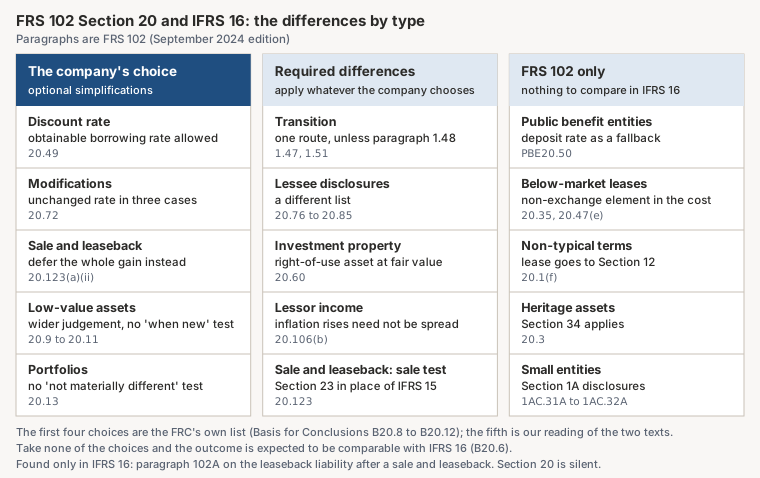
The differences that change the numbers
The difference between IFRS 16 and FRS 102 that a reader meets first is the discount rate. Four others follow.
The discount rate: one more option under FRS 102
Both standards start with the interest rate implicit in the lease, if it can be readily determined. If it cannot, IFRS 16 requires the lessee's incremental borrowing rate (paragraph 26). FRS 102 lets the lessee choose, lease by lease, between that rate and the lessee's obtainable borrowing rate (20.49). The two are different definitions, not two names for one rate. The incremental borrowing rate is defined the same way in both standards: borrowing over a similar term, with a similar security, the funds to obtain an asset of similar value to the right-of-use asset in a similar economic environment. The obtainable rate is the rate to borrow, over a similar term, an amount similar to the total undiscounted lease payments (FRS 102 Glossary); the FRC calls it "a broadly similar concept" (B20.12(a)). A different rate gives a different liability, asset and interest charge for the whole lease. How to set either rate is in our guide to the obtainable borrowing rate under FRS 102.
Lease modifications: when the rate stays the same
Under IFRS 16, a modification that is not a separate lease is remeasured at a revised discount rate (paragraph 45(c)); the only exceptions are the two temporary reliefs noted further down. FRS 102 has the same rule (20.71(c)) but lets the lessee keep the unchanged rate in three cases (20.72): the extra consideration is insignificant to the total consideration of the original lease; the scope shrinks and the price falls by a commensurate amount; or the consideration for the remaining term falls and the scope does not shrink. A lessee that uses the exception discloses that fact and the carrying amount of the liabilities remeasured that way (20.79).
An invented example of the third case. A 10-year property lease starts on 1 January 2026 at £120,000 a year in arrears, discounted at 6%. From 1 January 2030, with six years left, the landlord cuts the rent to £100,000; nothing else changes, and the lease did not provide for the cut. The lessee's incremental borrowing rate on that date is 8%.
| Unchanged rate, 6% (FRS 102 20.72(c)) | Revised rate, 8% (IFRS 16 para 45(c)) | |
|---|---|---|
| Lease liability before the modification | £590,079 | £590,079 |
| Lease liability after | £491,732 | £462,288 |
| Reduction, also taken off the right-of-use asset | £98,346 | £127,791 |
| Right-of-use asset after | £431,580 | £402,135 |
| Depreciation a year | £71,930 | £67,023 |
| Interest in 2030 | £29,504 | £36,983 |
| Charge to profit in 2030 | £101,434 | £104,006 |
Figures are rounded to the nearest pound. The liability and the asset are each £29,444 higher at the unchanged rate, and the 2030 charge is £2,572 lower. Over the six years the total charge is £539,847 on both bases; only its timing and its split between interest and depreciation differ. A market rent review under the lease's existing terms is a reassessment, not a modification, and keeps the old rate in both standards (20.68(b), 20.69; IFRS 16 paragraphs 42(b), 43).
Sale and leaseback: a choice of gain
Where the transfer is a sale, IFRS 16 has one treatment: the seller-lessee measures the right-of-use asset at the retained proportion of the asset's previous carrying amount, and so recognises only the gain or loss on the rights transferred (paragraph 100(a)). FRS 102 offers that as policy (i) and adds policy (ii): measure the asset at cost like any other lease, defer any excess of proceeds over the carrying amount and amortise it over the lease term, and recognise any shortfall at once (20.123(a)). The policy is applied consistently, and the use of (ii) is among the disclosures in 20.77(d)(v). IFRS 16 paragraph 102A, added in September 2022, has the seller-lessee measure the leaseback liability afterwards in a way that recognises no gain or loss on the right of use it retained. Section 20 has no such paragraph.
Low-value assets: no figure, and a list of what is not low value
Both standards judge low value on an absolute basis. IFRS 16 judges the asset's value when new and gives examples of low-value assets: tablet and personal computers, small items of office furniture, telephones (B3, B8). FRS 102 has no "when new" test, no monetary limit and no list of low-value assets. Its list is of assets that are not low value, from cars and vans to land and buildings and production line equipment (20.11). The FRC treats IFRS 16's examples as the minimum that qualifies (B20.10) and expects fewer leases on the balance sheet as a result (B20.11). The figure often quoted, US$5,000, is in neither standard's requirements. The FRC's Factsheet 11 says IFRS 16 states no threshold in the standard and indicates a figure in its Basis for Conclusions; the IASB's Effects Analysis of January 2016 put it "in the order of magnitude of US$5,000 or less".
Public benefit entities and below-market leases
FRS 102 has two rules with no counterpart in IFRS 16. A public benefit entity that cannot readily determine any of the three rates uses the rate it could obtain on deposits with financial institutions (PBE20.50). And where rent is significantly below market because the lessor is giving a government grant or, to a public benefit entity, a non-exchange benefit, the lessee adds that element to the cost of the right-of-use asset (20.35, 20.47(e)). If the payments are so low that they are not substantive, the arrangement may not be a lease at all (20.35).
Transition: one route under FRS 102, a choice under IFRS 16
FRS 102 gives one route. Comparatives are not restated, the cumulative effect goes to opening equity (1.47), and for a former operating lease the right-of-use asset equals the lease liability, adjusted for prepaid or accrued lease payments (1.51). IFRS 16 gave a choice between full retrospective application and that cumulative catch-up (C5), and within the second a lease-by-lease choice between measuring the asset as if the standard had always applied and setting it equal to the liability (C8(b)). The FRC chose one route "in the interests of simplicity" (B20.17). So two companies with the same lease can carry different right-of-use assets until it ends, depending on when and how each made the change.
The reliefs are close. Both let a lessee keep its earlier conclusions on which contracts contain a lease (1.45; C3), carry former finance leases over at their existing amounts (1.55; C11), and use a single rate for a portfolio, an onerous-lease provision in place of an impairment review, a 12-month run-off and hindsight (1.53; C10). IFRS 16 asked for the weighted average incremental borrowing rate and a reconciliation from the old operating lease commitments (C12); FRS 102 asks for the effect on the current period's profit, where practicable (1.44). The one FRS 102 route to IFRS 16 numbers is paragraph 1.48, covered below. A transition worked through in figures is in our FRS 102 lease accounting example.
Disclosures: where FRS 102 asks for less, and where it asks for more
FRS 102 leaves out some of IFRS 16's disclosures and adds others. The first four rows below go further than IFRS 16 or have no counterpart in it, as do two disclosures of choices made: 20.78 (a portfolio or the component election) and 20.77(d)(v) (sale and leaseback policy (ii)).
| Disclosure | FRS 102 | IFRS 16 |
|---|---|---|
| Right-of-use assets | By class: gross amount, accumulated depreciation and a full reconciliation, which is not needed for prior periods (20.81) | Depreciation and closing carrying amount by class; additions in total (para 53(a), (h), (j)) |
| Commitments under exempt leases | Short-term and low-value, each in three time bands (20.82) | Short-term only, and only if the portfolio is dissimilar to the one behind the year's expense (para 55) |
| Discount rates | Types of rate used and the share of the total liability at each, when relevant (20.77(c)) | Not in paras 51 to 60 |
| Modifications at an unchanged rate | The fact and the carrying amount (20.79) | Not applicable |
| Maturity analysis of lease liabilities | Not in Section 20; Section 11 leaves leases out (11.7(c)); financial institutions only (34.28) | Required, with IFRS 7 (para 58) |
| Format | No single-note or table requirement | One note or section (para 52); a table unless another format suits better (para 54) |
| Amounts for the period | Interest, short-term, low-value and variable expense, sublease income, total cash outflow, sale and leaseback gains or losses (20.80) | The same items (para 53(b) to (g), (i)) |
A UK small entity applying Section 1A gives a general description, more where needed, and the short-term, low-value and variable lease expense (1AC.31A, 1AC.31B, 1AC.32A); the rest is in our guide to the FRS 102 Section 1A disclosure requirements. A qualifying entity under FRS 102 may take exemption from the total cash outflow in 20.80(f) and from 20.116, on the conditions in paragraph 1.11 (paragraph 1.12(cA)).
A UK subsidiary of an IFRS group: keeping one set of lease numbers
It can start from the group's numbers and, by its choices, stay close to them. At transition, paragraph 1.48 lets a lessee recognise the carrying amounts calculated under IFRS 16 "for the purposes of including the entity in consolidated financial statements" prepared under IFRS Accounting Standards, in place of the FRS 102 calculation. It applies to all the lessee's leases or none, former finance leases included (1.55), and its use is disclosed. The FRC's Factsheet 9 says amounts that are later eliminated on consolidation would "not necessarily preclude" it. After that the subsidiary applies Section 20 (1.49), so the numbers stay equal only while its choices match the group's.
| Choice | FRS 102 paragraph | To stay on the group's IFRS 16 numbers | If not, what reconciles |
|---|---|---|---|
| Opening balances | 1.48 | Take the group's IFRS 16 amounts for every lease | Asset and liability on each lease in place at transition, until it ends |
| Rate for new leases | 20.49 | The incremental borrowing rate, where the implicit rate is not readily determinable | Liability, asset, interest and depreciation for the life of the lease |
| Rate on reassessment | 20.67 | The incremental borrowing rate at that date, on the same condition | The same, from the reassessment |
| Modifications | 20.71(c), 20.72 | A revised rate every time: the implicit rate or, failing that, the incremental borrowing rate | The remeasurement, as in the example above; the 20.79 disclosure |
| Sale and leaseback | 20.123(a) | Policy (i) | A deferred gain and a larger asset under policy (ii) |
| Low-value assets | 20.9 to 20.11 | The group's threshold (B20.8) | Leases expensed in one set of figures and capitalised in the other |
| Short-term leases and components | 20.7, 20.33 | The group's elections, for the same classes | The same |
| Portfolios | 20.13 | Only where the group does, on IFRS 16's condition (B1) | Estimation differences |
Some things cannot be matched by choice. Both standards define the rate as one the lessee would have to pay; if the group pack used a rate set for the group, neither text says that rate is the subsidiary's, and that is a judgement for the preparer. A lease from another group company is in the subsidiary's accounts and eliminated in the group's. Investment property held under a lease is at fair value under FRS 102 whatever the group does, unless it is let to another group entity and the cost option in 16.4A(b)(ii) is taken (20.60). A subsidiary that did not use paragraph 1.48 starts from different balances. The disclosures follow Section 20 either way.
Two related cases. A company moving from IFRS to FRS 102 for the first time may carry over its IFRS 16 asset and liability for all its leases (35.10(x)). A subsidiary of a US group has no such option, because paragraph 1.48 names IFRS 16 only; see US GAAP vs UK GAAP.
The subsidiary's lease figures are reported twice, to the group under IFRS 16 and in its own accounts under FRS 102. The file should show which choices were made and reconcile the two sets, because the subsidiary's auditor and the group auditor may each ask. If the revised FRS 102 is adding to your audit work, partner with us: we bring clients and a platform designed to save your team hours, and your firm remains the auditor and signs.
Does IFRS 16 apply where FRS 102 is silent?
Not automatically. Where an FRS does not specifically address a transaction, management uses judgement and looks, in order, to the FRSs on similar issues, any applicable SORP, and the concepts in Section 2 (10.4, 10.5). It "may also consider the requirements and guidance in adopted IFRS" on similar and related issues (10.6). So IFRS 16's application guidance and examples can inform a policy. They are not requirements of FRS 102, and they cannot displace a paragraph of Section 20 that says something different.
Nor do the IASB's later amendments reach FRS 102 until the FRC makes them. Section 20 has no counterpart to three additions to IFRS 16: the covid-19 rent concession relief (paragraphs 46A and 46B, limited to payments originally due by 30 June 2022), the interest rate benchmark reform relief (paragraphs 104 to 106) and paragraph 102A. Whether a company may reach for paragraph 102A under 10.6 is not settled by the text: Section 20 already has general rules for measuring a lease liability after commencement (20.62).
IFRS 16 may also move. On 21 July 2026, in its post-implementation review, the IASB found the standard "overall working as intended" and agreed to add a research project on the cost of remeasurements and discount rates; a simplified rate, and an unchanged rate for some remeasurements, are among the ideas it will explore. On 19 November 2026 the project page still showed the project summary as the next milestone.
Questions practitioners ask
When will FRS 102 adopt IFRS 16?
It has, in its own form. The revised Section 20 applies for accounting periods beginning on or after 1 January 2026. Early application is permitted only if all the Periodic Review 2024 amendments are applied at the same time (1.37(b)). The rest of those amendments are in our guide to the FRS 102 changes.
Can a company apply IFRS 16 instead of FRS 102's lease rules?
Only by changing its whole framework. FRS 102 is for entities that are not applying adopted IFRS, FRS 101 or FRS 105 (the FRC's description), so the routes to IFRS 16 are UK-adopted IFRS or, for the individual accounts of a qualifying entity, FRS 101 (paragraph 2). Whether a company may make that move, and what else changes if it does, is outside this guide.
Is lessor accounting different?
Largely not. Both standards keep the finance and operating lease classification for lessors (20.86; IFRS 16 paragraph 61). This page found two differences in the texts. Under FRS 102 the straight-line requirement for operating lease income does not apply where the payments are structured to rise with expected general inflation (20.106(b); IFRS 16 paragraph 81 has no such exception). And impairment of a finance lease receivable follows the lessor's financial instruments policy, which can itself be IFRS 9 (20.103, 11.2), where IFRS 16 points to IFRS 9 directly (paragraph 77).
What should be on the file when a client uses both?
Three things: the policy choices in the table above, with the paragraph for each; the paragraph 1.48 disclosure if the group's amounts were used at transition; and a reconciliation of the lease balances reported to the group to those in the FRS 102 accounts, by cause. The data behind all three is the lease register; our lease register template lists the fields.