US GAAP vs UK GAAP (FRS 102): the differences a US parent's controller needs
By Alon Zieve FCA · Last reviewed
A UK subsidiary of a US group cannot file its statutory accounts under US GAAP. It uses UK GAAP, such as FRS 102, or an IFRS-based framework, so the US GAAP vs UK GAAP question comes up at every year end. For accounting periods beginning on or after 1 January 2026, FRS 102 puts most leases on the balance sheet and uses a five-step revenue model, so the two largest differences from US GAAP have narrowed but not closed. Goodwill, development costs, credit losses, below-market intercompany loans, deferred tax, impairment, LIFO and borrowing costs still differ. This guide sets out the main differences with the FRS 102 paragraph and ASC topic for each, the policy choices that narrow them, and a worked bridge from a US GAAP reporting package to the FRS 102 accounts.
Compared: FRS 102 (September 2024 edition), including the Periodic Review 2024 amendments for periods beginning on or after 1 January 2026, and the FASB Accounting Standards Codification (ASC) as set out in the FASB's published Accounting Standards Updates. Two Updates the page refers to are recent: ASU 2025-05 (credit losses on current receivables, annual periods beginning after 15 December 2025) and ASU 2025-06 (internal-use software, annual periods beginning after 15 December 2027). Both dates apply to all entities, and both Updates allow early adoption. Last checked: 1 November 2026.
Can a UK subsidiary of a US company use US GAAP?
No. Under the Companies Act 2006, a UK company's individual accounts are either "Companies Act individual accounts" or "IAS individual accounts" (s395(1)), and the directors must not approve them unless they give a true and fair view (s393). Companies Act accounts are prepared under UK GAAP: FRS 102, or FRS 101 or FRS 105 where the company is eligible (see FRS 105 vs FRS 102 and, for a small company, who can use FRS 102 Section 1A). IAS accounts use UK-adopted IFRS. US GAAP is not one of the options, even when the group reports nothing else.
So the US parent receives a reporting package (the US GAAP financial information a subsidiary sends to its parent for the group consolidation), and the UK company separately prepares FRS 102 accounts for Companies House. A subsidiary that chooses FRS 101 (the Reduced Disclosure Framework) or UK-adopted IFRS faces a comparison with IFRS instead, which is for a separate guide (UK GAAP vs IFRS); this page compares US GAAP with FRS 102.
A subsidiary may cut its FRS 102 disclosures using the exemptions in paragraph 1.12, but only if it is a "qualifying entity" (in the Glossary, a member of a group whose parent "prepares publicly available consolidated financial statements which are intended to give a true and fair view", and that member is included in the consolidation) and meets the conditions in paragraph 1.11. Those conditions include disclosing "a brief narrative summary of the disclosure exemptions adopted" and the name of the parent in whose consolidated financial statements it is consolidated, "and from where those financial statements may be obtained" (FRS 102 Glossary; paragraphs 1.8 to 1.12). A private US parent that does not publish its consolidated statements does not make its subsidiary a qualifying entity, unless another parent in the group publishes consolidated statements that include the subsidiary. Whether the subsidiary also needs a UK audit is a separate question: see does my UK subsidiary need an audit.
US GAAP vs UK GAAP: the main differences after the 2026 FRS 102 amendments
After the 2026 amendments, the main differences are the lessee lease cost pattern, the revenue options on advance payments and contract costs, goodwill amortisation, pushdown accounting, development costs, below-market intercompany loans, credit losses, deferred and uncertain tax, impairment, LIFO and borrowing costs. The table compares US GAAP with FRS 102 as it applies from 1 January 2026. It lists the main differences a US-owned UK subsidiary meets, not every difference between the two frameworks. "Changed in 2026?" says whether the Periodic Review 2024 amendments altered the FRS 102 side; a dash means the FRS 102 rule cited is in the current text, with no claim either way about the amendments.
| Area | US GAAP (ASC) | FRS 102 from 1 Jan 2026 | Changed in 2026? | Effect on the UK accounts |
|---|---|---|---|---|
| Lessee leases | Finance or operating lease; an operating lease gives a single straight-line cost; only short-term leases may stay off the balance sheet (ASC 842) | One model: right-of-use asset depreciated, interest on the lease liability (20.45, 20.57, 20.64); short-term and low-value exemptions (20.5) | Yes: most leases now on the balance sheet | For a US operating lease: higher total charge early in the lease, lower later; part of it is interest |
| Revenue: payment in advance | Adjust for a significant financing component; no adjustment needed if payment and delivery are expected to be a year or less apart (ASC 606) | Adjusting for an advance payment is optional (23.59); a deferred payment beyond normal terms must be adjusted (23.58) | Yes: five-step model (23.4) | Revenue and interest can differ on long prepaid contracts |
| Revenue: costs to obtain a contract | Incremental costs capitalised if expected to be recovered; may be expensed if the amortisation period is a year or less (ASC 340-40) | Capitalising is a policy choice (23.113, 23.114) | Yes | Commissions expensed in the UK accounts if that is the policy |
| Goodwill | Not amortised, tested for impairment; a private company may elect to amortise over 10 years or less (ASC 350-20) | Amortised over its useful life, not more than 10 years if no reliable estimate (19.23); impairment never reversed (27.28) | — | Lower UK profit each year, unless the parent also amortises |
| Pushdown accounting | An acquired company may elect to push the acquirer's basis into its own statements (ASC 805-50) | No equivalent option; the acquirer applies the purchase method (19.6) | — | Acquisition fair values and goodwill stay out of the acquired company's UK accounts |
| Development costs | Research and development expensed (ASC 730); separate rules for software (ASC 350-40, 985-20) | May be capitalised if six criteria are met; the policy applies to all qualifying spend (18.8H, 18.8K) | — | If the company capitalises: higher UK assets, and higher profit while the spend is capitalised, lower as it is amortised |
| Below-market intercompany loans | Interest imputation does not apply to transactions between a parent and its subsidiaries (ASC 835-30) | Measured at present value at a market rate (11.13); a loan repayable on demand stays at face value (ICAEW/ICAS TECH 02/17BL) | — | Credit to equity at the start, interest expense over the term |
| Credit losses | Expected losses (CECL) for receivables at amortised cost; loans between entities under common control excluded (ASC 326) | Loss recognised only on objective evidence of impairment (11.21); option to apply IFRS 9 instead (11.2) | No: the FRC added no expected loss model | Unless the IFRS 9 option is taken, a UK allowance only once there is evidence of a loss event |
| Deferred tax | Recognised on all temporary differences, with limited exceptions; a valuation allowance where realisation is not more likely than not (ASC 740) | "Timing differences plus" (29.6 to 29.11); an asset only to the extent recovery is probable (29.7) | — | Different items can carry deferred tax |
| Uncertain tax positions | Recognised if more likely than not to be sustained; measured at the largest amount more than 50 percent likely (ASC 740-10) | Where acceptance is not probable, the most likely amount or the expected value (29.17A to 29.17C) | Yes: new requirements | The two provisions can differ for the same position |
| Impairment of other long-lived assets | Recoverability test on undiscounted cash flows; no reversal for assets held and used (ASC 360) | Recoverable amount: higher of fair value less costs to sell and value in use (27.11); reversal required when the reasons cease (27.29) | — | The UK test can show an impairment the US test does not; for assets held and used, only the UK reverses |
| Inventory | LIFO permitted (ASC 330) | FIFO or weighted average; LIFO not permitted (13.18) | — | LIFO stock is restated for the UK accounts |
| Borrowing costs | Interest capitalised on assets that take time to get ready, where material (ASC 835-20) | Capitalising is a policy choice (25.2) | — | Narrower if the UK policy capitalises; scope and amounts can still differ |
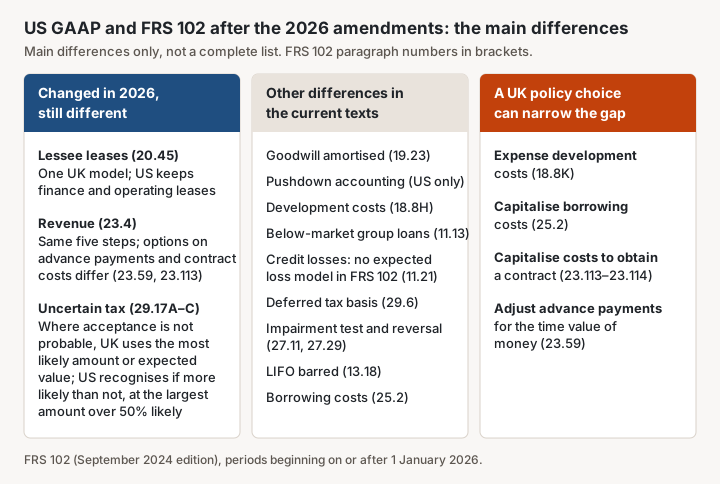
Many UK GAAP vs US GAAP comparisons open with "principles versus rules". That is a generalisation; what moves the numbers is each difference above. Comparisons written against FRS 102 before 2026 are out of date on leases and revenue, and the FRS 102 changes set out what moved. What else is new in a UK subsidiary's accounts at a December 2026 year end, in company law as well as the standards, is in UK GAAP changes.
US GAAP vs UK GAAP lease accounting: ASC 842 vs FRS 102
Both frameworks now put most leases on the balance sheet. The difference is that ASC 842 keeps two lessee models and FRS 102 has one. Under ASC 842 a lessee recognises a right-of-use asset and a lease liability at commencement (842-20-25-1), and for an operating lease recognises "a single lease cost" allocated "on a straight-line basis" (842-20-25-6). Under FRS 102 every lease that is not exempt is accounted for like a US finance lease: the right-of-use asset is depreciated (20.57) and interest accrues on the liability (20.64).
For a lease the package treats as an operating lease, the FRS 102 charge is higher in the early years and lower later, because the interest falls as the liability is paid down; and the whole charge sits in depreciation and interest, so operating profit before depreciation is higher in the UK accounts. The cash flow statements differ too: ASC 842 classifies operating lease payments within operating activities (842-20-45-5), while FRS 102 classifies the principal portion as financing (7.6(e)).
The other differences:
- Exemptions. FRS 102 lets a lessee leave short-term leases and leases of low-value assets off the balance sheet (20.5). ASC 842's only recognition exemption is the short-term lease election, made by class of asset (842-20-25-2).
- Discount rate. FRS 102 uses the rate implicit in the lease if it can be readily determined, otherwise the lessee's incremental borrowing rate or its obtainable borrowing rate, chosen lease by lease (20.49). ASC 842 uses the implicit rate, otherwise the incremental borrowing rate, and a lessee that is not a public business entity may elect a risk-free rate by class of asset (842-20-30-3, as amended by ASU 2021-09). Where the implicit rate is not used, a US group that made that election can have different lease balances from the UK accounts from day one.
- Transition. A former operating lease still running when the company first applies the
revised FRS 102 (1 January 2026 for a calendar year end) is measured in the UK accounts at the
present value of the remaining payments, discounted at the incremental or obtainable borrowing
rate at that date (1.51(a)). The package carries it at the rate set when the lease began, when
the group adopted ASC 842 (for private companies, fiscal years beginning after 15 December
- or when the lease was last remeasured. The two balances can differ for the rest of the lease.
- No shortcut through group numbers. Paragraph 1.48 lets a UK company take its lease balances from the group's numbers only where they were "calculated under IFRS 16" for consolidated statements "prepared in accordance with IFRS Accounting Standards". There is no equivalent for ASC 842 balances, so a subsidiary of a US GAAP group calculates its FRS 102 lease figures itself. For a subsidiary of an IFRS group, see FRS 102 vs IFRS 16.
Lessor accounting is not covered here. The mechanics of the UK side are in FRS 102 lease changes and the FRS 102 lease accounting example.
US GAAP vs UK GAAP revenue recognition: ASC 606 vs FRS 102
Both now apply the same five steps: identify the contract, identify the performance obligations, determine the transaction price, allocate it, and recognise revenue as each obligation is satisfied (ASC 606-10-05-4; FRS 102 23.4). The FRC based Section 23 on IFRS 15 and chose to "offer accounting simplifications compared to IFRS 15" (B23.9). Two of them create differences from ASC 606 that a US-owned subsidiary meets:
- Payments in advance. ASC 606 requires the transaction price to be adjusted when the timing of payment gives either party "a significant benefit of financing" (606-10-32-15), with a practical expedient where payment and delivery are a year or less apart (606-10-32-18). FRS 102 makes the adjustment for an advance payment optional (23.59), although a payment deferred beyond normal business terms must be adjusted (23.58), and gives the same 12-month relief (23.60). A customer who prepays a three-year contract can produce different revenue and interest in the two sets.
- Costs to obtain a contract. ASC 340-40 requires the incremental costs of obtaining a contract to be recognised as an asset if the entity expects to recover them (340-40-25-1), but allows them to be expensed where the amortisation period would be a year or less (340-40-25-4). FRS 102 makes capitalisation a policy choice, applied to all qualifying costs, except that costs with an amortisation period of one year or less "may be expensed when incurred" (23.113, 23.114). A UK company that expenses sales commissions has a difference every year.
The UK side is covered in FRS 102 revenue recognition.
Goodwill and acquisitions: amortised in the UK accounts, not always in the US package
FRS 102 treats goodwill as having a finite life and amortises it "on a systematic basis over its life"; only where, in exceptional cases, the life cannot be reliably estimated is it capped at 10 years (19.23(a)). An impairment of goodwill is never reversed (27.28). US GAAP does not amortise goodwill: it is tested for impairment at least annually, or more often if certain conditions exist.
There is an exception for private groups. Since ASU 2014-02, a private company may elect to amortise goodwill "on a straight-line basis over 10 years, or less than 10 years if the entity demonstrates that another useful life is more appropriate" (350-20-35-63), and then test it for impairment only when a triggering event occurs. If the US parent is a private company that has made the election, the package and the UK accounts both amortise and the gap narrows to the useful life and the impairment test. If the parent is public, or has not elected, the gap widens each year the UK accounts amortise, unless the goodwill is impaired.
Pushdown accounting is a US-only point. Since ASU 2014-17 an acquired company "shall have the option to apply pushdown accounting in its separate financial statements" when an acquirer obtains control (805-50-25-4), so a package may carry the parent's acquisition fair values and goodwill. FRS 102 has no such option: the purchase method applies in the acquirer's accounts (19.6), so the UK company's own accounts keep its own carrying amounts unless it bought the business itself.
Development costs and software
Under FRS 102 a company may recognise an intangible asset from development "if, and only if" it can demonstrate six things, from technical feasibility to measuring the spend reliably (18.8H). The choice is a policy: once adopted, it applies to all development spend that meets the criteria (18.8K). US GAAP expenses research and development as incurred (ASC 730, from FAS 2 paragraph 12), with separate rules for software: internal-use software under ASC 350-40, and software to be sold under ASC 985-20, where costs are expensed until technological feasibility is established.
ASU 2025-06 replaces the project stages in ASC 350-40 with a "probable-to-complete" threshold for annual periods beginning after 15 December 2027, for all entities, with early adoption permitted. It does not change ASC 985-20.
A UK subsidiary that capitalises development creates a difference in assets and profit, and possibly in deferred tax; one that expenses removes most of it.
Financial instruments: intercompany loans and credit losses
Two differences catch US-owned subsidiaries.
Interest-free or below-market loans from the parent. FRS 102 treats a loan "financed at a rate of interest that is not a market rate" as a financing transaction and measures it at the present value of the payments, discounted at a market rate for similar debt (11.13). ICAEW and ICAS guidance on distributable profits (TECH 02/17BL, April 2017) describes the result for an interest-free loan from a parent that is not repayable on demand: the subsidiary records the loan at present value and "credits equity with the amount of the capital contribution", then recognises interest expense over the term (9.50); a loan repayable on demand stays at face value (9.47). The entries for each direction of lending are in our guide to below-market intercompany loans. US GAAP's interest imputation rules do not apply to "transactions between parent and subsidiary companies" (ASC 835-30, from APB 21 paragraph 3(f)), so nothing in ASC 835-30 requires the package to discount the loan.
Credit losses. US GAAP measures expected credit losses (CECL) on receivables at amortised cost under ASC 326, which replaced "the incurred loss impairment methodology"; private companies applied it from fiscal years beginning after 15 December 2022 (ASU 2019-10). Loans and receivables between entities under common control are outside its scope (326-20-15-3(f)). ASU 2025-05 adds a practical expedient for current accounts receivable and current contract assets under Topic 606, which "assumes that current conditions as of the balance sheet date do not change for the remaining life of the asset", and, for an entity other than a public business entity "that elects the practical expedient", a policy election to consider collection activity after the balance sheet date (326-20-30-10C, 326-20-30-10E). FRS 102 keeps an incurred loss model: an impairment is recognised only where there is "objective evidence of impairment" (11.21), and in the Periodic Review 2024 "the FRC made no amendment to incorporate the expected credit loss model" (B11.49ZA). A UK company may choose IFRS 9's recognition and measurement instead (11.2(c)), but that is IFRS 9's expected loss model, not CECL.
Deferred tax and uncertain tax positions
The bases differ. ASC 740 recognises deferred tax on all temporary differences, with limited exceptions; these are the differences between the tax basis of an asset or liability and its reported amount (FAS 109 paragraphs 9 and 16, now ASC 740). FRS 102 recognises it on timing differences, which arise when income and expenses are taxed in periods different from those in which the accounts recognise them (29.6), plus specified extras such as business combination fair values (29.11): the FRC's "timing differences plus". For a deferred tax asset the words are close but the mechanics differ: FRS 102 recognises it only to the extent recovery is "probable" (29.7), which the Glossary defines as more likely than not, while ASC 740 recognises the full asset and reduces it by a valuation allowance if realisation is not more likely than not.
Uncertain tax treatments are new in FRS 102 from 2026. Where it is not probable that the tax authority will accept a treatment, the company reflects the uncertainty using "the most likely amount" or "the expected value", whichever better predicts the outcome (29.17B). Under ASC 740-10 a position is recognised only if it is more likely than not to be sustained on examination, and is measured at the largest amount that is more than 50 percent likely to be realised (FIN 48 paragraphs 6 and 8). The two can give different provisions for the same position.
Most other differences on this page can carry deferred tax, measured on a different basis in each set, so the tax lines of the package and the UK accounts can differ even for the same transactions.
From the US GAAP reporting package to the FRS 102 accounts
Keep one schedule of GAAP differences through the year, and post the differences as adjustments from the package, or the ledger, to the statutory accounts. Some differences can be removed at source by the UK company's choice of accounting policy; the rest have to be tracked.
FRS 102 policy choices that narrow the gap
| FRS 102 choice | Paragraph | Choose this to move closer to US GAAP | Remaining gap |
|---|---|---|---|
| Development costs | 18.8H, 18.8K | Expense development spend | US software rules (ASC 350-40, 985-20) still capitalise some costs |
| Borrowing costs | 25.2 | Capitalise on qualifying assets | Scope and amounts can differ: the two texts define them separately |
| Costs to obtain a contract | 23.113, 23.114 | Capitalise incremental costs expected to be recovered | Small; both allow expensing at a year or less |
| Payments in advance | 23.59 | Adjust for the time value of money | Both give 12-month relief; ASC 606 adjusts only for a significant financing component |
| Credit losses | 11.2(c) | IFRS 9 recognition and measurement | IFRS 9 is not CECL |
Some differences cannot be aligned from the UK side: the lease cost pattern (FRS 102 has one lessee model), goodwill amortisation (aligned only if the private US parent elects the ASC 350-20 alternative), LIFO (barred by 13.18), below-market intercompany loans (11.13) and the reversal of impairment losses (27.29).
Worked example: bridging an invented UK subsidiary
UK Ltd is invented. It has a 31 December year end, so 2026 is its first year under the revised FRS 102, and its parent is a private US company that has not elected the goodwill alternative. Four differences:
- Lease. An office lease from 1 January 2026: five years, £100,000 a year in arrears, discounted at 6% in both sets. The lease liability starts at £421,236. ASC 842 operating lease cost: £100,000. FRS 102: depreciation £84,247 plus interest £25,274, a charge of £109,521 for the year.
- Goodwill. £600,000 on a trade UK Ltd bought on 1 January 2024, amortised over 10 years in the UK accounts (£60,000 a year) and not amortised in the package.
- Development costs. £150,000 meeting 18.8H, capitalised under UK Ltd's policy and expensed in the package; the project is not finished, so there is no amortisation yet.
- Interest-free parent loan. £1,000,000 received on 1 January 2026, repayable on 31 December 2030, not on demand, with a market rate of 7%. Present value £712,986; £287,014 credited to equity; interest unwind of £49,909 in 2026.
| Profit before tax | Net assets at 31 Dec 2026 | |
|---|---|---|
| US GAAP reporting package | £1,200,000 | £4,000,000 |
| (1) Lease: FRS 102 charge above the ASC 842 cost; right-of-use asset £336,989 against £346,511 | (£9,521) | (£9,521) |
| (2) Goodwill amortisation, 2026 and cumulative since 2024 | (£60,000) | (£180,000) |
| (3) Development costs capitalised | £150,000 | £150,000 |
| (4) Parent loan: interest unwind; loan carried at £762,895, not £1,000,000 | (£49,909) | £237,105 |
| FRS 102 accounts | £1,230,570 | £4,197,584 |
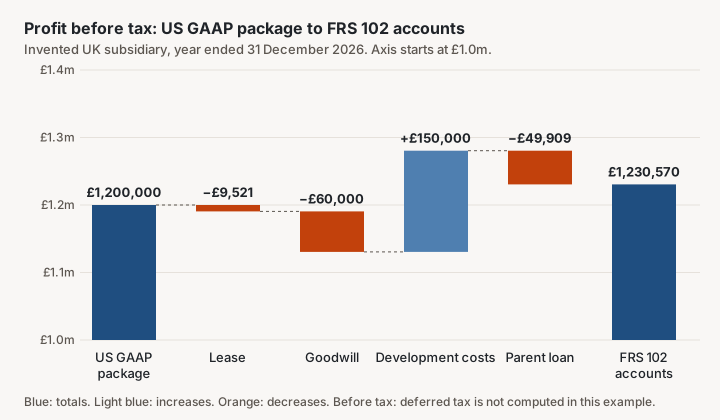
The bridge is before tax. Deferred tax would follow each line, but the amount depends on the UK tax treatment of each item, such as relief for goodwill and development spend, which the example does not specify. The £287,014 on the loan is credited directly to equity, not to profit; the same amount is charged to profit as interest over the five years. A lease already running on 1 January 2026 would add a further difference, because the two sets measure it from different dates.
Keeping the schedule for the year end and the audit
For each difference, the schedule records the FRS 102 paragraph and the ASC topic, the amount in profit and in net assets, the deferred tax, and whether and when it reverses. Built up month by month alongside the management accounts pack, it turns the year-end bridge into a check rather than a project. It is also what the auditors on both sides can work from: the group auditor (the firm auditing the group's consolidated statements) for the package, and the UK auditor for the statutory accounts, which a private company must file within nine months of its year end (s442(2)(a)), so one schedule serves both timetables. The year end audit checklist lists the rest of what a UK audit will ask for.
If your subsidiary needs its own audit, talk to us: Innate offers statutory audits signed by an ICAEW-registered partner firm, which the subsidiary appoints as its auditor, with our platform taking on the legwork to save you time and money.