Director loan below market rate under FRS 102, and interest-free intercompany loans
By Alon Zieve FCA · Last reviewed
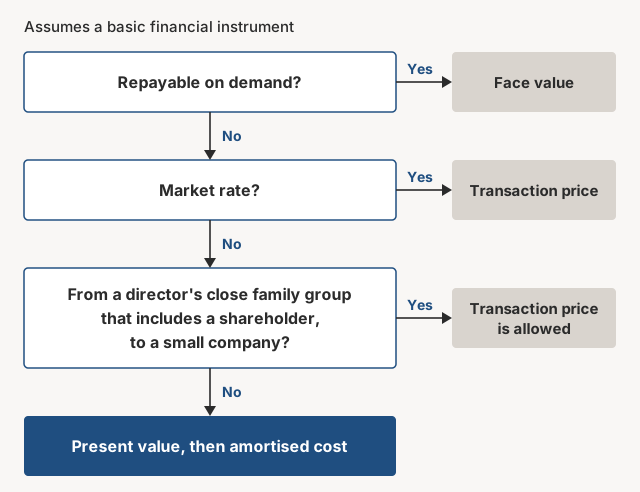
A director loan below market rate under FRS 102 is discounted to present value if it has a fixed term, unless it is a basic loan to a small company from a director or close family member, with a shareholder in that family group. A loan repayable on demand stays at face value. Loans to directors and loans between group companies get no exception, and the difference can be a distribution in law.
This guide applies the FRC's latest full edition of FRS 102 (September 2024), the main standard in UK GAAP.
When does a director loan below market rate have to be discounted?
When it has a term and its rate is not a market rate, unless the exception in the next section applies. Paragraph 11.13 records a loan at the transaction price unless the arrangement is in effect a financing transaction, and finance at a rate that is not a market rate is one. So interest-free loans under FRS 102 and loans with a token coupon are treated alike.
A financing transaction is measured at the present value of the future payments, discounted at a market rate for a similar debt instrument. It is then carried at amortised cost, using the effective interest method at that same market rate (11.14(a)(iii)).
All of this assumes the loan is a basic financial instrument (11.8 and 11.9). A loan whose return depends on profits or a share price will generally fail those conditions and go to fair value through profit or loss under Section 12, so read the terms first.
FRS 102 does not say where the difference between the cash and the present value goes. ICAEW's Know-How on loans at non-market rates points to judgement under paragraph 10.4. The routes used in practice come from TECH 02/17BL chapter 9, which dates from April 2017, before the exception below existed.
Can a small company keep an interest-free director loan at face value?
A director's loan can be interest free: FRS 102 governs how it is measured, not whether interest is charged. A small company can often keep it at face value, but only for money lent to the company. Under FRS 102 11.13A(a), an interest-free director loan may stay at transaction price if it is a basic financial liability of a small entity, from a person "within a director's group of close family members", and that group includes at least one shareholder. The Periodic Review 2024 left this limb unchanged.
It is an option, and it sits in Section 11, not Section 1A. The Glossary's "small entity" test is Companies Act 2006 ss382 to 384 (size limits, and no s384 exclusion), so a small company on full FRS 102 can use it too. No notional interest follows: the effective rate is the contract rate, which may be zero (11.14(a)(i)).
| Who lends | Qualifies? | Why |
|---|---|---|
| Director who holds shares | Yes | The group is the director and close family; a sole director-shareholder is included |
| Spouse or domestic partner of a director-shareholder | Yes | Named in the Glossary |
| Adult child of a director-shareholder | Usually | The Glossary says children, with no age limit, but its lead-in covers family who may be expected to influence or be influenced in dealings with the entity: an estranged child is a judgement |
| Director with no shares whose spouse holds shares | Yes | The family group contains a shareholder (B11.38) |
| Director with no shares and no shareholder close family | No | B11.38 |
| Shareholder who is not a director or close family of one | No | Outside every director's group |
| A director's own company | No | The lender must be a person in the family group; the FRC describes a natural person (B11.36) |
| Parent or fellow subsidiary | No | Group entities were deliberately left out (B11.37) |
| The company lends to the director | No | The exception covers a financial liability only |
| A loan that is not basic | No | 11.13A(a) says basic |
The standard does not say when the shareholder test is applied, or what happens if the shareholder later sells. Because 11.13A concerns initial measurement, a reasonable reading is inception, so record the position at that date.
Growing out of it, or back into it
A company that stops being small remeasures to present value prospectively from the first reporting date afterwards, using facts at that time or at inception (11.13B). A company that becomes eligible and chooses the exception applies it retrospectively (11.13C). Higher size limits apply to financial years beginning on or after 6 April 2025, so more companies may now be eligible: see FRS 102 1A thresholds.
Micro-entities
FRS 105 records a loan at the amount borrowed or lent (paragraph 9.5), with no discounting: see FRS 105 vs FRS 102. The company-law point below still applies.
Repayable on demand or fixed term: the fact everything turns on
A loan the lender can call at any time stays at face value (TECH 9.47). The earliest payment date is now, so there is nothing to discount, and paragraph 2A.14 gives the same floor for the fair value of a liability. Paragraph 11.10(c) lists demand loans to or from subsidiaries and associates among instruments that would normally be basic.
ICAEW's Know-How says a rolling notice period of a year or more is discounted over the notice period, unless immaterial, and that a letter of support is usually only a statement of intent, which then does not change the accounting.
Classification tests the same fact. On the statutory balance sheet formats, a creditor is due within one year unless the company has an unconditional right to defer settlement for at least 12 months (4.7). Small entities on Section 1A are outside Section 4 (1A.7A), but company law applies the same earliest-demand test to them (SI 2008/409 Sch 8 para 6).
So, for a below-market loan outside 11.13A, "due after more than one year" and "face value" cannot both stand. Either the lender can call it at any time, and it is current at face value, or it cannot, and it is discounted if the effect is material.
What if the loan has no written terms?
If there are no written terms, the usual conclusion is repayable on demand, because the company cannot point to a right to hold the lender off. An oral agreement or a course of dealing can still set a term, so this is a judgement on the evidence, and a large balance may justify legal advice.
Finding the market rate for a director or group loan
The test is a market rate for a similar debt instrument, determined at initial recognition (11.13). The standard does not say what makes a debt similar. In practice that is read as the same term, security and ranking, and the borrower's credit. On that reading, a company borrowing looks to its own rate, a company lending to a director looks to the director's personal rate, and a parent-to-subsidiary loan looks to the subsidiary's. Document the judgement.
Stakeholders told the FRC this is hard for small companies, since such loans are often made because commercial funding is unavailable (B11.33). Useful evidence is a lender's indication, a recent facility or a documented build-up from a base rate. The lease obtainable borrowing rate is a separate test, defined by reference to lease payments.
Discounting intercompany loans under FRS 102
An intercompany loan needs discounting if it has a term and is not at a market rate. Interest-free loans under FRS 102 between group companies have no small-company exception, even in a small group (B11.37). Directors appear below too: TECH extends its guidance to shareholders acting as such (TECH 9.48).
In this table, 9.xx means TECH 02/17BL chapter 9, not FRS 102 Section 9, and a director-shareholder is one acting as shareholder.
| Loan | Discount? | Where the difference goes | Realised? | Distribution in law? |
|---|---|---|---|---|
| Director-shareholder to small company, using 11.13A | No | No difference arises | Not applicable | No |
| Director-shareholder to company not small, or small company not using 11.13A | Yes | Credit equity: capital contribution | Not realised (9.53, via 9.48) | No |
| Company to director-shareholder | Yes | Debit equity: distribution | Interest income realised if qualifying consideration (9.61, via 9.48) | Can be, if at undervalue (9.49) |
| Company to director or employee with no shares | Yes | Employee benefit under Section 28, on the facts (9.48) | TECH is silent | Not as a member |
| Parent to subsidiary | Yes | Parent: debit investment. Subsidiary: credit equity | Subsidiary's credit not realised; parent's interest income realised (9.53, 9.57, subject to 9.59) | No |
| Subsidiary to parent | Yes | Subsidiary: debit equity. Parent: credit income | Parent's receipt realised (9.61, 9.63); parent's interest expense a realised loss | Yes (9.62) |
| Subsidiary to sister or same-owner company | Yes | At the parent's behest, lender: distribution; borrower: capital contribution (9.65; ICAEW Know-How). Same-owner companies: the same, unless the facts show a reason for the rate other than common control (ICAEW Know-How) | As the two rows above | Can be (9.65, 9.70) |
| Any of these on demand | No | Face value (9.47) | Not applicable | Upward or sideways loans can be, if at undervalue (9.67) |
For a director, ICAEW's Know-How says shareholder capacity can generally be presumed if the director is the majority shareholder, a presumption that similar loans to employees can rebut. Where a director lends outside 11.13A without shares or in another capacity, it says the treatment depends on the circumstances.
A company can lend to a director interest-free, but it generally needs members' approval (Companies Act 2006 s197), unless an exception applies, such as an aggregate of £10,000 or less (s207(1)). For the approval itself and the other exceptions, see can a director borrow money from their company.
Interest-free loan from a parent
The parent records the receivable at present value and debits the difference to its investment in the subsidiary, which is tested for impairment if there are indicators. The subsidiary records the same payable and credits equity. Over the term, the parent books interest income and the subsidiary interest expense, each equal to the contribution (TECH 9.50, 9.52).
Loan from a subsidiary to its parent
The direction reverses. The subsidiary records the receivable at present value and debits a distribution to equity. The parent records the payable and a distribution received. The subsidiary then earns the interest income and the parent bears the expense (TECH 9.60). In group accounts, the entries on any intragroup loan are eliminated (FRS 102 9.15).
Worked example: a 1% director loan in a company that is not small
The figures are illustrative. A director-shareholder, acting as shareholder, lends a medium-sized company £60,000 on 1 January 2026 for three years at 1%, paid annually. The market rate is 7% and the year end is 31 December. The present value of £600, £600 and £60,600 is £50,552, which leaves a capital contribution of £9,448 to credit to equity.
| Year | Opening | Interest at 7% | Cash paid | Closing |
|---|---|---|---|---|
| 2026 | £50,552 | £3,539 | £600 | £53,491 |
| 2027 | £53,491 | £3,744 | £600 | £56,635 |
| 2028 | £56,635 | £3,965 | £600 | £60,000 |
Rounded to the nearest pound, with the last year taking the difference.
| Date | Entry | Debit | Credit |
|---|---|---|---|
| 1 Jan 2026 | Cash | £60,000 | |
| Director's loan | £50,552 | ||
| Equity: capital contribution | £9,448 | ||
| 31 Dec 2026 | Finance cost | £3,539 | |
| Cash | £600 | ||
| Director's loan | £2,939 | ||
| 31 Dec 2028 | Finance cost | £3,965 | |
| Cash | £600 | ||
| Director's loan | £3,365 | ||
| Repayment | Director's loan | £60,000 | |
| Cash | £60,000 |
The 2027 entry follows the same pattern, from the 2027 row above.
The reserves line is where this matters. The £9,448 is not a realised profit (TECH 9.53). The notional interest above the coupon, £2,939 in 2026 and £9,448 over the term, is not a loss in law, and is available to eliminate that credit (TECH 9.54). Only the £600 a year of real interest reduces realised profits. Those paragraphs are written for a parent and subsidiary, and applying them to a director relies on TECH 9.48.
If the same loan qualified under 11.13A, it would stay at £60,000 with £600 of interest a year and no equity entry.
When a cheap loan is a distribution in law
When a company lends at an undervalue to a member or, in a group, to a fellow subsidiary at its parent's behest. A distribution is any distribution of a company's assets to its members, in cash or otherwise (s829), and needs enough profits available to cover it (s830). How to work those out is in our guide to distributable reserves.
Take a subsidiary with no distributable profits that lends its parent £100,000 interest-free for three years, with a market rate of 6%. The receivable is £83,962 and the distribution £16,038. Without reserves to cover it, the transaction is unlawful (TECH 9.62, 9.68).
Making the loan repayable on demand does not necessarily cure this. The accounting distribution is nil, but the loan may still be at an undervalue in law if the borrower could not practicably repay, and with no positive reserves any distribution, however small, is unlawful (TECH 9.67, 9.68). FRS 105 is no shelter either: it does not discount, but a loan to a parent or shareholder may still be a distribution in law (TECH 9.49).
Companies under common ownership can face the same issue (TECH 9.70), and an upstream transfer can be an unlawful distribution by an intermediate holding company (TECH 9.71). On the receiving side, a capital contribution in equity does not add to distributable profits (TECH 9.53).
If last year's accounts got it wrong
The common error is a fixed-term, below-market loan outside 11.13A held at face value. If material, correct it retrospectively, by restating the comparatives or the opening balances of the earliest period presented, to the extent practicable (10.21). Use the market rate at inception, not today's. An immaterial error can be fixed going forward. A demand loan at face value was measured correctly.
Papering a demand balance as a term loan changes the future, not the past. A substantial modification is an extinguishment and a new liability (11.37), which, for a below-market term loan outside 11.13A, is measured at present value (11.13). FRS 102 does not define "substantial". Paragraph 11.38 sends the difference to profit or loss and makes no carve-out for owners, yet a concession by an owner acting as owner looks like a contribution. The standard does not settle this, so document the judgement.
Tax follows its own rules. A loan to an employee or director below HMRC's official rate can be a taxable benefit where more than £10,000 is outstanding (ITEPA 2003 ss175 and 180), and an overdrawn loan can bring corporation tax on the company. This guide does not cover the corporation tax treatment of notional interest or the equity credit: take tax advice.
What an auditor asks for on a below-market loan
An auditor has to ask management about related parties and transactions with them (ISA (UK) 550 para 13). For these loans that usually means:
- signed loan terms, or evidence that none exist;
- support for the market rate, and why it is reasonable as an estimate;
- the reasoning on capacity (shareholder, employee or group);
- a reserves check at the date of any distribution.
The note matters too. For periods beginning on or after 1 January 2026, a small entity gives related party disclosure under 1AC.35, so a material loan is disclosed on any terms, subject to the exemptions in 33.1A and 33.11: see directors' loan account disclosure. Advances and credits to directors also need the details in Companies Act 2006 s413 (1AC.36).
A change of auditor brings all of this up again, because a new auditor has to obtain evidence on opening balances (ISA (UK) 510 para 6). If you are looking for a new auditor, Innate offers statutory audits signed by an ICAEW-registered partner firm, which your company appoints as its auditor, with our platform finding the documents and reconciling the numbers: ask for a quote.