FRS 102 1A thresholds and eligibility: who can use Section 1A, and who cannot
By Alon Zieve FCA · Last reviewed
Section 1A of FRS 102 is open to a "small entity": for a company, one that qualifies as small under the Companies Act 2006 and is not excluded from the small companies regime. The FRS 102 1A thresholds are the small company limits: two or more of turnover of not more than £15 million, a balance sheet total of not more than £7.5 million and no more than 50 employees, for financial years beginning on or after 6 April 2025. Size is only half the test. A company is shut out at any size if, at any time in the financial year, it was a public company, a bank, an insurer or another of the types section 384 lists, or a member of an ineligible group, and one day is enough. It then prepares full FRS 102, or FRS 101 or UK-adopted IFRS where it may. Even a company that qualifies may choose not to use Section 1A.
Who can use FRS 102 Section 1A?
FRS 102's Glossary defines a small entity as "(a) a company meeting the definition of a small company as set out in section 382 or 383 of the Act and not excluded from the small companies regime by section 384", (b) a small LLP not excluded from the small LLPs regime, or (c) another entity that would meet (a) if it were a company.
Section 1A is a choice. It applies to "a small entity that chooses to apply the small entities regime" (para 1A.1); one that does not applies full FRS 102, unless it chooses UK-adopted IFRS or, if eligible, FRS 101 (para 1A.2). Section 1A changes presentation and disclosure only: recognition and measurement are FRS 102's throughout (para 1A.1). What it asks for is in FRS 102 1A disclosure requirements, and how the UK frameworks fit together in the UK GAAP guides.
Is the small companies regime the same as Section 1A?
No. The regime is company law, for a company that qualifies as small and is not excluded (s381); Section 1A is the FRS 102 presentation a small entity may choose. Some regime reliefs do not depend on that choice: the strategic report exemption (s414B) and, until the Economic Crime and Corporate Transparency Act 2023 filing changes come into force, the s444 filing option.
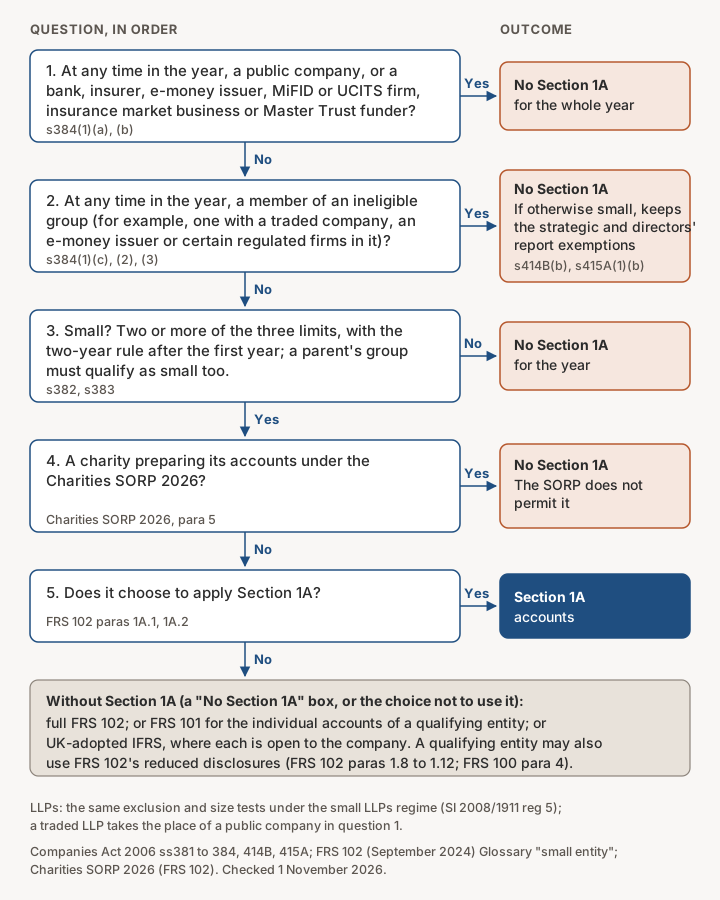
The FRS 102 1A thresholds: size is the first test, not the only one
The Section 1A thresholds are the Companies Act small company limits (s382(3), as amended by SI 2024/1303). A parent qualifies only if the group it heads qualifies as small (s383(1)). After the first year, a change counts only when it happens in two consecutive years (s382(2)). How each figure is measured, the group limits and the April 2025 transition are on company size thresholds. This page covers UK law: a small entity reporting in the Republic of Ireland follows the Companies Act 2014 and Appendix D to Section 1A (para 1A.16A; footnote 6 to para 1A.4).
Which companies cannot use Section 1A at any size?
A company cannot use Section 1A, whatever its size, if at any time in the financial year it was a public company, a bank, an insurer or another of the types section 384 lists, or a member of an ineligible group. The small companies regime "does not apply to a company that … was at any time within the financial year to which the accounts relate" one of the following (s384(1)).
| Excluded if, at any time in the year, it was | Section | What it prepares instead |
|---|---|---|
| A public company | s384(1)(a) | Full FRS 102 (with reduced disclosures in a qualifying entity's individual accounts), FRS 101 for a qualifying entity's individual accounts, or UK-adopted IFRS; a parent with securities on a UK regulated market uses UK-adopted IFRS for group accounts (s403(1)) |
| An authorised insurance company, banking company, e-money issuer, MiFID investment firm or UCITS management company | s384(1)(b)(i) | The same; a financial institution has fewer reduced disclosures (para 1.9) |
| A company carrying on insurance market activity, or a Master Trust scheme funder | s384(1)(b)(ii), (iii) | The same |
| A member of an ineligible group | s384(1)(c), (2) | The same; a subsidiary in its parent's publicly available consolidated accounts is often a qualifying entity |
Can a plc use FRS 102 Section 1A? No, not even a small one (s384(1)(a)). A small plc parent can still be exempt from group accounts: the exemption covers a company that "would be subject to the small companies regime but for being a public company" (s399(2A)(a)(ii)), on the same group condition as a private parent (s399(2A)(b)).
A company excluded only by being in an ineligible group, and otherwise small, keeps the small companies exemptions for the strategic report and the directors' report (s414B(b), s415A(1)(b)): see companies that cannot use the small or medium-sized rules. Any company excluded by section 384 is also outside the micro-entity provisions (s384B(1)(a)), so FRS 105 is closed too: see FRS 105 vs FRS 102.
Ineligible groups: when another company in the group shuts you out
A group is ineligible if any member is one of the types in section 384(2), and then every company in it is excluded (s384(1)(c)). A group is a parent undertaking and its subsidiary undertakings (s474(1)), so sister companies count as well as parents. The types are:
- a traded company: one with transferable securities admitted to trading on a UK regulated market (s474(1));
- a body corporate other than a company with shares admitted to trading on a UK regulated market;
- a person, other than a small company, with a Part 4A permission under the Financial Services and Markets Act 2000 to carry on a regulated activity;
- an e-money issuer, of any size;
- a small company that is an authorised insurance company, banking company, MiFID investment firm or UCITS management company;
- a person carrying on insurance market activity, or a Master Trust scheme funder.
A plc in the group is not the same as a listed company in the group
The group test names a "traded company", not a public company (s384(2)(a)). An unlisted plc excludes itself, but it does not make the rest of its group ineligible on that ground. Shares on AIM do not, on that ground alone, make a company a traded company: the London Stock Exchange describes AIM as a multilateral trading facility, which UK MiFIR (article 2(1)) defines separately from a UK regulated market. Check every class of security, though: "transferable securities" include bonds (s1173(1)).
Can a subsidiary of a listed group use Section 1A?
Not if a group member is a company with any transferable securities, shares or bonds, on a UK regulated market, or a body corporate other than a company with shares on one. A parent listed only on an overseas exchange does not make the group ineligible on that ground alone: see does a US-listed parent make the group ineligible.
Regulated firms in the group: the small-company carve-out
A medium-sized or large company with a Part 4A permission (granted by the FCA or the PRA) makes the group ineligible; a small one does not, unless it is a bank, insurer, MiFID investment firm, UCITS management company or e-money issuer, or carries on insurance market activity (s384(2)(c) to (e)). The carve-out is for a small company: a member that is not a company is caught whatever its size. "Small" is judged on the member's "last financial year ending on or before the end of the financial year to which the accounts relate" (s384(3)). And section 474 narrows "regulated activity": it leaves out, for example, mortgage broking and general insurance broking, so a permission covering only those does not make the group ineligible under s384(2)(c), though a broker placing business at Lloyd's may carry on insurance market activity, which does (s384(2)(e)).
Worked case B (invented). A small trading company with a 31 March year end has a sister company, a consumer credit broker with a Part 4A permission (section 474 does not leave consumer credit broking out), which was not small for its last financial year ending on or before 31 March. The group is ineligible and the trading company cannot use Section 1A that year. Had the broker been small, it would not make the group ineligible on that ground.
One day is enough: the exclusions and the two-year rule run on different clocks
An exclusion applies to the whole financial year if it applied "at any time within the financial year", with no grace year.
Worked case C (invented). A private company with a 31 December year end re-registers as a plc on 1 November. It cannot use Section 1A for that whole year, though it was private for ten months. A plc that re-registers as private in December is likewise excluded for that year.
Worked case A (invented). A small company is bought on 1 December by a group whose parent's shares are admitted to trading on a UK regulated market. It is a member of an ineligible group from that day, so it is excluded for the whole year to 31 December, small as it is on its own figures.
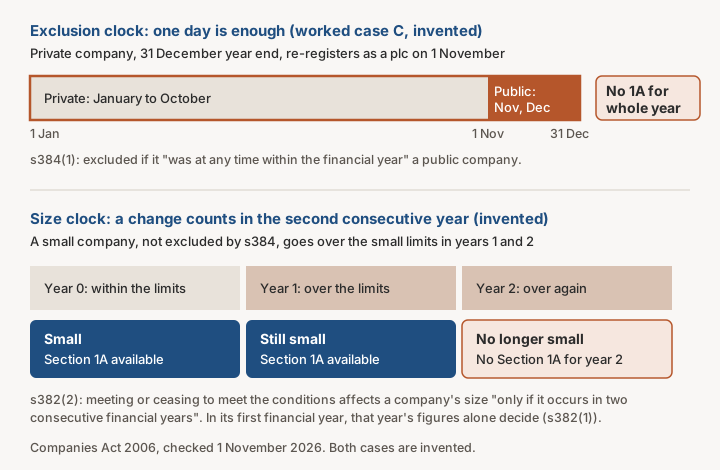
The size clock is slower: a company over the small limits for one year stays small, and stops qualifying only if it is over them again the next year (s382(2)); a new company is judged on its first year alone (s382(1)). See the two-year rule and the April 2025 increase.
Can an LLP, a charity or another entity use Section 1A?
LLPs. Yes, if the LLP qualifies as small and is not excluded from the small LLPs regime (Glossary, part (b)). Sections 381 to 384 apply to LLPs in modified form, with the same limits (SI 2008/1911 reg 5). The first exclusion is "a traded LLP" rather than a public company, and the group test also spares a small LLP.
Other entities. An entity that is neither a company nor an LLP is a small entity if it would meet part (a) of the definition were it a company (Glossary, part (c)).
Charities. The Charities SORP 2026 (FRS 102), for reporting periods beginning on or after 1 January 2026 (or, where regulations specify which SORP applies, once new regulations allow this one: para 21), "does not permit the use of Section 1A Small Entities of FRS 102". A charity preparing its accounts under the SORP, a charitable company included, uses FRS 102 without Section 1A whatever its size.
Can a small parent use Section 1A for group accounts?
Yes, if it chooses to prepare them: it applies Section 9's consolidation procedures and "shall comply so far as practicable with the requirements of Section 1A as if it were a single entity" (para 1A.22(a), (c)). Usually it need not prepare them (para 1A.21). A parent subject to the small companies regime is exempt unless, at any time in the year, its group had a member established in the UK and required to prepare accounts in accordance with the requirements of Part 15 of the Act that has transferable securities on a UK regulated market, is a CRR credit institution or would be an insurance undertaking (s399(2A), (2B)); it may prepare them anyway (s399(4)). Its own eligibility depends on its group being small and not ineligible.
What happens when a company stops qualifying for Section 1A?
It prepares full FRS 102 or another framework from the first year it is excluded (at once) or no longer small (the second consecutive year over the limits). Recognition and measurement do not change (para 1A.1).
What the accounts add
Section 1A relieves a small entity from Sections 4 to 7 (para 1A.7A) and from the specific disclosures of Sections 8 to 35 (para 1A.17). Full FRS 102 requires a statement of changes in equity (or a statement of income and retained earnings, para 3.18), which a small entity may already present (para 1A.9), and a statement of cash flows (para 3.17), unless an exemption applies, such as a qualifying entity's from the cash flow statement (para 1.12(b)), and the disclosures of Sections 8 to 35. Comparatives are needed for all amounts presented unless FRS 102 permits otherwise (para 3.14), so last year's figures for the new statements and notes must generally be prepared too. It is not a first-time adoption under Section 35: Section 1A is part of FRS 102.
What it may use instead of full FRS 102
Instead of full FRS 102, a qualifying entity (a group member included in its parent's publicly available consolidated financial statements intended to give a true and fair view, Glossary) may use FRS 102's reduced disclosures for qualifying entities in its individual accounts, provided it otherwise applies FRS 102's recognition, measurement and disclosure requirements and discloses a summary of the exemptions used, the parent's name and where its consolidated statements can be obtained (paras 1.8–1.12), or, for its individual accounts, FRS 101. UK-adopted IFRS is the other option, though not for a charity's individual accounts (s395(2)).
What else may change
A company that has outgrown the small limits loses the small-company report and filing reliefs and, unless another exemption applies, needs an audit: see when your company changes size. A public company or one of the other types section 384(1)(b) names is outside the small companies audit exemption too (s478), and so is a member of an ineligible group (s479(1)), a dormant subsidiary aside; other audit exemptions have their own conditions: see audit exemption thresholds. If you want an audit where software does the legwork and people make the judgements, Innate offers statutory audits signed by an ICAEW-registered partner firm, which your company appoints as its auditor: find out more.
Checking Section 1A eligibility at the year end
To check who can use FRS 102 Section 1A for the year, ask five questions in this order:
- At any time in the year, was the company a public company or one of the types section 384(1)(b) names?
- At any time in the year, was any group member, parents and sister companies included, a section 384(2) type? Check where each member's shares and bonds are traded, its Part 4A permissions and, for a regulated member, its size.
- Is the company small on the two-year rule, and, if a parent, is its group?
- Does the Charities SORP or the small LLPs regime apply?
- Choose Section 1A, full FRS 102, FRS 101 or UK-adopted IFRS; if a re-registration, an acquisition or a second year over the limits is coming, plan the move now, comparatives included.