UK company size thresholds: micro, small, medium and large, and what each size changes
By Alon Zieve FCA · Last reviewed
The UK company size thresholds, for financial years beginning on or after 6 April 2025, put a company in one of four sizes. It is micro, small or medium-sized if it meets at least two of three conditions for that size: turnover of not more than £1 million, £15 million or £54 million; a balance sheet total of not more than £500,000, £7.5 million or £27 million; and no more than 10, 50 or 250 employees on average. A company that is none of these is large. A change of size counts only once it has happened two years running, and a public company cannot use the small or medium-sized rules. The size largely decides the accounting framework, the reports, what is filed and whether an audit is required, so checking it is one of the company director responsibilities at every year end.
Status, 29 October 2026. Limits in force: financial years beginning on or after 6 April 2025 (SI 2024/1303). Earlier years: turnover limits of £632,000 (micro), £10.2 million (small) and £36 million (medium). Energy and carbon reporting (SECR) keeps its own £36 million / £18 million / 250 test for unquoted companies. Last checked: 29 October 2026.
UK company size thresholds at a glance
Table 1. Companies (two or more of the three conditions; "old" is for financial years beginning before 6 April 2025, "new" for years beginning on or after it)
| Size | Turnover, old | Turnover, new | Balance sheet total, old | Balance sheet total, new | Average employees |
|---|---|---|---|---|---|
| Micro-entity | £632,000 | £1m | £316,000 | £500,000 | 10 |
| Small | £10.2m | £15m | £5.1m | £7.5m | 50 |
| Medium-sized | £36m | £54m | £18m | £27m | 250 |
| Large | Not micro, small or medium-sized |
Table 2. Groups (a parent company is small or medium-sized only if its group is too)
| Group | Turnover, old | Turnover, new | Balance sheet total, old | Balance sheet total, new | Employees |
|---|---|---|---|---|---|
| Small | £10.2m net or £12.2m gross | £15m net or £18m gross | £5.1m net or £6.1m gross | £7.5m net or £9m gross | 50 |
| Medium-sized | £36m net or £43.2m gross | £54m net or £64m gross | £18m net or £21.6m gross | £27m net or £32m gross | 250 |
Each limit is a maximum: the Companies Act 2006 says "not more than", so turnover of exactly £15 million meets the small condition. The limits are in sections 382(3), 383(4), 384A(4), 465(3) and 466(4) of the Act, as amended by regulations 9 and 10 of SI 2024/1303, made on 9 December 2024. The new medium group gross limits are £64 million and £32 million, not the £64.8 million and £32.4 million (net multiplied by 1.2) some pages print. Limited liability partnerships use the same limits (regulation 11). This page covers UK law, not Irish law.
How is company size determined?
Company size is determined by three figures, turnover, balance sheet total and average number of employees, measured against the limits for each size: a company needs to be within two of the three, and a parent company is judged on its group's figures as well. Each figure is defined in the Act:
- Turnover is the amounts derived from the provision of goods and services, after trade discounts, VAT and other taxes based on those amounts (s474). For a financial year that is not twelve months, the turnover limit is "proportionately adjusted" (s382(4), s465(4)): for an 18-month first period, £22.5 million (small) and £81 million (medium).
- Balance sheet total is "the aggregate of the amounts shown as assets in the company's balance sheet" (s382(5)): gross assets, before any liabilities are deducted. Leases brought onto the balance sheet add to it (see FRS 102 lease changes).
- Employees is the average of the monthly numbers of people employed under contracts of service, counting anyone employed during the month (s382(6)): a headcount, not full-time equivalents.
A parent company is small only if the group it heads qualifies as a small group (s383(1)), and medium-sized only if its group qualifies as medium-sized (s466(1)). The group is the parent and its subsidiary undertakings (s474), and its figures are added up across every member. For turnover and balance sheet total the company may use the net figure (after eliminating intra-group transactions) or the gross figure, choosing for each condition separately (s383(6), s466(6)).
Companies that cannot use the small or medium-sized rules
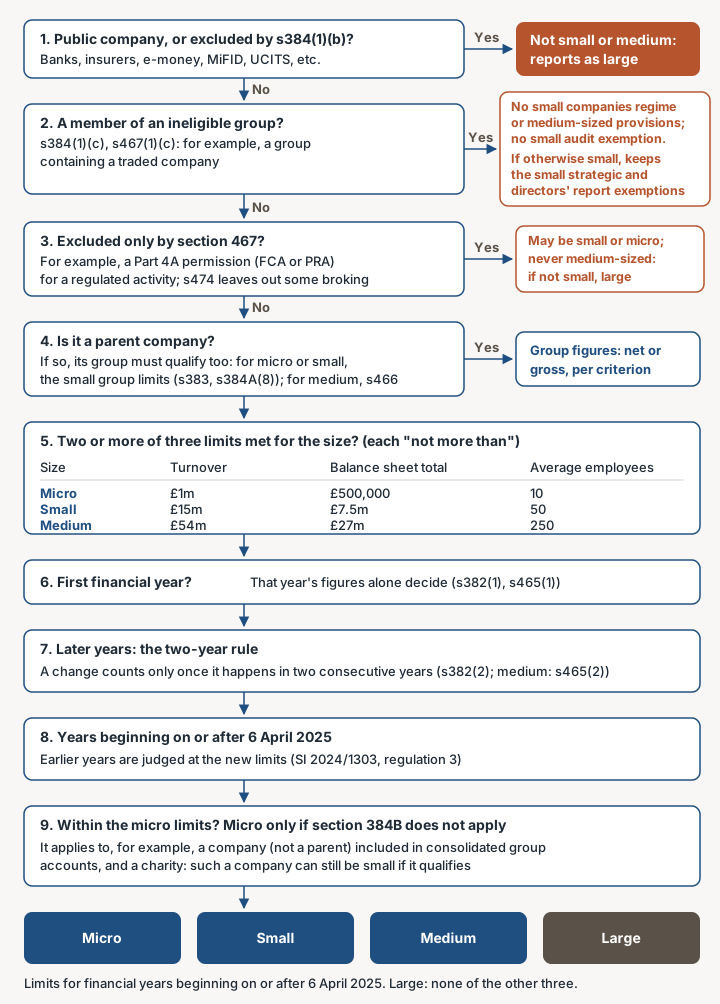
Section 384 excludes from the small companies regime a company that was, at any time in the year, a public company; a bank, insurer, e-money issuer, MiFID investment firm or UCITS management company; a company carrying on insurance market activity or funding a Master Trust pension scheme; or a member of an ineligible group (one containing, for example, a traded company). Section 467 sets similar exclusions for the medium-sized provisions, but its list is not the same: instead of naming banks, insurers, MiFID investment firms and UCITS management companies, it bars a company with a Part 4A permission under the Financial Services and Markets Act 2000, from the FCA or the PRA, to carry on a regulated activity. "Regulated activity" here is narrower than in the 2000 Act: section 474 leaves some activities out, for example mortgage broking and general insurance broking, so a permission covering only those does not by itself exclude a company under section 467. What an exclusion leaves depends on which one applies:
- A public company, or a company excluded by section 384 as one of the financial businesses listed above, is on both lists, so it reports as large, however small its figures.
- A member of an ineligible group is on both lists too (s384(1)(c), s467(1)(c)). Its accounts cannot be prepared under the small companies regime or use the medium-sized provisions, and it cannot take the small companies audit exemption (s479(1); a dormant subsidiary aside, s479(3)). But if it would otherwise be small, it keeps the small companies exemptions for the strategic report and the directors' report (s414B(b), s415A(1)(b)): it need not prepare a strategic report, and it files its accounts with the directors' report optional (s444A).
- A company excluded only by section 467, such as a consumer credit firm with a Part 4A permission that is not in an ineligible group, can still be small (or a micro-entity, unless s384B excludes it) if its figures qualify, but it can never be medium-sized: if it is not small, it reports as large.
The two-year rule and the April 2025 increase
In its first financial year, a company's size depends on that year's figures alone (s382(1), s465(1)). After that, a change counts only when it happens in two consecutive years: a small company that fails the small conditions for one year stays small, and becomes medium-sized or large only if it fails them again the next year (s382(2)). The medium-sized test reaches the same place in its own words: a company is medium-sized if it meets the conditions this year and last year, or this year and was medium-sized last year, or met them last year and was medium-sized last year (s465(2)).
The new limits apply to financial years beginning on or after 6 April 2025 (SI 2024/1303, regulation 2(2)), not to years ending after it:
| Year end | First financial year at the new limits |
|---|---|
| 31 December | 1 January 2026 to 31 December 2026 |
| 31 March | 1 April 2026 to 31 March 2027 |
| 5 April | 6 April 2025 to 5 April 2026 |
| 30 June | 1 July 2025 to 30 June 2026 |
| 30 September | 1 October 2025 to 30 September 2026 |
So "the old limits apply until 31 March 2026" is wrong as a rule: a 30 June company's year to 30 June 2026 is already under the new limits, while a 31 March company's year to 31 March 2027 is its first.
Regulation 3 of SI 2024/1303 applies to every financial year beginning on or after 6 April 2025: whenever the two-year rule looks back at an earlier year, that year is judged by the new limits. In practice it makes a difference only in the first year under the new limits, the one whose previous year began before 6 April 2025, and later years follow on from that result. That does not switch off the two-year rule; it re-tests the earlier years. A company within the new limits this year and last year changes size at once. One that was over them in both of the two previous years needs a second year within them. In between, the result depends on the years before; worked example 1 below shows two cases. For the audit consequences, see audit exemption thresholds.
Medium-sized company thresholds: what makes a company medium-sized
Under the medium-sized company thresholds, a company is medium-sized if it meets two of three conditions: turnover of not more than £54 million, a balance sheet total of not more than £27 million and no more than 250 employees on average (s465(3)), applying the two-year rule above and not being excluded by s467. A parent also needs its group to be within £54 million net or £64 million gross turnover, £27 million net or £32 million gross balance sheet total and 250 employees (s466(4)). The 250 is an average headcount, not full-time equivalents.
The main differences from a large company are these; it is not a complete list, and the Act and the regulations under it have the full rules:
- Strategic report. Still required, but the analysis using key performance indicators need not cover non-financial information (s414C(6)).
- No section 172(1) statement of how the directors had regard to the matters in section 172 (s414CZA(2)).
- Accounts disclosures. Its Companies Act individual accounts need not state whether they follow applicable accounting standards, and need disclose only related party transactions not concluded under normal market conditions with owners holding a participating interest in it, companies in which it has a participating interest, and its directors (SI 2008/410 regulation 4(2A), (2B)). Its accounts need disclose only the audit fee, not the fees for its auditor's other services, which a large company generally discloses (SI 2008/489 regulations 4 and 5).
A medium-sized company still needs an audit: see do medium-sized companies need an audit. The government said on 21 October 2025 that it intends to exempt most medium-sized private companies from the strategic report; on 29 October 2026 no regulations to do so had been made.
What is a large company in the UK?
A large company is one that is not micro, small or medium-sized. In practice, that is a company over two or more of the medium-sized limits (£54 million turnover, £27 million balance sheet total, 250 employees) in its first financial year or in two consecutive years, until it is back within them for two years running. A public company, or a company excluded by section 384 as one of the financial businesses it lists, reports as large whatever its figures. A member of an ineligible group, and a company excluded only by section 467, are treated differently: see companies that cannot use the small or medium-sized rules. Compared with a medium-sized company, the main additions, not a complete list, are the section 172(1) statement, the strategic report's analysis using non-financial key performance indicators (where appropriate), the accounts disclosures a medium-sized company may leave out (listed above) and, usually, payment practices reporting.
Worked example 1 (invented). A private company with a 31 December year end has turnover of £50 million, a balance sheet total of £25 million and 300 employees, the same every year.
| Test | Turnover £50m | Balance sheet total £25m | Employees 300 | Conditions met | Result |
|---|---|---|---|---|---|
| Old medium limits (£36m / £18m / 250) | Over | Over | Over | 0 of 3 | Large |
| New medium limits (£54m / £27m / 250) | Within | Within | Over | 2 of 3 | Medium-sized |
Its 2025 accounts (year beginning 1 January 2025) are under the old limits: large. For 2026, the first year under the new limits, regulation 3 re-tests 2025 at those limits, both years meet two conditions, and it is medium-sized. Had it been at £60 million, £30 million and 300 staff in both 2024 and 2025, it would stay large for 2026 and become medium-sized in 2027, after a second year back at £50 million, £25 million and 300 staff. A single year over the limits, in 2025 alone, would not have held it back: it would still be medium-sized for 2026.
What each size changes: accounts, reports, filing and audit
Table 3. The main differences by size (financial years beginning on or after 6 April 2025). This is not a complete list of what changes with size: the Companies Act 2006 and the regulations made under it have the full rules. The micro and small columns are for a company not excluded by section 384, and the medium-sized column for one not excluded by section 467 (see above).
| Micro | Small | Medium-sized | Large | |
|---|---|---|---|---|
| Accounting framework (FRS 100 para 4) | FRS 105 (unless s384B applies), or any framework open to a small company | FRS 102 with Section 1A; or full FRS 102, FRS 101 (individual accounts of a qualifying entity) or UK-adopted IAS | Full FRS 102, FRS 101 (individual accounts of a qualifying entity) or UK-adopted IAS | As medium-sized, except that the group accounts of a parent company whose securities are admitted to trading on a UK regulated market must use UK-adopted IAS (s403(1)) |
| Strategic report (s414A, s414B) | Not required | Not required | Required, but not the non-financial KPI analysis or a section 172(1) statement (s414C(6), s414CZA(2)) | Required, with a section 172(1) statement (s414CZA(1)) |
| Directors' report (s415) | Not required (s415(1A)) | Required | Required | Required |
| Filed at Companies House | Balance sheet; profit and loss account and any directors' report optional (s444(1)) | Balance sheet; profit and loss account and directors' report optional (s444(1)) | Accounts, strategic report, directors' report and auditor's report (s445) | Accounts, strategic report, directors' report, any separate corporate governance statement and auditor's report (s446); a quoted company also the directors' remuneration report (s447) |
| Audit | Exempt if the conditions are met | Exempt if the conditions are met | Required unless another exemption applies (s475(1)) | Required unless another exemption applies (s475(1)) |
Notes: UK-adopted IAS means UK-adopted international accounting standards, which a charity cannot use (s395(2), s403(3)). For a small or micro company whose accounts were audited, the auditor's report is filed with any profit and loss account (s444(2)); where the profit and loss account is not filed, the notes to the balance sheet give details of the auditor's report, except for a micro-entity using the micro-entity provisions (s444(5A) to (5C)). The filing row is today's law; Companies House accounts filing changes covers what is changing. The audit row is the small companies exemption with its group and other conditions: see audit exemption thresholds.
A micro-entity may use FRS 105 instead of FRS 102 (FRS 100 paragraph 4(a)). Section 384B takes away the micro-entity provisions, and with them FRS 105, from some companies that otherwise qualify, such as a company (not itself a parent) whose accounts are included in consolidated group accounts, or a charity, without taking away the small companies regime. How the two standards differ is in FRS 105 vs FRS 102; the wider framework is under UK GAAP.
Section 1A of FRS 102 is open to a "small entity", which FRS 102 defines as a company meeting the definition of a small company in section 382 or 383 and not excluded from the small companies regime by section 384; a small entity may instead choose full FRS 102, FRS 101 if eligible, or UK-adopted IAS (FRS 102 paragraphs 1A.1 and 1A.2 and the Glossary). What Section 1A asks for is set out in FRS 102 1A disclosure requirements.
Thresholds that did not move in April 2025
Tests that borrow the Companies Act limits moved with them in April 2025; tests with their own figures did not.
Moved, by cross-reference: payment practices reporting. It uses "the maximum figures" in s465(3), so £54 million and £27 million for years under the new limits, and its own rule applies the new figures to the two previous years too (SI 2017/395 regulation 5(5)(b), (6) and (7)). A company reports where it was over two or more of those limits on both of its last two balance sheet dates (in its second financial year, on its first), never in its first year; a parent company's group must also be over the medium-sized group limits (regulation 5(2) to (4)). That cannot happen to a small or medium-sized company.
Did not move:
| Test | Its own figures | Source |
|---|---|---|
| Energy and carbon report (SECR), unquoted company | Exempt if two or more of: turnover not more than £36m, balance sheet total not more than £18m, not more than 250 employees; own two-year rule | SI 2008/410 Sch 7 para 20B |
| SECR, parent company | Group: £36m net or £43.2m gross; £18m net or £21.6m gross; 250 | Sch 7 para 20C |
| Statement of corporate governance arrangements | More than 2,000 employees, or turnover over £200m and balance sheet total over £2bn | Sch 7 Part 8, para 23 |
| Modern slavery statement | Total turnover of £36m or more | Modern Slavery Act 2015 s54; SI 2015/1833 reg 2 |
| Gender pay gap reporting | 250 or more employees on the snapshot date | SI 2017/172 reg 1 |
| Senior accounting officer | Previous year's turnover over £200m, or balance sheet total over £2bn, aggregated across group companies | Finance Act 2009 Sch 46 para 15 |
The SECR figures are the old medium-sized limits, so a company that has just become medium-sized under the new limits can still owe an energy and carbon report. A "large company" for corporation tax instalment payments is unrelated: it turns on profits over £1.5 million, a limit divided among related associated companies (SI 1998/3175 regulation 3).
When your company changes size
The two-year rule gives a year's warning, so model the size before the next year end, using this year's actual figures and next year's forecast.
Moving up. A small company that becomes medium-sized can no longer use Section 1A, prepares a strategic report, and files its full accounts, strategic report and directors' report. Unless another exemption applies, it also needs a statutory audit every year (for many, their first), and an auditor in time to plan it (see first statutory audit).
Once the exemption no longer applies, Innate can arrange a statutory audit signed by an ICAEW-registered partner firm, which your company appoints as its auditor: get a quote. Our platform finds the data and documents and helps the audit team prepare its work, to save you questions, time and money.
A medium-sized company that becomes large takes on the additions listed under what is a large company in the UK, which are the main ones, not a complete list.
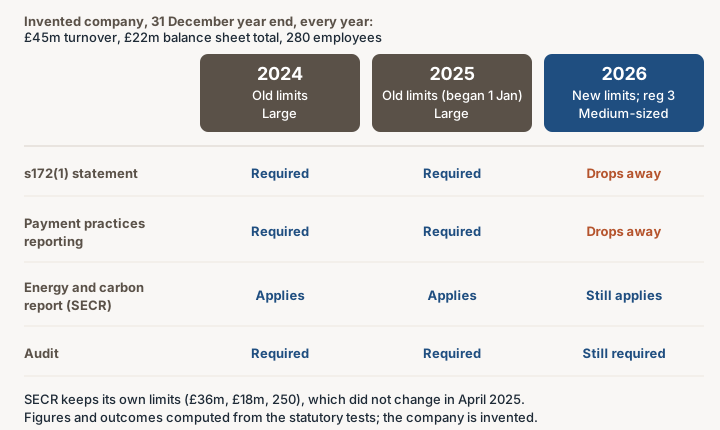
Moving down: worked example 2 (invented). A private, unquoted company, neither a parent nor a subsidiary, with a 31 December year end, has turnover of £45 million, a balance sheet total of £22 million and 280 employees in every year from 2023 to 2026, and was over the old medium-sized limits in the years before.
| Year | Limits that apply | Medium conditions met | Size | Section 172(1) statement | Payment practices reporting | SECR | Audit |
|---|---|---|---|---|---|---|---|
| 2023 | Old | 0 of 3 | Large | Required | Required | Applies | Required |
| 2024 | Old | 0 of 3 | Large | Required | Required | Applies | Required |
| 2025 | Old (year began 1 January 2025) | 0 of 3 | Large | Required | Required | Applies | Required |
| 2026 | New; 2025 re-tested (regulation 3) | 2 of 3 | Medium-sized | Not required | Not required | Applies | Required |
At 31 December 2025 its figures are over only one new limit (employees), so payment practices reporting stops. SECR continues: £45 million and £22 million are over its unchanged £36 million and £18 million. The audit continues, because the company is not small.