Directors' loan account rules in the UK: approval, limits and what happens if you get it wrong
By Alon Zieve FCA · Last reviewed
The directors' loan account rules in the UK come from the Companies Act 2006. A company may lend money to its director, but the loan needs a resolution of the members before it is made, unless an exception applies. The best-known exception covers loans whose value, added to earlier loans made to the same director under that exception, does not exceed £10,000. Company law sets no maximum. A loan made without the approval it needed can usually be reversed by the company, and the director who received it must make good the company's loss, as must any director who authorised it, unless they show they did not know the circumstances.
This guide covers the company law; tax and the accounts note are linked where they touch it.
Can a director borrow money from their company?
Yes. A UK company can lend to its director, and company law puts no cap on the amount. But a loan to a director of the company or of its holding company, or a guarantee or security the company gives for a loan someone else makes to such a director, needs a resolution of the company's members (in a company limited by shares, its shareholders) first (s197), unless an exception applies or the members are exempt. A shadow director counts as a director for these rules (s223).
This is an approval rule, not a ban. It applies to transactions entered into from 1 October 2007 (SI 2007/2194, art 2(1)(d) and Sch 3 para 8). Before then the Companies Act 1985 prohibited such loans outside narrow exceptions (s330), and for public companies and their groups a breach could be a crime (s342).
The Act does not define "loan"; in its ordinary sense it is money paid on terms that it will be repaid. Cash a director draws beyond salary, dividends and expenses, and must pay back, is borrowing, recorded as a debit on the directors' loan account. Where the company instead pays a director's personal bill to be reimbursed, the Act's definition of a quasi-loan fits more closely (s199). Which label fits is a question of fact, and it matters (next section).
The approval is separate from the tax (GOV.UK: director's loans) and from the directors' loan account disclosure in the accounts; both apply whether or not approval was needed. For the wider duties, see company director responsibilities.
Directors' loan account rules in the UK: what the Companies Act 2006 requires
The rules on directors' loans sit in Part 10, Chapter 4 of the Act (ss197 to 214).
| Transaction | Everyday example | Private company | Public company, or associated with one | Section |
|---|---|---|---|---|
| Loan to a director | Director draws cash, to be repaid | Approval needed | Approval needed | s197 |
| Guarantee or security for a loan to a director | Company guarantees the director's personal bank loan | Approval needed | Approval needed | s197 |
| Quasi-loan to a director | Company pays the director's personal bill, to be reimbursed | Not covered | Approval needed | ss198, 199 |
| Loan or quasi-loan to a connected person | Loan to the director's spouse | Not covered | Approval needed | s200 |
| Credit transaction for a director or connected person | Company supplies goods or services and lets payment wait | Not covered | Approval needed | ss201, 202 |
| Related arrangement | A third party lends to the director and the company gives it a benefit, or the company takes over the director's debt | Approval needed if the underlying transaction would need it | Same | s203 |
"Not covered" means no members' approval is required under these sections. The directors' general duties still apply.
"Associated" has a group meaning: two companies are associated if one is a subsidiary of the other or both are subsidiaries of the same body corporate (s256). A private company with a plc parent or plc sister is therefore under the wider rules. The list of connected persons is closed: the director's family as the Act defines it, companies the director is connected with, and certain trustees, partners and firms (ss252 and 253). A person who is a director of the same company is not a connected person (s252(3)).
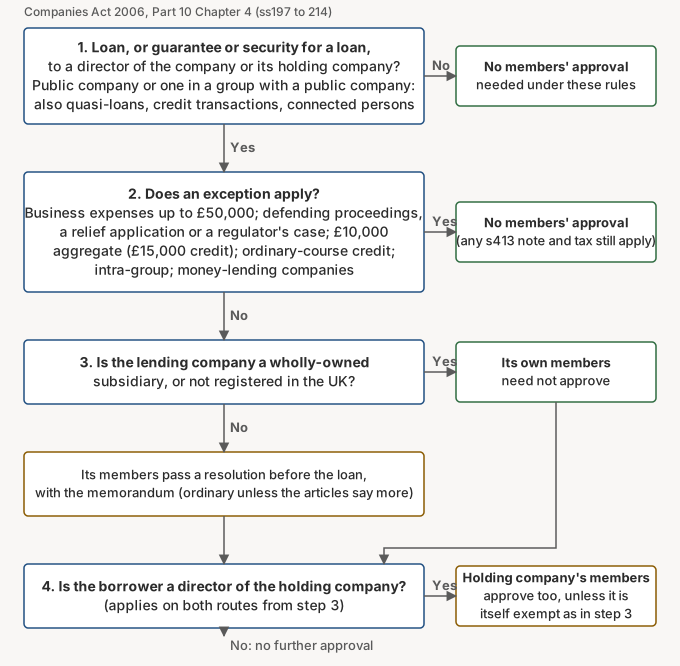
The route in the diagram: is the transaction covered? If not, no approval. Does an exception apply? If so, none. Is the lending company a wholly-owned subsidiary or not UK-registered? If so, its own members need not approve; otherwise they resolve first. On either route, if the borrower is a director of the holding company, the holding company's members approve too, unless it is exempt in the same way.
How to get members' approval for a director's loan
By an ordinary resolution of the members, passed before the loan is made, unless the articles require a higher majority: s197 does not say what kind of resolution, so s281(3) applies. A memorandum must be made available before the resolution is passed, setting out the nature of the transaction, the amount of the loan and its purpose, and the extent of the company's liability under any transaction connected with the loan (s197(3) and (4)).
Written resolution
Private companies only (s281). The memorandum goes to every eligible member at or before the time the resolution does (s197(3)(a)). It passes when members holding a simple majority of the total voting rights of all eligible members agree, not a majority of those who reply (s282(2)). It lapses if not passed within the period in the articles or, if none, 28 days from circulation (s297).
At a general meeting
The memorandum is available for inspection at the registered office for at least 15 days ending with the date of the meeting, and at the meeting itself (s197(3)(b)). A public company must use a meeting (s281(2)).
A sole director who owns all the shares
The resolution is still required. A written resolution with the memorandum attached takes minutes, and it is the evidence the company's auditor, a buyer or a liquidator will later ask for. A sole member who decides otherwise than by written resolution must give the company details of the decision (s357), and the company keeps its records of resolutions for at least ten years (s355).
Holding companies and subsidiaries
The holding company's members approve too when the borrower is one of its directors (s197(2)), and the members of a wholly-owned subsidiary or a non-UK company never need to (s197(5)). So a wholly-owned subsidiary lending to its own director, who is not a director of any holding company, needs no members' approval.
The board's side
The director declares the nature and extent of the interest to the other directors before the company enters into the loan, unless they already know of it (s177(4) and (6)). Under the model articles for private companies, an interested director does not count in the quorum or vote, unless the members disapply that by ordinary resolution, no conflict is reasonably likely, or a listed permitted cause applies (art 14); a loan to the director is not one. Where the articles allow a single director, a sole director takes decisions without those rules (art 7(2)). Once members approve under Chapter 4, or no approval is needed, the director need not also comply with the duties in ss175 and 176, but s177 still applies (s180(2)).
Specimen written resolution and memorandum. Illustrative wording; check your articles and take advice.
Written resolution of [Company] Limited (company number [number]), proposed by the directors as an ordinary resolution and circulated on [date].
THAT the company make a loan of £[amount] to [director], a director of the company, on the terms set out in the memorandum sent with this resolution.
Memorandum under section 197(4) of the Companies Act 2006
- Nature of the transaction: an unsecured loan by the company to [director], repayable [on demand / by date], at [rate / no interest].
- Amount and purpose: £[amount], required for [purpose].
- The company's liability under any transaction connected with the loan: [none / describe, for example a guarantee the company gives for the same purpose].
The circulated copy must also tell members how to signify agreement and the date by which the resolution lapses (s291(4)).
Is there a directors' loan account limit?
No. Company law sets no maximum on how much a director can borrow from the company with members' approval. The figure people call the limit is £10,000: no approval is needed where the value of the loan, added to the value of other relevant transactions, does not exceed £10,000 (s207(1)).
What goes into the aggregate:
- earlier loans and quasi-loans made for the same director, or a person connected with them, under the same exception, by the company or its subsidiaries (for a parent director, by the parent or its subsidiaries) (s210);
- a loan at its principal (a quasi-loan at the amount to be reimbursed), reduced by repayments (s211(1)(b), (2) and (3));
- a transaction whose value cannot be expressed as a specific sum is deemed to exceed £50,000 (s211(7)), so no capped exception can cover it.
Because s210 counts only transactions made "by virtue of the relevant exception", a loan the members approved does not count towards the £10,000 on the words of the Act, and neither does a loan made under the separate business-expenditure exception.
Worked example (illustrative; figures computed in calc/). A private company lent its director £6,000 in year 1 under s207 and £1,000 has been repaid.
| Step | Counted earlier loans (value now) | Proposed loan | Aggregate | Approval needed? |
|---|---|---|---|---|
| Year 2, January: loan B | £5,000 | £5,000 | £10,000 | No: does not exceed £10,000 |
| Year 2, February: loan C | £10,000 | £500 | £10,500 | Yes, for loan C |
| Variant: loan A was approved by the members; loan B | £0 | £5,000 | £5,000 | No |
| Variant: loan C | £5,000 | £500 | £5,500 | No |
In the variant the director owes £10,500 in total, yet loans B and C need no resolution, because the approved loan sits outside the s207 count.
Which £10,000? Several figures get called "the limit". Only the first three are company-law approval rules.
| Figure | Source | What it does | Area |
|---|---|---|---|
| £10,000 aggregate | CA 2006 s207(1) | No members' approval for loans and quasi-loans within it | Company law |
| £15,000 aggregate | s207(2) | The same for credit transactions, which only public companies and their groups need approve | Company law |
| £50,000 aggregate | s204 | Cap on funds for company business expenditure without approval | Company law |
| £10,000 | ITEPA 2003 s180 | No taxable cheap-loan benefit while the director's cheap or interest-free loans total no more than this throughout the tax year | Tax |
| No threshold | s413 | Every advance, credit or guarantee for a director that existed at any time in the year goes in the notes | Accounts |
| No threshold, except loans totalling £15,000 or less to a full-time working director with no material interest (s456); a time test | CTA 2010 s455 | A tax charge on a close company that lends to a participator, payable if the loan is still outstanding nine months after the end of the accounting period (GOV.UK) | Tax |
The real limits are practical: the company's cash, the directors' duties (ss171 and 172) and, if the plan is to clear the balance later with a dividend, the company's distributable reserves.
When a director's loan needs no approval
Each exception below removes the need for members' approval. It does not remove any note in the accounts or tax that would otherwise apply.
| Exception | Section | Cap | Conditions |
|---|---|---|---|
| Company business expenditure | s204 | £50,000 aggregate | Funds for spending for the company's purposes, or to let the director properly perform their duties; also covers connected persons |
| Defending proceedings | s205 | None | Proceedings over alleged negligence, default or breach of duty or trust towards the company or an associated company, or an application for relief; repayable if the director loses, by the date that becomes final |
| Regulatory investigation or action | s206 | None | Defending a regulator's investigation or proposed action over the same kinds of allegation |
| Minor loans and quasi-loans | s207(1) | £10,000 aggregate | None beyond the aggregate |
| Minor credit transactions | s207(2) | £15,000 aggregate | Relevant only where s201 applies |
| Ordinary-course credit transactions | s207(3) | None | In the ordinary course of business, at a value no greater and on terms no more favourable than for an unconnected person of the same financial standing |
| Intra-group | s208 | None | Loans, quasi-loans and credit transactions for an associated body corporate (a group company), not for an individual director |
| Money-lending companies | s209 | None | In the ordinary course of business, on arm's-length terms; a home loan to a director may be on the terms the company ordinarily offers its employees |
| Members exempt | s197(5) | None | The lending company is a wholly-owned subsidiary or not UK-registered (the holding company's members may still need to approve) |
Can a director lend money to the company?
Yes. Section 197 covers loans to directors, not from them, so no members' approval is needed. The director still declares the interest (s177), and the board follows its articles on who may vote.
Put the terms in writing: the amount, any interest, when it is repayable and any security. A charge the company gives the director protects them only if it is delivered to Companies House within 21 days beginning with the day after its creation, or a longer period the court allows (s859A); if it is not, the security is void against a liquidator, an administrator and the company's creditors (s859H), though the debt itself stands. Interest the company pays the director has its own tax treatment (GOV.UK). How the loan is measured, and why on-demand and fixed-term loans differ: director loan below market rate under FRS 102.
What happens if a director's loan is not approved?
The loan is voidable by the company, and, whether or not the company avoids it, the director who received it and any other director who authorised it must account to the company for any gain and indemnify it, jointly and severally, for any loss (s213(2) to (4)). The right to avoid is lost if restitution is no longer possible, the company has been indemnified, or avoidance would affect a third party's rights acquired in good faith, for value and without actual notice (s213(2)).
| Who | Liability under s213(3) | Defence |
|---|---|---|
| The director (of the company or its holding company) who received the loan | Account for any gain; indemnify the company for any loss | None in s213 |
| A connected person who received it (public companies and their groups) | The same | Did not know the relevant circumstances when it was made (s213(7)(a)) |
| The director that person is connected with | The same | Took all reasonable steps to secure the company's compliance (s213(6)) |
| Any other director who authorised it | The same | Did not know the relevant circumstances when it was made (s213(7)(b)) |
Affirmation. If the members (and, where their approval was required, the holding company's members) affirm the loan by resolution within a reasonable period, it may no longer be avoided under s213 (s214). It does not say whether affirmation also ends the duty to account and indemnify under s213(3), or define a reasonable period, so a board relying on a late resolution should take advice on both.
There is no criminal offence for a breach of these sections; the consequences are civil, and other remedies remain open (s213(8)). The same facts can also be a breach of the directors' general duties. If the members ratify that breach, the votes of the director concerned and of members connected with them do not count (s239), unless every member agrees.
An overdrawn account is often cleared with a dividend. If the profits available for distribution could not cover it (s830), the dividend is unlawful, and a member who knew or had reasonable grounds to believe it was must repay it (s847), leaving the director owing the company again. Check the distributable reserves before the dividend.
If the company becomes insolvent
If the company goes into liquidation or administration, money a director owes the company is one of its assets, and the liquidator or administrator will collect it like any other debt. Money the company owes a director ranks as an ordinary unsecured debt, unless the director holds a charge that was registered in time. A floating charge given to a director in the two years before the onset of insolvency is invalid except to the extent of new money or value given for it (s245).
In a winding up, on the application of the liquidator, official receiver, a creditor or a contributory, the court can order an officer who misapplied company money or breached a duty to repay it with interest or pay compensation (Insolvency Act 1986 s212).
Repaying a director's credit balance shortly before insolvency can be a preference. In England and Wales, a payment that improves a creditor's position in an insolvent liquidation can be reversed if the company was influenced by a desire to prefer them (s239). A director is connected with the company (s249), so the look-back period is two years ending with the onset of insolvency and the desire is presumed unless the contrary is shown (s240(1)(a); s239(6)). The payment is caught only if the company was unable to pay its debts at the time, or became so because of it (s240(2)); for a preference, unlike a transaction at an undervalue, that is not presumed. Scotland has its own provisions.
A director who knew, or ought to have concluded, that there was no reasonable prospect of avoiding insolvent liquidation or insolvent administration can be ordered to contribute to the company's assets (s214); the Directors hub's section on personal liability covers that. Misfeasance and breach of duty are also weighed in deciding whether a director is unfit (CDDA 1986 Sch 1).
Writing a director's loan off gives up a company asset. It needs authority under the articles and must meet the directors' duties; where the director is also a shareholder the release may be a distribution in law (s829), which can only be made out of distributable profits. A released loan is taxable on the director (GOV.UK).
What the accounts and the auditor will look for
Every advance or credit to a director that existed at any time in the year goes in the notes, with its amount, interest rate, main conditions and any amounts repaid, written off or waived, and so does any guarantee the company gave for a director (s413); the directors' loan account disclosure guide sets out the note. An interest-free or fixed-term loan may also need discounting; see director loan below market rate under FRS 102.
Where the company is audited (see audit exemption thresholds), the auditor must ask management who the related parties are and what transactions there were with them in the period (ISA (UK) 550, para 13). For a loan to a director, expect the auditor to ask for the members' resolution and memorandum, or the exception the company relied on, and to compare the loan account with the note. If you need an audit that meets the current standards, ask us: Innate offers statutory audits signed by an ICAEW-registered partner firm, which your company appoints as its auditor, with our platform doing the legwork to save you time and money.