Companies House identity verification: the deadline, the penalties and what to do if you missed it
By Alon Zieve FCA · Last reviewed
Position at 18 November 2026. The 12-month transition for directors and people with significant control (PSCs) already in post ended on 17 November 2026. The first convictions were on 16 September 2026; Companies House's plan puts compliance activity against people who have not verified at "no earlier than the end of 2026". Change log.
Companies House identity verification is compulsory for every individual director and person with significant control (PSC) of a UK company, and the 12-month transition for people already in post ended on 17 November 2026. It was never one deadline for everyone. An existing director had to give a Companies House personal code with the company's first confirmation statement filed in the transition; a PSC had a 14-day window of their own. If your date has passed, you are late: verify now, file the confirmation statement with every director's code, and answer any Companies House letter in time.
Has the Companies House identity verification deadline passed?
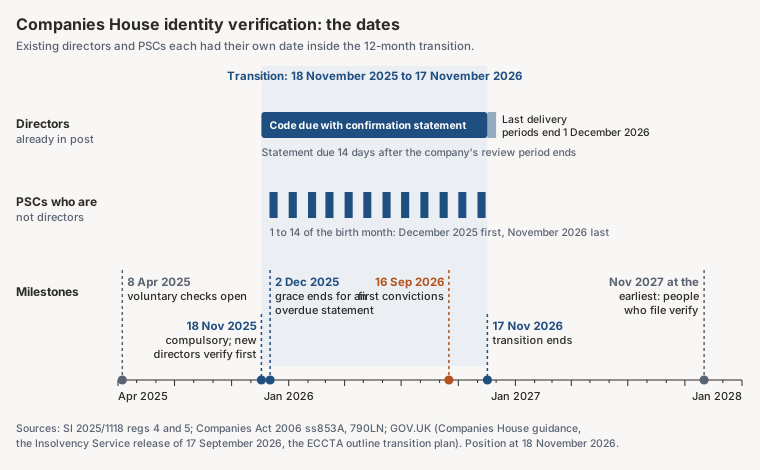
The transition was "the period of 12 months beginning with 18th November 2025" (SI 2025/1118 reg 4(9)), so its last day was 17 November 2026; 18 November 2026, which some guides give, is the first day after it. Each person's own date fell inside it or, for a few companies, is still running.
Existing directors. For anyone who was a director before 18 November 2025, the company had to deliver an identity verification statement with its next confirmation statement in the transition (reg 4(2)). A confirmation statement is due within 14 days after the end of each 12-month review period (Companies Act 2006 s853A). The ban on acting unverified reached an existing director only on the day after the company filed or, if it did not, the day after those 14 days ended (reg 4(6)). A company whose confirmation statement was already overdue on 18 November 2025 had until the end of 2 December 2025 (reg 4(7)).
Who is late today
A director whose company's 14 days have ended without their code; a PSC whose window, and any extension, has passed; and the directors of a company that filed nothing in the transition, which must still give the codes with its next confirmation statement (reg 4(3)).
Who is not late yet
The directors of a company whose review period ended between 4 and 17 November 2026 and which has no earlier statement outstanding, because its 14 days are still running. One that ended on 17 November 2026 needs the statement, with every director's code, by 1 December 2026. On our reading of reg 4(6), the existing directors may act until then.
Your position today, by role
| Who you are | When you had to verify | Position on 18 November 2026 | What to do now |
|---|---|---|---|
| Director before 18 Nov 2025; statement filed with your code | With that statement | Done | Nothing |
| Director before 18 Nov 2025 who left before it was filed | No duty (reg 4(4)) | Not late | Check your leaving was notified |
| Director before 18 Nov 2025; review period ended 4–17 Nov 2026 | With that statement | Not late yet (1 Dec 2026 at the latest) | Verify and give your code in time |
| Director before 18 Nov 2025; statement overdue | With that statement | Late | Verify and file now; expect a default letter |
| Director and PSC of the same company (details not protected) | Both within the delivery period | Late if it has ended | Give the code on the statement and to the PSC service |
| PSC before 18 Nov 2025, not a director (or details protected) | 14 days from the 1st of your birth month | Late: the last window was 1–14 Nov 2026 | Verify and give your code now |
| Director appointed since 18 Nov 2025 | Before acting | Late if acting unverified | Verify |
| PSC registered since 18 Nov 2025 | On registration or within 14 days | Late if 14 days have passed | Verify and give your code now |
| Director of an overseas company with a UK establishment | By the anniversary of the date it opened | Late if that date has passed | File form OS VS01 |
| Corporate director, officer of a corporate PSC, corporate LLP member, limited partnership, or someone who only files | Not yet | Nothing due | Watch for notice |
In most cases you verify once and give the same personal code for each role and each company (When you need to verify).
What happens if I don't verify my identity with Companies House?
The company cannot file its confirmation statement: Companies House "will not accept" it until all directors have verified (GOV.UK). A director who acts unverified commits an offence, as do the company and every officer in default if the company lets them act (Companies Act 2006 s167M(1)–(4)).
- The offence is criminal and summary-only. The penalty is a fine in England and Wales; in Scotland and Northern Ireland, a fine up to level 5 on the standard scale and a daily default fine of up to one-tenth of level 5 while it continues (s167M(5)). There is no prison term.
- An officer is in default if they authorise or permit, participate in, or fail to take all reasonable steps to prevent the breach (s1121(3)). A verified director can be one.
- What you did as a director still stands. The offences are "the only consequences", and a breach "does not in any way affect the validity of an individual's acts as a director" (s167M(6)). Accounts an unverified director signed are not invalid for that reason.
- The late confirmation statement is a separate offence, by the company and every officer in default, with a daily default fine until the statement is delivered (s853L).
- What else GOV.UK says will follow: "In the future", a note against your name on the public register, and you will be unable to be appointed as a new director, register a new company or register as an Authorised Corporate Service Provider (ACSP) (Verifying your identity for Companies House).
Companies House identity verification penalties and prosecutions
Companies House names three routes: prosecution, referral to the Insolvency Service, and financial penalties. A fixed financial penalty on its published table (below) is £250 to £2,000, more can follow while a breach continues, and none may exceed £10,000; a court sets its own fine. After a missed due date it sends a default letter saying it may act "without further notice". Prosecution is likelier in serious cases, which it is likely to see as 3 or more offences in 5 years ("a guideline … rather than a rule"), and it prioritises fraudulent identity documents or other criminal activity (Companies House approach to non-compliance).
A fine from a court or a financial penalty, not both
A financial penalty is an alternative to prosecution, imposed by the registrar rather than a court under the Economic Crime and Corporate Transparency Act 2023 (Financial Penalty) Regulations 2024 (in force 2 May 2024), if "satisfied beyond reasonable doubt" that the conduct amounts to an offence. The power covers Companies Act offences outside Parts 12, 13 and 16 (s1132A(2)), so it reaches s167M, the PSC offence and the late confirmation statement, and Companies House says it "may issue financial penalties at company or individual officer level where directors or PSCs fail to comply". No one can be both convicted and penalised for the same conduct (reg 3). We have found no published figures on penalties issued for identity verification.
How a financial penalty works
A warning notice comes first. "You will not receive a financial penalty if you take the required action, within 28 days beginning the day after the date on your penalty warning notice" (Companies House approach to financial penalties). Otherwise the amount comes from this table:
| Seriousness | First offence | Second | Third | Fourth or more |
|---|---|---|---|---|
| Minor (level 3 offences) | £250 | £500 | £750 | £1,000 |
| Serious (level 5 offences) | £500 | £750 | £1,000 | £1,500 |
| Very serious (either way or imprisonable) | £750 | £1,000 | £1,500 | £2,000 |
Companies House has not said which band applies to the identity verification offences, and in England and Wales the s167M fine is not set at a level on the scale, so the guidance does not settle it. A penalty cannot exceed the most a court could fine, and never more than £10,000 (reg 7(1)). Where the offence carries no daily default fine, the registrar may impose more than one fixed penalty while the breach continues (reg 7(2)–(3)). An appeal needs the court's permission, normally sought within 28 days of the penalty notice (reg 8).
The first prosecutions
On 16 September 2026, at City of London Magistrates' Court, the Insolvency Service secured its first convictions for identity verification offences: three directors of two companies (GOV.UK, 17 September 2026). Two had acted unverified, including signing company accounts; the third had verified but failed to take reasonable steps to stop an unverified co-director acting. All three were also convicted over late confirmation statements. The fines were £80, £166 and £307, each with £85 costs and a victim surcharge. Both unverified directors had verified by the hearing.
The automatic late filing penalty for accounts is a separate regime.
What to do if you missed your deadline
Verify now, free through GOV.UK One Login or through an ACSP; file the overdue confirmation statement with every director's code; PSCs give theirs through the PSC service. Then answer any letter in time.
1. Check each person's dates
The company's page on the Companies House register shows the "Next statement date" and when it is "due by". A PSC sees their 14-day period by signing in to the PSC service.
2. Verify
GOV.UK One Login is free and routes you to the app, to security questions online, or to a Post Office. Online you need a biometric passport from any country, a UK photo driving licence, or a UK biometric residence permit, residence card or Frontier Worker permit (Verify your identity). Or use an ACSP, such as an accountant or solicitor registered with Companies House, which may charge.
3. File the confirmation statement with the codes
It needs each director's code and a ticked statement that each has verified. If a director has left, notify that first, as the company must within 14 days of their leaving (s167G); someone who is no longer a director when the statement is filed does not need a code on it.
4. Answer any letter in time
Two different 28-day periods apply, so read the letter:
- Default letter. You may make a representation within 28 days of its date, and not before. Companies House is likely to accept one where there were "exceptional circumstances related to the due date", such as a serious IT failure. If accepted, enforcement is paused, "usually for up to 2 months". The decision is final (Make a representation).
- Penalty warning notice. Act within the 28 days described above and Companies House says no penalty follows.
5. Keep the code safe
The code is personal to you: share it only with people you trust to file for you.
Companies House identity verification for PSCs: missed your 14-day window?
Verify and give your code through the PSC service now: "You cannot apply for an extension after your verification deadline has passed" (Request to extend). A PSC registered before 18 November 2025 who is not a director, or whose details are protected, had 14 days from an appointed day set by birth month, and the last window closed on 14 November 2026 (SI 2025/1118 reg 5; s790LN(3)):
| Birth month | 14-day window (s790LN(3)) |
|---|---|
| December | 1 to 14 December 2025 |
| January | 1 to 14 January 2026 |
| February | 1 to 14 February 2026 |
| March | 1 to 14 March 2026 |
| April | 1 to 14 April 2026 |
| May | 1 to 14 May 2026 |
| June | 1 to 14 June 2026 |
| July | 1 to 14 July 2026 |
| August | 1 to 14 August 2026 |
| September | 1 to 14 September 2026 |
| October | 1 to 14 October 2026 |
| November | 1 to 14 November 2026 |
- A director who is also a PSC (details not protected) has the same 14 days as the company's confirmation statement for its first review period ending in the year from 18 November 2025; filing early does not move them. Some of these windows run to 1 December 2026.
- Extensions are "by up to 14 days at a time" (s790LN(4)): two through the online service, then by a form with evidence, decided by an examiner. With two full extensions, asked for in time, a November PSC could be in time until 12 December 2026.
- The offence is failing to comply "without reasonable excuse" (s790LT), with the same fines as s167M. Letters usually go to the PSC's residential address.
- PSCs with protected details cannot use the online service. A PSC who has died need not verify.
Directors who live outside the UK
The rule is the same wherever you live. One Login accepts a biometric passport from any country, and an ACSP can verify you "from any country". The bank details and Post Office routes are for UK residents.
If you are a director of an overseas company with a UK establishment, the company files form OS VS01 confirming that all its directors have verified, by the anniversary of the date the UK establishment was opened. GOV.UK's example: opened on 3 May 1995, file by 3 May 2026 (OS VS01).
Formal letters normally go to the company's service address: make sure someone reads them. If your group's UK company needs a statutory audit, Innate offers one signed by an ICAEW-registered partner firm, which the UK company appoints as its auditor, with our platform doing the legwork to save you time and money: ask for a quote.
What if a co-director won't verify?
The company cannot file its confirmation statement, and the other directors are exposed too. The company must make sure no unverified person acts as a director, and every officer in default commits the offence (s167M(2), (4)), as the conviction of a verified director in September 2026 showed. It is part of company director responsibilities.
- Put it in writing, with dates, and do not let them act until they verify.
- They can resign, and the company tells Companies House within 14 days.
- Shareholders can remove a director by ordinary resolution at a meeting, with special notice (s168); the articles may give other ways. Take advice first.
What happens next
- Compliance activity. Companies House's outline transition plan says that "by no earlier than the end of 2026" it should be able to "start compliance activity against those who have failed to verify their identity" (transition plan).
- Corporate directors, corporate LLP members, officers of corporate PSCs and limited partnerships: verification comes "at a later date", with no date yet published (GOV.UK).
- People who file. Presenter verification, and agents filing only as registered ACSPs: "by no earlier than November 2027", with at least 6 months' notice.
- Where compliance stood. At 30 September 2026, 78.03% of director appointments and 65.56% of individual PSC appointments were verified: appointments, not people, and unaudited management information (Companies House, 29 October 2026).
The accounts reforms are separate: see Companies House accounts filing changes.
Common claims, corrected:
| What you may have read | The position |
|---|---|
| Existing directors could verify voluntarily until November 2026 | It was compulsory with the company's confirmation statement in the transition |
| No one will be prosecuted during the transition | Three directors were convicted on 16 September 2026 |
| You can go to prison for not verifying | s167M and s790LT are summary offences punishable by a fine |
| You will be automatically disqualified | Disqualification needs a court order or an undertaking (Company Directors Disqualification Act 1986) |
| Anyone who files for a company must verify now | Not yet: no earlier than November 2027 |
| 18 November 2026 was everyone's deadline | Most dates were earlier, and some delivery periods run to 1 December 2026 |
Change log
| Date | Change |
|---|---|
| 18 November 2026 | First published. Position: transition ended 17 November 2026; first convictions 16 September 2026; 78.03% of director appointments verified at 30 September 2026. |