Abridged accounts and filleted accounts: what they are and whether you can still file them
By Alon Zieve FCA · Last reviewed
Position at 8 November 2026. Abridged and filleted accounts can be filed now. On 23 October 2026 the government said both will continue after 1 April 2028. The law that would end them is on the statute book but not in force, apart from regulation-making powers. Change log.
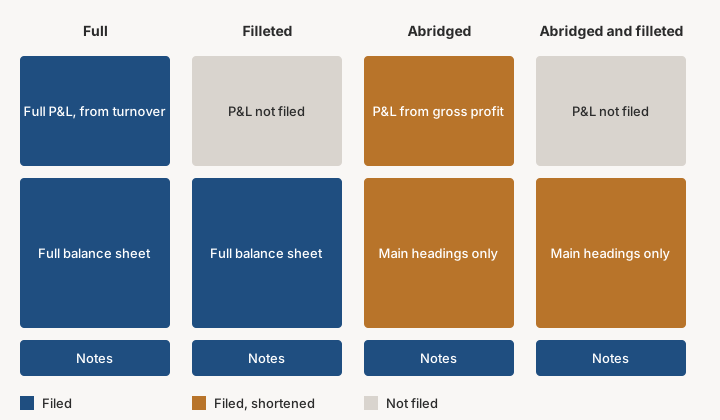
A UK company in the small companies regime can put less on the public record than its full accounts in two ways. Abridged accounts are prepared in shortened formats and need every member's consent, each year. Filleted accounts are the company's full accounts with the profit and loss account (and, if the directors choose, the directors' report) left out of what is filed at Companies House; they need no consent. A company can do both. Both are open today, and the government's stated position is that both continue after 1 April 2028.
The table further down compares the five ways a small company can file, from full accounts to micro-entity accounts: who must agree, what the register shows and what the auditor's report does. For the wider picture of what the board answers for, see the guide to company director responsibilities.
What are abridged accounts?
Abridged accounts are small-company accounts drawn up in shortened formats: the balance sheet shows only the main headings, and the profit and loss account starts at gross profit, so turnover and cost of sales are not shown. They are allowed by paragraph 1A of Schedule 1 to the Small Companies and Groups (Accounts and Directors' Report) Regulations 2008 (SI 2008/409), where appropriate to the circumstances of the company's business, and only if all the members consent. A company can abridge the balance sheet, the profit and loss account or both.
The two shortened statements work like this:
- The balance sheet. Using one of the standard formats, the directors show only the items marked with letters and Roman numerals: fixed assets, current assets, creditors and so on, without the Arabic-numbered lines beneath them. Debtors and creditors must still be split between amounts falling due within one year and after more than one year, because note (5) to the formats (and note (10) for format 2) still applies (paragraph 1A(1)).
- The profit and loss account. Turnover, cost of sales, gross profit or loss and other operating income are combined into one line, "Gross profit or loss" (items 1, 2, 3 and 6 of format 1, or items 1 to 5 of format 2: paragraph 1A(2)). Every other line is shown as usual.
These accounts are not a separate filing version. They are the accounts the company prepares and sends to its members, so the members receive the shortened statements too. A copy filed at Companies House must be a copy of those annual accounts (s444(3)).
Shortened statements do not mean shorter notes. A company using FRS 102 Section 1A may need to add detail in the notes to keep the accounts true and fair; the guide to FRS 102 1A disclosure requirements covers what goes in them.
Abridged accounts replaced abbreviated accounts, a filing-only version that ended for financial years beginning on or after 1 January 2016 (or a year beginning in 2015, if the directors chose): SI 2015/980 removed them from s444 (regulation 8, with its dates in regulation 2).
What are filleted accounts?
Filleted accounts are not a different set of accounts. The company prepares its full small-company accounts for its members, then files at Companies House only the balance sheet and the notes to it, leaving out the profit and loss account and, if it chooses, the directors' report. Companies Act 2006 s444(1) requires only the balance sheet; the other two are optional. No member consent is needed.
What the filed copy must carry:
- a statement, in a prominent position on the balance sheet, that the accounts have been delivered under the provisions for companies subject to the small companies regime (s444(5));
- a statement that the profit and loss account has not been delivered (s444(5A)(a));
- the name of the director who signed the balance sheet for the board (s444(6)).
"Filleting" is the informal name for this choice; the Act does not use the word, but the government's announcement of 23 October 2026 uses it ("remove, or 'fillet', their profit and loss information").
A company can abridge and fillet at the same time: it prepares the shortened formats with every member's consent, and files only the shortened balance sheet and notes. The register then shows the least a small company outside the micro-entity rules can show.
Can you still file abridged or filleted accounts?
Yes. Both are allowed under the Companies Act 2006 as it stands, and on 23 October 2026 the government said it "will continue to allow companies to file abridged accounts and retain the option for smaller companies to remove, or 'fillet', their profit and loss information from the accounts filed at Companies House after 1 April 2028" (GOV.UK). Neither has been abolished.
The law and the policy are worth keeping apart, because they could move separately:
- The law. The Economic Crime and Corporate Transparency Act 2023 contains the changes that would end both options: section 58 omits paragraph 1A (abridged accounts), section 54 substitutes a new s444 under which small companies must file their profit and loss account and directors' report, and section 53 adds a new s443A under which a micro-entity must file its annual accounts. These sections are in force only so far as they give power to make regulations (s219(2)(b)); the rest of each needs commencement regulations, and none of the seven sets made up to Commencement No. 7 in 2026 covers them (checked on legislation.gov.uk, 8 November 2026).
- The policy. The government has paused the requirement for small companies and micro-entities to file a profit and loss account from April 2028, which is why abridging and filleting stay. The announcement gives no end date for the pause.
Today, Companies House's online accounts service asks which type of accounts you have prepared and lists abridged, full and micro-entity accounts; filleted is not listed as a type of its own. From 1 April 2028 accounts can be filed only in iXBRL through commercial software, and Companies House closes its web and paper accounts filing. The same announcement lists other April 2028 changes, including a stronger eligibility statement for companies claiming audit exemption. The guide to Companies House accounts filing changes tracks every measure and its status.
Abridged vs filleted accounts: the five filing options compared
The difference between abridged and filleted accounts is where the cut happens. Abridging shortens the accounts themselves, for the members as well as the register, and needs every member's consent. Filleting leaves the accounts whole and files less of them, and needs no consent.
| Full small-company accounts | Filleted | Abridged | Abridged and filleted | Micro-entity (filleted) | |
|---|---|---|---|---|---|
| Who can use it | Any company in the small companies regime | Same | Same, except a company preparing IAS accounts or one that was a charity at any time in the year | Same as abridged | A micro-entity using the micro-entity provisions |
| Who must agree | The board | The board | The board and every member, for that financial year | The board and every member, for that financial year | The board |
| What members receive | Full accounts | Full accounts | Abridged accounts | Abridged accounts | Micro-entity accounts |
| Filed at Companies House | Balance sheet, P&L, notes; directors' report optional | Balance sheet and notes; directors' report optional | Abridged balance sheet, abridged P&L, notes; directors' report optional | Abridged balance sheet and notes; directors' report optional | Balance sheet, with less information than a small company's |
| Register shows turnover? | Yes | No | No | No | No |
| Register shows profit for the year? | Yes | No | Yes | No | No |
| Statements on the filed balance sheet | Signing director (s444(6)); plus s444(5)(b) statement if no directors' report | Small companies regime (s444(5)); P&L not delivered (s444(5A)(a)); signing director | Members' consent (s444(2A)); signing director; plus s444(5)(b) statement if no directors' report | Small companies regime; P&L not delivered; members' consent; signing director | Small companies regime (s444(5)); signing director; no P&L-not-delivered statement (s444(5C)) |
| Auditor's report, if audited | Filed (s444(2)) | Need not be filed; notes give its details (s444(5A)(b), (5B)) | Filed (s444(2)) | Need not be filed; notes give its details | Need not be filed; notes need not give its details (s444(5C)) |
| After 1 April 2028 | Continues | Continues (government, 23 Oct 2026) | Continues (government, 23 Oct 2026) | Continues (government, 23 Oct 2026) | P&L filing requirement paused (government, 23 Oct 2026) |
Position at 8 November 2026. Sources: Companies Act 2006 s444; SI 2008/409 Sch 1 para 1A; GOV.UK news, 23 October 2026. "Continues" is the government's stated position, not a statutory guarantee: ECCTA 2023 ss53, 54 and 58 are on the statute book but not in force, apart from regulation-making powers. Every balance sheet also carries the s414(3) statement above the director's signature. A company that is exempt from audit also puts the audit-exemption statements on its balance sheet, whichever option it uses. The abridged columns assume both statements are abridged. The two are separate choices under paragraph 1A: a company that abridges only its balance sheet and files its profit and loss account in full still shows turnover.
Two rows decide most choices. If the aim is to keep turnover and profit off the register, filleting does it without asking anyone. Abridging both statements hides turnover and cost of sales but, filed on its own, still shows the profit for the year, and it needs unanimous consent.
Who can file abridged or filleted accounts?
Only a company subject to the small companies regime for the financial year. In broad terms that is a company meeting at least two of these for financial years beginning on or after 6 April 2025: turnover of not more than £15 million, a balance sheet total of not more than £7.5 million, and not more than 50 employees (s382). The tests, the two-year rule and the older limits are in the guide to UK company size thresholds.
Meeting the size tests is not enough on its own. Section 384 keeps a company out of the small companies regime if, at any time in the financial year, it was a public company, an authorised insurance company, a banking company, an e-money issuer, a MiFID investment firm or a UCITS management company, carried on insurance market activity, was a Master Trust scheme funder, or was a member of an ineligible group (s384). A company excluded in this way cannot use either option, however small it is.
Three further limits:
- Charities cannot abridge. Paragraph 1A does not apply to a year in which the company was a charity at any time (paragraph 1A(4)).
- IAS accounts cannot be abridged. Paragraph 1A sits in the schedule for Companies Act accounts, and a small company preparing UK-adopted IAS accounts must deliver a full balance sheet (Companies House guidance).
- Medium-sized and large companies file in full. A medium-sized company delivers its full annual accounts, strategic report, directors' report and any auditor's report (s445).
Members' consent for abridged accounts
Every member must agree, not a majority. Paragraph 1A says consent "may only be given as regards the preparation of" the balance sheet or profit and loss account "in respect of the preceding financial year". The regulations do not say what that year precedes. The natural reading, which this guide follows, is the financial year before the consent is given: consent comes after the year end, for one year, and is needed again the next year. Neither the regulations nor Companies House's guidance spells that out, so a company relying on consent given at any other time should take advice. For a company with one shareholder who is also the director, this is a formality; for a company with several shareholders, it is a real condition.
How it works in practice:
- After the year end and before the shortened accounts are drawn up, the directors ask every member to consent to abridging the accounts for the financial year just ended. The regulations prescribe no form; consent in writing, signed by each member, gives the directors evidence for the statement in step 3.
- The directors keep the signed consents with the company's records.
- The filed accounts carry a statement by the company that all the members have consented to the abridgement (s444(2A)). Companies House's guidance puts it on the balance sheet.
An illustration of the wording a consent might use (not prescribed wording, and not advice on your company's documents):
We, being all the members of [company name] Limited, consent to the company's directors drawing up an abridged balance sheet and an abridged profit and loss account for the financial year ended [date], under paragraph 1A of Schedule 1 to the Small Companies and Groups (Accounts and Directors' Report) Regulations 2008.
If one member refuses, the company cannot abridge for that year. It prepares full small-company accounts, and can still fillet them at Companies House, which needs no consent. A refusing member also receives the full accounts, because every member is sent a copy of the annual accounts (s423).
If your company is audited: the audit report and filleted accounts
The auditor's report does not have to be filed with filleted accounts; the notes to the filed balance sheet give its details instead.
Small companies can usually claim exemption from audit (the guide to audit exemption thresholds sets out when), but some are audited anyway: because a lender, investor or parent asks for it, because the members require it, or because the company is in a group that is not exempt. Both options remain open to an audited small company, with these effects on the auditor's report.
- If the accounts are abridged, they are audited in that form. The auditor reports on the annual accounts the directors prepare for the members, so if the members have consented to abridged statements, the audit covers those statements. Abridging changes the formats, not the audit. Unaudited abridged accounts follow the same consent and filing rules, with the audit-exemption statements on the balance sheet (s475).
- If the profit and loss account is filed, the auditor's report is filed with it (s444(2)). The filed report names the auditor and, for a firm, the senior statutory auditor who signed it, unless the conditions in s506 for omitting names are met (s444(7)).
- If the accounts are filleted, the auditor's report need not be filed. Instead, the notes to the filed balance sheet must state whether the report was qualified or unqualified; if qualified, the basis of the qualification; if unqualified, any matter the auditor drew attention to by way of emphasis; and the auditor's name and the senior statutory auditor's name, unless the conditions in s506 for omitting names are met (s444(5A)(b) and (5B)).
- Micro-entity accounts are outside the notes rule. Subsection (5A) does not apply to a company preparing micro-entity accounts (s444(5C)).
If you would rather spend year end on the accounts than on chasing documents, Innate offers statutory audits signed by an ICAEW-registered partner firm, which your company appoints as its auditor, while our platform finds the documents and reconciles the numbers: see how it works.
What can someone see on the register, and what does HMRC get?
Anyone can look up a company's filed accounts on the Companies House register. With filleted accounts they see the balance sheet and its notes, but not turnover, gross profit or the profit for the year. With accounts abridged in both statements and not filleted, they see the profit for the year but not turnover or cost of sales, and the balance sheet only at its main headings. HMRC gets the company's statutory accounts with its Company Tax Return, whatever is filed at Companies House.
Can someone work out the profit from filleted accounts? Not exactly. Two consecutive balance sheets show how much the company's reserves moved in the year, and a reader can use that as a rough guide. But the movement is mainly the profit after tax less any dividends paid, and the dividends are not on the filed balance sheet, so the figure is an estimate at best.
HMRC is a different matter. Whatever the company files at Companies House, it sends its statutory accounts to its members and to HMRC as part of its Company Tax Return (GOV.UK). HMRC's manual says it requires the full accounts as prepared for the members, not the filleted copy (CTM93180), so filleting changes only what the public register shows. Abridging shortens the accounts the members receive as well as the filed copy. On the same logic those are what goes to HMRC, but the manual does not deal with abridging.
Micro-entity, abridged or full accounts: which should you file?
If the company qualifies as a micro-entity and the directors use those provisions, micro-entity accounts show the least. Otherwise, filleting keeps trading figures off the register with no consent; abridging also cuts the balance sheet to its main headings, but needs every member's consent and shortens the members' accounts too; and full accounts suit a company whose lender, customer or investor expects to find the profit and loss account on the register.
The directors decide what to prepare and file, within the law: they need every member's consent to abridge, and nobody's to fillet. The choice usually comes down to three questions.
- Does the company qualify as a micro-entity? If it does and the directors use the micro-entity provisions (FRS 105), the accounts are already the shortest a company can prepare, and filing only the balance sheet shows the least of any option. What micro-entity accounts leave out, and what they cost you in accounting choices, is in the guide to FRS 105 vs FRS 102.
- Is the aim to keep trading figures off the register? Filleting does that for any small company, with no consent, and the members still get full accounts.
- Do the members want shorter accounts too? Abridging gives them that, and needs all of them to agree, every year.
Whichever option the company uses, the accounts still have to be prepared and filed on time, and from 1 April 2028 filed through commercial software.
Change log
| Date | Change |
|---|---|
| 8 November 2026 | First published. Position: abridged and filleted accounts can be filed; the government said on 23 October 2026 both continue after 1 April 2028, having paused the requirement for small companies and micro-entities to file a profit and loss account; ECCTA 2023 ss53, 54 and 58 not in force except for regulation-making powers. |