Segregation of duties in a small business: who does what when there are three of you in finance
By Alon Zieve FCA · Last reviewed
This guide is for the finance director, or the director who owns finance, of a UK company with one to four people in finance. The short answer on segregation of duties in a small business (also called separation of duties): no one person should both move money and record it, or both approve a transaction and record it. A team of two or three gets most of the way there by using a director outside finance as the second pair of hands in the bank, and by giving the review of reconciliations to someone outside the payment process. Where you still cannot separate, put compensating controls round the gap and keep the evidence: the auditor tests what is evidenced, not what is said. This is one of our guides for finance teams.
What is segregation of duties, and what is it designed to prevent?
It splits four functions between different people: authorising a transaction, having custody of the asset (the bank mandate, the cash, the stock), recording it in the ledger, and reconciling or reviewing the result. One person should not hold two of them for the same transaction where the pair would let them both cause and conceal an error or a fraud; Table 1 lists the eight pairings that matter. It is designed so that one person's error, or fraud, cannot pass unseen.
Why four and not three? The auditing standard's own description names three: different people authorising, recording and keeping custody, to reduce the opportunity for anyone to both commit and conceal an error or a fraud in the ordinary course of their duties (ISA (UK) 315 (Revised July 2020), Appendix 3). Review is the fourth, and the one a small team can most easily give away: reading a bank statement or a journal listing needs no ledger access. The worst pairing is custody with recording: whoever can move the money can also write the entry that hides it.
Is it an internal control? Yes, one control activity among several (para A153), and one of a minimum set of internal controls for a small business; the standard also says it may be less practicable in less complex entities with fewer employees (para A157), which is where this guide starts.
Why a small finance team is the most exposed, and whose problem it is
The exposure comes from headcount, not negligence: with three people, whoever sets up a supplier may also pay it, and whoever posts the journals may also prepare the accounts they change. Trust is not a control, because a control is something another person can see operating. In my years as a CFO, the control that caught most was the simplest: a bank statement read line by line by someone who had not made the payments.
Whose problem is it? The primary responsibility for preventing and detecting fraud rests with management and those charged with governance (ISA (UK) 240 (Revised May 2021) para 4); the auditor's responsibility is reasonable assurance that the financial statements as a whole are not materially misstated, whether by fraud or error (para 5). Company law frames it: every company must keep adequate accounting records, sufficient to show and explain its transactions and to disclose its financial position with reasonable accuracy at any time (Companies Act 2006 s386); if it does not, every officer in default commits an offence (s387(1)), with a defence for one who acted honestly and whose default was excusable in the circumstances (s387(2)). Each director must exercise reasonable care, skill and diligence (s174) and act in the way they consider, in good faith, most likely to promote the company's success for the benefit of its members as a whole (s172); the wider list is in UK company director responsibilities.
Is separating duties a legal requirement in the UK?
Nothing in the Companies Act requires a private company to separate duties: it requires adequate records (s386) and sets the directors' duties; how the finance team meets them is the board's decision. A regulated business should also check its sector's rules. The UK Corporate Governance Code, whose Provision 29 asks boards to declare on the effectiveness of their material internal controls for financial years beginning on or after 1 January 2026, applies to companies listed in the commercial companies or closed-ended investment funds categories, and the FRC says it does not apply to private companies. The failure to prevent fraud offence (Economic Crime and Corporate Transparency Act 2023 s199, in force since 1 September 2025) reaches only a large organisation: two of turnover above £36 million, balance sheet total above £18 million and more than 250 employees in the previous financial year (s201). A small stand-alone company is outside it; a subsidiary whose parent group is large is not (s199(2), with the group's figures aggregated under s202).
Segregation of duties examples: the eight pairings to keep apart
The clearest examples are pairings: two duties that, held by one person, let an error or a theft pass unseen. Table 1 lists the eight that matter in a small UK company.
| Process | The pairing one person should not hold | What goes wrong if they do |
|---|---|---|
| Suppliers | Setting up a supplier or changing its bank details, and paying it | A fictitious supplier, or payments diverted |
| Purchases | Raising or approving a purchase, and releasing the payment | Private purchases paid without a second look |
| Payments | Releasing payments, and reconciling the bank | A duplicate or diverted payment hidden by a matching entry |
| Sales and cash | Raising invoices and credit notes, and allocating cash | A credit note that covers a receipt that was taken |
| Payroll | Changing standing data, and running payroll or approving the register | A ghost employee, or a pay rise nobody authorised |
| Journals | Posting manual journals, and reviewing the accounts they change | A journal that moves a loss out of sight |
| Expenses | Submitting expenses, and approving them | Self-approved claims |
| Systems | Administering user permissions, and doing any of the above | An administrator who can grant themselves every duty |
Table 1: the pairings, and the loss each lets through.
Segregation of duties for a small business: who does what with two, three and four people
The hands, by code: F1 the finance lead (FD or financial controller); F2 a second finance person; F3 a third; D a director outside finance (owner-manager, chief executive, a non-executive) with bank authority but no ledger access; X an external bookkeeper, where used. Each cell of Table 2 reads: initiates · approves or releases · records · reviews.
| Process | Two people (F1 + D) | Three people (F1 + F2 + D) | Four people (F1 + F2 + F3 + D) |
|---|---|---|---|
| Supplier set-up and bank-detail changes | F1 · D, after a call-back · F1 · D | F2 · F1, after a call-back · F2 · D | F2 · F1, after F3's call-back · F3 · D |
| Purchase orders and supplier invoices | F1 · D · F1 · D | F2 · F1 (D above the bank limit) · F2 · F1 | F3 · F1 · F2 · F1 |
| Payment runs | F1 · D, every payment · F1 · D | F2 · D, never F1 alone · F2 · F1 | F2 · D, with F1 above the limit · F2 · F1 |
| Bank reconciliation | F1 · – · F1 · D | F2 · – · F2 · F1 | F3 · – · F3 · F1 |
| Sales invoices, credit notes, cash receipts | F1 · D, credit notes · F1 · D | F2 · F1, credit notes · F2 · F1 | F3 · F1, credit notes · F2 · F1 |
| Payroll: standing data and the run | F1 · D, the register · F1 · D | F1 · D, the register · F2 · F1 | F1 · D, the register · F2 · F3 |
| Manual journals | F1 · – · F1 · D | F2 · F1 · F2 · D | F2 · F1 · F2 · D |
| Staff expenses | each · the other · F1 · D | F2, F1 · F1 for F2's, D for F1's · F2 · F1 | all · F1 for staff, D for F1's · F3 · F1 |
Table 2: a starting split by headcount.
What the reviewer reads: D, when approving or reviewing, the monthly listing of supplier changes, the bank statement line by line, the payroll register against last month and the HR changes, the monthly journal listing (F1's own journals included) and the expenses total; F1, aged creditors and debtors, the bank reconciliation and the payment run against the bank. With two people, F1 both prepares and posts the journals with no approver before posting, so D's reading of the listing is the compensating control and the gap is logged as an exception. System administration (user permissions) is the ninth row in every column: someone who neither posts nor pays, or the external accountant, never F1 alone.
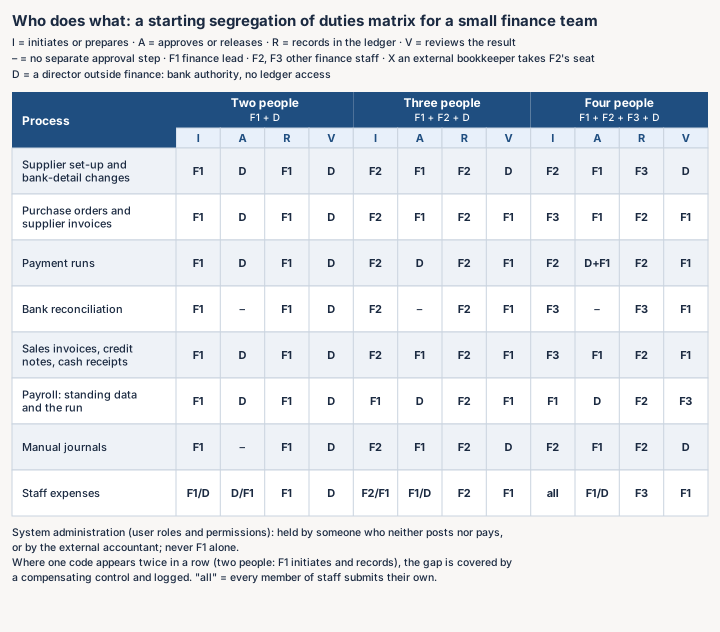
The rule of thumb: with two people, D releases every payment and reads the bank statement, and initiating and recording sit together with D's review and the exception log round them. With three, F1 never records and never releases alone. With four, payroll separates fully, payments have a releaser, a recorder and a reviewer who are three different people, and every journal has a reviewer who did not post it.
What are the compensating controls when you cannot segregate duties?
A compensating control is a different control that catches what the missing separation would have prevented: a second person reading the output, where there cannot be a second person in the process. It counts only if it operates every time and leaves evidence someone else can inspect later; a check that happens "usually" and leaves nothing is not a control.
| Control | The gap it covers | The evidence it leaves | What the auditor can do with it |
|---|---|---|---|
| Dual authorisation in the bank mandate above a limit, D as a releaser | The preparer of the run could also release it | The bank's approval record: user, amount, time | Inspect; re-perform against the payments |
| Bank statement and payment listing read monthly, line by line, by someone outside finance, initialled and dated | The payer also records and reconciles | The initialled statement, queries noted | Inspect; ask what was queried |
| A director's view-only access to the bank and the ledger | No independent eye on cash between month ends | The login history and the director's note | Inspect; little without the note |
| Supplier bank-detail changes confirmed by a call-back to a number already on file, never the one on the request | Set-up and payment in one pair of hands | A note on the change form: who, which number, when | Inspect; re-perform on a change |
| Manual journals above a limit approved by someone who did not post them; a monthly listing of all journals read and initialled | The poster also prepares the accounts | The approval; the initialled listing | Inspect; re-perform |
| Payroll register compared with last month and the HR change list by someone outside payroll | Standing-data changes and the run in one pair of hands | The comparison, differences explained, initialled | Inspect; re-perform |
| An exception log for every month one person covered two functions | Any gap, while it is temporary | Owner · reason · period · what was reviewed · by whom · where the evidence is | Inspect; follow it to the evidence |
| Mandatory continuous leave, someone else doing the job meanwhile | Concealment that needs daily attention | The leave record and the cover's notes | Inspect; ask the cover |
| Announced-but-unscheduled checks by a director, from a written list, written up each time | Any process the director rarely sees | A dated note of what was checked and found | Inspect; nothing without the note |
Table 3: compensating controls, ranked by the evidence they leave.
Controls over journal entries are among the controls the auditor must identify (ISA (UK) 315 para 26(a)(ii)), and the standard expects them to be identified on every audit (para A160).
One correction to what is often said: compensating controls do not "satisfy" the auditor, who considers your controls to design the audit, not to express an opinion on them (ISA (UK) 265 para 2). They decide how far the auditor can rely on a control and what else the auditor does; that is the auditor's judgement. What you control is whether the evidence exists.
Let the accounting system and the bank do the separating
Most of the split can be built into the systems rather than remembered.
- Roles by task, not seniority. Each user gets the rights their tasks need and nothing more, and uses their own log-in: ISA (UK) 315 lists both among the general IT controls over access (Appendix 6). A shared login proves nothing about who did what.
- Administrator rights away from the ledger. Whoever creates users and changes permissions should neither post nor pay, or should be the external accountant; review the user list whenever anyone joins, leaves or changes job.
- Approval workflows switched on. Whether you use Xero, Sage, QuickBooks or another package, if it can hold a bill or a payment run until a named approver has released it, switch that on.
- The audit trail on, and read. Changes to supplier bank details, edited invoices and deleted transactions sit in a history someone reads monthly.
- Emergency access logged and withdrawn. If F1 must be given a right for a day, note why, and take it back.
On the bank side: two to release above a limit, a daily payment limit, alerts to the director's phone, and a view-only login for the director, so reading the statement needs no password that can pay. An AI or automation tool with posting rights is a system user with the same rules as a person, which is where AI in the month-end close starts; who may post is a people decision, as how to use AI in a finance department sets out. The same applies to an outside accountant's tools that post to your ledger; how accountants use AI covers what a practice may do with your data.
A segregation of duties matrix for a small team: one sheet, kept with the close
The matrix takes about an hour to build and is among the first things an auditor, a lender or a new investor asks to see. One row per process; columns for who initiates, approves, records and reviews, the system role each holds, and the exception. Fill it with names, not titles, mark every row where one name appears twice, and for each either move the duty or add a control from Table 3 in the exception column.
Table 2 is a starting matrix: copy it into your own sheet and overwrite the codes with names. Review it at each month-end close, with the month-end close checklist, and whenever anyone joins, leaves or is promoted: the split that worked in March is broken by a resignation in April. The preparer and reviewer columns in the management accounts pack are the same idea applied to the pack. Keep it with the close file, beside the month's evidence.
What will your auditor look at, and what happens if duties are not separated?
The auditor must obtain an understanding of your control activities when assessing the risks of misstatement (ISA (UK) 315 para 26), and in a small company that means asking who can do what, whether an owner-manager's direct oversight compensates for the limited split, and whether one person's dominance creates an opportunity to override controls (para A157). What the auditor then does with a gap is the auditor's judgement: how far to rely on a control, and what else to do.
A gap can become a finding. A deficiency exists when a control cannot prevent, or detect and correct, misstatements in time, or a necessary control is missing; a significant deficiency is one the auditor judges important enough for those charged with governance (ISA (UK) 265 para 6). Significant deficiencies go in writing to those charged with governance (para 9) and to management (para 10(a)), with a description of each and an explanation of its potential effects (para 11(a)); other deficiencies that merit management's attention go to management (para 10(b)). A point repeated in the auditor's control findings year after year is itself the finding. What closes a finding is the control and its evidence.
The fraud standard changes for periods beginning on or after 15 December 2026: a 31 December 2027 year end, not a 31 December 2026 one. Under ISA (UK) 240 (Revised March 2026) the auditor's understanding of your information system must include how journal entries and other adjustments are initiated, processed, recorded and corrected (para 35), and the auditor must obtain evidence about the completeness of the population of journals and other adjustments made throughout the period (para 49(b)). "Who can post and approve journals" is already asked on every audit (ISA (UK) 315 para 26(a)(ii)); the revised standard asks for the evidence behind the answer, and the year-end audit checklist puts it on the request list.
A month, worked through. The FD (F1), the controller (F2), the assistant (F3) and a director outside finance. In the close file: the weekly payment-run listings showing the director's release and the FD's second approval above the limit; the bank statement initialled by the director; the monthly journal listing initialled by the director, with the FD's approval on the journals; the assistant's comparison of the payroll register with last month and the HR change list; a dated note that the matrix was reviewed. One exception: the controller was on leave in the second week, so the assistant ran payroll and posted it, and could not also be its reviewer. The log entry: owner, the assistant; reason, the controller's leave; period, the second week's payroll; what was reviewed, the register against last month and the HR change list, by the FD, before the director approved it; where filed, the close file. The gap, the compensating control that covered it, and where the auditor can find both.
If you want an audit where software does the legwork and people make the judgements, Innate offers statutory audits signed by an ICAEW-registered partner firm, which your company appoints as its auditor: find out more.
Questions finance directors ask
Can a director who is not in finance be the second approver?
Yes, and it is the commonest small-company pattern: the director holds bank authority, releases payments, reads the statement and approves the payroll register. Two conditions: the director reads what they approve, against the invoices or the register; and holds no ledger access, or the second pair of hands is the first pair again.
Does an external bookkeeper or accountant count as a separate pair of hands?
Yes, for recording or for review, if the engagement letter says which and they are not also releasing payments. An external bookkeeper who posts, reconciles and holds bank authority is the one-person gap moved outside the building. The auditor may ask to see their work, so keep it with the close file.
What if the finance team is one person?
The director takes authorisation and the statement review, the one person never releases a payment alone, and the matrix shows every row where their name appears twice, each with its covering control. The director's monthly reading of the statement, the journal listing and the payroll register is the control the auditor will test.
Does owner review on its own count?
Only if it is done every month, leaves evidence, and the owner is not the person it is there to catch: an owner-manager's oversight may compensate for limited separation, but domination by one individual can itself be a deficiency (ISA (UK) 315 para A157).