How do accountants use AI? A UK practice's guide to the uses, the rules and client data
By Alon Zieve FCA · Last reviewed
How do accountants use AI? Mostly to read, sort and draft. UK practices use it to automate data entry and bank reconciliation, read invoices and receipts, draft emails and letters, summarise documents, transcribe meetings and produce first drafts of tax research. The accountant should check every output, because the professional duties stay with the practice whatever produced the draft. That applies to every UK practice; firms registered for audit have extra rules. This guide to AI for accountants in the UK covers the uses service by service, the rules that apply, client data, what to tell clients, and where to start.
How do accountants use AI? The short answer
Accountants mostly use AI in two forms: features built into the bookkeeping, tax and practice software they already pay for, and a general-purpose assistant such as ChatGPT or Microsoft Copilot. Both are good at reading and drafting. Neither is reliably right without a check.
The professional bodies say so in their own terms. For tax work, the guidance the seven Professional Conduct in Relation to Taxation (PCRT) bodies published on 19 January 2026 says AI outputs "should not be used as authoritative tax or legal advice" and should be treated "as if it were prepared by a less experienced junior colleague". Members are "ultimately responsible for any work they produce", and regulated firms for the work the firm prepares, "irrespective of the use of AI tools in its creation".
So an AI tool has no professional status, and nothing about the work moves to it. For a company client, the directors still approve the annual accounts and a director signs the balance sheet (Companies Act 2006 s414). This guide is one of a set on AI in auditing and finance.
How many UK accountants use AI?
We found no official count. The most detailed recent UK survey we found was run by AccountingWEB in association with Sage, a software vendor: late in 2025 it surveyed over 600 AccountingWEB members in practice and business, publishing in February 2026. It is a survey of one publication's members, not a representative sample, but the pattern is plain: use is widespread and transformation is rare.
- 71% use external AI tools such as ChatGPT or Microsoft Copilot for work, most often for researching tax legislation (59%), drafting emails (59%) and summarising financial data (54%).
- 66% believe their core accounting software already incorporates AI; a further 14% are not sure.
- 53% report minimal or moderate benefits; 7% a "transformational impact".
- Data security (62%) tops the implementation challenges, and accuracy and hallucinations are the largest single concern (29%).
The second point matters most. The duties below apply to AI inside your software whether or not anyone chose to switch it on, so the first job is to find out what is there.
How accounting firms use AI varies with what they can build. ICAEW's regulatory team notes that some firms "have their own AI platforms, which keep all data within the firm"; most survey respondents used a general assistant. The rules are the same either way.
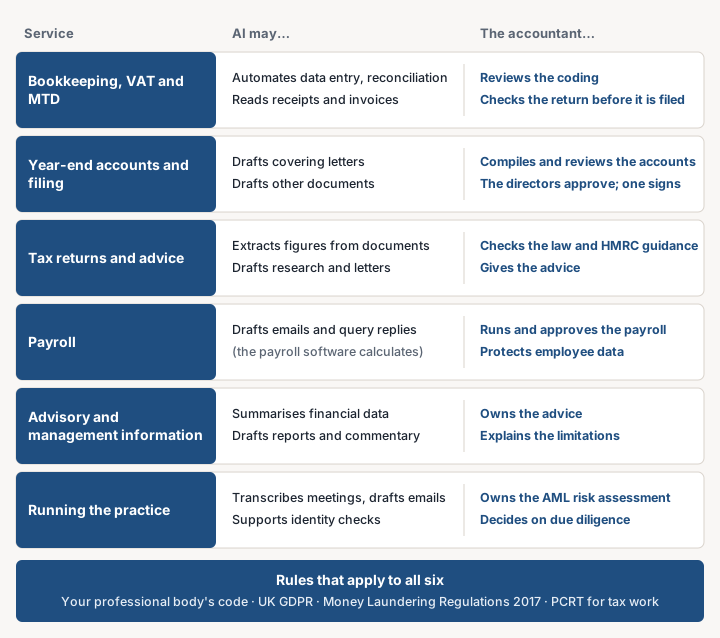
How is AI used in accounting? Service by service
How AI is used in accounting differs by service line, and so does the rule that bites hardest.
| Service | What practices use AI for | What the accountant still does | Rule or guidance that applies |
|---|---|---|---|
| Bookkeeping, VAT and MTD | Automating data entry and bank reconciliation; reading receipts and invoices | Reviews the coding; checks the return before it is filed | Professional body's code (competence); HMRC's Making Tax Digital rules |
| Year-end accounts and filing | Drafting covering letters and other documents | Compiles and reviews the accounts; the directors approve them | Companies Act 2006 s414; ICAEW TECH 07/16 AAF (ICAEW members) |
| Tax returns and advice | Extracting figures from documents; first-draft research and letters | Checks against legislation and HMRC guidance; gives the advice | PCRT and its AI guidance (January 2026) |
| Payroll | Drafting emails and replies to queries (the payroll software calculates) | Runs and approves the payroll and its reports to HMRC | UK GDPR (employee data); HMRC payroll reporting |
| Advisory and management information | Summarising financial data; drafting reports and commentary | Owns the assumptions and the advice; explains the limitations | Professional body's code (competence) |
| Running the practice, including AML | Meeting notes and emails; supporting identity checks and risk analysis | Risk assessment and due diligence decisions | Money Laundering Regulations 2017; UK GDPR |
Bookkeeping, VAT and Making Tax Digital
In bookkeeping, the common uses are automating repetitive work and reading documents. In the AccountingWEB survey, 45% cited AI or machine learning for automating repetitive tasks such as invoice processing or bank reconciliation, and 39% AI-powered document processing, which extracts and categorises data from documents such as receipts and invoices.
The route to HMRC is digital. GOV.UK says all VAT-registered businesses should be signed up for Making Tax Digital for VAT and must use compatible software to keep records and file returns. From 6 April 2026, Making Tax Digital for Income Tax applies to sole traders and landlords with annual income from self-employment and property over £50,000, unless exempt. AI can suggest the code; a wrong code nobody reviewed becomes a wrong return, so the preparer should review the coding before it goes. For a company's own close, see AI for the month-end close.
Year-end accounts and filing
AI features in accounts software, and general assistants, can draft covering letters and other documents for the accountant to edit. None of it changes who is responsible: the directors approve the accounts (s414), and the compilation is the practice's work. ICAEW's technical release TECH 07/16 AAF guides ICAEW members in practice who compile financial statements for clients.
Filing is moving to software too. Companies House says that from 1 April 2028 accounts can be filed only using commercial software, with paper and WebFiling ending; see Companies House accounts filing changes.
Tax returns and tax advice
The PCRT guidance lists the uses itself: collating client data and identifying what matters for filing, from investment portfolios and pension reports to cryptocurrency transactions; drafting reports on a client's position; and research into legislation, case law and guidance.
It is equally direct about the failure. AI tools "are known to 'hallucinate'", presenting inaccurate content as fact, and the guidance cites Harber v HMRC [2023] UKFTT 1007 (TC). Its safeguards: confirm that any case or legislation in the output exists, and check the advice against current legislation, because an outdated model gives outdated advice.
Payroll
The calculation stays in the payroll software, which GOV.UK tells employers to use to record pay, calculate deductions and send a Full Payment Submission to HMRC on or before payday. General AI tools can help around it, for example by drafting emails and replies to queries. The risk is the data: payroll holds personal data on every employee, and sickness records are data concerning health, which is special category data (UK GDPR Article 9).
Advisory and management information
Summarising financial data is a common use: 54% of the survey's external-tool users did it. The ICAEW Code requires accountants, where appropriate, to make clients aware of the limitations of their work (R113.3). A forecast drafted with AI help still rests on assumptions the client and adviser own, so label drafts as drafts and say what the figures rest on.
Running the practice
Transcription and email drafting are the low-risk end, on a tool the practice has approved. A transcript is usually personal data of the people on the call, so the privacy information should cover it.
Anti-money laundering is the high-stakes end. External accountants and tax advisers are relevant persons under the Money Laundering Regulations 2017 (regs 8 and 11). The PCRT guidance notes that AI can support identifying and verifying clients and risk analysis, and reg 28(19) lets an electronic identification process that is secure from fraud and misuse, and gives the necessary assurance, count as a reliable, independent source. But the practice must still assess its own risks and keep a written record unless its supervisor says it need not (reg 18), and verify each customer's identity (reg 28). A tool gathers evidence; the decisions stay with the practice.
AI for accountants in the UK: the rules that apply
There is no UK law written specifically for accountants' use of AI. The existing duties apply to AI-assisted work, and the professional bodies have said so. Two of those duties are covered elsewhere on this page: client personal data in an AI tool is a UK GDPR question first, covered in the next section; and for anti-money laundering, tools support due diligence while the obligations under regs 18 and 28 stay with the practice (see Running the practice above).
Your professional body's code
The ICAEW Code of Ethics, 2026 edition, applies from 1 July 2026. Three provisions do most of the work:
- Competence (R113.1, R113.2). Keep the knowledge and skills to give a competent service, act diligently, and make sure people working under your authority have appropriate training and supervision.
- Confidentiality (R114.1, 114.1 A1). Respect the confidentiality of client information, and take reasonable steps to make your staff, and those you obtain advice and assistance from, do the same, across the information's "collection, use, transfer, storage or retention".
- Using the output of technology (R320.11, in practice). Before using a technology's output, determine whether the use is appropriate for the purpose, considering how it was tested, the controls over its use and whether its inputs are appropriate.
On 9 November 2026 ICAEW's regulatory team was direct: "We expect firms to have policies addressing the use of generative AI, including the potential risks to confidentiality." ACCA's Code of Ethics and Conduct sets out the same five fundamental principles as the ICAEW Code (110.1 A1): integrity, objectivity, professional competence and due care, confidentiality and professional behaviour.
Tax work: PCRT and its AI guidance
An updated PCRT applies from 1 January 2026, and the ICAEW Code requires members doing any UK tax work to comply with it (R380.24 and 380.27 A1; R280.24 for members in business). The AI guidance reads PCRT's fundamental principles through AI: be transparent with clients and able to explain how a conclusion was reached; know the data sources and the risk of bias; be competent with the tools, train staff and review output with scepticism; protect confidentiality (below); and review AI-drafted correspondence before it goes to HMRC.
Who answers for the work
The accountant answers for the work, and for a company client the directors answer for the accounts (s414). The same holds in audit, where the auditor is a firm, the senior statutory auditor signs "for and on behalf of the auditor" (s503(3)); whether a tool could ever take that role is covered in can AI do an audit.
Can accountants use ChatGPT or Copilot with client data?
Yes, in principle, on a business licence whose terms make the provider your processor and keep your data out of model training, under your policy and using only the data the task needs. Not on a free or personal account: there, ask only anonymised, generic questions. The PCRT guidance says putting client data into publicly available AI tools "is likely to constitute a breach of client confidentiality, unless the client has consented", and that such data should be anonymised so the client cannot be identified.
| Kind of tool | What the provider's terms say (checked 12 November 2026) | What to allow |
|---|---|---|
| Free or personal account (for example ChatGPT Free, Plus or Pro) | OpenAI: "we may use your content to train our models" unless the user opts out. The account is the individual's contract, not the practice's | No client data; anonymised, generic questions only |
| Business licence (ChatGPT Business or Enterprise; Microsoft Copilot used by an organisation) | OpenAI: business data not used for training by default. Microsoft: covered by its Data Protection Addendum "with Microsoft acting as a data processor", data not used to train foundation models; web queries go to Bing, where Microsoft is an independent controller | Client data the task needs, under your policy, once terms and settings are checked |
| AI inside your accounting, tax or practice software | That vendor's terms and data processing agreement | As for that software, once you have read its AI terms: training, data location, sub-processors |
Controller or processor. The ICO's example (in guidance the ICO says is under review after the Data (Use and Access) Act and may be subject to change) is an accountant doing a firm's books: the accountant is a controller for the personal data in the accounts, because of the professional obligations accountants work under. Other services turn on their own facts. As controller, the practice decides what goes into an AI tool, and a business AI provider acting on its instructions under terms like those above is its processor. UK GDPR requires processors "providing sufficient guarantees" (Article 28(1)), a binding contract (Article 28(3)) and security appropriate to the risk (Article 32).
Confidentiality is wider than personal data. The ICAEW Code says the safe approach is to assume "all unpublished information about a client's or employer's affairs" is confidential, so a company's draft results are protected even with no personal data in them.
Training settings. The Code's application material describes firms seeking authorisation from whoever provided confidential information before it is used "in the development of products or technology" (114.3 A3). Turn model training off where you can, and confirm it in the contract.
DPIAs. The ICO's AI guidance, also under review, says that "in the vast majority of cases" AI involves processing likely to result in a high risk, which requires a data protection impact assessment; where you decide a use is not high risk, document why. Payroll data is the obvious candidate.
If it goes wrong. ICAEW says a breach of a firm's AI policy is not automatically reportable to it, but a possible breach of the Code must be assessed against the duty to report misconduct, and the firm must consider telling the client and its UK GDPR duties: a notifiable personal data breach goes to the regulator within 72 hours of becoming aware of it, where feasible.
For a company's own finance team, see how to use AI in a finance department.
What to tell clients about AI, and the engagement letter
Tell clients, in the engagement letter and privacy notice, that AI-enabled software may be used and how their data is protected. No rule we found prescribes the words. The PCRT guidance suggests an engagement letter statement that AI-enabled software may be used, and considering disclosure of actual use when the work is delivered, which helps avoid "misleading a client by omission". UK GDPR requires privacy information to name the recipients, or categories of recipient, of personal data (Articles 13(1)(e) and 14(1)(e)), and an AI provider acting as your processor is one.
What to cover, in your own words:
- the kinds of AI tool used with client data, and the contract behind them;
- whether client data is used to train the provider's models;
- where the data is processed, if outside the UK;
- that a qualified person reviews all work before it is relied on;
- how a client can ask questions or object.
This guide does not offer a clause; your professional body's engagement letter material and your own adviser are the place for wording.
If your practice is registered for audit
The audit work carries extra rules. The Financial Reporting Council has published AI in audit: Illustrative example and documentation guidance (26 June 2025), which is not prescriptive, and its Generative and Agentic AI Guidance (30 March 2026); publishing the second, the FRC said "the human auditor is always accountable". ISQM (UK) 1 sets as a quality objective that appropriate technological resources are obtained or developed, implemented, maintained and used (paragraph 32(f)), and an AI tool is one of them.
For what audit teams use AI for at each stage, see how auditors use AI; for the file, documenting AI tools under the FRC's guidance.
How the Innate platform uses AI sets out what its tools do and do not do. If you are considering AI on your audit files, partner with Innate: the platform takes the hours out of the legwork, your team reviews and judges, and your firm remains the auditor and signs.
How should accountants use AI? Where to start
Start small, with checkable work, and write the rules down before the tools spread:
- Find the AI you already have. List the AI features in your bookkeeping, tax and practice software, read their terms, and switch off what you will not govern.
- Pick one low-risk use with a checkable answer, such as drafting emails or summarising a document you have read.
- Buy business licences and set them up: data processing terms signed, training off, access restricted. No client data in personal accounts.
- Write a short AI policy: approved tools, what data may go where, who reviews output.
- Train staff to check output against sources: every figure to the record, every citation opened and read.
- Update engagement letters and the privacy notice.
- Review after three months, and widen use only where the checks have held.
Whether AI will replace accountants is a separate question this guide does not try to answer; every rule quoted here assumes a person who uses the tool and answers for it. The ICAEW Code expects accountants to keep up with technology-related developments relevant to their work (113.1 A3).
In short: accountants use AI to read, sort and draft, and the practice answers for every word and figure that leaves it.