Month-end close checklist for small finance teams: who does what, day by day
By Alon Zieve FCA · Last reviewed
This guide is for a UK company whose month-end close is run by two or three people: one or two in finance, and a director outside finance who reviews. A month-end close checklist for a small team gives every step a working day, a person who prepares it, a different person who reviews it, and the evidence kept. The close below runs from two working days before month end to sign-off on working day 5, with the management accounts after. Around it sit the UK dates the close feeds: PAYE paid by the 22nd of the next tax month, VAT usually each quarter. Each reconciliation done in the month-end close process is one the year-end audit will not have to wait for. It is one of our guides for finance teams, and what the close feeds is the management accounts pack.
What is the month-end close process, and what must a small team's close produce?
The month-end close is the routine of recording, reconciling, adjusting and reviewing the ledger so the month's figures can be relied on, and then locking the period. For a small UK company it produces a reconciled trial balance, reviewed reconciliations, agreed tax and payroll control accounts, and the management accounts.
The law sets the standard, not the timetable. Every company must keep adequate accounting records, sufficient to show and explain its transactions and to disclose its financial position "with reasonable accuracy, at any time" (Companies Act 2006 s386). No rule says to close monthly, but a company that never reconciles between year ends will struggle to show its position at any time. A private company keeps its accounting records for three years from the date they are made (s388(4)); HMRC's periods are longer (§ 6).
The close is not the board pack, which has its own checks, and it is not the year end, which adds a stock count, the tax computation and the auditor's request list (§ 9).
Who does what when there are three of you
The checklist uses the role codes of our guide to segregation of duties in a small finance team, so the two read as one system:
- F1, the finance lead: the financial controller, or the FD doing that job.
- F2, a second finance person: an assistant or bookkeeper.
- D, a director outside finance who approves payments and has no ledger access.
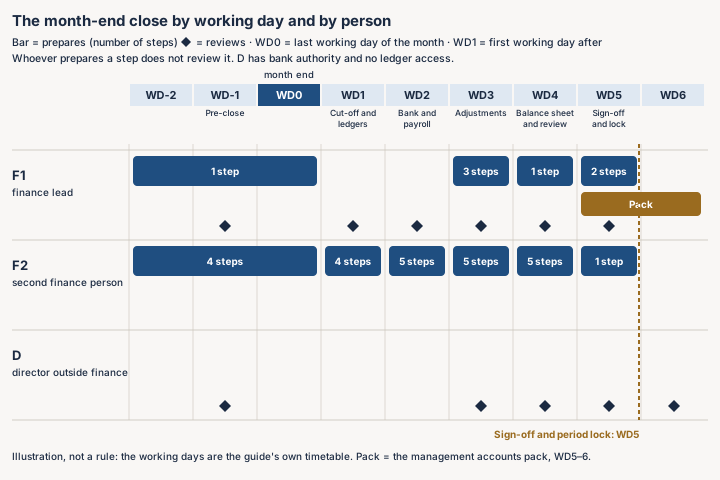
The rule the checklist applies: whoever prepares a step does not review it. F2 prepares most reconciliations and F1 reviews them. F1 prepares the judgemental items, the accruals, the stock adjustment and the journal listing, and D reviews them, so the finance lead's own work is never unreviewed. D also releases the payment run and approves the payroll register.
With two people (F1 and D), F1 prepares every step. D then reviews the bank reconciliation, reads the journal listing and approves the payroll register, and the gaps that remain are logged as exceptions, as the segregation of duties guide describes. An outside bookkeeper or accountant counts as a preparer or a reviewer for a step, never both.
In my years as a CFO, the close that slipped was most often the one where the reviewer was also doing the preparing: the review waited until the preparing was done, and then it was rushed.
The month-end close checklist, working day by working day
The close runs in six blocks from WD-2 to WD5, and each step has an owner, a reviewer and the evidence kept. WD1 is the first working day after month end and WD0 the last working day of the month. The order matters more than the days: bank and ledgers before the adjustments, every reconciliation before the review, the review before the lock. The timetable is an illustration to adapt, not a rule. Table 1 has the 32 steps that run every month; the CSV in § 8 has the same rows.
| # | Working day | Step | Owner role | Reviewer role | Evidence kept |
|---|---|---|---|---|---|
| Pre-close (WD-2 to WD0) | |||||
| 1 | WD-2 | Send the cut-off reminder: last dates for expense claims, purchase orders and sales invoices | F2 | F1 | The reminder, dated |
| 2 | WD-2 | Chase missing supplier invoices and goods received notes | F2 | F1 | List of items chased |
| 3 | WD-1 | Last payment run of the month: F2 prepares, D releases | F2 | D | The bank's release record |
| 4 | WD-1 | Payroll final: D has approved the register, and the FPS went on or before payday | F1 | D | Approved register; FPS receipt |
| 5 | WD0 | Update bank feeds and match transactions to date | F2 | F1 | Unmatched items list |
| Cut-off and ledgers (WD1) | |||||
| 6 | WD1 | Raise every sales invoice for the month; note the last despatch note number | F2 | F1 | Last invoice and despatch numbers |
| 7 | WD1 | Post the supplier invoices received; list goods received not invoiced | F2 | F1 | Goods received not invoiced list |
| 8 | WD1 | Post credit card statements and expense claims (D approves F1's) | F2 | F1 | Statements; approved claims |
| 9 | WD1 | Close the sales and purchase ledgers for the month | F2 | F1 | Aged debtors and creditors at month end |
| Bank and payroll (WD2) | |||||
| 10 | WD2 | Reconcile every bank, card and loan account to its month-end statement, dormant ones too | F2 | F1 | Reconciliation, statement, unreconciled items aged |
| 11 | WD2 | Post the payroll journal from the payroll report | F2 | F1 | Payroll report; journal |
| 12 | WD2 | Reconcile the PAYE and NI, pension and net wages control accounts | F2 | F1 | Reconciliations to the payroll reports, HMRC online account and pension schedule |
| 13 | WD2 | Reconcile CIS deductions to the monthly return and subcontractor statements (if: pays construction subcontractors) | F2 | F1 | Reconciliation; return receipt |
| 14 | WD2 | Reconcile the sales and purchase ledgers to their control accounts; review aged debtors and creditors | F2 | F1 | Reconciliations; aged lists with notes |
| Adjustments (WD3) | |||||
| 15 | WD3 | Accruals from the goods received list and known costs | F1 | D | Accruals schedule with support |
| 16 | WD3 | Release prepayments from the schedule; add new ones | F2 | F1 | Prepayments schedule agreed to the ledger |
| 17 | WD3 | Deferred income released and added | F2 | F1 | Deferred income schedule |
| 18 | WD3 | Depreciation from the fixed asset register; additions and disposals posted | F2 | F1 | Register agreed to the ledger |
| 19 | WD3 | Stock adjustment (if: stock held) | F1 | D | Stock report or count; valuation |
| 20 | WD3 | Reverse last month's accruals, if the system does not | F2 | F1 | Reversals on the journal listing |
| 21 | WD3 | Agree intercompany balances with the other entity (if: group company) | F2 | F1 | The other entity's confirmation |
| 22 | WD3 | Journal listing for the month: every manual journal with its support and approval | F1 | D | Listing initialled by D |
| Balance sheet and review (WD4) | |||||
| 23 | WD4 | Agree the VAT control account to the VAT reports | F2 | F1 | Reconciliation |
| 24 | WD4 | Clear the suspense and clearing accounts, or list each item with an owner | F2 | F1 | Item list, aged |
| 25 | WD4 | Reconcile the directors' loan accounts (no director reviews their own) | F2 | F1 | Reconciliation |
| 26 | WD4 | Reconcile the main suppliers' statements | F2 | F1 | Statements, reconciled |
| 27 | WD4 | Reconcile every other balance sheet account; D reviews any F1 prepared | F2 | F1 | One reconciliation per account |
| 28 | WD4 | Trial balance against last month and budget; explain movements over the team's own threshold | F1 | D | Trial balance with commentary |
| Sign-off and lock (WD5) | |||||
| 29 | WD5 | Sign the close checklist: F1 for the close, D as reviewer of F1's steps | F1 | D | Signed checklist |
| 30 | WD5 | Lock the period in the accounting system | F1 | D | Lock date record |
| 31 | WD5 | File the close | F2 | F1 | Folder for the month |
| 32 | WD5–6 | Issue the management accounts pack | F1 | D | Pack as issued |
Table 1: the monthly close for a team of F1, F2 and D. Delete the rows that do not apply to your company. The threshold in step 28 is the company's own choice.
If WD5 slips, do not hold the pack for perfection: issue it with the estimates labelled as estimates, and correct them next month.
The UK dates around the close: VAT, PAYE, pensions and corporation tax
Most HMRC dates are not month-end dates. The close's job is to reconcile the tax and payroll control accounts every month, and to prepare each return in the close before it falls due. The VAT return is usually quarterly, PAYE is paid by the 22nd of the next tax month, and the tax month runs from the 6th to the 5th, so it never matches a calendar-month close.
| Obligation | How often | Deadline | What the close does |
|---|---|---|---|
| VAT return and payment | Usually every 3 months | Usually one calendar month and 7 days after the VAT period ends, online; the payment must reach HMRC by then, even if that day is a weekend or bank holiday | Every month, step 23. In a VAT quarter, F2 prepares the return from the digital records and F1 reviews it before it is filed through compatible software |
| PAYE: Full Payment Submission | Each payday | On or before payday | Step 4 confirms every pay run in the month was reported |
| PAYE: Employer Payment Summary | When there is something to claim, for example statutory pay, or no one was paid in the tax month | By the 19th of the following tax month | Step 12 agrees the claim to the payroll reports |
| PAYE and National Insurance payment | Monthly; quarterly may be possible if you usually pay less than £1,500 a month (ask HMRC's helpline) | By the 22nd of the next tax month; by the 19th if paying by cheque through the post | Step 12: the control account at month end is normally the deductions not yet paid |
| Workplace pension contributions | Each pay period | On the dates agreed with the provider; by law, contributions taken from pay reach the scheme by the 22nd of the next month (19th by cheque) | Step 12 agrees the pension control account to the provider's schedule |
| CIS monthly return (if you pay subcontractors for construction work) | Monthly | By the 19th after the tax month ends; deductions paid with PAYE by the 22nd (19th by post) | Step 13 |
| Corporation tax instalments (large companies only) | Quarterly | First 6 months and 13 days after the period starts, then every 3 months; the last 3 months and 14 days after it ends | In an instalment quarter, update the year's tax estimate (CSV row) |
| Annual accounts; confirmation statement | Annual, not monthly | Accounts: 9 months after the period end (private company; a first or shortened period can differ); confirmation statement: within 14 days after each 12-month review period | Nothing: both are year-end or annual tasks |
Table 2: the UK obligations around the close. Sources: GOV.UK on VAT return deadlines, the FPS, the EPS, paying HMRC, CIS returns and corporation tax instalments; The Pensions Regulator on making contributions; Companies Act 2006 s442 and s853A.
The VAT return is not a step in every month's close, whatever some templates say: for most companies it is a quarterly step, built on a VAT control account agreed every month. VAT-registered businesses must keep their VAT records and file returns through compatible software unless they are exempt, and the VAT online account shows each return's due date.
A company is large for instalments if its profits are at an annual rate of more than £1.5 million, divided by the number of its associated companies plus one; different rules apply above £20 million. There are exceptions, such as a total liability under £10,000, or profits of no more than £10 million in a company that was not large in the previous 12 months (SI 1998/3175 reg 3). Pension contributions have special rules for each employee's first payments, so check your provider's schedule. A Bacs payment to HMRC usually takes 3 working days (GOV.UK), so pay early. Where a payroll bureau files for you, the reconciliation is still the company's.
Which monthly reconciliations will your auditor want to see?
At the year end the auditor will ask for the reconciliation behind each balance sheet line. The ones a small team should do every month are those whose year-end version is hard to rebuild later: bank, VAT and payroll control accounts, debtors, creditors with supplier statements, accruals and prepayments, fixed assets, intercompany, suspense and directors' loan accounts.
| Reconciliation | What the year-end auditor will ask for | What to keep each month |
|---|---|---|
| Bank, cards and loans | The year-end reconciliation and statement | Each reconciliation with its statement and aged unreconciled items |
| VAT control account | The VAT returns reconciled to the ledger | The monthly agreement; each quarter's return working |
| PAYE and NI, pension, net wages | Payroll reconciled to the ledger and to the HMRC submissions | Control-account reconciliations, FPS and EPS receipts, the provider's schedule |
| Sales ledger | Aged debtors, agreed to the control account | The aged list with notes on old balances |
| Purchase ledger | Aged creditors and supplier statement reconciliations | Main suppliers' statements, reconciled |
| Accruals, prepayments, deferred income | A schedule behind each balance, with support | The schedules, with invoices or contracts |
| Fixed assets | The register agreed to the ledger; support for additions and disposals | The register agreed monthly; invoices for additions |
| Intercompany (groups) | Balances agreed with each group company | The other entity's confirmation |
| Suspense, clearing and directors' loan accounts | Nil or fully explained balances | The item lists and the loan account reconciliation |
Table 3: monthly reconciliations and the year end. Your auditor's own request list governs.
The auditor has a right of access to the company's books, accounts and vouchers, and may require information and explanations from its officers and employees (s499). A reconciliation signed and dated by a preparer and a reviewer at the time shows that the review happened; one rebuilt at the year end shows only that it was rebuilt. Differences carried unexplained from month to month become year-end questions. What each reconciliation needs to contain, and the evidence that proves each account, is in what a good balance sheet reconciliation looks like. What the auditor relies on, and how much testing it does, is the auditor's judgement. The full request list is in the year-end audit checklist, and the hub covers audit readiness more widely.
Many companies meet all this for the first time when they pass the audit exemption thresholds, and a first year audit also has opening balances to support. Once the exemption no longer applies, Innate can arrange a statutory audit signed by an ICAEW-registered partner firm, which your company appoints as its auditor: get a quote. Our platform finds the data and documents and helps the audit team prepare its work, to save you questions, time and money.
What a reviewed close looks like on file
One folder per month, named by period, holding:
- the signed checklist, with owner and reviewer initials and dates for each step (the CSV's last columns);
- each reconciliation with its source statement, and its unreconciled items listed and aged;
- the month's journal listing, with each manual journal's support and approval;
- the payroll report and the HMRC and pension submissions;
- the VAT working, in a VAT quarter;
- the trial balance at lock, and the period-lock date.
Attachments held in the accounting system count, if the folder says where they are. Keep each close for the longest period that applies: three years from the date made for a private company's accounting records under s388(4); six years from the end of the last company financial year they relate to for HMRC, or longer in some cases (GOV.UK); and at least six years for VAT records (VAT Notice 700/21, para 2.4). The segregation of duties guide asks for its matrix review to sit in the same file.
How long should the month-end close take?
No rule sets it. For a close run by two or three people on cloud accounting, sign-off by working day 5 and the pack by working day 5 to 7 is a realistic aim, and it sits inside the working day 5 to 10 that our management accounts guide calls a common target for the pack.
What makes the close slip: late supplier invoices, a reviewer who is also preparing, and reconciliations left until month end. What shortens it: matching the bank daily, recurring journals, accrual templates and a cut-off everyone knows. A fast close is its own subject; get the order and the reviewers right first.
A month-end close checklist template to download
The checklist is a CSV that opens in Excel or any spreadsheet, with no sign-up: Download the month-end close checklist (CSV).
It has 36 rows: the 32 monthly steps of Table 1, word for word, and 4 that run only in some months (the VAT return in a VAT quarter, the corporation tax estimate in an instalment quarter, and the year-end extras). Its 16 columns are: #, Block, Working day, Area, Step, Owner role, Reviewer role, Evidence kept, Frequency, UK obligation it feeds, Applies if, then blank Done by, Date done, Reviewed by, Date reviewed and Notes. The first row says it is an example, not advice, and explains the role codes.
To use it: copy it once a month, put names over the role codes, delete the rows that do not apply (stock, intercompany, CIS, instalments), add your own reconciliations, and keep the completed copy in the close file.
Questions finance teams ask about the month-end close
Do we need to close every month if the board only sees quarterly figures?
Yes, at least the bank, payroll and VAT control accounts and the sales and purchase ledgers, because those reconciliations are hard to rebuild later. Some small companies run a full close only quarterly and report quarterly; that is a choice, not a rule.
Should we lock the period?
Yes, once it is signed off. A correction found later goes into the open month with a journal that says why, so the signed figures stay as signed and the change is visible.
What if the reviewer is away?
The step waits, or D reviews it; it is never self-reviewed. Log the exception, with who prepared, who reviewed instead and why, in the close file.
Does an outside bookkeeper or accountant change the checklist?
No. Put them in the owner column for the steps they prepare; someone in the company still reviews them, and their work goes in the close file.
Can an AI tool do some of the steps?
It can prepare bank matches, schedules and first-draft commentary. Its output is prepared work: it needs the same reviewer and the same evidence as anything F2 prepares. Our guide to AI in the month-end close covers the controls.
What changes at quarter end and year end?
A VAT quarter adds the VAT return (VAT quarters need not end with the calendar quarters) and, for a large company, an instalment quarter adds the tax estimate. The year end adds the stock count, cut-off evidence, the tax computation and the auditor's list, which the year-end audit checklist sets out, and a timetable of its own.