The bank reconciliation process: best practice for UK finance teams
By Alon Zieve FCA · Last reviewed
This guide is for the finance team of a UK company that keeps its books on a bank feed and is audited, or soon will be. The bank reconciliation process proves that the bank balance in the ledger agrees with the balance on the bank's own statement at the same date, with every difference listed as either a timing item that will clear or an entry still to post. It is finished when the unexplained difference is nil, the bank's statement is on file, and it has been prepared by someone who cannot release payments alone and reviewed by a second person. Matching every line in the feed is most of the work, and it is not the same thing. This is one of our guides for finance teams; what every other account on the balance sheet needs is in balance sheet reconciliations.
What is a bank reconciliation, and what does it prove?
A bank reconciliation is a working paper that agrees the balance on one bank account in the ledger to the bank's statement at the same date, and explains every difference item by item. It proves the cash figure, and because cash is the other side of most entries, it is the first test of everything else in the ledger.
The bank's statement is a record of every transaction on the account, kept by someone outside the company, which is why this reconciliation carries so much weight. It catches entries never posted, posted twice or posted to the wrong bank account, and payments nobody in the company recognises.
The Companies Act does not say "prepare a bank reconciliation", and it is not a filing requirement of Companies House or HMRC. The duty is wider: every company must keep accounting records sufficient to show and explain its transactions and to disclose its financial position "with reasonable accuracy, at any time" (Companies Act 2006 s386).
Matched is not reconciled: the three balances that have to agree
A fully matched feed is not a reconciled account. It shows that every line the software received has been dealt with, not that the software received every line. The account is reconciled when three figures at the same date are tied:
- the closing balance on the bank's own statement, from online banking;
- the statement balance the accounting software holds;
- the balance on the bank account in the ledger.
Agreeing 1 to 2 tests the feed. The difference between 2 and 3 is the list of reconciling items.
A fully matched account can still be wrong when:
- the feed has a gap, for example a day missed after the bank connection was re-authorised;
- a line has been imported twice;
- a statement line has been deleted, or marked as reconciled by hand with no ledger entry behind it;
- a backdated entry has changed the opening balance of a period already reconciled;
- a bank line has been turned into a ledger entry against the wrong account or the wrong customer. It matches, and it is wrong.
So the evidence to keep is the bank's statement for the month end, downloaded from the bank, not a screenshot of the feed. In my years as a CFO, the bank account that worried me was never the one with a long list of timing items. It was the one that had "reconciled" for months without anyone opening the bank's own statement.
The bank reconciliation process, step by step
To do a bank reconciliation, fix the date, get the bank's own statement, agree the software's statement balance to it, match or post every line the bank shows, list what only the ledger shows, prove that the difference is nil, and have a second person review it. Those are the seven bank reconciliation steps:
- Fix the date and lock what came before. Last month's reconciled closing balance is this month's opening balance in both records. If it is not, something was backdated: find it first.
- Get the bank's statement to that date, for every account, from the bank itself.
- Tie the feed to it. The statement balance in the software equals the bank's closing balance. Import what is missing and remove what is duplicated.
- Match or post every statement line. Match each to the invoice, bill or transfer already in the ledger, and post what only the bank knew: charges, interest, direct debits, receipts. Never create an entry just to clear a line.
- List what the ledger has and the bank has not: payments that have not left the account and receipts the bank has not credited, each with its date and the day it should clear.
- Draw up the statement and prove nil. The bank's balance, plus outstanding lodgements, less unpresented payments, equals the ledger balance. Any difference left is an error to find, not an item to carry.
- Sign, review and file. The preparer signs and dates it, then the reviewer (§ 6). The bank's statement and the reconciliation go in the close file, and the period is locked.
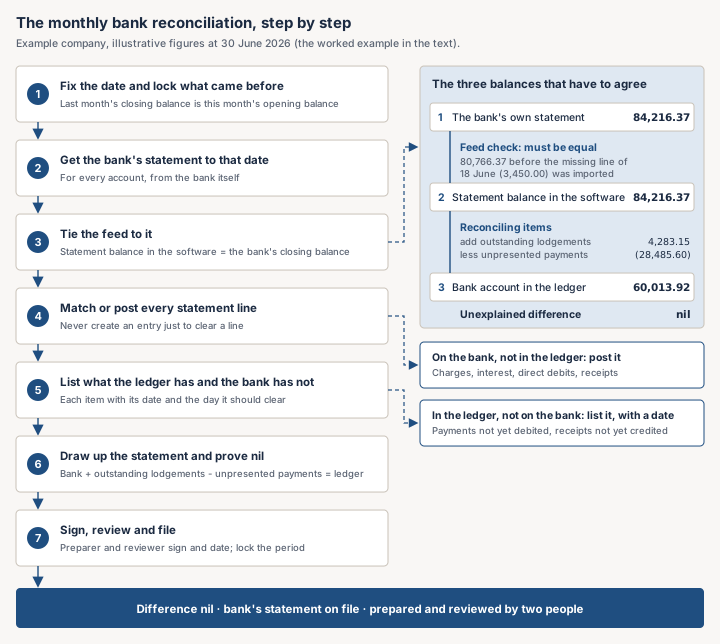
The bank's statement is never changed. Every correction is made in the ledger, and a genuine bank error is raised with the bank and listed until it is corrected.
Which reconciling items are normal, and how long can each stay open?
A timing item is normal when you can say what it is and when it will clear, and most clear within the first few working days of the next month. Anything on the bank's statement that is not in the ledger, a genuine bank error apart, is not a reconciling item at all: post it before you finish.
| Item | Where it appears first | List it or post it | When it should clear | If it has not |
|---|---|---|---|---|
| Bacs run submitted (suppliers, payroll) | The ledger, if dated the day the file is submitted | List as unpresented | Bacs payments usually take 3 working days | The file was rejected or withdrawn: read the submission report |
| Faster Payment or CHAPS sent | Both records, on the same or the next working day | Nothing to list | – | It was not sent, or it left a different account |
| Cheque issued | The ledger | List as unpresented | When the payee banks it | Contact the payee; your bank may decline to pay an old cheque (§ 7) |
| Cash and cheques paid in | The ledger | List as an outstanding lodgement | Cheques: typically by the end of the next weekday | Check the paying-in record: was it banked? |
| Card takings (the acquirer's settlement) | The till or sales system | Post sales to a card clearing account; otherwise list | As your merchant agreement says | Query a missing day with the acquirer; post any fees deducted |
| Processor payouts (for example Stripe, GoCardless, PayPal) | The processor | Keep a processor clearing account; list only a payout in transit | On the processor's payout schedule | Agree it to the processor's payout report |
| Direct debits you collect | The ledger | List until credited | On your collection schedule | Unpaid collections can come back later: post each to the customer's account |
| Direct debits and standing orders you pay | The bank | Post | – | Query an unrecognised one before posting it |
| Bank charges and interest | The bank | Post | – | Never left as a reconciling item |
| A receipt you cannot identify | The bank | Post to unallocated receipts (a liability), not sales | When the payer is identified | Ask the bank for the remitter's details (§ 7) |
| Returned or unpaid items | The bank | Post the reversal | – | Reinstate the debtor or the creditor |
| Transfers between your own or group accounts | Both accounts, sometimes a day apart | Post once, as a transfer | The same or the next working day | One side missing is an error, not a timing item |
| Currency accounts | – | Reconcile in the account's own currency | – | The sterling difference is revaluation, not a reconciling item |
Table 1: reconciling items on a UK company's bank account. Your bank's and your payment providers' own terms govern the timings.
The Bacs timing is GOV.UK's guidance to employers paying HMRC; the cheque timing is Pay.UK's, for a cheque paid in before the bank's cut-off, bank holidays excluded. Date a Bacs run in the ledger on the day the payments leave the bank, not the day the file is submitted, and the run never becomes a reconciling item.
A bank reconciliation example: a UK current account at the month end
The bank reconciliation statement is the one-page result of the process. Here is one for a small UK company's current account at 30 June 2026 (illustrative figures). F2 and F1 are the role codes of § 6.
The three balances first. The bank's own statement closes at £84,216.37. The statement balance in the software is £80,766.37: the feed missed 18 June, after the bank connection was re-authorised, and with it a customer receipt of £3,450.00. F2 imports the missing day, and balances 1 and 2 agree. The ledger, at £58,199.42, agrees with neither.
Posted in the ledger before the statement is drawn up:
- the £3,450.00 receipt;
- June's bank charges of £48.50, a line still unmatched in the feed;
- an insurance direct debit of £312.00, also unmatched, that nobody had entered;
- the reversal of a £1,275.00 customer receipt recorded twice, once by matching the feed line and once keyed from the remittance advice.
At £60,013.92, the ledger is now right.
Timing items, listed. A Bacs supplier run of £27,845.60, dated in the ledger on Monday 29 June when the file was submitted, left the bank on Wednesday 1 July. Card takings for 29 and 30 June, which this company books straight to the bank account, were settled on 1 and 2 July. And a cheque for £640.00, issued to a supplier in November 2025, has never been presented.
| Bank reconciliation statement: current account, 30 June 2026 | £ |
|---|---|
| Balance per the bank's own statement (the software's statement balance agrees) | 84,216.37 |
| Add: outstanding lodgements | |
| Card takings of 29 June, settled 1 July | 2,318.40 |
| Card takings of 30 June, settled 2 July | 1,964.75 |
| Less: unpresented payments | |
| Bacs supplier run dated 29 June, left the bank 1 July | (27,845.60) |
| Cheque 100482 dated 10 November 2025, not presented; owner F1 | (640.00) |
| Balance per the ledger after the corrections (agrees to the trial balance) | 60,013.92 |
| Difference | nil |
| Prepared F2, 2 July; reviewed F1, 3 July |
Table 2: a bank reconciliation statement, with the date each timing item cleared or, for the cheque, its owner.
Three things made it a reconciliation: the bank's own statement was the starting point, which is how the missing day was found; everything on the bank's side was posted, not listed; and every item listed has the date it cleared or an owner. The cheque, more than seven months old, will not clear by itself.
Bank reconciliation best practice: who prepares it, who reviews it and what they check
The practice that matters is independence and evidence. The person who reconciles the bank cannot release payments alone, the reviewer looks at the bank's statement and not only at the reconciliation, and both sign at the time.
Who should do the bank reconciliation?
Someone who cannot release a payment alone prepares it, and a different person reviews it. Our guide to segregation of duties in a small finance team uses role codes, and this page borrows four: F1 is the finance lead, F2 a second finance person, F3 a third, and D a director outside finance who has bank authority and no ledger access.
- Two people: F1 prepares, D reviews.
- Three people: F2 prepares, F1 reviews.
- Four people: F3 prepares, F1 reviews.
Whoever releases payments never prepares the reconciliation. An outside bookkeeper or accountant can be the preparer or the reviewer, never both.
What the reviewer checks
The reviewer proves the reconciliation against the bank, not against itself, in seven checks:
- Open the bank's statement in online banking (view-only access is enough) and agree its closing balance and date to the reconciliation.
- Agree the ledger balance to the trial balance for the locked period.
- Trace each timing item to the bank after the date: the amount and the day.
- Read the oldest items against Table 1's "when it should clear".
- Look at entries on the bank account in the ledger that did not come from the bank: manual journals, and lines unreconciled or deleted since last month.
- Count the accounts: every account at every bank, including savings, currency, card and dormant ones, and any opened or closed in the month.
- Scan the statement for a payee or a direct debit nobody recognises, and escalate it the same day.
Then sign and date it that day. A signature added months later proves the signature, not the review.
What to do with items that never clear
Three things turn up on bank reconciliations and stay: a cheque nobody banks, a receipt nobody can identify, and a small difference nobody can find. None is cleared by a journal that makes the reconciliation agree.
The unpresented cheque. Contact the payee. If it is lost, or your bank tells you it would no longer pay one of that age, stop it, cancel it in the ledger and put the amount back on the supplier's account. It is still owed, so it does not go to profit. Someone above the preparer approves the entry.
The unidentified receipt. Hold it as a liability and ask the bank for the remitter's details. Never post it to sales to clear the list: it may be a duplicate payment, or somebody else's money.
The small difference. On a bank account there is no immaterial difference, no rounding and no threshold below which one can be written off, because both figures are known to the penny. Look for a transposition, which always leaves a difference that divides by 9 (£312.00 keyed as £321.00 leaves £9.00), then a duplicate, an entry in the wrong bank account, or a backdated entry that moved the opening balance.
Who may approve a write-off, and how reconciling items are aged, is in balance sheet reconciliations.
What will your auditor ask for on the bank?
Be ready to give your auditor the year-end reconciliation for every account, the bank's statements to the year end and for the weeks after it, and, if it decides to confirm balances with the bank, your authority for the bank to answer it directly. Cash is a balance an auditor can confirm with the party that holds it, so expect it to ask.
- The auditor may go to the bank itself. When it does, ISA (UK) 505 requires it to keep control of the request, with the reply sent directly to the auditor and not through the company (para 7).
- The bank may need your authority. The standard notes that a confirming party may only be willing to respond to a request that carries management's authorisation (para A4). If management refuses to allow a request, the auditor must ask why, evaluate what the refusal means for the audit and get its evidence another way (para 8).
- The confirmation does not replace the reconciliation. The bank gives the auditor the bank's figure; the reconciliation joins it to the figure in the accounts. The first statements after the year end show each timing item clearing, and on which side of the date it fell.
- Access is a legal right. The auditor has a right of access at all times to the company's books, accounts and vouchers (s499); what it does with them is its own judgement.
Have ready:
- a list of every account open at any time in the year, including closed, dormant, currency, deposit, loan and card accounts;
- the signed authority to the bank, if the auditor asks for one;
- the bank's year-end statement for each account;
- each reconciliation, with the date every item cleared and an explanation for anything old.
Auditing standards bind the auditor, not the company. The full list of what to prepare is in the year-end audit checklist.
Not every audit is required by law. Some companies are audited because a lender or an investor asks for audited accounts, which is a voluntary audit, and the audit of cash starts from the bank reconciliation either way. If your investors have asked for an audit, tell us about your company: Innate offers statutory audits signed by an ICAEW-registered partner firm, which your company appoints as its auditor, with our platform doing the legwork to save you time and money.
Questions finance teams ask about bank reconciliations
How often should a bank reconciliation be done?
Reconcile every account at every month end, proving the three balances, and match the feed daily or weekly in between so that the month-end work is short. The Companies Act sets no frequency. The month-end close checklist puts the bank early in the close.
Why does my bank reconciliation not balance?
Check in this order: the opening balance, the software's statement balance against the bank's own statement, a duplicate, an entry in the wrong bank account, and a transposition. Both records are exact, so it can always be found.
Is a bank reconciliation a legal requirement in the UK?
Not by name in the Companies Act. The duty is to keep adequate accounting records (s386), and the reconciliations belong with them. A private company must preserve its accounting records for three years from the date they are made (s388(4)); GOV.UK's guidance for limited companies says you must keep records for 6 years from the end of the last company financial year they relate to, or longer in some cases, for example if you sent your Company Tax Return late or HMRC has started a compliance check (GOV.UK). Keep the longer.
Do savings, card and dormant accounts need reconciling?
Yes, every account. A dormant one takes one line. A company credit card is reconciled to the card issuer's statement in the same way. Petty cash is counted, not reconciled to a statement.
Can software or AI do the bank reconciliation?
It can match lines and propose entries. Tying the three balances, deciding what an unmatched item really is, and the review stay with people. AI in the month-end close covers the controls.