Balance sheet reconciliations: what good looks like, account by account
By Alon Zieve FCA · Last reviewed
This guide is for the finance team of a UK company that closes its books monthly and is audited, or soon will be. A balance sheet reconciliation proves that one balance in the ledger agrees with evidence from outside the ledger at the same date, lists every item that explains a difference, and is signed by someone who did not prepare it. A good one shows a nil unexplained difference, reconciling items that are dated, owned and clearing, and support that would convince a stranger. At the year end, these are among the first papers an auditor asks for. This is one of our guides for finance teams; when each reconciliation happens in the month is in the month-end close checklist.
What is a balance sheet reconciliation?
It is a working paper that agrees the closing balance of one account on the balance sheet to an independent source at the same date, and explains any difference item by item. Without it, a balance is simply whatever the ledger says.
A trial balance that balances proves nothing about any one balance. Debits equal credits even when a payment is posted to the wrong account: the error sits, perfectly balanced, in two places. Profit and loss accounts are reviewed rather than reconciled, because their errors surface on the balance sheet: a missing accrual as an invoice received after the date with nothing accrued for it, an unreleased prepayment as an asset for a period that has already passed.
The responsibility is the company's. Every company must keep adequate accounting records, sufficient to show and explain its transactions and to disclose its financial position "with reasonable accuracy, at any time" (Companies Act 2006 s386). The directors prepare the accounts (s394); the auditor reports on them to the members (s495). Keeping the balances right is not the auditor's job.
What a good balance sheet reconciliation looks like
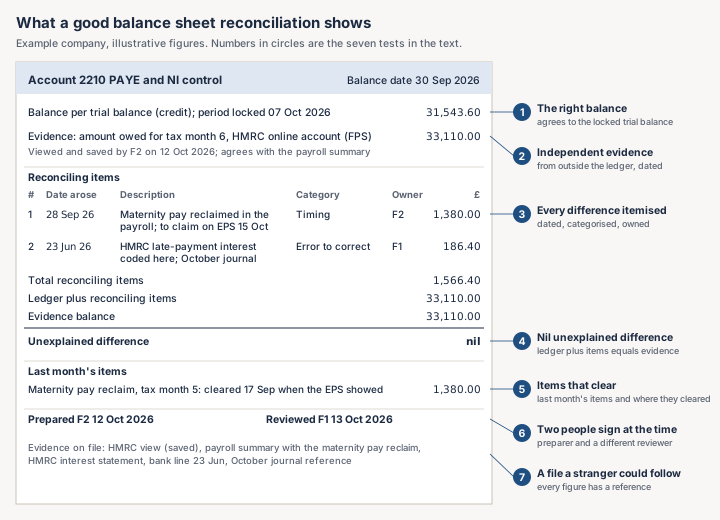
A good reconciliation passes seven tests. One that passes all seven proves the balance; one that fails any is a restatement of the ledger, however tidy. The balance sheet reconciliation process is the same for every account; only the evidence changes (§ 3).
- The right balance. The account, the date and the balance agree to the trial balance after the period is locked. The ledger figure is extracted, not typed in.
- Independent evidence for the same date. The support comes from outside the ledger: a third party's statement, a separate system, a count. Its source and date are stated, with who extracted it. A report from the same ledger is a tie-out, not proof.
- Every difference itemised. Each reconciling item has its own line: the date it arose, the amount, a description, a category (timing, error to correct, unrecorded) and an owner. No "sundry" line, no netting.
- A nil unexplained difference. The ledger, plus or minus the items, equals the evidence exactly. A balancing figure labelled "unreconciled" or "immaterial" means the work is not finished, and a small difference is often two larger errors netting off.
- Items that clear. Timing items clear in the next period, and the reconciliation shows last period's items and where each one cleared.
- Two people sign, at the time. A preparer and a different reviewer, with initials and dates, as part of that month's close (§ 5).
- A file a stranger could follow. Evidence attached or referenced, so a new hire or the auditor reaches the same balance without asking.
In my years as a CFO, the reconciliation that hid a problem was rarely the messy one. It was the one that agreed to the penny every month, because it agreed to itself.
What should each balance sheet account be reconciled to?
Reconcile each account to the most independent evidence available for it. A third party's statement beats a separate system, which beats a schedule the team built, which beats a report from the ledger itself. Where only a schedule exists, its inputs (the invoices, contracts and registers behind each line) are the evidence, and the schedule is fine once they are on file.
| Account | Reconcile it to | What actually proves it | Not proof on its own | Typical reconciling items |
|---|---|---|---|---|
| Bank and cards | The statement at the date | The bank's or card issuer's statement | The bank feed screen | Uncleared payments, receipts in transit, unposted charges |
| Payment processor and sales platform clearing | The payout and balance report | That report, each payout matched to the bank | The balance shown by the software's integration | Payouts in transit, unposted fees and refunds |
| Petty cash | A count at the date | The count, signed by the counter and a witness | The petty cash book | Vouchers not posted |
| Sales ledger control | The aged debtors report and later receipts | Cash received after the date for named invoices; customer statements or confirmations | The aged debtors report (in integrated software it agrees by construction); collectability is a separate review | Unallocated cash, credit balances, journals posted to the control |
| Purchase ledger control | Aged creditors and supplier statements | The main suppliers' statements, reconciled | The aged creditors report | Invoices in transit, disputed items |
| Accruals | The accruals schedule | Invoices received after the date; contracts; meter readings | The schedule alone | Accruals not reversed; costs accrued and invoiced |
| Prepayments and deferred income | The schedules | The invoice or contract behind each line; the release calculation | The schedules alone | Releases missed |
| Fixed assets | The fixed asset register | Invoices for additions, disposal records, the assets themselves | The register alone | Additions expensed, disposals left in |
| Leases | The lease register | The signed leases and any variations | The register alone | New leases not added, changed terms |
| Stock | The count and the valuation | Signed count sheets; invoices behind the costs used | The system quantity alone | Goods in transit, cut-off |
| VAT control | The last VAT return, plus VAT on postings since | The return as filed; what is owed in HMRC's VAT online account | The ledger's VAT report alone | Postings into a filed period, payments coded elsewhere |
| PAYE and NI | The payroll summary | The payroll reports; what you owe in HMRC's online account | The payroll journal | EPS reclaims; payments or charges coded here (§ 4) |
| Pensions | The provider's contribution schedule | The provider's schedule and record of payments | The payroll journal | Contributions not yet paid over |
| Net wages | Nil after payday | The payroll report and the bank payment | The payroll journal | A late or returned payment |
| Corporation tax | The tax computation | The computation; payments in the company's HMRC online account | Last year's figure rolled forward | Instalments, last year's final liability |
| Loans and finance | The lender's statement | The lender's statement | A repayment schedule the team built | Instalments coded wholly to interest |
| Intercompany | The other company's ledger | The other company's written confirmation | Your own side alone | Items in transit, one-sided recharges |
| Directors' loan accounts | The director's own record | A statement of the balance signed by the director | The ledger listing | Personal costs paid by the company; for approval and tax, see directors' loan account rules |
| Suspense and clearing | Nil | Nil: every item cleared to its proper account | A list of what is in it | Anything at all |
| Share capital | The register of members | The register and the allotment paperwork | The Companies House record alone | Allotments not entered or filed |
| Retained earnings and reserves | Last year's signed accounts, rolled forward | The signed accounts, the year's result, dividends declared | The ledger's opening balance alone | Postings to a closed year |
Table 1: what proves each balance. Your auditor decides what evidence it needs.
For share capital, the statutory record is the company's own register of members, which every company must keep (s113). Leases now need a row: the revised FRS 102 brings most leases onto the lessee's balance sheet for periods beginning on or after 1 January 2026, with exemptions for short-term and low-value leases (FRC).
Dormant and zero-balance accounts still get a one-line reconciliation. Reconcile from the trial balance, not last month's file, so a new account code is picked up the month it appears.
A balance sheet reconciliation example: the same account done badly and done well
Take the PAYE and NI control account of a small UK company at 30 September 2026 (illustrative figures). Payroll is paid on the 28th. The tax month runs from the 6th to the 5th, so September's pay falls in tax month 6, and its deductions are due to HMRC by 22 October, the 22nd of the next tax month for a monthly payer (a cheque by post must arrive by the 19th) (GOV.UK). At the month end the control should hold exactly that liability. The company reclaims statutory maternity pay each month on its Employer Payment Summary (EPS).
| Version A: postings in September | £ |
|---|---|
| Balance b/f at 1 September (August PAYE) | 30,904.50 |
| Difference b/f | (186.40) |
| Paid to HMRC, 22 September | (30,904.50) |
| Payroll journal, 28 September | 31,730.00 |
| Balance per trial balance, 30 September | 31,543.60 |
| Difference | nil |
| Prepared F2, 06 Oct; reviewed: blank |
Version A agrees to the penny because it agrees to itself: every line comes from the same ledger, the £186.40 "difference b/f" dates from June, and only the preparer signed.
In Version B, F2 agrees the balance to the payroll summary on working day 4, then to HMRC's own figure. What you owe from the Full Payment Submission (FPS) can be viewed online from the 10th of the next tax month, an EPS claiming a reduction is sent by the 19th, and the balance shows within 2 days of it (or by the 14th, if the EPS went before the 11th) (GOV.UK).
| Version B: PAYE and NI control, 30 September 2026 | £ |
|---|---|
| Balance per locked trial balance (credit) | 31,543.60 |
| Add 1: statutory maternity pay reclaimed, dated 28 Sep; to be claimed on the EPS F2 sends on 15 Oct; timing; F2; expected to clear by 17 Oct | 1,380.00 |
| Add 2: HMRC late-payment interest coded here on 23 Jun, 99 days old; error, corrected by an October journal to interest; F1 | 186.40 |
| Ledger plus reconciling items | 33,110.00 |
| Owed for tax month 6 per HMRC's online account, from the FPS, viewed 12 Oct; agrees with the payroll summary | 33,110.00 |
| Unexplained difference | nil |
| Last month's item: August's maternity pay reclaim, cleared 17 Sep (EPS) | 1,380.00 |
| Prepared F2, 12 Oct; reviewed F1, 13 Oct |
Three things made B proof: the evidence came from outside the ledger; the old difference was traced to its cause, late-payment interest (HMRC may charge interest and penalties on late PAYE), and corrected rather than carried; and someone else signed, before the payment was due.
How do you review a balance sheet reconciliation?
The reviewer is testing whether the reconciliation proves the balance, not whether the arithmetic adds up. Start from the trial balance, open the evidence, read the reconciling items and challenge the oldest, and sign only when a stranger could reach the same balance. The reviewer's checklist:
- The balance agrees to the locked trial balance.
- The evidence is for the same date and comes from outside the ledger.
- The evidence has been opened, not just referenced.
- Every item has a date, an owner and a category.
- Nothing is older than the company's own limit without an escalation note.
- Last period's items have cleared, or are carried with a reason.
- There is no plug and no "unreconciled difference".
- Correcting journals are posted, supported and approved.
- The movement since last month makes sense against what the business did.
- Someone else prepared it, and it is signed and dated now, not at the year end.
When one fails, send it back with the reason written on it. Do not fix it and then sign as reviewer: that is reviewing your own work.
Who reviews whom follows the role codes of our guide to segregation of duties in a small finance team: F1 is the finance lead, F2 a second finance person, and D a director outside finance with bank authority and no ledger access. F1 reviews what F2 prepares. D reviews what F1 prepares, such as accruals and corporation tax, including the bank and directors' loan account reconciliations whenever F1 prepares them. No director reviews their own loan account.
Reconciling items: ageing, clearing and writing off
A reconciling item is a difference you can explain and expect to clear. Age it from the date it arose, not from the latest month it was copied into, and give it one of three ends: it clears, it is corrected by a journal, or it is written off with approval. It never becomes a permanent line.
Set the age limits yourself and write them down: for example, over three months goes to F1 with a note, over six months to D. That is an illustration; no law sets the number.
- Clears. A timing item, such as the EPS reclaim in § 4, drops out next period, and the next reconciliation says where.
- Corrected. An error is put right by a journal in the open period, with its support and an approver, and the reconciliation carries the journal's reference.
- Written off. Only an item that cannot be traced or recovered, with the reason recorded and an approver above the preparer (D, or the board above whatever limit the company's policy sets). A write-off is a decision, not a tidy-up.
Never move an unexplained difference to suspense or another account to make a reconciliation balance; that only moves the question. Unexplained items come back at the year end, when nobody remembers the answer.
How often should balance sheet accounts be reconciled?
Reconcile the accounts that move or carry risk every month you report on: bank, the sales and purchase ledger controls, VAT, payroll, suspense and directors' loan accounts. Stable, low-risk accounts such as share capital can be reconciled quarterly if your policy says so, and every account is reconciled at the year end. Risk, not habit, sets the frequency.
Three things decide it: volume, judgement (how much of the balance is an estimate) and exposure to error or fraud. A quarterly account still gets a look at its monthly movement. The register (§ 9) suggests a frequency for each account, with the reason.
In the month-end close checklist, reconciliations are done on working day 4. They come before the management accounts pack is issued: a pack built on unreconciled balances is an estimate.
A reconciliation policy on one page
Write down six things:
- Scope: every asset, liability and equity account in the trial balance.
- Frequency, account by account (the register).
- The evidence standard (Table 1).
- The deadline, as a working day.
- Who prepares and who reviews.
- Age limits, and who may approve a write-off.
Then retention. Keep the reconciliations with the accounting records. A private company must preserve its accounting records for three years from the date they are made (s388(4)), while HMRC expects records to be kept for 6 years from the end of the last company financial year they relate to, or longer in some cases (GOV.UK). Keep the longest that applies.
What will the auditor do with your reconciliations?
The auditor starts from them. Reconciliations are usually among the first things an auditor asks for, because each links a balance in the trial balance to the evidence behind it. What further evidence the auditor needs, and how it gets it, is the auditor's judgement.
The principles, from the finance team's side:
- The auditor has a right of access at all times to the company's books, accounts and vouchers, and may require its officers and employees, among others, to provide the information and explanations it thinks necessary for its duties (s499).
- A reconciliation is information produced by the company. An auditor using it must evaluate whether it is reliable enough for its purposes, including, as necessary, obtaining evidence about its accuracy and completeness (ISA (UK) 500, para 9).
- Evidence is generally more reliable when it comes from independent sources outside the company (para A35). That is why Table 1 ranks evidence as it does.
- The sign-off dates matter: a review dated at the close shows it happened then, and a reconciliation rebuilt during the audit shows only that someone rebuilt it.
- Differences the auditor finds at the year end become audit adjustments, harder to explain than a correction made in the month.
- Knowingly or recklessly giving an auditor information or explanations it requires, or is entitled to require, in a statement that is misleading, false or deceptive in a material particular is an offence (s501).
The reconciliations usually sit near the top of the "prepared by client" (PBC) list; the full list is in the year-end audit checklist.
The audit cannot start in earnest until the reconciliations exist, and a private company normally has nine months from the end of its accounting reference period to file its accounts at Companies House (s442). If your filing deadline is approaching and the audit has not started, Innate offers statutory audits signed by an ICAEW-registered partner firm, which your company appoints as its auditor, with our platform doing the legwork: ask for a quote.
A balance sheet reconciliation template to download
Two CSV files that open in Excel or any spreadsheet, with no sign-up:
The template is one account's working paper, one copy per account per month: a header block for the balance and the evidence, a reconciling-items table with 10 columns from "Item #" to "Cleared in", and closing rows for the unexplained difference (which must be nil) and both sign-offs.
The register is the index the reviewer and the auditor start from: the 21 accounts of Table 1, with the evidence type, a suggested frequency and why, the preparer and reviewer roles, and blank columns for each month's balances and sign-off. Put names over the role codes, delete rows that do not apply, add any missing account from your trial balance, and keep completed copies in the close file. Neither file has formulas; if you add your own, lock them.
Questions finance teams ask about reconciliations
What is the difference between a bank reconciliation and a balance sheet reconciliation?
A bank reconciliation is one of them: the reconciliation for cash. Teams usually do it well because the bank sends a statement; the surprises are in the accounts where the team must find the evidence itself.
Do profit and loss accounts need reconciling?
No. They are reviewed for movement and reasonableness against last month, the budget and what the business did. The exceptions worth agreeing are payroll costs to the payroll reports and revenue to the sales or billing system.
Can software or an AI tool do the reconciliation?
It can match transactions and propose reconciling items. The evidence standard, what has cleared and the sign-off stay with people; the tool's output is prepared work that needs the same reviewer. Our guide to AI in the month-end close covers the controls.
What if a reconciliation is not finished by the close deadline?
Sign off what is proved, and list what is not, with the amount and an owner. If the management accounts use an estimate for that balance, label it. Never sign an unfinished reconciliation as complete.
Does a small company really need a reconciliation for every account?
Yes, but many are one line: a zero-balance account, or share capital in a quiet year. The rule is that no balance in the trial balance is left unexplained.