Going concern audit procedures for small companies: the evidence an auditor needs
By Alon Zieve FCA · Last reviewed
Going concern audit procedures under ISA (UK) 570 apply to every UK audit, small owner-managed companies included. The auditor evaluates management's assessment, which under FRS 102 must look at least twelve months ahead from the date the financial statements are approved, not from the year end, and does more when events or conditions cast doubt. This guide sets out what a going concern audit requires, the evidence for each step on a small company (including one with no formal forecast), the assessment period worked to the day, and a going concern file for an invented company's first audit, for a 31 December 2026 year end.
What going concern audit procedures are required on every audit?
The audit procedures to assess going concern apply on every audit: the auditor obtains evidence about, and evaluates, management's assessment of the company's ability to continue as a going concern, whether or not anything looks wrong. Where events or conditions that may cast significant doubt are identified, further work follows. There is no separate auditor going concern assessment: the auditor evaluates management's and does not make one.
Two editions are live. A period beginning before 15 December 2026, such as a year ending 31 December 2026, is audited under ISA (UK) 570 (Revised September 2019) (Updated September 2025). A period beginning on or after that date is audited under ISA (UK) 570 (Revised March 2026), published on 30 April 2026; FRC staff guidance says early adoption is not permitted. What changed between them is covered in ISA 570 revised; the other standards are on the UK auditing standards hub.
The UK text has required this evaluation on every audit for periods beginning on or after 15 December 2019 (2019 paragraphs 12-1 and 12-2; 2026 paragraph 17).
Audit procedures for going concern risk start at planning, inside the ISA (UK) 315 risk assessment (2019 paragraph 10-1; 2026 paragraphs 11 and 12). They are not "substantive audit procedures for going concern" in the ISA (UK) 330 sense, which means tests designed to detect misstatement at the assertion level (paragraph 4(a)). They are ISA (UK) 570's own requirements about management's assessment, fed by substantive work such as post year-end receipts and subsequent events.
The going concern assessment period: at least twelve months from the date of approval
If the going concern assessment period covers less than twelve months from the date of approval of the financial statements, the auditor asks management to extend it to at least twelve months from that date (2019 paragraph 14-1; 2026 paragraph 21). If management refuses, the auditor discusses it with management and, where appropriate, those charged with governance, then considers the implications for the audit (2019 15-1; 2026 22–23).
ISA (UK) 560 paragraph 5(b) defines the date of approval as the date on which all the statements, including the notes, have been prepared and those with recognised authority have asserted that they take responsibility for them; a later shareholder approval does not move it (A2). FRS 102 paragraph 3.8 says the same from the preparer's side: "at least, but is not limited to, 12 months" from when the statements are authorised for issue. Twelve months from the end of the reporting period is IAS 1's period, not the UK auditing requirement. The auditor's report cannot be dated before approval (ISA (UK) 700 paragraph 49).
For the company in the worked example below:
| Step | Date |
|---|---|
| Year end | 31 December 2026 |
| Expected date of approval | 30 June 2027 |
| Twelve months from approval | 30 June 2028 |
| Management's forecast ends | 31 December 2027 |
| Shortfall | 6 months |
| Extension requested | to at least 30 June 2028 |
| If approval slips to | 30 September 2027 |
| Required end moves to | 30 September 2028 |
| Extended forecast then short by | 3 months |
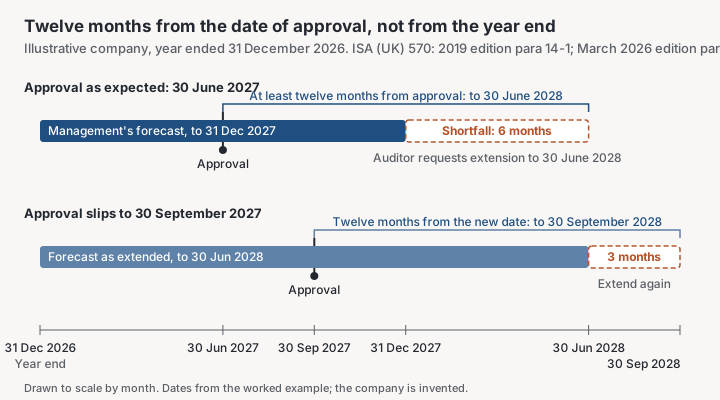
When approval slips, the required end moves with it, so an extended forecast can fall short again. Where approval is significantly delayed, the 2019 edition also requires the auditor to ask why and, if the delay could relate to going concern, to perform further procedures under 12-1 and 12-2 (paragraph 26). The 2026 edition drops that requirement; A52 instead suggests agreeing the expected approval date early and putting the twelve-month expectation in the engagement letter.
Beyond the period, the auditor's only required procedure is inquiry of management about known later events or conditions; if any are identified, management is asked to evaluate their significance (2019 paragraph 10-4 and A6-2; 2026 paragraphs 20 and A48).
Going concern audit evidence: testing management's forecast
How to test going concern, in practice, is mostly how to test the forecast: evaluating its method, significant assumptions and data and checking the calculations (2019 paragraph 12-2; 2026 paragraph 19), comparing past forecasts with outcomes, and asking whether management's plans are feasible (2019 12-2(d); 2026 paragraph 26, where events or conditions exist), with scepticism "in particular when reviewing future cash flow" (2019 12-3; 2026 18-1).
Method
Is it an integrated model or a cash-only spreadsheet? Does it start from agreed closing balances? The evaluation covers management's whole assessment period (2019 13-1(a); 2026 A34-1). Both editions accept a simple cash flow forecast and budget, or equivalent analysis, where the business is simple (2019 A3-13 and A4-1; 2026 A39).
Assumptions
Identify the few assumptions the answer turns on, usually revenue, margin and facility renewal, and take each to evidence: post year-end management accounts and bank statements, the order book, contracts, facility letters. Check consistency with assumptions used elsewhere, such as impairment (2019 12-2(c); 2026 19(b)). Seek evidence that could contradict the forecast, not only support it. The 2019 edition puts that at the evaluation stage, taking into account all relevant evidence "whether corroborative or contradictory" (18-1(b)). The 2026 edition adds it at the design stage: procedures must not be "biased towards obtaining audit evidence that may be corroborative" (paragraph 18), with examples in A37.
Data and arithmetic
Agree the opening position to the ledger, re-perform the totals and trace each line into the net cash flow (2019 12-2(a)(iii) and (b); 2026 19(a)(ii) and (c)).
Track record
Compare earlier forecasts with what happened (2019 A3-15 and A8-3; 2026 A42). On a first audit there is no audited prior-year comparison, so use management's internal budget for the year under audit against its actuals.
Sensitivity and headroom
Both editions ask whether management considered alternative assumptions, for example "pessimistic" and "optimistic" scenarios (2019 A8-7; 2026 A42). Neither sets a percentage to flex or a headroom figure: the downside the team runs, and why, is a judgement to record.
A director's verbal assurance on its own is not evidence. The 2019 edition accepts discussion with management only where its contentions "can be corroborated by sufficient documentary evidence" (A12), and written representations "do not provide sufficient appropriate audit evidence on their own" (A9-1).
Evidence when there is no formal forecast
Under the 2019 edition, a small company does not always need a formal forecast. A11-4 says evidence "may not require formal cash flow forecasts and budgets" for the twelve months from approval, that alternative sources "may also be acceptable", particularly for entities with uncomplicated circumstances, and that many smaller companies fall into that category. A12 says the request to extend the assessment may be met by discussion, inquiry and inspection of documents, such as orders received for future supply. A8-1 allows the evaluation without detailed procedures where there is a history of profitable operations and ready access to finance, if other procedures suffice.
The March 2026 edition has no equivalent of A11-4 or A12. It puts scaling differently: management's analysis may be less extensive where the entity is profitable, has no liquidity concerns and has identified no events or conditions (A35); the method for a simple business may be "a simple cash flow forecast and budget or other equivalent analysis" (A39); the auditor's procedures may be less extensive where the method is simple (A46); and management may extend its assessment "through less formal means" (A56). Paragraph 19 still requires the method, significant assumptions and data to be evaluated, whatever form they take; A35's example excludes companies with identified events or conditions.
| Evidence | What it shows | Its limit |
|---|---|---|
| Post year-end management accounts | Trading since the year end against the forecast | Unaudited; check to the bank and ledger |
| Bank statements to near approval | Actual cash and facility use | Shows the past, not the period ahead |
| Facility letter and renewal correspondence | Limits, expiry, conditions, lender's stance | A lender may not confirm renewal in writing |
| Order book and signed contracts | Committed revenue | Orders can be cancelled; margin not shown |
| Aged creditors and HMRC position | Pressure on cash, arrears | A snapshot |
| Board minutes | Plans, financing discussions | Records intentions, not ability |
| Director's personal means (where support is relied on) | Ability to provide support | Needs documents, not assertion |
Identifying events or conditions on a small company
The standards list financial, operating and other examples (2019 A3; 2026 A7), and both note that small entities may lack reserves and are particularly exposed to lenders ceasing support and to losing a major customer or key employee (2019 A5; 2026 A15). On owner-managed companies the usual ones are one customer, one director, a director's loan repayable on demand, an overdraft repayable on demand, HMRC time-to-pay arrangements, and a first audit after rapid growth. The understanding includes how management budgets and forecasts (2019 10-2(c); 2026 12(c)). Under the 2026 edition the auditor also concludes, from the ISA (UK) 315 work, whether there are control deficiencies over management's going concern assessment (paragraph 15).
The 2026 edition also requires events or conditions to be identified before mitigating factors in management's plans are considered (paragraph 11); the 2019 edition said the same in application material (A3-1).
Further procedures when events or conditions exist
Once events or conditions are identified, the auditor does more to decide whether a material uncertainty exists; the editions organise it differently.
Under the 2019 edition, much of it is on every file already: 12-2 includes evaluating management's plans, their feasibility and whether they improve the position (12-2(d)), later facts (12-2(e)) and written representations on the plans (12-2(f)). For events or conditions management had not identified or disclosed, 11-1 adds asking management to assess them, asking why its assessment missed them, and applying 12-1 and 12-2. Paragraph 20 then requires the related disclosures to be evaluated.
Under the 2026 edition, the work is in two tiers:
- Every audit: understand the entity and its forecasting (11, 12); remain alert (13); evaluate management's assessment, with method, assumptions and data (17 to 19); inquire beyond the period (20); request any needed extension (21); written representations on four matters (39).
- When events or conditions are identified: evaluate management's plans, their feasibility and management's intent and ability (26); apply 19(b) and (c) to the plans' assumptions and data (27); obtain evidence about third-party or owner-manager support (28); evaluate disclosure, including significant judgements, where there is no material uncertainty (32); three further representations (40); communicate the matters in 42; for any management missed, the steps in 25.
Facilities and lenders
Read the facility letter: limit, expiry, conditions, covenants, repayment on demand. Where a renewal falls inside the period, an external confirmation may be appropriate (2019 A8-14; 2026 A61). A lender's reluctance to confirm renewal is not in itself evidence of a material uncertainty, though a refusal for reasons specific to the company needs weighing (2019 A8-15); the 2026 edition treats it as a possible limitation on evidence and suggests asking the lender why (A62).
Owner-manager support
Where the plans depend on an owner-manager not withdrawing a loan, or providing more money, the 2026 edition requires evidence of both intent and ability (paragraph 28). A63 points to written confirmation of the terms and the period of support; A64 to past support and the supporter's financial position; A65 to documentary evidence of any subordination. In 2019 this was application material, and A8-13 said the auditor "may evaluate" ability.
A worked going concern file for a first-year audit
Kelstow Fabrications Ltd is invented for this example. Figures come from a model built for this page.
The facts
Kelstow is a sheet-metal fabricator whose managing director is its sole shareholder. Turnover was £16,400,000 in 2025 and £18,100,000 in 2026, and its balance sheet total was £8,050,000 and £8,600,000, above the £15m and £7.5m limits in both years. Having exceeded two of the three limits in two consecutive years, it no longer qualifies as small; having taken the small companies exemption before, its first audit is for the year ended 31 December 2026 (see audit exemption thresholds). Its period began on 1 January 2026, so the 2019 edition applies.
Finance: a £500,000 overdraft due for renewal on 31 October 2027, an invoice-finance facility advancing 85% of approved debts, and a £350,000 director's loan repayable on demand. In 2026 the company made an operating loss of £95,000 against a budgeted profit of £420,000 for the year.
The period
Management's cash-only forecast ran to 31 December 2027, six months short (the table and timeline above), so the team asked for an extension to 30 June 2028.
The forecast tested
Arithmetic. Re-performing the spreadsheet found the £180,000 March 2027 capital expenditure row left out of the net cash flow total. Corrected, the lowest headroom over the facilities fell from £354,735 (January 2027) to £223,687 (March 2027).
Track record. Against the 2026 budget, revenue was £500,000 (2.8%) ahead, but gross margin was 23.1% against 26.0%, a 2.9-point shortfall that cost £524,900 of gross profit. Margin is where management has been optimistic, so it got most attention.
Three assumptions and their evidence:
- Revenue up 6% in 2027: the order book at the approval date, two signed contracts, and January to May 2027 invoicing.
- Gross margin of 24%: January to March 2027 management accounts at 23.6%, supplier price letters, and contract pricing clauses.
- Overdraft renewed on the same terms in October 2027: the facility letter, the bank's annual review correspondence and the relationship manager's reply to the team's inquiry. The bank did not confirm renewal in writing, which the team recorded and weighed (A8-15).
Downside. The team ran revenue 8% lower and margin 1 point lower from July 2027, chosen because the 2026 margin miss was nearly three points and two new contracts carry most of the growth. The lowest headroom was £102,118, in March 2028.
Facilities and support
The forecast assumes the director's loan stays in. With the loan withdrawn in July 2027, the base case runs out of headroom: the lowest point is -£4,400, in September 2027. So the plan depends on the director. The team obtained a signed undertaking not to demand repayment before 30 September 2028, chosen to cover a slipped approval, and evidence of the director's means.
The file, procedure by procedure
| Procedure | 2019 para | 2026 para | Evidence on Kelstow's file | Conclusion |
|---|---|---|---|---|
| Understand forecasting and finance | 10-1, 10-2 | 11, 12 | Walkthrough of the spreadsheet; facility letters | Simple method, cash-only |
| Events or conditions, gross | 10-1, A3-1 | 11 | 2026 loss; renewal inside period; loan on demand | Events or conditions exist |
| Period from approval | 14-1 | 21 | Extension to 30 June 2028 obtained | Period covered |
| Method and arithmetic | 12-2(a) | 19(a) | Re-performance; capex row added | Corrected |
| Assumptions | 12-2(c) | 19(b) | Order book, contracts, 2027 management accounts | Supported; margin judged the key risk |
| Data | 12-2(b) | 19(c) | Opening balances agreed to the ledger | Reliable |
| Contradictory evidence | 18-1(b) | 18, 30(b) | Budget miss; unconfirmed renewal | Weighed in the downside |
| Plans and support | 12-2(d), A8-13 | 26–28, A63–A65 | Director's undertaking and means | Intent and ability evidenced |
| Later facts | 12-2(e) | 24, A57-2 | Bank statements to the end of May 2027 | No new events |
| Beyond the period | 10-4 | 20 | Inquiry of the director | Nothing known |
| Representations | 12-2(f) | 39–40 | Plans and feasibility; loan undertaking referenced | Requested |
| Conclusions | 17-1, 18-1 | 30, 31 | All of the above | Basis appropriate; no material uncertainty |
| Disclosure | 20 | 32 | Going concern note mentions the facility and the loan | Evaluated |
Conclusion and what goes elsewhere
The team concluded that the going concern basis is appropriate and that no material uncertainty exists, a judgement resting on the renewal and the director's support, so the disclosure of those events or conditions was evaluated under paragraph 20. The representation letter, the auditor's report, the going concern note and opening balances on a first audit (ISA (UK) 510) are outside this guide.
If you take on first-year audits, partner with us: we introduce companies that need an audit and give your team a platform designed to save it hours, and your firm remains the auditor and signs.
Concluding, documenting and what a reviewer looks for
The file should show management's assessment and the auditor's evaluation separately, the challenge of each key assumption with its evidence, both conclusions (basis appropriate; whether a material uncertainty exists) and the representations, with the significant judgements documented (2019 26-1; 2026 44).
What a reviewer looks for:
- a forecast covering at least twelve months from the actual approval date, re-checked if approval slipped;
- each key assumption traced to evidence, including evidence that cuts against it;
- the arithmetic re-performed, not just read;
- the downside the team ran, and why;
- support evidenced for intent and ability, not only a letter.
ICAEW's What good looks like – Going concern helpsheet (27 September 2021) makes two related points: documentation should distinguish management's assessment from the auditor's evaluation, and recording how management was asked to fix a deficient assessment shows the scepticism applied. At firm level, the gap between recording management's forecast and recording the team's own challenge is the risk in row P1 of the ISQM 1 risk assessment template. A cold file review is one place to catch it.
Those conclusions then decide the report; each outcome, and the opinion that follows, is set out in the ISA 570 decision tree.
What changes for periods beginning on or after 15 December 2026
The procedures stay recognisable, but the paragraph numbers change (the file table carries both), events or conditions must be identified before mitigating factors (11), procedures must not favour corroborative evidence (18), owner-manager support needs evidence of intent and ability (28), and, where events or conditions exist but there is no material uncertainty, the disclosure of significant judgements is evaluated (32). For a 31 December year end, that starts with the year ending 31 December 2027. The full changes are in ISA 570 revised.