ISA (UK) 315 (Revised): risk assessment for smaller audits without the box-ticking
By Alon Zieve FCA · Last reviewed
ISA (UK) 315 (Revised July 2020) is the standard every UK auditor applies to identify and assess the risks of material misstatement, on small audits as much as large ones, and it has applied to periods beginning on or after 15 December 2021. This guide sets out what ISA 315 revised requires and what changed, which controls you must still understand on a fully substantive audit, and a worked risk assessment for an invented owner-managed company with a 31 December 2026 year end. Paragraph numbers are those of the UK edition.
What does ISA (UK) 315 require?
The auditor's objective is to identify and assess the risks of material misstatement, whether due to fraud or error, at the financial statement and assertion levels, as a basis for the responses ISA (UK) 330 requires (paragraph 11). The assessment rests on risk assessment procedures that produce audit evidence (paragraph 13), not on a completed questionnaire.
The current text is ISA (UK) 315 (Revised July 2020) (Updated September 2025), published by the FRC on 25 September 2025. It is effective for periods beginning on or after 15 December 2021 (paragraph 10), and it is written for audits of all entities "regardless of size or complexity" (paragraph 9).
The requirements run in five blocks: risk assessment procedures (13–18); understanding the entity, the financial reporting framework and the system of internal control (19–27); identifying and assessing the risks (28–34); evaluating the evidence, the stand-back and revision (35–37); and documentation (38).
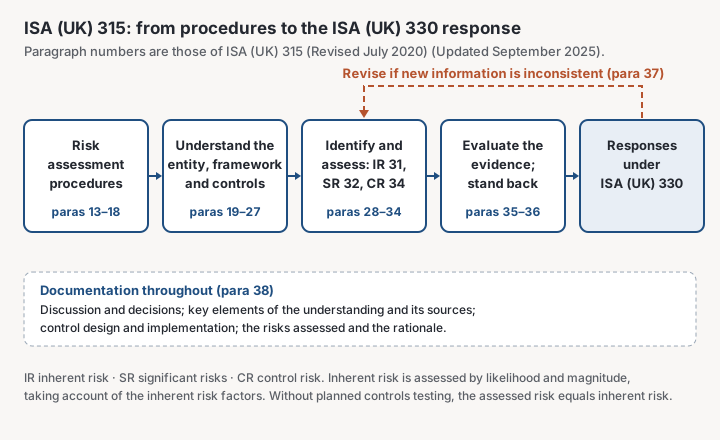
This is the engagement's risk assessment; a firm's own quality risk assessment under ISQM (UK) 1 is separate (see the ISQM 1 risk assessment template).
ISA 315 revised: summary of the changes
The July 2020 revision replaced ISA (UK) 315 (Revised June 2016). What changed, on a smaller file:
| Change | Paras | On a smaller file |
|---|---|---|
| Inherent risk and control risk assessed separately | 5, 31, 34 | With no controls testing, the risk of material misstatement equals inherent risk |
| Five inherent risk factors and a spectrum of inherent risk | 12(f), 31 | Each risk needs a reason for its position |
| Significant risk: close to the upper end of the spectrum, or required by another ISA (UK) | 12(l), 32 | Replaces the 2016 definition, a risk that "requires special audit consideration" |
| Procedures must produce evidence, without bias towards corroboration | 13 | The file shows what each procedure found |
| An evaluation of each internal control component | 21–25, 27 | Each component ends in a conclusion |
| Controls identified in the control activities component | 26(a) | Replaces "controls relevant to the audit"; journal controls on every audit |
| IT applications, risks arising from IT, general IT controls | 26(b)–(c) | Usually short on one commercial package (A170) |
| Contradictory evidence taken into account | 35 | The file records what did not fit |
| The stand-back | 36 | A short evaluation of material items with no identified risk |
| "Scalability" material in place of smaller-entity sections | 9, A16–A17 | Proportion comes from complexity, not a lighter standard |
What did not change: the audit risk model is ISA (UK) 200's (paragraph 13(c)), and the responses are still ISA (UK) 330's.
What risk assessment procedures does ISA (UK) 315 require?
Three types: inquiries of management and others, analytical procedures, and observation and inspection (paragraph 14). The auditor also considers information from acceptance or continuance and when applicable, from other engagements the engagement partner has performed for the entity (15), evaluates whether any earlier-year information it uses is still relevant and reliable (16), and holds the engagement team discussion (17–18), whose fraud emphasis comes from ISA 240 revised.
All three types must be used, though not for every aspect of the understanding (A20). Where an owner-managed company has no structured processes, the same understanding is required, but the auditor may be able to perform the procedures "through observation and inquiry" (A17), and on a recurring audit they may focus on what has changed (A18).
Are they the same as further audit procedures? No, they build the basis for them (13(b)), though both may be performed at the same time where efficient (A19).
Understanding the entity and its environment
Paragraph 19 covers the entity (structure, ownership, governance, business model, external factors, performance measures), the framework and accounting policies, and how the inherent risk factors affect susceptibility to misstatement; paragraph 20 adds an evaluation of the policies. Each component of internal control then ends in an evaluation:
| Component | Para | The auditor concludes on | At an owner-managed company |
|---|---|---|---|
| Control environment | 21 | A culture of honesty and ethical behaviour; an appropriate foundation; deficiencies that undermine the rest | The owner-director may be the governance (A99); evidence may not be documentary (A100) |
| Risk assessment process | 22–23 | Whether it suits the entity; why it missed a risk it should have identified (23) | Often the owner's direct involvement, unwritten (A113) |
| Monitoring | 24 | Whether it suits the entity | Hands-on oversight; review of management accounts (A114–A115) |
| Information system and communication | 25 | Whether it supports the preparation of the financial statements | For significant classes, balances and disclosures |
| Control activities | 26 | Controls identified; design and implementation | Next section |
| Deficiencies | 27 | Whether any are identified | Recorded and communicated |
The FRC's Practice Note 28 (March 2026), on applying the ISAs (UK) to small and medium-sized entities, says that where few factors raise risk, "a brief description of the key aspects and their impact will usually be sufficient" (paragraph 45). Where that holds, an owner-managed company's understanding can be one integrated note, not a questionnaire per component.
IT in a less complex entity
Appendix 5 (paragraph 6) says the IT environment is easier to understand where a less complex entity uses commercial software and cannot change its source code, and A170 says such an entity is unlikely to have, or need, formal general IT controls. Who can access the package is usually the question that remains.
Must you understand controls on a substantive audit?
Not all of them, but some, whatever the approach. Paragraph 26 lists the controls to identify (table below); for each, design is evaluated and implementation determined by more than inquiry (26(d)). If no controls testing is planned, the risk of material misstatement is assessed as equal to inherent risk (paragraph 34).
| Control | Identify | Design and implementation | Test operating effectiveness? |
|---|---|---|---|
| Over a significant risk | 26(a)(i) | Yes | Only if relying on it, then in the current period (ISA (UK) 330 para 15) |
| Over journal entries | 26(a)(ii); every audit (A160) | Yes | Only if relying on it |
| The auditor plans to rely on | 26(a)(iii) | Yes | Yes (330 para 8(a)) |
| Substantive procedures alone not enough | 26(a)(iii), para 33 | Yes | Yes (330 para 8(b)) |
| Others, by judgement | 26(a)(iv) | Yes | Only if relying on it |
| General IT controls over identified applications | 26(c) | Yes | Only if relying on them |
Identifying a control over a significant risk does not mean testing it: testing follows only where the auditor intends to rely on the control (330 paragraph 15) or substantive procedures alone are not enough (330 paragraph 8(b)), and a substantive-only response to a significant risk must include tests of details (330 paragraph 21). Practice Note 28 adds that where no controls are relied on and there are no significant risks and no other risks needing design and implementation work, the identified controls may be only those over journals and the IT controls supporting them (paragraphs 64–68), but that auditors "should not automatically default to a fully substantive approach" (paragraph 69).
Inherent risk factors and the spectrum of inherent risk
Inherent risk is an assertion's susceptibility to material misstatement before any related controls; control risk is the risk that the entity's system of internal control will not prevent, or detect and correct, that misstatement on a timely basis (paragraph 4). The two are assessed separately (5, 31, 34).
For each assertion-level risk the auditor assesses inherent risk by likelihood and magnitude, taking account of how far the inherent risk factors affect the relevant assertions (paragraph 31). Paragraph 12(f) names five: complexity, subjectivity, change, uncertainty, and susceptibility to misstatement due to management bias or other fraud risk factors. A low likelihood with a very high magnitude can still put a risk high on the spectrum (A213).
The standard sets no grades. The auditor may use categories, and the assessment is appropriate when the further procedures respond to it and to its reasons (A214). That is the point of a spectrum: the reason drives the response (ISA (UK) 330 paragraph 7(a)).
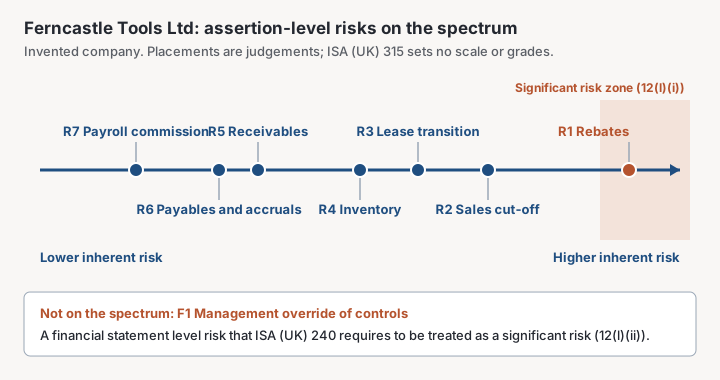
A significant risk sits close to the upper end, or another ISA (UK) requires it to be treated as significant (12(l), 32); ISA (UK) 240 makes every assessed fraud risk significant (paragraph 28), including the presumed revenue fraud risk (unless the presumption is rebutted) and management override, and ISA (UK) 550 paragraph 18 does the same for significant related party transactions outside the normal course of business. Paragraph 33 asks whether substantive procedures alone could fall short, for example where processing is highly automated (A224).
A worked risk assessment for a smaller owner-managed company
Ferncastle Tools Ltd is invented. The layout is not any firm's methodology, and the positions on the spectrum are judgements, not the output of a formula.
The facts
- Business. Distributes tools to builders' merchants; year ending 31 December 2026; a continuing audit. Revenue £19,200,000, total assets £10,360,000, 46 employees: above two of the small-company limits (£15m turnover, £7.5m balance sheet total), as for several years.
- Ownership. The managing director owns 75% and plans to sell a minority stake in 2027 at a price based on 2026 EBITDA. The sales director owns the rest.
- Finance. One finance manager; a cloud accounting package with a stock module; a payroll bureau.
- Change. The first year under the revised FRS 102 (periods beginning on or after 1 January 2026). The ten-year warehouse lease, with a year-five break, comes on balance sheet: a right-of-use asset of £1,960,000 and a lease liability of £2,050,000 at the year end, comparatives not restated (FRS 102 paragraph 1.47). Volume rebates are variable consideration under the revised Section 23 (23.43 to 23.47), with an accrual of £610,000 at the year end.
- Materiality. £165,000, set by the engagement team.
- Approach. No testing of the operating effectiveness of controls is planned.
The understanding, in one page
One note, organised by paragraph (on file, each line names its source):
- Entity (19(a)). The stake sale puts weight on 2026 EBITDA: a management bias factor.
- Framework (19(b), 20). A new rebate estimate and the lease transition; policies appropriate.
- Control environment (21). Open culture, but the managing director approves almost everything (A157): an adequate foundation, with dominance carried as risk F2.
- Risk assessment process (22–23). Unwritten monthly review by the directors. It missed the lease transition until planning raised it, so the note records why (23).
- Monitoring (24). Monthly management accounts reviewed against budget.
- Information system (25). Dispatch triggers the invoice; rebates and the lease schedule sit in spreadsheets outside the ledger.
- Deficiencies (27). Manual journals are not reviewed (below).
The risk table
No controls testing is planned, so for every row the assessment equals inherent risk (paragraph 34).
| Ref | Area | Relevant assertions | Inherent risk factors present | Position on the spectrum, and why | Response (ISA (UK) 330) |
|---|---|---|---|---|---|
| R1 | Revenue: customer volume rebates | Accuracy (revenue); valuation, completeness (accrual) | Change, subjectivity, susceptibility to management bias or fraud | Upper end: significant risk. Year-end estimate by the sales director, in the year EBITDA prices a stake sale; the presumed revenue fraud risk is directed here | Tests of details on the accrual and post-year-end credit notes (330 para 21) |
| R2 | Revenue: sales cut-off | Cut-off, occurrence | Susceptibility to management bias | Higher. December dispatches run high; the exposure is goods shipped in the last days | Cut-off testing against dispatch records |
| R3 | Leases: warehouse lease on transition | Completeness, accuracy, valuation; presentation | Change, complexity, subjectivity | Middle. One lease, but the borrowing rate and the year-5 break are one-off judgements | Recompute; challenge the rate and the break |
| R4 | Inventory: valuation and existence | Valuation, existence | Subjectivity, uncertainty | Middle. Age-band provision set by the finance manager; two lines being discontinued | Attend the count; test the provision against later sales |
| R5 | Trade receivables: recoverability | Valuation | Uncertainty | Lower-middle. Mostly credit-insured; one uninsured customer is over 90 days overdue | After-date cash; review the overdue account |
| R6 | Trade payables and accruals: completeness | Completeness | Susceptibility to management bias | Lower. Invoices matched in the stock module; year-end freight and duty arrive late | Search for unrecorded liabilities |
| R7 | Payroll: sales commission | Accuracy, occurrence | Complexity (limited) | Lower end. Bureau payroll; only quarterly commission is a spreadsheet | Recalculate commission |
| Ref | Financial statement level risk | Assessment, and why | Response |
|---|---|---|---|
| F1 | Management override of controls | Significant risk by rule. ISA (UK) 240 (Revised May 2021) para 32: present in all entities | Journal testing and the other override procedures |
| F2 | Owner-director dominance; informal controls | Not placed: raises R1 and R4. The managing director owns 75% and approves almost everything | More scepticism; senior review of judgements (330 para 5) |
R1 is significant on two counts. ISA (UK) 240 (Revised May 2021) presumes a fraud risk in revenue recognition and requires the auditor to evaluate which types of revenue give rise to it (paragraph 27); here that is the rebate estimate, not routine invoicing or cut-off, which dispatch triggers. And a 30% error in the rebate accrual moves profit by £183,000, more than materiality. The accounting behind R1 and R3 is in our guides to FRS 102 revenue recognition and FRS 102 lease changes.
If the revised FRS 102 is adding to your audit work, partner with us: we bring clients and a platform designed to save your team hours, and your firm remains the auditor and signs.
Controls identified under paragraph 26
- Over R1 (26(a)(i)). The managing director signs each rebate agreement and reviews the year-end accrual, which the finance manager calculates from the stock module's volume reports and the sales director's estimate of which customers will reach each tier. Design and implementation: inspect the agreements, walk through the December calculation, inspect the evidence of review. Inquiry alone does not establish implementation (26(d)(ii)).
- Over journals (26(a)(ii)). The finance manager posts every manual journal and nobody reviews them; the managing director also has administrator rights. No control over manual journals is designed, so the team records a deficiency (27). The F1 override procedures run regardless.
- IT (26(b)–(c)). The package is the IT application identified, because the R1 review relies on its volume reports and every journal is posted in it; user access is the general IT control evaluated.
- 26(a)(iii) and (iv). None: no controls testing, and no risk that substantive procedures alone cannot address (33).
The stand-back (paragraph 36)
For each material class, balance or disclosure not determined to be significant (no assertion has an identified risk), the auditor evaluates whether that determination remains appropriate. Among the balances modelled at Ferncastle, that is cash (£720,000), fixtures and vehicles (£540,000) and VAT payable (£280,000); any other material class or disclosure with no identified risk gets the same evaluation. Each determination is confirmed, and all three still get substantive procedures, which ISA (UK) 330 paragraph 18 requires for every material class.
Risks considered and not taken: going concern (profitable and cash-positive; the going concern audit procedures are still done); foreign exchange (euro payables of £120,000, below materiality); and fraud in routine invoicing, where the revenue presumption was evaluated and directed elsewhere.
Documenting it without the box-ticking
Paragraph 38, read with ISA (UK) 230, requires four things: the team discussion and significant decisions; the key elements of the understanding (paragraphs 19, 21, 22, 24 and 25), their sources and the procedures performed; the evaluation of design and implementation of identified controls; and the assessed risks, with the rationale for significant judgements.
The form is the auditor's judgement (A239). For a less complex entity it "may be simple and relatively brief", need not cover the whole understanding or every inherent risk factor (A241), and may be carried forward and updated (A237). Practice Note 28 says a single sentence per line item may justify a low inherent risk (paragraph 83). ICAEW's Audit & Beyond called checklists aide-memoires, "not the audit" (March 2024).
A reviewer will look for:
- a reason beside each position, tied to an inherent risk factor;
- implementation evidence for journal controls that goes beyond inquiry;
- the paragraph 36 evaluation;
- contradictory evidence and what was done with it (35);
- a line from each risk to its response.
ICAEW's Audit Monitoring Report 2026 says the weaknesses its reviews find "have not substantially changed", and names risk assessment first among those its previous report highlighted. A cold file review tests a file for them. Paragraph 37 requires the assessment to be revised when new information is inconsistent with the evidence it rested on.
ISA (UK) 315 and the 2026 revisions
Two revised standards build on ISA (UK) 315 for periods beginning on or after 15 December 2026, first affecting calendar-year files ending 31 December 2027. Ferncastle's 2026 file still uses the earlier editions of ISA (UK) 240 and 570.
- ISA 240 revised: ISA (UK) 240 (Revised March 2026) adds fraud requirements to the ISA (UK) 315 understanding of the entity, each component and deficiencies (paragraphs 31 to 37) and treats management override as a financial statement level fraud risk (40).
- ISA 570 revised: ISA (UK) 570 (Revised March 2026) requires events or conditions to be identified before mitigating factors (11) and a conclusion on control deficiencies in management's going concern assessment from the ISA (UK) 315 evaluation (15).
Both make conforming amendments to ISA (UK) 315, effective with them: ISA (UK) 240's add "whether due to fraud or error" to paragraph 35 and update cross-references. The FRC's standard page still lists the September 2025 update as the current edition.
The IAASB's ISA for Less Complex Entities is not adopted in the UK. After a call for views, the FRC's feedback statement of 25 August 2026 found no basis "to reconsider its position", pointing to the ISAs (UK) supported by Practice Note 28. Effective dates for every standard are on the UK auditing standards hub.