FRS 102 Section 23 transition: the two methods, the practical expedients and the first-year disclosures
By Alon Zieve FCA · Last reviewed
Every company reporting under FRS 102 makes the Section 23 transition in its first accounting period beginning on or after 1 January 2026, unless it adopts early (paragraph 1.37(b)), from a date of initial application at the start of that period (1.40(a)). It chooses one of two methods (1.61): take the cumulative effect to opening retained earnings at that date, without restating comparatives and only for contracts not completed under the old rules; or restate the comparatives in full under Section 10.
Below, for the FRS 102 revenue transition: dates by year end, each method's expedients, one set of contracts worked through both, and the first-year note. The five-step model itself is explained in FRS 102 revenue recognition. Paragraphs are from FRS 102 (September 2024), the current edition.
When the revenue transition applies to your year end
The revised Section 23 applies, with the rest of the Periodic Review 2024 amendments, to periods beginning on or after 1 January 2026 (1.37(b)).
| Year end | First year end on the new rules | Date of initial application (1.40(a)) | Method (b): earliest period presented begins |
|---|---|---|---|
| 31 December | 31 December 2026 | 1 January 2026 | 1 January 2025 |
| 31 March | 31 March 2027 | 1 April 2026 | 1 April 2025 |
| 30 June | 30 June 2027 | 1 July 2026 | 1 July 2025 |
| 30 September | 30 September 2027 | 1 October 2026 | 1 October 2025 |
| 30 June, adopting early | 30 June 2026 | 1 July 2025 | 1 July 2024 |
The dates assume 12-month periods and one comparative period. FRC staff give the 31 March case as Example 1 in Factsheet 9.
Leases are different: lessees have a single method, with no restated comparatives (1.47): see FRS 102 lease changes. The other amendments' transition rules are in FRS 102 changes, and the series in the UK accounting guides.
FRS 102 Section 23 early adoption
Not on its own. Early application is permitted only "provided that all these amendments are applied at the same time" (1.37(b)), so a company adopting the revised Section 23 early also adopts the new lease model and the rest, and discloses that fact (1.38; a small entity in the Republic of Ireland is only encouraged to). It means applying them to a period that began before 1 January 2026, so it is open now only where those accounts are not yet approved.
How the FRS 102 Section 23 transition works: two methods
Paragraph 1.61 gives two methods, both retrospective: (a) with the cumulative effect taken to opening retained earnings (or another component of equity) at the date of initial application, or (b) under paragraph 10.12, restating comparatives.
| Method (a): cumulative effect | Method (b): full retrospective | |
|---|---|---|
| FRC staff name (Factsheet 9) | Modified retrospective approach | Full retrospective approach |
| Comparatives | Not restated (1.62(a)) | Restated (10.12) |
| Contracts caught | Those not completed at the date of initial application (1.62(b)) | All in the periods presented, less any 1.65(a) exclusions |
| Where the effect goes | Opening retained earnings at the date of initial application (1.61(a)) | Opening equity of the earliest period presented, and the comparatives (10.12) |
| Practical expedients | Two: 1.65(b) and (c) (1.62(c)) | Four: 1.65(a) to (d) |
| First-year disclosure | 1.63 in place of 10.13(b) to (d) | 10.13, with 10.13(b) for the immediately preceding period only (1.64) |
The standard names neither method; the table's names are the FRC staff's, from FRS 102 Factsheet 9 (re-issued May 2026), which is guidance, not the standard. The FRC's Basis for Conclusions describes method (a) as "similar to the 'cumulative catch-up' transition method in IFRS 15", with more scope for hindsight (B23.12). Some guidance swaps the paragraph letters; in the standard, 1.61(a) is the cumulative-effect method.
Under method (b), the new policy is applied to comparatives as if it had always applied, to the earliest date practicable (10.12). For a 31 December 2026 year end that means a restated balance sheet at 31 December 2025 and a restated 2025 income statement, which needs a restated position at 1 January 2025 that is not itself presented (Factsheet 9, Example 2).
First-year revenue often comes out the same under both, as in the worked example, but not always: a contract that counts as completed under 1.67 drops out of method (a) yet is restated under method (b), and the expedients differ.
Which contracts each method catches
Under method (a), every contract that is not a completed contract at the date of initial application (1.62(b)). Under method (b), every contract in the periods presented, unless the company uses 1.65(a) to leave out completed contracts that begin and end within the same annual reporting period (1.65(a)(i)), or that are completed at the beginning of the earliest period presented (1.65(a)(ii)). Neither expedient is available under method (a), which leaves completed contracts out.
What counts as a completed contract
A completed contract is one for which the company "has transferred all the goods or services identified in accordance with previous requirements" (1.67). The test looks back at what the old policy identified, not at the performance obligations Section 23 would identify. So if the old policy treated a sale as a single delivery of goods and recognised all of it on delivery, the contract is completed once the goods were delivered, even if Section 23 would have deferred part of the price for a service still to be provided. Under method (a) that contract drops out.
The input either way is a list of contracts open at the date of initial application, with their terms and modification history from inception; method (b) adds the contracts open at any point in the comparative year.
FRS 102 Section 23 practical expedients: what each method allows
There are four practical expedients (1.65). Method (b) can use all four; method (a) only 1.65(b) and (c) (1.62(c)). Each one used is applied consistently to all contracts and periods presented, and its use is disclosed (1.66).
| Expedient | What it does | Method (a) | Method (b) |
|---|---|---|---|
| 1.65(a)(i) | No restatement of completed contracts that begin and end within the same annual reporting period | No | Yes |
| 1.65(a)(ii) | No restatement of contracts completed at the beginning of the earliest period presented | No | Yes |
| 1.65(b) | For completed contracts with variable consideration, use the transaction price at completion instead of estimating it in the comparative periods | Yes (1.62(c)) | Yes |
| 1.65(c) | Reflect the aggregate effect of all modifications before a cut-off date, instead of restating each one under 23.15 to 23.16 | Yes (1.62(c)) | Yes |
| 1.65(d) | No 23.137 disclosure (unsatisfied performance obligations) for prior periods presented | No | Yes |
Some summaries leave 1.65(b) out of method (a); 1.62(c) includes it.
Modifications before the date of initial application
Under 1.65(c), a contract modified before the date of initial application need not be replayed modification by modification under 23.15 to 23.16. The company looks at it once, reflecting the aggregate effect of all modifications before the beginning of the earliest period presented or before the date of initial application, to identify the satisfied and unsatisfied performance obligations, determine the transaction price and allocate it. The standard does not tie either cut-off to a method; Factsheet 9 says it depends on the transition approach. For a calendar year company the two dates are 1 January 2025 and 1 January 2026.
Variable consideration, and a point the standard leaves open
1.65(b) lets a company take the transaction price at completion of a completed contract rather than estimate variable consideration in the comparative periods. Method (a) may use it too (1.62(c)), but the wording does not fit: 1.65(b) speaks of completed contracts and comparative periods, while method (a) leaves completed contracts out (1.62(b)) and restates no comparatives (1.62(a)). The standard does not say how the two fit together.
FRC staff describe the expedient under method (a) as applying to contracts "completed by the reporting date" (Factsheet 9). That is staff guidance, not the standard. A company relying on 1.65(b) under method (a) should record the reading it has taken, apply it to all contracts, and disclose that it used the expedient (1.66).
Subsidiaries of IFRS 15 groups
There is no revenue equivalent of the lease option to take over a group's IFRS figures (1.48 is for leases only). The FRC's aim was to "allow, but not require" policies equivalent to IFRS 15 (B23.5(a)), and the requirements allow a policy that meets both (B23.9), but a subsidiary of an IFRS 15 group still applies 1.61 to 1.67 to its own contracts.
Worked example: three contracts through both methods
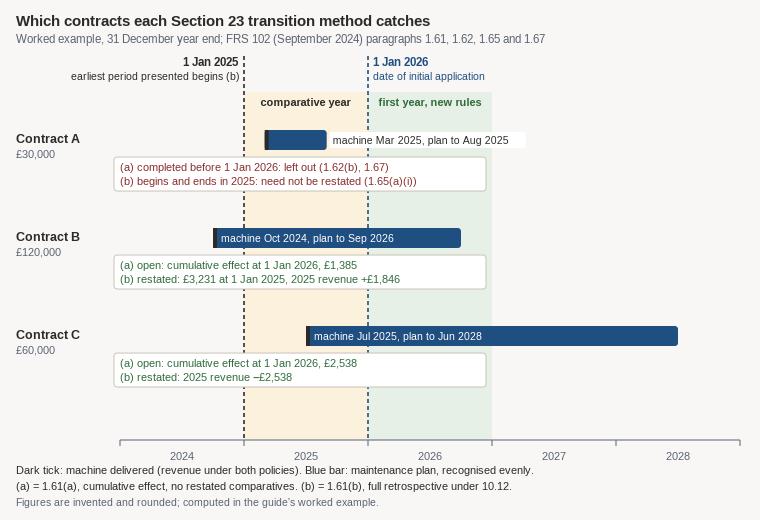
An equipment supplier with a 31 December year end sells machines with a maintenance plan included in the price. Figures are invented and computed in code.
- Old policy (FRS 102 January 2022, 23.8 and 23A.19): machine revenue on delivery; the amount deferred for servicing is its expected cost plus a profit, here 20%, recognised evenly.
- New policy (23.65, 23.67): the price is allocated on relative stand-alone selling prices; machine on delivery, maintenance evenly over the plan.
| Contract | Price | Delivered | Plan | Old: deferred for maintenance | New: allocated to maintenance |
|---|---|---|---|---|---|
| A | £30,000 | 1 March 2025 | 6 months, to August 2025 | £3,600 | £5,625 |
| B | £120,000 | 1 October 2024 | 24 months, to September 2026 | £24,000 | £27,692 |
| C | £60,000 | 1 July 2025 | 36 months, to June 2028 | £10,800 | £13,846 |
A's machine and maintenance were both delivered by August 2025, so A is a completed contract at 1 January 2026 (1.67). B and C are not: the old policy identified maintenance still to be provided.
Method (a). Only B and C are adjusted, with the cumulative effect at the date of initial application.
| Contract | Revenue to 31 December 2025, old policy | Revenue to 31 December 2025, new policy | Adjustment at 1 January 2026 |
|---|---|---|---|
| B | £111,000 | £109,615 | £1,385 |
| C | £51,000 | £48,462 | £2,538 |
| Total | £3,923 |
At 1 January 2026: debit retained earnings £3,923, credit contract liability £3,923. Deferred maintenance revenue rises from £18,000 to £21,923 on that date.
Method (b). At 1 January 2025 only B had started: restating it gives an opening adjustment of £3,231 to retained earnings. 2025 revenue is then restated contract by contract: B rises by £1,846, C falls by £2,538, and A is unchanged in total because it began and ended in 2025, which is why 1.65(a)(i) spares the work. Restated 2025 revenue from the three contracts is £92,308 against £93,000 as reported, £692 lower. The £3,231 and the £692 together equal method (a)'s £3,923, the fall in restated retained earnings at 31 December 2025.
2026, the first year. Under either method, revenue from B and C in 2026 is £15,000, against £12,600 under the old policy: £2,400 higher. Maintenance costs are unchanged, so profit before tax is £2,400 higher too. 1.63(a) also asks for the profit or loss adjustment, after any tax, not computed here. The £3,923 deferred at transition is recognised over 2026 to 2028.
FRS 102 revenue transition disclosures in the first year
The change-of-policy note under 10.13 applies, with a substitution. Under method (a), 10.13(b) to (d) are replaced by the current period's adjustment to revenue and to profit or loss, to the extent practicable, with the reasons for significant changes (1.63). Under method (b), the line-item adjustments under 10.13(b) are given for the immediately preceding period only (1.64).
| Disclosure | Method (a) | Method (b) |
|---|---|---|
| Nature of the change (10.13(a)) | Yes | Yes |
| Line-item adjustments (10.13(b)) | Not required (1.63) | Immediately preceding period only (1.64) |
| Adjustment for periods before those presented (10.13(c)) | Not required (1.63) | Yes, to the extent practicable; 1.64 limits only (b) |
| Explanation if impracticable (10.13(d)) | Not required; 1.63(b) gives its own | If impracticable |
| Current-year effect on revenue and profit or loss (1.63(a)) | Yes, to the extent practicable | No |
| Expedients used (1.66) | Yes, if any | Yes, if any |
| Early adoption (1.38) | If adopted early | If adopted early |
| Unsatisfied performance obligations for prior periods (23.137) | No 1.65(d) relief; comparatives are not restated (1.62(a)) | Not required if 1.65(d) is used |
Some guidance asks for 10.13(b) amounts for every prior period under method (b); 1.64 does not.
The ongoing revenue disclosures (23.131 to 23.139) start in the same year: see FRS 102 revenue recognition. Under method (a) the opening adjustment goes to equity, not profit or loss (1.61(a)); nothing in 1.61 to 1.67 makes it an exceptional item.
Keeping the old figures for a year
To give the 1.63(a) figure, a company on method (a) needs the first year's revenue and profit under both the new policy and the old one. That means running the old policy in parallel for that year, or explaining why the amounts are impracticable to determine (1.63(b)).
Illustrative note wording
For the worked example's company only: "The company has applied the revised Section 23 of FRS 102 from 1 January 2026, recognising the cumulative effect, a reduction of £3,923 before tax, in opening retained earnings. Comparatives have not been restated. Revenue and profit before tax for the year are £2,400 higher than under the previous policy, because more of each contract price is allocated to maintenance, recognised over the plan rather than on delivery."
Section 1A companies
A small company gives the Appendix C disclosures as a minimum (1A.16A), plus what a true and fair view needs (1A.16). It is not specifically required to comply with the disclosures in Sections 8 to 35 (1A.17), so 10.13 is not specifically required. The transition paragraphs sit in Section 1, which 1A.17 does not list, and 1A.1 applies every requirement unless Section 1A excludes it. The standard does not say expressly whether 1.38, 1.63 and 1.66 bind a small company, so giving them is the cautious course.
Company law adds particulars where a comparative is adjusted (1AC.8, Schedule 1 paragraph 7(2)), which arises under method (b), and the effect of any prior-period amount included in an income statement item (1AC.9). From the first year a small company also gives the performance-obligation disclosures in 23.135(a) to (c) (1AC.32B). The full checklist is in FRS 102 1A disclosure requirements.
Choosing a method, and the transition file
The standard sets no criteria. The choice turns on who reads the accounts and what data exists for contracts open during the comparative year.
| Situation | Leans towards | Why |
|---|---|---|
| Lenders or investors compare the two years | Method (b) | Both years on the same basis |
| Covenants, earn-outs or bonuses defined on revenue or profit | Read the agreement | Its definitions decide |
| Few contracts open at the date of initial application | Method (a) | Only open contracts are adjusted |
| Poor records for contracts completed in the comparative year | Method (a) | Method (b) needs them, unless an expedient applies |
| Many contracts begin and end within a year | Either | Left out of both: completed (a), or 1.65(a)(i) (b) |
| Group reports under IFRS 15 | Either | Group records may help where the policy meets both (B23.9) |
| Prior year accounts were audited | Weigh the extra work | Restated comparatives need supporting workings |
Either way, keep a transition file:
- the method chosen and why;
- the list of contracts open at the date of initial application, with their terms;
- the completed-contract judgements under 1.67, made against the old policy;
- each expedient used, and the reading taken on 1.65(b) under method (a);
- the workings for the opening adjustment, contract by contract;
- under method (a), the first year's revenue and profit under the old policy;
- the workings behind the 1.63 or 1.64 disclosures.
It belongs with the rest of the year end audit checklist. For accountants in practice, the first year ends on the new rules add this work to a normal busy season. If capacity limits how many audits you can accept, partner with us: our platform finds documents, reconciles figures and helps your team prepare its work, saving it hours, and you remain the auditor and sign.
Tax, first-time adopters and other cases
Deferred tax and corporation tax
The adjustment can create or change a timing difference, on which Section 29 recognises deferred tax (29.6); tax on an item taken to equity is presented in equity (29.22). For corporation tax, a trading company's change of accounting policy changes the basis on which its trade profits are calculated (Corporation Tax Act 2009 s180(3)); where both bases accord with the law and practice of their periods (s180(1)), the adjustment, calculated under s182, is brought into account as a receipt or a deduction treated as arising on the first day of the first period of account on the new basis (s181), subject to sections 183 to 185. Leases have their own tax rules (see FRS 102 changes); take tax advice on the timing for your company.
Companies adopting FRS 102 for the first time
A first-time adopter may use the 1.65 expedients, reading the date of initial application as the beginning of the reporting period and "completed contract" by its previous financial reporting framework; if it does, it applies 1.66 too, so it uses them consistently and discloses them (35.10(y)).
A company resuming FRS 102
A company that applied FRS 102 before but not in its most recent annual accounts discloses why it stopped, why it is resuming, and whether it has applied Section 35 or applied the standard retrospectively under Section 10 (35.12C).
Micro-entities on FRS 105
Micro-entities apply the revised revenue section only to contracts that begin after the date of first application, and do not change the policy for contracts in progress at that date (FRS 105 1.11): see FRS 105 vs FRS 102.