Lease term, break clauses and options under FRS 102
By Alon Zieve FCA · Last reviewed
For accounting periods beginning on or after 1 January 2026, a company applying FRS 102 sets the lease term at the commencement date: the non-cancellable period, plus any period under an option to extend that it is reasonably certain to exercise, plus any period after a break clause it is reasonably certain not to exercise (paragraph 20.38). So a tenant's break clause is not automatically the end of the lease term, a break that only the landlord can use never shortens it, and a UK business lease that runs on past its end date under the Landlord and Tenant Act 1954 can still be a lease with a term to set.
This guide is for finance teams setting the term, and for the accountants and audit teams who review it: each type of break and option, the 1954 Act, when to revisit the term, a worked example and the evidence to keep. What else changed for lessees is in FRS 102 lease changes; the rest of the series is under lease accounting guides in our UK accounting guides.
What is the lease term under FRS 102?
The lease term is the non-cancellable period of the lease, plus periods covered by an option to extend that the lessee is reasonably certain to exercise, plus periods covered by an option to terminate that it is reasonably certain not to exercise (20.38). It begins at the commencement date and includes any rent-free period the landlord gives (20.37).
- It is judged at the commencement date (20.40), the date the landlord makes the property available for use (Glossary), not the inception date. The pre-2026 Section 20 tested options "at the inception of the lease", and some guidance still describes that test.
- The shorter period wins unless the tenant is reasonably certain to choose the longer (20.40).
- "Reasonably certain" is not defined. FRS 102 gives factors (20.41) and past practice (20.42), but no percentage.
Small companies set the term the same way: Section 1A relieves disclosures, not recognition and measurement (1A.1). The revised Section 20 is based on the IFRS 16 model (Basis for Conclusions B20.3), and the lease term is not among the simplifications the FRC lists (B20.8 to B20.12); the comparison is in FRS 102 vs IFRS 16.
The term sets the payments in the lease liability (20.49, 20.51) and the depreciation period (20.58). A term of 12 months or less at commencement, with no purchase option, makes a short-term lease (Glossary), which can be kept off the balance sheet by election (20.5(a), 20.7).
Paragraphs are FRS 102 (September 2024 edition, still current; the March 2025 and February 2026 amendments do not touch Section 20).
How does a break clause affect the lease term under FRS 102?
It depends on who can use the break and on the tenant's incentives. The period after a tenant-only break counts only if the tenant is reasonably certain not to break (20.38(c)); a landlord-only break is ignored; a break both sides can use freely ends the enforceable period (20.39).
| Clause | Who can use it | Effect on the lease term | Paragraph |
|---|---|---|---|
| Tenant break | Tenant only | The period after the break counts only if the tenant is reasonably certain not to break | 20.38(c), 20.40 |
| Landlord break | Landlord only | The period after the break counts: it is part of the non-cancellable period | 20.38(c), last sentence |
| Mutual break | Each side, without the other's permission, with no more than an insignificant penalty | The lease is not enforceable beyond the break | 20.39 |
| Conditional tenant break | Tenant, if it meets the conditions | As a tenant break; the conditions are weighed in the judgement | 20.38(c), 20.41(e) |
| Tenant break with a penalty | Tenant | The penalty is a cost of leaving, and a lease payment if the term assumes the break | 20.41(c), 20.51(e) |
| Option to extend | Tenant | The extra period counts only if the tenant is reasonably certain to exercise it | 20.38(b) |
| Renewal only by agreement | Neither side alone | Adds nothing: no enforceable right beyond the initial period | 20.39, Glossary "contract" |
| Option to buy | Tenant | Exercise price in the liability if reasonably certain; never a short-term lease | 20.51(d), Glossary |
| 1954 Act continuation | The statute (England and Wales) | Occupation after the end date can still be an enforceable lease | 20.39; 1954 Act s24 |
| Contracted-out lease at its end date | Not applicable | The lease ends; staying on is a new arrangement | 20.39; 1954 Act s38A |
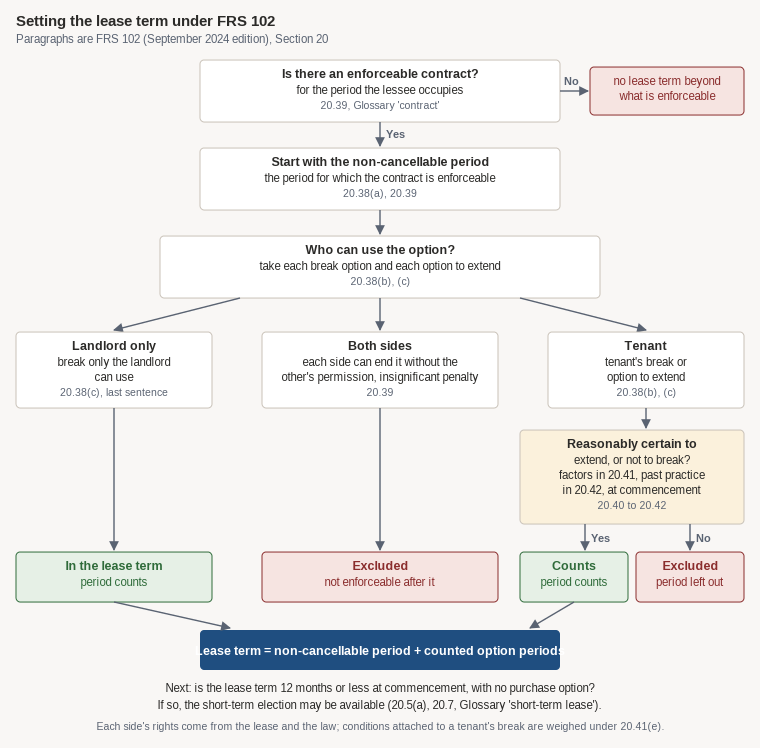
Landlord-only and mutual breaks
"If only the lessor has the right to terminate the lease, the non-cancellable period of the lease includes the period covered by the lessor's option to terminate the lease" (20.38(c)). So a landlord's redevelopment break does not shorten the term, however likely its use.
Where both sides can end the lease at the break date, each without the other's permission and with no more than an insignificant penalty, the lease stops being enforceable there (20.39). The FRC's Factsheet 11, on rolling leases, asks whether "any economic penalty" from cancelling is more than insignificant, which suggests the test looks beyond a contractual fee: a tenant facing a large fit-out write-off and a costly move may not be free to leave on equal terms, so the lease may stay enforceable past the break.
Conditional breaks and break penalties
Tenant breaks are often conditional on vacant possession, rent paid to the break date or no material breach, and "conditionality associated with exercising the option" is a factor (20.41(e)): a tenant that could not realistically give vacant possession on time has a weaker case for a term to the break. A break penalty is a cost of leaving (20.41(c)) and, if the term assumes the break, a lease payment (20.51(e)). In the FRC's Example 3d, a tenant reasonably certain not to use a five-year break with a CU5,000 penalty has a ten-year term and no penalty in its payments.
A rent review on the break date is not a break: a review to market rent is a variable payment (20.53), remeasured when the new rent takes effect (20.68(b)).
Extension options, renewals and options to buy
A tenant's option to extend adds its period only if the tenant is reasonably certain to exercise it (20.38(b)). Start with the rent: an option at a rent well below the expected market rent gives a reason to stay; one at market rent gives none on price (20.41(a)). The FRC's Example 2 counts a five-year extension because of a significant fit-out and a history of extending.
A "renewal" that needs both sides to agree adds nothing. A contract "creates enforceable rights and obligations" (Glossary), and the non-cancellable period is the period for which it is enforceable (20.39); an agreement to negotiate gives neither side a right beyond the initial period.
An option to buy is a lease payment only if the tenant is reasonably certain to exercise it (20.51(d)), and then the right-of-use asset is depreciated over the property's useful life (20.58).
Is it reasonably certain? The lease term factors and the evidence to keep
The judgement weighs the facts that give the tenant an economic reason to stay or to go, using the factors in 20.41 and the company's past practice with similar assets (20.42), as they stand at the commencement date. The list in 20.41 is not exhaustive.
| Factor in FRS 102 | In a UK office, shop or warehouse lease | Evidence to keep |
|---|---|---|
| (a) "the contractual terms and conditions compared with market rates" | Rent in the option period, or after the break, against the market rent | Agent's rent evidence; the rent review clauses |
| (b) "significant leasehold improvements expected to have significant economic benefit when the option becomes exercisable" | A fit-out with years of useful life left at the break date | Fit-out budget and approval; its depreciation life |
| (c) "the costs relating to the termination of the lease" | Break penalty, moving, a new fit-out elsewhere, disruption, dilapidations on exit | Dated estimates or quotes |
| (d) "the importance of the underlying asset to the lessee's operations" | A head office, flagship shop or specialised warehouse, against a satellite office | Site strategy; board papers |
| (e) "conditionality associated with exercising the option" | Vacant possession, rent paid to date, no material breach | The clauses; whether the company can meet them |
| 20.42: past practice "regarding the period for which it has typically used similar assets" | How long the company has stayed in similar sites, and whether it used past breaks | The lease register's history |
Add the board-approved business plan horizon at the commencement date, and a note of who made the judgement, when, and the conclusion in one sentence. The lease register template keeps the judgement next to the lease it belongs to.
If documentation is where your audit hours go, partner with Innate: the platform takes the hours out of the legwork on the workpapers, and your firm remains the auditor and signs.
Holding over and security of tenure: the Landlord and Tenant Act 1954
A business tenancy protected by Part II of the 1954 Act does not end at its contractual end date: it "shall not come to an end unless terminated in accordance with" Part II (s24(1)). A company that holds over under a protected tenancy is still a tenant, so FRS 102 needs a lease term for it. The FRC asks preparers to consider "for what period the lease is enforceable" here (Factsheet 11), without saying how. What follows maps the statute onto the standard; the legal position of a tenancy comes from the lease and the company's lawyers.
Part II applies to a tenancy of premises the tenant occupies for its business (s23(1)). The Act does not extend to Scotland or Northern Ireland (s70(3)), where the FRS 102 tests are the same but the facts about enforceability need local advice.
A protected lease after its end date
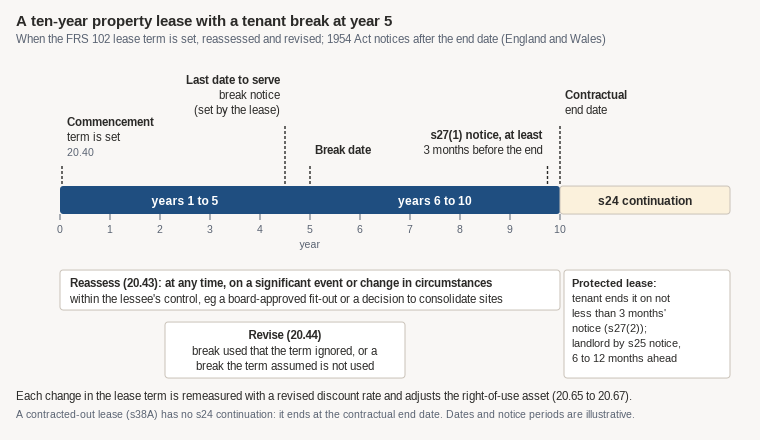
- The tenant can end it by written notice given not later than three months before the contractual end date (s27(1)) or, once it is continuing, by not less than three months' notice (s27(2)). A tenant not in occupation at the end date gets no continuation (s27(1A)).
- The landlord, short of forfeiture or surrender (s24(2)), can end it only by a notice under s25, given not more than twelve nor less than six months before the termination date (s25(2)) and not earlier than the contractual end date (s25(4)). The tenant can then apply for a new tenancy, which the landlord can oppose only on the grounds in s30(1), such as redevelopment or the landlord's own occupation.
Read against 20.38 and 20.39, the landlord cannot end a continuing tenancy at will, so it stays enforceable, and the tenant's three-month right works like a termination option. The term is then at least the notice period, plus any period the tenant is reasonably certain not to give notice. That is a reading of the words, not a rule of the standard, and it turns on the facts, including any s25 notice served.
The right to a new tenancy at the start of a lease
A tenant with a term certain of more than one year can request a new tenancy (s26(1)). Whether that right is an "option to extend" when the term is first set is not settled by the standard. If it is treated as one, a tenancy the court orders is, failing agreement, at an "open market" rent (s34(1)) and, if for a term certain, for no more than fifteen years (s33), so any incentive to stay comes from the fit-out and the cost of moving, not the rent.
Contracted-out leases
Before granting a lease for a term certain, the parties can agree that ss24 to 28 will not apply (s38A(1)). The agreement is void unless the landlord served the notice in Schedule 1 to the Regulatory Reform (Business Tenancies) (England and Wales) Order 2003 and the Schedule 2 requirements, including the tenant's declaration, were met (s38A(3)). A valid contracted-out lease ends at its end date. Whether staying on afterwards is an enforceable lease, and for how long, is a legal question about what the parties agreed.
Short lettings outside the Act
A tenancy for a term certain of six months or less is outside Part II unless it provides for renewal or extension beyond six months, or the tenant (with any predecessor in its business) has been in occupation for more than twelve months (s43(3)).
Rolling, periodic and undocumented leases
The non-cancellable period ends only when landlord and tenant can each terminate without the other's permission and with no more than an insignificant penalty (20.39). A right only the landlord holds does not end it; a right only the tenant holds is a termination option (20.38(c)).
- Month to month after an initial term. The FRC asks whether a notice period "forms a non-cancellable element" and whether any economic penalty on cancelling is more than insignificant (Factsheet 11).
- A subsidiary in its parent's building, or a company in a director's property, with no document. Factsheet 11 says group arrangements "may or may not create enforceable rights and obligations", depending on their substance; the same question applies to a director's property. If none exist, there may be no lease.
- A periodic business tenancy. Whether the 1954 Act protects it is a legal question; if it does, a landlord's notice to quit does not end it (s24(1)).
The standard sets no default term for any of these, and this guide gives none. If the term is 12 months or less with no purchase option, the lease is short-term (see FRS 102 lease changes); if the exemption is used and the term later changes, it is treated as a new lease (20.8).
When do you reassess or revise the lease term?
Outside a lease modification, only in two cases. The tenant reassesses its options on a significant event or significant change in circumstances that is within its control and affects whether it is reasonably certain to exercise, or not to exercise, an option (20.43). And the term is revised when the non-cancellable period changes (20.44).
Reassessment (20.43). FRS 102 gives no examples. In a property lease they could include approving a major fit-out, sub-letting part of the space or consolidating other sites into it. A rise in market rents or a landlord's decision is not within the tenant's control, so by itself it does not trigger a reassessment (20.43(a)).
Revision (20.44). The standard's examples are exercising an option not included in the term, or not exercising one that was. A break the term assumed would be used can no longer be used once the last date for serving notice passes, and the non-cancellable period then runs past the break. FRS 102 does not say whether the revision falls at the notice deadline or the break date; this guide reads it as the deadline, when the non-cancellable period changed.
The accounting. The revised payments are discounted at a revised rate (20.66(a)): the rate implicit in the lease for the remainder of the term, or else the incremental or obtainable borrowing rate at the date of reassessment (20.67). The change adjusts the right-of-use asset; any reduction beyond its carrying amount goes to profit or loss (20.65).
A new break or extension agreed with the landlord changes the original terms, so it is a lease modification (Glossary; 20.70 to 20.73), not a reassessment.
Worked example: a break judgement that changes in year 4
The figures are invented and computed in code; the rates are inputs, not market rates. A company with a 31 December year end takes a 10-year office lease from 1 January 2027 at £50,000 a year, paid annually in arrears, with a tenant-only break at the end of year 5. With no plan beyond five years and no significant fit-out, it is not reasonably certain to stay: the term is 5 years, discounted at 6.0%. There are no incentives, initial direct costs or restoration costs.
On 31 December 2030, before the break notice deadline, the board approves a substantial fit-out and moves two other sites into this building. That is a significant event within the company's control (20.43): the term becomes 10 years, and the six remaining payments are discounted at a revised 6.5% (20.66(a), 20.67).
| Term to the break | After reassessment | |
|---|---|---|
| Lease liability at 1 January 2027 | £210,618 | |
| Interest in 2027 | £12,637 | |
| Depreciation a year (straight line) | £42,124 | £39,501 |
| Lease liability at 31 December 2030 | £47,170 | £242,051 |
| Right-of-use asset at 31 December 2030 | £42,124 | £237,005 |
| Interest in 2031 | £15,733 |
The liability rises by £194,881, and the same amount is added to the right-of-use asset (20.65), which is depreciated over the six remaining years (20.58).
The mirror case: had the company set a 10-year term and then, on the same date, approved a move out using the break, the liability of £245,866 would fall to £46,948 (one payment at 6.5%), and the £198,918 reduction would come off the right-of-use asset, leaving £21,885 to depreciate over the final year. Had it kept the 5-year term and let the notice deadline pass, the term would be revised under 20.44 by the same steps: on this guide's reading at the deadline, and at the rate on that date.
Transition, rent-free periods and the notes
Setting the term for existing leases at transition
For leases previously classified as operating leases, a company may use hindsight, "such as in determining the lease term if the contract contains options to extend or terminate the lease" (1.53(d)), lease by lease. The date of initial application is the start of the first period applying the amendments (1.40(a)), and comparatives are not restated (1.47). A transition in figures is in the FRS 102 lease accounting example.
Rent-free periods and the break date
The lease term includes any rent-free period (20.37), and the liability holds the payments due during the term (20.51). So a rent-free period's benefit is spread, through interest and depreciation, over whatever term is set: a term to the break spreads it over fewer years.
What the notes say about break clauses
Where necessary for users to understand significant leasing arrangements, the notes give information about future cash outflows not in the lease liability, including extension and termination options (20.77(a)). The old note of future minimum lease payments under non-cancellable operating leases (20.16(a) in the January 2022 edition) survives only for leases kept off the balance sheet as short-term or low-value (20.82). A small company gives a general description and, if necessary, further information (1AC.31A, 1AC.31B); see FRS 102 Section 1A disclosure requirements.