Sole practitioner alternates: Audit Regulation 2.02A and the ICAEW alternate agreement
By Alon Zieve FCA · Last reviewed
If your firm is a sole practice registered for audit by ICAEW, ICAS or Chartered Accountants Ireland, including a company with a single director, Audit Regulation 2.02A requires you to put in place formal arrangements with an alternate, to take effect if you die or become incapacitated, and to confirm them to ICAEW (or your registering Institute). The alternate can be any member of ICAEW, ICAS, CAI or ACCA. They need not be a responsible individual (RI), and being your alternate does not let them sign your audit reports. ICAEW publishes no template ICAEW alternate agreement.
Below: the rule, who can act, what happens to your audits, the agreement clause by clause, notification, and a worked first ten business days. For the wider rulebook, see UK auditing standards and audit regulation.
What does Audit Regulation 2.02A require?
The regulation, in the UK Audit Regulations and Guidance effective from 1 October 2026, reads: "If a Registered Auditor is a sole practice, the sole practitioner must put in place formal arrangements with an alternate, to take effect in the event of the incapacity or death of the sole practitioner. The sole practitioner must confirm to the Registration Committee that such arrangements have been put in place."
- Who it binds. A "sole practice" is a sole practitioner, or "a corporate practice which has a single director" practising as one. The joint ICAEW, ICAS and CAI regulations "apply to all firms regardless of the registering Institute, unless stated otherwise"; 2.02A states no exception.
- No minimum. ICAEW's 2024 consultation feedback concluded that a de minimis number of audits "is not appropriate". The rule applies with one audit, or none, while you are registered.
- A standalone obligation. 2.02A sits outside the eligibility conditions in regulation 2.02. ICAEW's Regulatory Board paper of January 2025 explained the effect: a firm without an alternate "would not automatically become ineligible", but "would be in breach of the Regulations and would likely be reported to the ARC if the position was not regularised" (the ARC is ICAEW's Audit Registration Committee).
- New firms should identify an alternate before applying for registration.
- Dates. The requirement took effect on 1 June 2025 with a six-month transition to 1 December
- The 1 October 2026 edition removed the transitional provision as redundant (ICAEW, October 2026 changes). In January 2026 ICAEW said its "current list of alternates is incomplete".
The regulation requires "formal arrangements", not an agreement in a set form. A written ICAEW alternate agreement is the way ICAEW recommends making them formal (below).
If ACCA registers your firm
2.02A is not ACCA's text. ACCA's Global Practising Regulations (amended 1 January 2026), regulation 11, require an ACCA practising certificate holder in practice on their own account to keep a written agreement with a "nominee" (another individual or firm) who "must hold equivalent qualifications and be authorised to carry on" the work; a holder who works only within a firm is covered by the firm's own continuity provision. That is stricter on who may act than 2.02A.
Who can be your ICAEW audit alternate?
Any member of ICAEW, ICAS, CAI or ACCA. The alternate does not need to be an RI or to hold a practising certificate. But "if the alternate is a responsible individual in their own firm, this status does not permit the alternate to act as RI on behalf of the sole practice" (2.02A guidance).
Weigh the candidate's "capacity and ability to act quickly, skills and any conflicts of interest" (2.02A guidance):
- Capacity in your busy season. ICAEW warns the call could come "at a busy time of year".
- Conflicts. A conflicted alternate may be limited to managing a transition.
- Their agreement. ICAEW reminds you to "get their agreement to act"; the form needs their signature.
- More than one alternate (for example audit and client money) is possible, with clear scope for each.
If you cannot find anyone, ICAEW suggests local networks, reciprocal arrangements with other sole practitioners, or a documented group "mutual support scheme".
| Candidate | Can act as 2.02A alternate? | Can sign your audit reports on day one? | What they would need first |
|---|---|---|---|
| RI in another registered firm | Yes | No | The client appointing their own firm, or (corporate practice only) RI approval in your firm (reg 4.05) |
| ICAEW member in practice, not an RI | Yes | No | An RI application and approval (corporate practice only); realistically, their role is the transition |
| ICAS, CAI or ACCA member | Yes | No | As above; and if the practice then falls outside ICAEW's member-firm definition, a dispensation within 14 days to keep "Chartered Accountants" and new anti-money laundering supervision |
| ICAEW member not in practice | Yes | No | An ICAEW practising certificate once they begin to act as a principal |
| Solicitor, relative or other non-member | No | No | They can be an attorney or executor, not the alternate |
What your alternate can and cannot do on your audits
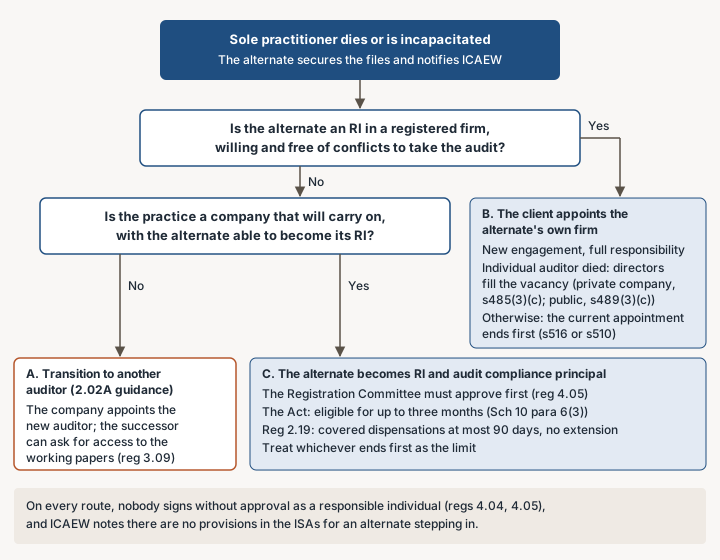
Being your alternate gives nobody the right to sign your audit reports. Regulation 4.04 says "only responsible individuals can be responsible for an audit and sign an audit report". Where the auditor is an individual, the report "must be signed by him" (Companies Act 2006 s503). ICAEW's guidance for alternates adds that "there are no provisions in the ISAs for an alternate stepping in": an RI who takes over must take "responsibility for the audit work as a whole under a new engagement". ICAEW describes three routes.
Transition the clients to another auditor
This is the route the 2.02A guidance points to: the alternate "could instead effect an orderly transition of clients to a new auditor". The company appoints its auditor; the alternate makes the change easy. How the current appointment ends depends on who holds it:
- You personally, and you die. The death "gives rise to a casual vacancy" (ICAEW), which the directors may fill (s485(3)(c) for a private company); the alternate must see that the cessation notification procedures are followed.
- Your company. The appointment is the company's and continues until it resigns by notice to the client (s516), with a statement on ceasing to hold office (s519) unless an exemption applies, or is removed. ICAEW says an alternate "would usually need to be appointed as a director".
- You personally, and you are incapacitated. Incapacity does not end the appointment. Neither the Act nor ICAEW's guidance says who may sign a resignation for an auditor who cannot act; whether an attorney can is a question for legal advice. The client's members can remove an auditor by ordinary resolution at a meeting, after special notice (s510).
Once appointed, the successor can ask in writing for "all relevant information" (reg 3.09). For the client's side, see changing auditors.
The alternate's own registered firm is appointed
If the alternate is an RI in a registered firm, the client may appoint that firm. It accepts a new engagement and takes "sole responsibility for all aspects of the audit". ICAEW suggests discussing the appointment with the executors or beneficiaries and the client "to avoid any perception of unethical behaviour".
The alternate becomes RI and audit compliance principal of your firm
This route is for a corporate practice: ICAEW frames it around reassessing "the corporate firm's eligibility". Regulation 2.02e applies to every sole practice, incorporated or not: the sole practitioner must be its RI and audit compliance principal. A company can meet that with someone new. Once the alternate is appointed a director it has two directors and, by the Regulations' definition, is no longer a sole practice; if you have died, the alternate can be its single director. An unincorporated sole practice is you personally (an appointment is "in the case of a sole practitioner, an individual"), so nobody else can take your place in it, and if you take in a partner "the audit registration does not carry over". Its clients take one of the other two routes.
To keep the company registered, the alternate applies to become its audit compliance principal and RI. The designation "shall not be effective until" the Registration Committee approves it, and the committee must be satisfied of "recent and sufficient experience of audit work" (reg 4.05). Meanwhile two time limits apply:
- The Act. A firm (which excludes an individual, s1173) that stops meeting the conditions on who does its audit work and who controls it "may be permitted to remain eligible… for a period of not more than three months" (Sch 10 para 6(3)). ICAEW's helpsheet describes this as a three-month dispensation.
- The Regulations. Where the matter is one regulation 2.19 covers (the eligibility conditions in 2.02d, 2.03b and 2.03c), a dispensation "will not last for more than 90 days, starting from the date that the situation first arose", and the 90 days "cannot be extended". In other cases the Registration Committee sets the period.
The limits are counted differently; treat whichever ends first as the deadline.
What happens to each audit
| Audit status | What the alternate can do | Who must appoint or approve | What to tell the client |
|---|---|---|---|
| Not started | Secure the records; agree a timetable | The company appoints a new auditor, or (corporate practice) the Registration Committee approves the alternate as RI | Who will audit, and when |
| In fieldwork, report not signed | Secure the working papers; no one concludes or signs the existing engagement | As above; the incoming RI takes responsibility for the audit as a whole under a new engagement | Expect delay; check the filing deadline now |
| Report signed, accounts not yet filed | Confirm the directors hold the signed report; keep the file (reg 3.11, at least six years) | No one for this year | The directors still file (s441) |
| Filing deadline close, report not signed | Tell the directors at once | The company can apply, before the deadline, for an extension, which may be given "for any special reason" (s442(5)) | An extension cannot go beyond twelve months after the year end (s442(5A)) |
Notifications in the first fortnight. ICAEW's guidance says the alternate must notify ICAEW no later than ten business days after the incapacity or death, citing regulation 2.11. Client money is separate: Clients' Money Regulation 31 requires arrangements for "the proper distribution or processing of clients' money", and that alternate can be someone else. An Authorised Training Employer tells ICAEW's Education and Training team, and a Designated Professional Body licence has its own ten-business-day notification.
The ICAEW alternate agreement: what to put in it
An agreement "can take any form, and could be a verbal agreement", but ICAEW calls a legally binding written agreement "good practice" and "strongly" recommends a legal review. A non-binding "simple agreement" may do for holidays. On death or mental incapacity the alternate "might be acting without proper authority", and it may not bind them to act.
| Clause | What to decide | Rule or source behind it | What goes wrong without it |
|---|---|---|---|
| Trigger | What counts as incapacity, and who confirms it (doctor, family, solicitor) | ICAEW: "in what circumstances the alternate's services would be required" | Nobody knows whether the alternate may act |
| Scope | Transition only, or carry on the practice; audit only or all work | 2.02A guidance | More, or less, than you meant |
| Authority | Binding agreement; lasting power of attorney; will (see below) | ICAEW helpsheets | Acts without "proper authority"; possible personal liability |
| Access | Client list, permanent and current audit files, audit software and cloud logins, quality management documentation, office | ICAEW: "IT access to relevant files and systems" | Files that exist but cannot be opened |
| Working papers | Who holds them, retention, successor access | Regs 3.09 and 3.11 | Successor requests go unanswered; papers lost |
| Client money | Same or separate alternate; bank mandate | Clients' Money Regulation 31 | Clients cannot get their money; banks may wait for probate |
| Insurance | Insurer told who the alternate is; continuing cover and run-off; the alternate's own insurer | ICAEW helpsheets | Uninsured work |
| Fees and expenses | Whether and how the alternate is paid, and records of expenses | ICAEW helpsheets; ICAEW Code of Ethics on fees | Disputes with the estate |
| Conflicts and sale | Non-solicitation; any right to buy the practice | ICAEW: an alternate buying the practice is "not improper" | Clients leave; the estate loses goodwill |
| Confidentiality and data | What client information the alternate may see and use | ICAEW item: "confidentiality" | Disclosure without a basis |
| Notifications | Who tells ICAEW, the insurer, staff and clients, and when | Reg 2.11; ICAEW helpsheets | Deadlines missed in the first fortnight |
| Review and termination | Annual review date; notice to end | Reg 2.11(d)(6): changes within ten business days | A stale arrangement on the register |
Authority: agreement, lasting power of attorney and your will
A property and financial affairs lasting power of attorney (LPA) covers "money and property", such as bank accounts and bills. Registration with the Office of the Public Guardian takes 8 to 10 weeks if there are no mistakes (GOV.UK), so register it in advance. An LPA works only in England and Wales. A sole director must check that the articles allow delegation by LPA. For death, ICAEW mentions a "special executor" clause in the will, but says that appointing the alternate as executor of the business "would not be appropriate for an audit alternate". Banks "will frequently refuse" to let an executor or alternate operate an account before probate.
Is there a template ICAEW alternate agreement?
No. ICAEW once offered templates, but its 2024 feedback said most arrangements are bespoke, so maintaining a template legal agreement was "unworkable"; it promised a checklist instead. Its helpsheet for sole principals lists eleven items, from the circumstances and role to remuneration, confidentiality and termination, and says "this is not an exhaustive list". The clause table above is a checklist for you and your solicitor, not a template and not legal advice.
How to tell ICAEW about your alternate
Use ICAEW's form "Notify ICAEW about your alternate". One form covers audit and client money (tick one, or both if the same person covers both). You both sign; the alternate confirms they "have no objection to ICAEW storing these details and providing these to clients of the above named firm in the event of relevant circumstances". You should both keep a copy.
ICAEW's pages disagree on where to send it: the form and ICAEW's practice news item on the 1 December 2025 deadline say annualreturns@icaew.com; most of its other guidance says annual.returns@icaew.com. Use the address on the latest version of the form, linked from icaew.com/regulatoryapplications. An ICAS or CAI firm confirms to its own Institute.
Then report, within ten business days, any change in "the name or address of the alternate, including if the alternate arrangement ceases" (reg 2.11(d)(6)). For client money, regulation 31 allows notice via the next annual return, and requires it immediately after any change.
Day one: a worked example of the first ten business days
The practice below is invented. It is a corporate sole practice: one director, who is the only RI, two staff and 14 audits. The alternate is an ACCA member in practice and not an RI. On Tuesday 9 February 2027 the RI is taken into hospital and is not expected to work for several months.
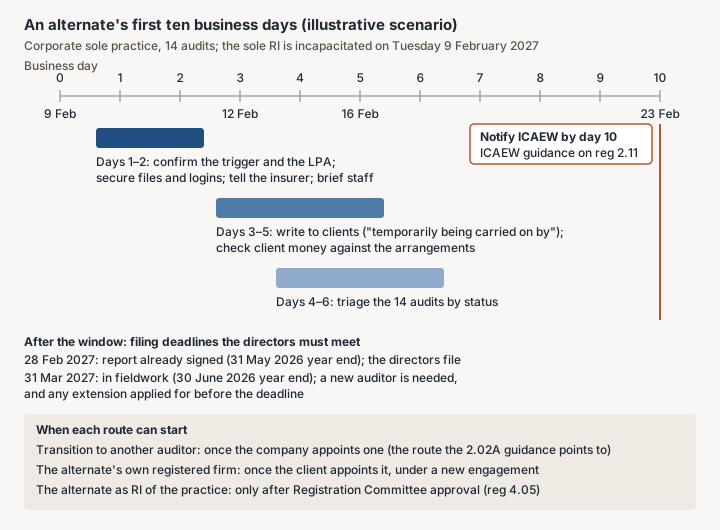
- Days 1–2 (10–11 February). The alternate confirms the trigger under the agreement and that the LPA is registered. They secure the office, the audit files and the logins. The insurer is told; staff are briefed.
- Days 3–5 (12–16 February). Clients get a letter. Business letters carry ICAEW's wording: "The practice of [name] who is temporarily incapacitated is temporarily being carried on by [name of alternate]." The client money account is checked against the arrangements.
- Days 4–6 (15–17 February), alongside the letters: triage. One client (31 May 2026 year end) has a signed report and accounts due on 28 February 2027: the directors are told to file. One (30 June 2026) is in fieldwork, accounts due 31 March 2027: the directors are told now, so the practice (with the alternate appointed a director) can resign, a new auditor be appointed and any extension be sought before the deadline. One (30 September 2026, due 30 June 2027) has not started; 11 have 31 December 2026 year ends. The alternate is not an RI, so all 14 take the transition route. If appointing an ACCA member as a director takes the company outside ICAEW's member-firm definition, ICAEW says it must apply for a dispensation "within 14 days" to keep using "Chartered Accountants", and ICAEW's anti-money laundering supervision "will end immediately".
- By day 10 (23 February). The alternate has notified ICAEW, and each client has a plan.
Keeping the arrangement ready
- Tell people where it is. ICAEW "strongly" recommends that close family or friends know the arrangements exist, where the details are and whom to contact.
- Keep access current, including IT access to files and systems; re-check after any change of software, cloud storage or passwords.
- Tell your insurer. ICAEW says the sole principal must ensure the insurers have been notified of the identity of the alternate.
- Clients. Neither the Audit Regulations nor ICAEW's alternates helpsheets require you to tell clients in advance; ICAEW says staff and clients "might also be informed". How the agreement treats client confidentiality is for you and your solicitor.
- Review it once a year. A natural point is the review of your firm's resources in the ISQM 1 annual evaluation. Re-check sooner if the alternate retires, moves firm or takes on a conflicting client, and notify any change within ten business days.
If your firm wants more audit clients, partner with Innate: we introduce companies that need an audit and give your team a platform designed to save it hours, and you remain the auditor and sign.
Do I still need an alternate if I stop auditing?
2.02A applies to "a Registered Auditor" that is a sole practice, so it ends when you give up audit registration. Clients' Money Regulation 31 still applies while you hold clients' money. If a sole practice becomes a partnership or a company, "the audit registration does not carry over"; a company with a single director still needs an alternate.